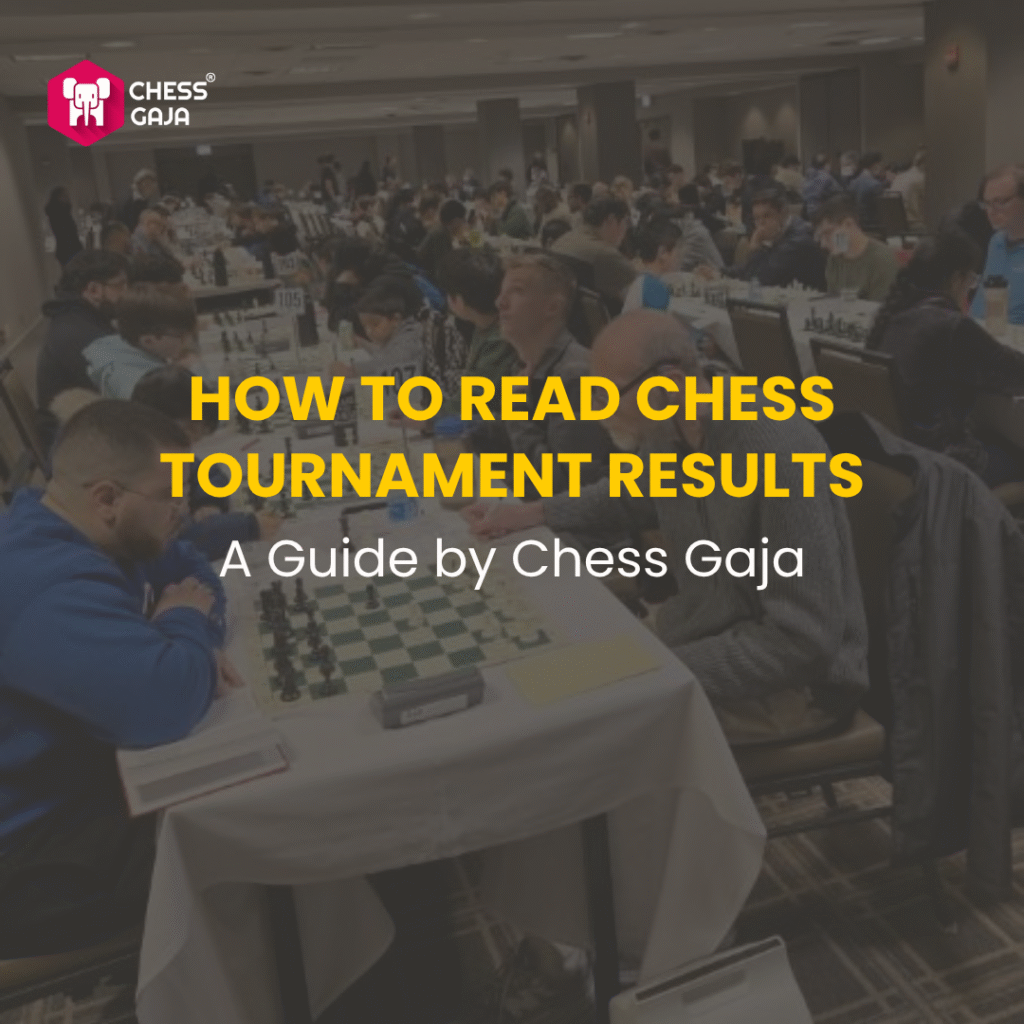
Participating in chess tournaments is an exciting part of every player’s journey. Whether you’re a beginner stepping into your first rated event or a seasoned player analyzing your progress, understanding tournament results is crucial for growth. At Chess Gaja, we guide our students not only in improving their skills on the board but also in making sense of what happens after the games are played
In this blog, we’ll walk you through how to read chess tournament results and explain what the different sections of a tournament crosstable mean — so you can better evaluate your own (or your child’s) performance.
Why Understanding Tournament Results Matters
Tournament results are more than just a scorecard. They reflect your pairing strength, consistency, progress, and can highlight areas for improvement. As part of our coaching methodology at Chess Gaja, we encourage our students to review every tournament performance in detail. Doing this builds chess maturity, helps set realistic goals, and creates a roadmap for rating growth.
Sample Tournament Crosstable Breakdown
Let’s walk through a typical tournament results table, often found on official chess federation websites like the US Chess Federation, FIDE, or tournament platforms like Chess Results.
Here’s a simplified example of what you might see:
| # | Name | Rating | Rd 1 | Rd 2 | Rd 3 | Total |
|---|---|---|---|---|---|---|
| 1 | Sarah | 1500 | W2 | D3 | L4 | 1.5 |
| 2 | Aakash | 1300 | L1 | W4 | L3 | 1.0 |
| 3 | Riya | 1400 | W4 | D1 | W2 | 2.5 |
| 4 | Arjun | 1350 | L3 | L2 | W1 | 1.0 |
Now let’s decode each part.
1. Player Information
- Name: The participant’s name.
- Rating: The official rating before the tournament began. For US tournaments, this is usually the USCF rating; for international events, it’s the FIDE rating.
2. Rating
This is the pre-tournament rating of the player. In most rated events, these are either USCF or FIDE ratings. Unrated players will typically be listed as “unrated” or with a provisional estimate.
3. Round Results
Each column (Rd 1, Rd 2, etc.) represents one round. The letter and number combo tell you:
- W = Win
- L = Loss
- D = Draw
- The number = your opponent’s player number
For example, “W2” means the player won against player #2.
4. Total Score
This is the sum of your points:
- Win = 1 point
- Draw = 0.5 points
- Loss = 0 points
So a player with 2.5 points out of 3 likely had a very strong tournament!
5. Final Rank
Rankings are based on total points. In case of a tie (like between Riya and Ayaan), organizers use tie-breaks to decide final placements. Tie-break methods vary (Buchholz, Sonneborn-Berger, Direct Encounter, etc.), but they aim to fairly rank players who finish with equal points.
In the example above, even though Riya and Ayaan both scored 2.5, Riya is ranked 1st — likely due to a better tie-break score.
How Chess Gaja Players Can Use This Data
We actively use these results in our training sessions. Here’s how our students benefit:
✅ Identifying Upsets and Strong Wins
Beating a higher-rated player? That’s an upset! We celebrate these wins and help you analyze what worked well.
✅ Spotting Trends
Consistently losing with Black? Struggling in Round 3? This data helps us spot patterns that can be corrected in training.
✅ Tracking Rating Progress
Results affect your rating. Our coaches monitor rating trends and advise when to play more or fewer tournaments.
✅ Pairing Logic
Understanding pairings (Swiss system) gives insight into tournament structure. It helps players mentally prepare for tougher opponents as they score higher.
Common Terms in Tournament Results
Here are some terms you might see in tournament crosstables or reports:
- Bye: A player skips a round, either requested (voluntary) or automatic (due to odd number of players). Usually gets 0 or 0.5 points depending on rules.
- Forfeit: Loss due to not showing up on time.
- Tie-Breaks: Scoring system to rank players who have the same total points.
- Performance Rating: A calculated rating based on the strength of opponents faced and score achieved.
- Unrated: A player without an official chess rating.
Pro Tips for Parents
If you’re a chess parent reviewing results:
- Don’t worry too much about a single tournament score.
- Focus on performance over outcome.
- Discuss the games calmly and ask questions like:
“What were you thinking here?”
“Did you consider another move?”
Let the child learn without pressure.
At Chess Gaja, we believe in holistic chess development. Tournament performance is just one piece of the puzzle, but knowing how to read and interpret the results is a skill every serious chess player (and parent) should have.
Understanding your scorecard helps you grow smarter, play stronger, and prepare better.
Have questions about your tournament results? We are here to guide you through every move — on and off the board.


