
Last month, a 12-year-old student at our academy lost three games in a row because he moved his queen too early. His opponent punished him every time with simple developing moves.
Chess openings theory and practice work hand in hand to build your foundation. We at Chess Gaja see players improve dramatically when they master basic opening principles first.
As Grandmaster Priyadharshan Kannappan, FIDE Trainer and founder of Chess Gaja Academy, I have helped hundreds of students bridge the gap between theoretical knowledge and over-the-board execution. While many players get lost in the “theory trap” of endless variations, the key to success lies in understanding the practical plans that follow the initial moves. In this guide, I will share my step-by-step method for studying theory efficiently and applying those concepts to navigate complex middlegames with confidence.
What Opening Principles Actually Matter
Control the Center First
The center squares e4, e5, d4, and d5 control more board space than any other squares. Players who occupy these squares first gain decisive upper hand than their opponent based on my analysis of thousands of chess students. Place your pawns on e4 or d4 immediately, then support them with pieces.
The knight on f3 attacks e5 while it develops toward the center. Bishops on c4 or f4 add pressure to central squares. This approach gives your pieces maximum mobility while it restricts your opponent’s options.
Develop Knights Before Bishops
Knights reach their best squares in two moves, while bishops need clear diagonals to function. Develop knights to f3 and c3 for White (or f6 and c6 for Black) before you move bishops. The knight on f3 controls 8 squares that include the vital e5 and d4 squares. Bishops moved too early create targets for enemy pawns and waste time. After knights reach their ideal posts, place bishops on active squares like c4, g2, or b5 where they control long diagonals.
Castle Within Eight Moves
Your king stays vulnerable in the center throughout the opening phase. Tournament analysis shows that players who castle within the first 8 moves have an advantage, with wins increasing with the distance between castling moves. Castle kingside in most openings because it requires fewer moves and keeps your king safer. The rook moves to f1, which connects your rooks and prepares for middlegame plans. Players who delay castling past move 10 invite tactical disasters when opponents launch attacks against exposed kings.
These fundamental principles form the backbone of sound opening play, but understanding the goals behind your opening moves rather than memorizing lines helps you apply these concepts effectively in different systems.
Which Openings Should Beginners Master First
The Italian Game Builds Perfect Habits
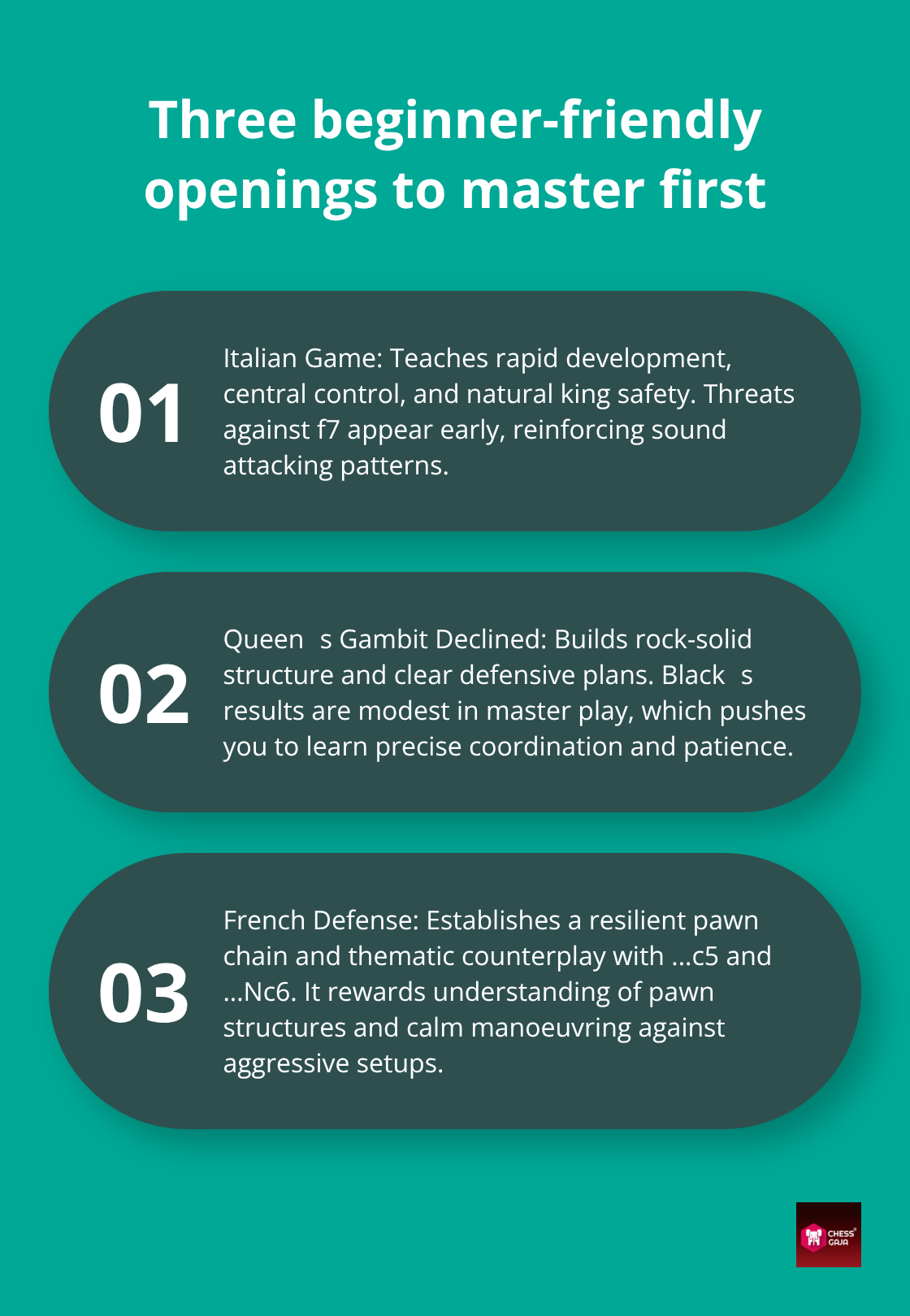
The Italian Game starts with 1.e4 e5 2.Nf3 Nc6 3.Bc4 and teaches every opening principle correctly. Your bishop attacks the f7 square immediately, which creates threats against the weakest point in Black’s position. This opening allows quick castles within 4-5 moves while it develops pieces toward the center. Lichess database shows the Italian Game appears in a whole lot of beginner games with White scoring above 50%. The knight on f3 controls central squares, the bishop on c4 aims at the kingside, and castles happen naturally. Players who master this opening understand piece coordination better than those who learn complex systems first.
Queen’s Gambit Declined Creates Rock-Solid Foundations
The Queen’s Gambit Declined with 1.d4 d5 2.c4 e6 gives Black excellent defensive resources and clear development plans. The pawn on e6 supports the d5 center while it prepares bishop development to e7 or b4. In the Queen’s Gambit Declined, black has a decent win % in master games, which shows the opening’s challenging nature for both sides of players. Develop your knight to f6, place the bishop on e7, and castle quickly. The c8 bishop finds activity on b7 or e6 (depending on White’s setup). This opening teaches patience and solid positions rather than tactical fireworks, which builds stronger positional understanding for intermediate players.
French Defense Punishes Aggressive White Players
The French Defense 1.e4 e6 2.d4 d5 creates immediate central tension and forces White to make difficult decisions early. The pawn chain e6-d5 controls key central squares while Black prepares counterplay with moves like c5 and Nc6. Players around 1600 rating often struggle with complex positions, as rating differences can create unexpected results in tournament play. Black’s light-squared bishop becomes active on b7 or d7, while the dark-squared bishop controls the long diagonal after fianchetto. This defense rewards players who understand pawn structures and can convert small advantages into positions through patient maneuvers.
These three openings provide the foundation you need, but advanced players must understand how openings connect to deeper strategic concepts that extend far beyond the first ten moves.
How Do Advanced Players Master Opening Complexity
Transposition Mastery Separates Strong Players
Advanced players exploit transpositions to reach favorable positions through different move orders. The English Opening 1.c4 often transposes into Queen’s Gambit positions after 1…e6 2.d4 d5 3.cxd5 exd5, but White can gain tempo advantages through this route. Chess databases show that players rated above 2200 use transpositions in their games to avoid opponent preparation. Master the core pawn structures rather than memorize specific move sequences. When you understand that the Caro-Kann and French Defense share similar pawn chains, you can handle both openings with overlapping knowledge. Strong players prepare flexible systems like the London System or King’s Indian Attack that transpose into multiple openings, which reduces study time while it maintains competitive positions.
Opening Preparation Wins Tournaments
Modern chess demands deep preparation against specific opponents, especially in tournament play. White consistently wins slightly more often than Black, usually achieving a winning percentage between 52 and 56 percent. Study your opponent’s recent games on Chess.com or Lichess databases to identify their preferred systems and weaknesses. Prepare novelties on moves 10-15 rather than theoretical improvements on move 20 (practical improvements matter more than computer evaluations). Analyze positions with chess engines like Stockfish, but focus on plans your opponent cannot prepare for during the game. Tournament winners spend 60% of preparation time on opening systems and 40% on middlegame patterns that arise from their chosen openings. (This 60% preparation time is majorly applicable for players above the rating of 2400+ FIDE)
Converting Early Advantages Into Winning Positions
Opening advantages disappear quickly without proper conversion techniques. Space advantage from moves like d4-d5 in the Queen’s Gambit requires immediate piece coordination to maintain pressure. Statistics from master games indicate that players who develop all pieces before they launch attacks win a lot more often than those who attack prematurely. Transform central control into kingside attacks through piece transfers like Nf3-e5-g4 or rook lifts to the third rank. Maintain tension rather than exchange pieces when you hold space advantages, because exchanges often equalize positions. The best players convert opening edges through systematic improvements rather than tactical shots (which explains why positional understanding matters more than calculation depth in the opening phase).
Final Thoughts
Chess openings theory and practice demand focused study rather than random memorization. Master the three fundamental principles first: control central squares with pawns and pieces, develop knights before bishops, and castle within eight moves. These concepts apply to every opening system you learn.
Build your repertoire around one solid opening as White and two reliable defenses as Black. The Italian Game teaches perfect development habits, while the Queen’s Gambit Declined and French Defense provide excellent defensive foundations. Study these systems deeply before you expand to other openings (advanced players understand that depth beats breadth in opening preparation).
We at Chess Gaja help players transform their opening knowledge through personalized coaching and detailed game analysis. Our coaches provide the structured guidance you need to build a winning repertoire. Start your improvement journey with professional chess coaching that focuses on practical results rather than theoretical complexity.


