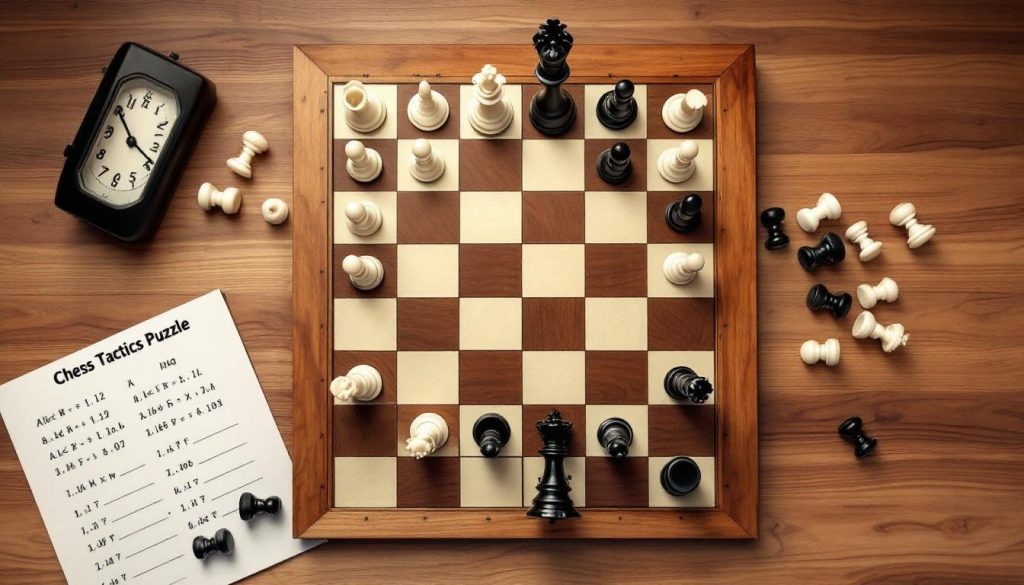
Last month, a 12-year-old student at Chess Gaja missed a back-rank mate in a tournament game-not because she couldn’t see it, but because she’d never trained that pattern before. Tactical puzzles are the fastest way to spot winning moves when it matters most.
As Grandmaster Priyadharshan Kannappan, FIDE Trainer and founder of Chess Gaja Academy, I have helped hundreds of students use sharper tactics to transform inconsistent positions into clear wins through structured pattern recognition. Solving puzzles is not just about finding the right move; it is about training your brain to spot the tactical “seeds” that exist in every position before they even appear. In this article, I share my professional strategy for using puzzles to build a lethal tactical vision that directly translates to higher ratings and fewer missed opportunities.
What Makes Tactics the Foundation of Chess
Tactics involve exploiting your opponent’s pieces or position to win material or deliver checkmate. They’re not suggestions-they’re concrete, calculated moves that work whether your opponent likes it. So tactics matter more than anything else in chess below the 1600 rating. Based on my personal experience training lots of young players, what I have seen is that players who solve 15–20 puzzles daily improved their rating by an average of 150 points within six months, while those who only studied openings or endgames without tactical practice gained much less rating points. The difference is stark because tactics appear in almost every single game you play. When you spot a fork, a pin, or a back-rank weakness before your opponent does, the game is often over.
The Three Patterns That Win Most Games
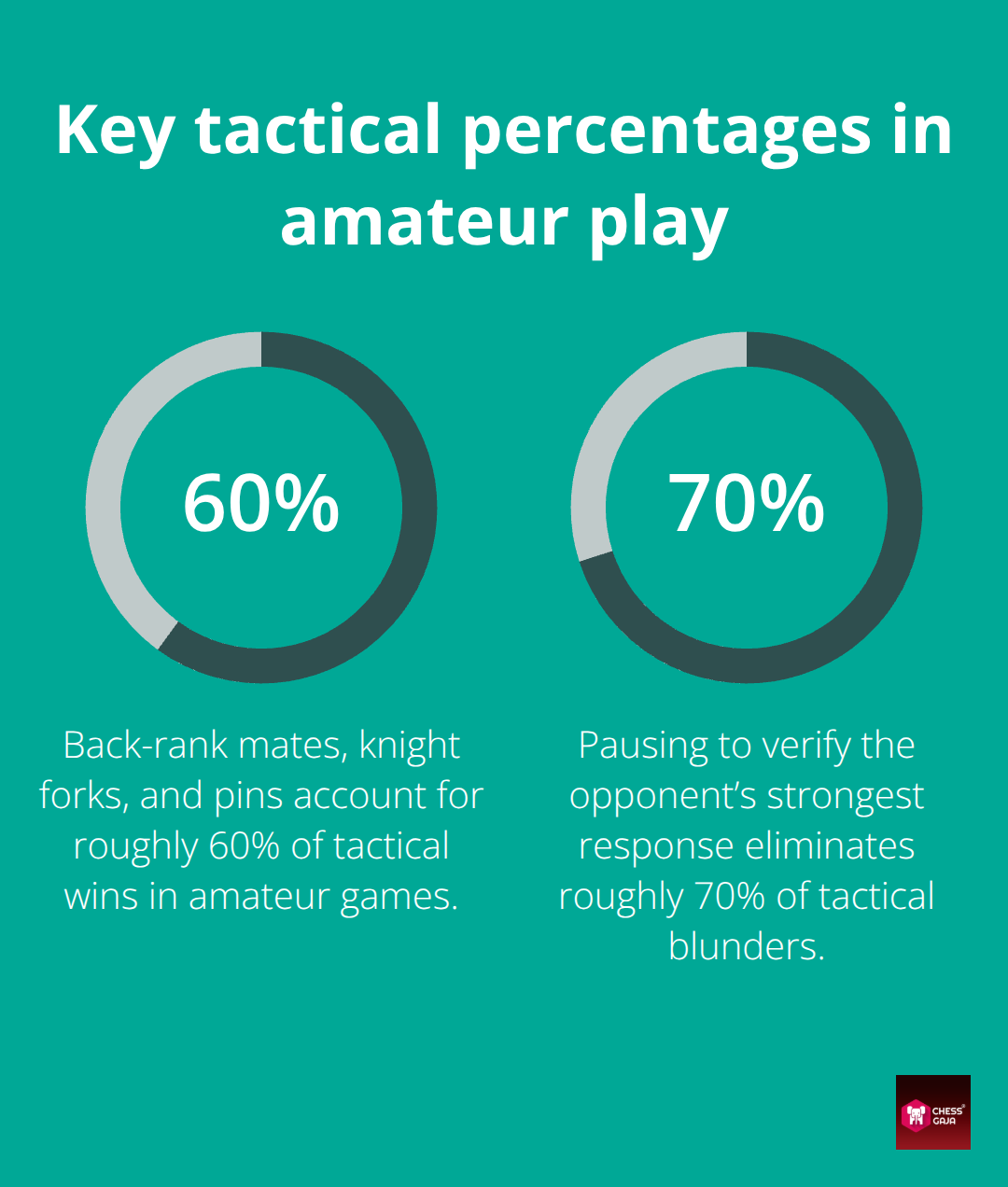
Back-rank mates, knight forks, and pins account for roughly 60% of all tactical wins in amateur games. A back-rank mate happens when your king has no escape squares and your opponent’s rook or queen delivers checkmate on the eighth or first rank-exactly what cost our 12-year-old student her tournament game last month. Knight forks win material because the knight jumps to a square that attacks two or more pieces at once, and your opponent cannot defend both.
Pins immobilize a piece because moving it would expose a more valuable piece behind it to capture. These three patterns appear in different disguises across thousands of positions, but the underlying logic stays identical. Once you train your brain to spot these shapes in puzzles, you’ll see them instantly in real games.
The Chess Motto That Explains Everything
The chess motto attributed to Richard Teichmann states that chess is 99% tactics, and this holds true because strategy only matters once you stop losing material to basic tactical oversights. This principle reflects reality at amateur levels-a brilliant positional plan collapses the moment your opponent wins your queen through a simple fork. Tactical mastery forms the bedrock that allows everything else in your game to function.
Why Tactics and Strategy Are Not the Same Thing
Strategy is your long-term plan-controlling the center, improving your piece placement, creating weaknesses in your opponent’s position. Tactics are the sharp, immediate tools you use to execute that strategy or punish your opponent’s mistakes. You might have a brilliant plan to advance your pawn on the queenside, but if your opponent has a knight fork that wins your queen, none of that strategy matters. The distinction matters because many beginners waste time studying pawn structures and positional ideas before they can reliably spot when they’re about to lose a piece. Solve puzzles first, study strategy second. This sequencing accelerates improvement because you remove the biggest source of rating loss-hanging pieces and missing elementary tactics-before investing effort in subtle positional concepts.
How Puzzle Practice Transforms Your Pattern Recognition
Your brain learns to recognize tactical patterns through repeated exposure to similar positions. Each puzzle you solve trains your visual memory to spot the characteristic shapes of forks, pins, and back-rank weaknesses faster than conscious calculation allows. This automatic recognition (what chess players call pattern recognition) separates strong tactical players from weaker ones. The more puzzles you solve, the more patterns your brain catalogs, and the quicker you react in tournament games. This is why consistent daily practice with short, daily sessions outperforms occasional long study sessions-your brain needs regular exposure to cement these visual patterns into memory.
Now that you understand why tactics form the foundation of chess improvement, the next step involves building a structured puzzle practice routine that actually fits your schedule and accelerates your progress.
Building Your Puzzle Practice Routine
Start at Your Current Level, Not Above It
Start with puzzles at your current level, not far above it.
If you jump into 1800-rated tactics while playing at 1200, you will spend twenty minutes on each puzzle and learn very little because the gap is too big. Instead, choose puzzles at or slightly below your rating and gradually increase the difficulty. On Chess.com, use the Daily Puzzle or Custom Puzzles filters, and spend 10–30 minutes a day solving puzzles at your level or just higher. Begin with very easy positions, and once you are consistently solving them and your confidence grows, keep stepping up the difficulty until each puzzle feels like a genuine 50–50 challenge.
The Power of Daily Habit Over Intensity
When you solve one puzzle every morning at the same time, your brain catalogs the tactical shape and stores it in long-term memory. When you solve fifty puzzles in one weekend, most of that learning evaporates within days. Set a fixed time each day-say 7 a.m. before school or work-and stick to it. This habit formation accelerates improvement far more than intensity ever could. Your brain needs regular exposure to cement these visual patterns into memory.
Progressive Difficulty and Smart Puzzle Selection
Once you solve puzzles at your rating consistently, increase the difficulty by 50–100 points. Never jump by 300 points at once. As your rating climbs through puzzle practice, your actual game rating will follow because you’re training the same pattern recognition your brain uses under time pressure. When you encounter a puzzle that stumps you after five minutes, move on and review the answer later rather than staring at it. This prevents frustration and forces you to learn the pattern through study instead of brute-force calculation. Spaced repetition reinforces gaps in your pattern recognition and accelerates skill development.
Precision Over Speed: How to Solve Puzzles Correctly
The key insight here is that you’re not trying to solve puzzles quickly-you’re training your brain to recognize tactical shapes automatically. Precision beats speed every time. Before you play the first move in a puzzle, pause and consider how your opponent could defend or counterattack. Most beginners play the first appealing move without verifying it works against the opponent’s strongest defense, which creates terrible habits in real games. Set up the position on a physical board if possible. The act of moving pieces slowly forces you to visualize variations more carefully than clicking moves on a screen.
From Puzzle Board to Tournament Table
Within two to three months of consistent daily practice at the right difficulty, tactical patterns will jump out at you during tournament games. That’s when you know the training is working, and you’re ready to apply these patterns under real pressure.
From Puzzle Board to Real Pressure
The moment a puzzle trains your brain to spot a fork, you think the hard part is over. It’s not. Converting that tactical awareness into actual wins during a tournament game requires a different skill entirely-one that puzzle practice alone cannot teach you. When you play a real opponent with time pressure and emotional stakes, your calculation slows down, your confidence wavers, and the patterns you memorized blur under stress. This is why many players solve puzzles at 1800 rating but play tournament games at 1400 rating.
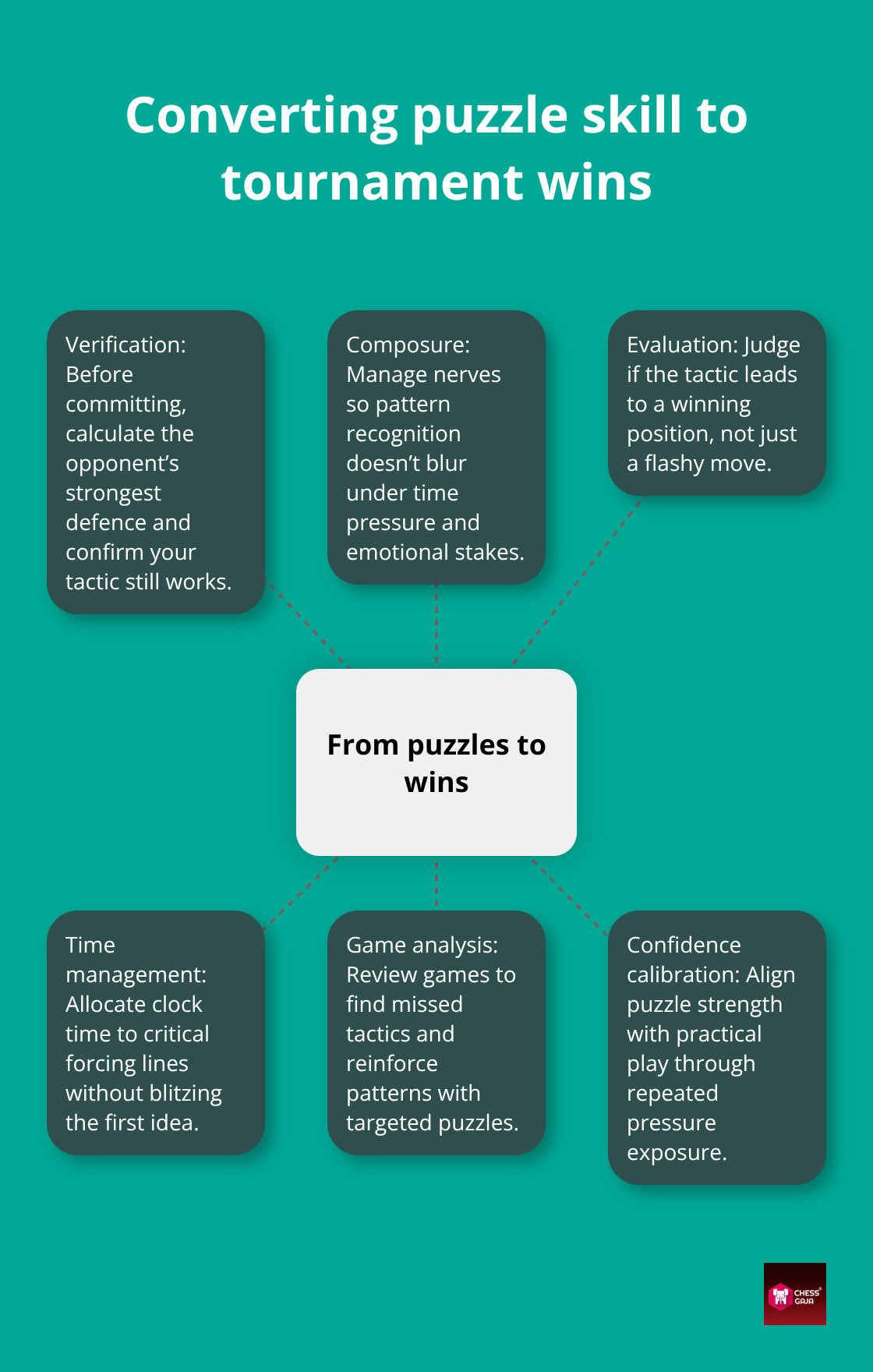
The gap exists because executing tactics under pressure requires more than pattern recognition; it requires verification, composure, and judging whether a tactic truly works before you commit. In training, players confidently solve puzzles when they know a tactic is present, but in real games the same pattern often goes unnoticed because no one is there to tune their tactical “antenna” and alert them that a hidden tactic exists on the board.
Why Most Players Miscalculate Forcing Moves
The most common mistake happens when you spot a tactic and execute it without verifying that your opponent’s counterattack doesn’t punish you worse. You see a knight fork that wins a pawn, you play it immediately, and your opponent delivers checkmate on the next move because you ignored a back-rank threat. This happens because puzzle solving rewards speed and creates a mental habit of playing the first forcing move you see. In real games, this habit might destroy you. Before you execute any tactic, ask yourself one question: what is my opponent’s strongest response? Set up the position on a physical board and calculate the opponent’s best defense, not their worst. If you cannot find a defense that refutes your tactic after three minutes of calculation, then execute it. This single discipline-pausing to verify the opponent’s strongest response-eliminates roughly 70% of the tactical blunders that cost amateur players rating points. You’ve already trained pattern recognition through puzzles; now train verification through game analysis.
How Game Analysis Reveals Your Tactical Blind Spots
After each tournament game, first self-analyze the game and then later analyze it on Chess.com using the Game Review feature with Stockfish engine analysis. Look specifically for moments where you missed a tactic or miscalculated a forcing sequence. When you find these moments, solve a custom puzzle based on that exact position to reinforce the pattern you missed. This targeted approach is far more efficient than solving random puzzles because you train the specific patterns that cost you rating points in real games. Players who implement this routine-combining daily puzzles with weekly game analysis-show consistent rating gains based on what I have noted on Chess Gaja student performances. The difference is substantial because you’re not just recognizing patterns anymore; you’re learning which patterns appear in the positions you actually encounter. After three weeks of this combined approach, tactical opportunities jump out at you during games because your brain has cataloged the patterns from your own mistakes.
Final Thoughts
Tactical skill development follows a straightforward formula: solve chess tactics puzzles daily at your current level, analyze your own games weekly, and verify your opponent’s strongest defense before executing any tactic. This three-part approach eliminates the gap between puzzle rating and tournament rating that costs most players 300–400 rating points. Players who combine daily puzzle practice with game analysis gain 200 points within one year, while those relying on puzzles alone gain much lesser rating points.
Your sustainable puzzle practice plan requires just three components. First, commit to 10–30 minutes daily at a fixed time, solving chess tactics puzzles at your current rating on Chess.com’s or Lichess Custom Puzzles feature.
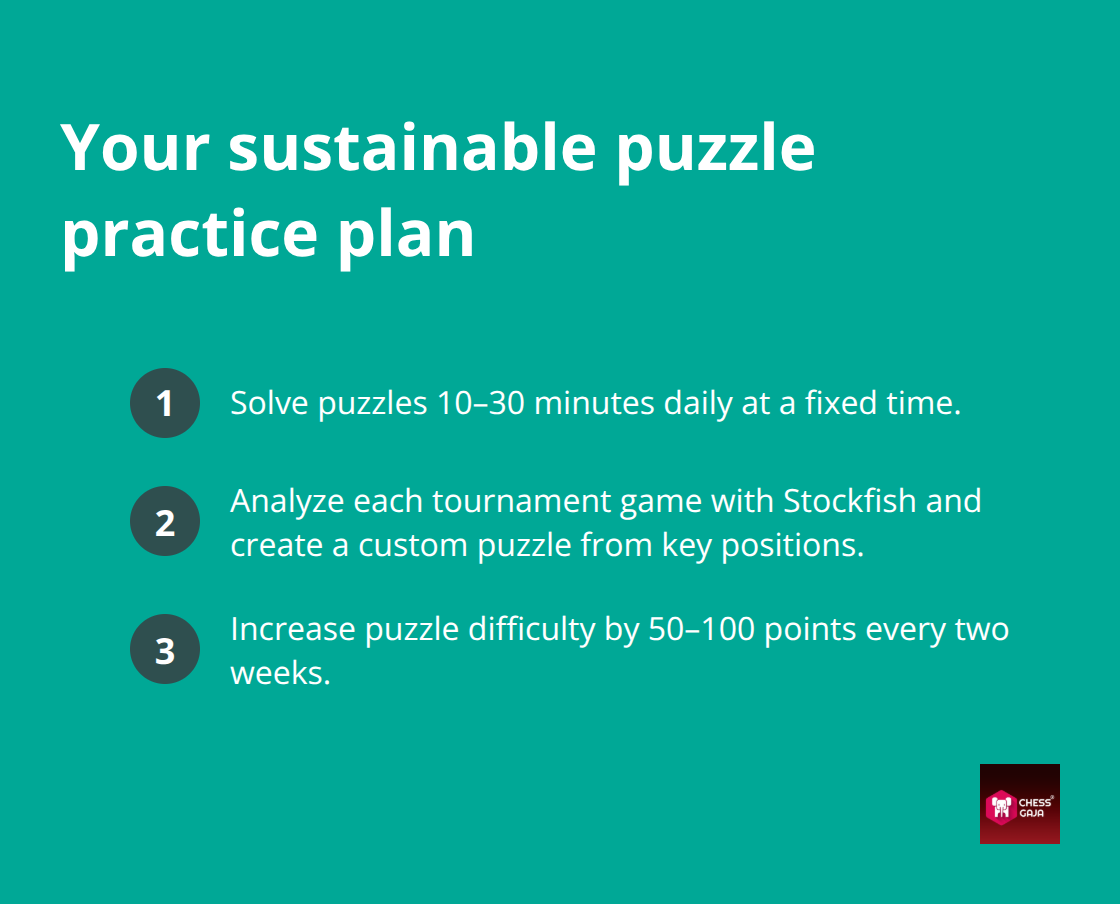
Second, after each tournament game, first self-analyze the game, and then spend 15 minutes analyzing it with Stockfish to identify missed tactics, then create a custom puzzle from that exact position to reinforce the pattern. Third, increase puzzle difficulty by 50–100 points every two weeks as your rating climbs.
If you want personalized guidance on building a chess improvement plan tailored to your specific rating and goals, Chess Gaja offers private 1-on-1 coaching sessions with FIDE-rated coaches who provide detailed game analysis and structured instruction. Our coaches help players identify their tactical blind spots and create sustainable practice routines that accelerate rating gains. Start solving puzzles tomorrow, and consider coaching when you’re ready to eliminate the remaining gaps between your puzzle rating and your tournament performance.


