
Last month, a 14-year-old student in Dubai lost a winning position because he moved too slowly, giving his opponent time to organize a counterattack. He had the advantage but didn’t know how to convert it quickly.
At Chess Gaja, we’ve seen this pattern countless times. Tempo-the ability to move faster and seize the initiative-separates players who win from those who don’t. This guide teaches you practical chess tempo tactics training methods that work, from puzzle solving to game analysis.
At Chess Gaja Academy, I’ve found that many players use Chess Puzzle apps for hours without seeing their ratings budge because they are clicking, not calculating. I’m Grandmaster Priyadharshan Kannappan, and I believe the secret to tactical growth isn’t just solving more puzzles—it’s using the right training mode to fix your specific blind spots. In this guide, I’ll show you my professional methods for utilizing Chess Puzzle apps features to build a deeper “muscle memory” for tactics, ensuring you spot winning shots in seconds rather than minutes.
What Tempo Really Means in Tactical Chess
Tempo means gaining moves on your opponent, forcing them to respond to your threats instead of executing their own plans. When you have the tempo, you dictate what happens on the board. A player with a one-move advantage creates threats faster than their opponent can defend. In tournament games, this advantage often decides the outcome before the endgame even arrives. The 14-year-old from Dubai had a material advantage but lacked tempo, which meant his opponent regained the initiative and turned the position around. Tempo connects directly to piece activity because active pieces create threats that demand responses. A knight that attacks two pieces at once gives you tempo. A rook that controls key squares forces your opponent to deal with it before advancing their own plan. Initiative and tempo work together: when you have the initiative, your pieces are more active and your opponent is always responding rather than attacking.
How Tempo Appears in Real Tournament Games
Tournament games reveal how tempo decides tactical sequences. In a game between two 2000-rated players, the winner often gains tempo by attacking an undefended piece, forcing the opponent to move it, then attacking something else before the opponent can counterattack. This is not flashy queen sacrifice material. It is practical chess where one extra move lets you win material or create an unstoppable threat.
The Tactical Patterns That Exploit Tempo
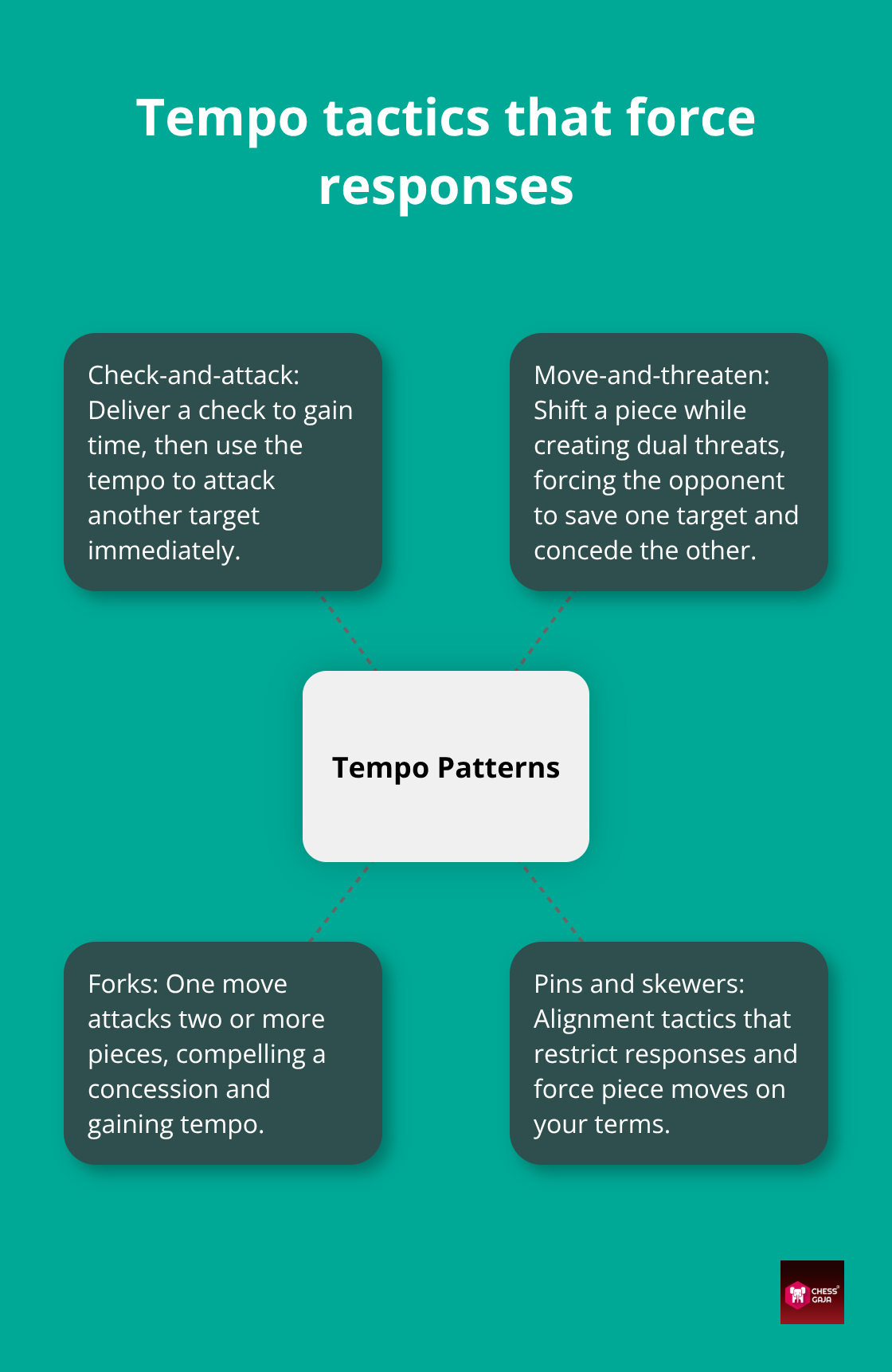
Common tactical patterns exploit tempo by forcing your opponent into a passive position where they cannot defend everything. The check-and-attack sequence works because you check the king to gain time, then attack another piece while the opponent is still dealing with the check. Another pattern is the move-and-threaten tactic: you move one piece and simultaneously threaten two targets, forcing your opponent to save one while you capture the other. The fork, pin, and skewer all operate on the same principle-they force your opponent to react rather than act.
Why Puzzle Training Differs from Real Games
In blitz games on chess websites, players at the 1500 rating often solve puzzles based on these patterns but miss them in real games because they do not recognize tempo as the underlying principle. The difference between solving puzzles and playing games is that in puzzles, the tempo advantage already exists and you execute it. In games, you must spot when tempo is available and strike immediately before your opponent reorganizes their pieces. This gap between puzzle performance and game performance reveals why recognizing tempo patterns matters more than speed alone.
How to Train Tempo Tactics Effectively
Solving Puzzles with Purpose and Reflection
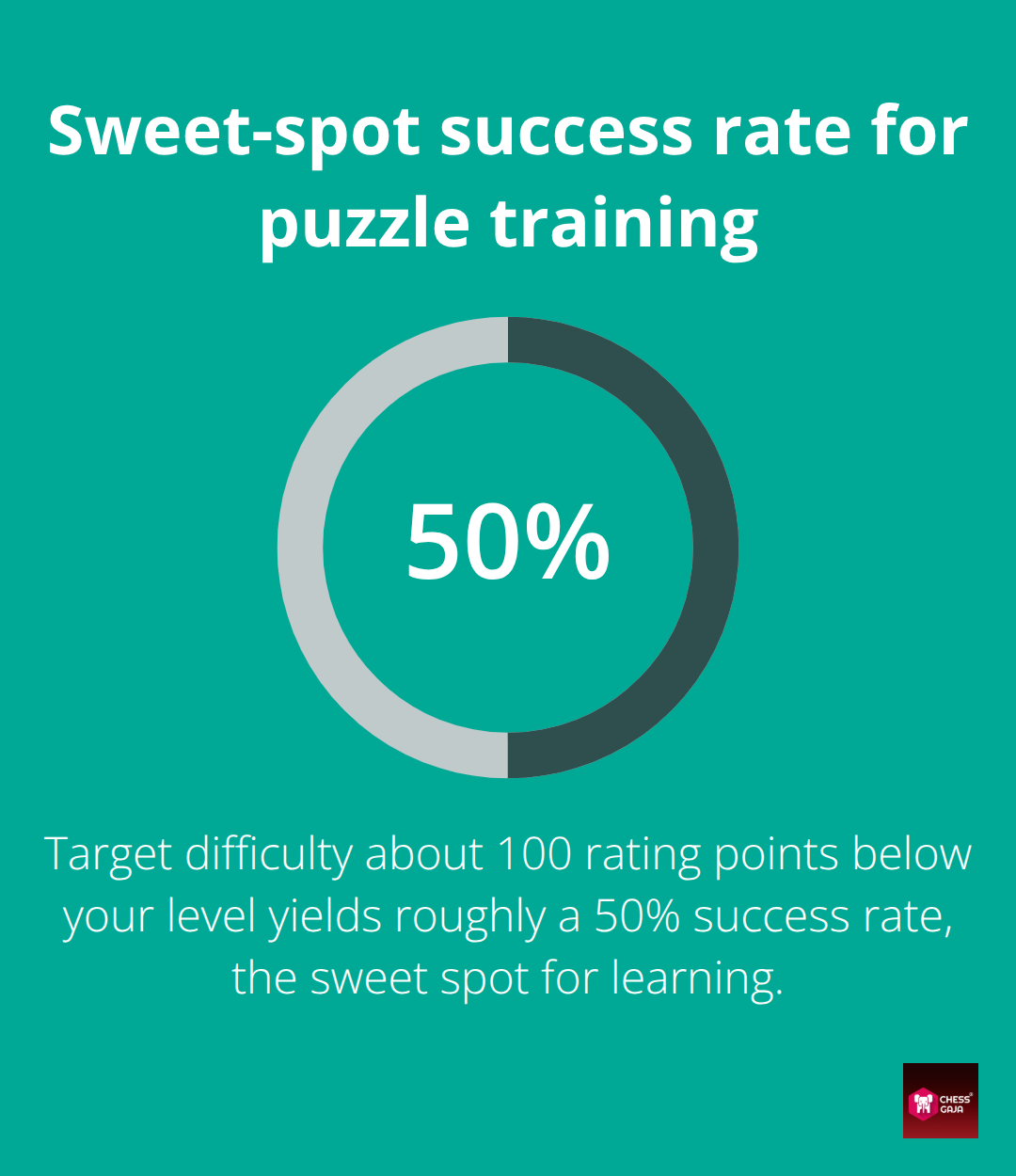
Solving tactical puzzles under time pressure works only if you solve them the right way. On Chess Puzzle apps, the timed mode forces you to find the best move within seconds, which mirrors real games where hesitation costs you tempo. These puzzle platform offers over 392,000 tactical problems drawn from actual games, meaning the positions you solve reflect what happens in tournaments. Set your difficulty target about 100 rating points above your current level-this gives you roughly a 50% success rate, which is the sweet spot for learning.
When you solve a puzzle incorrectly, read the problem comments and write down exactly what you missed. This step matters far more than solving ten puzzles without reflection. A player who solves 20 puzzles per day and writes explanations for five failures learns faster than someone solving 100 puzzles and ignoring the mistakes.
Identifying and Eliminating Your Mistake Patterns
The mistake categories that matter most: failing to consider your opponent’s defensive resources and failing to search for all candidate moves. After you identify which type of error you made, tag that puzzle with a personal label and return to it using spaced repetition for chess puzzle training. One player tracked 630 difficult problems over several months, studied 367 of them, logged 1,400 attempts, and wrote 77 comments-and gained roughly 50 rating points in two months as a result. This approach works because you are not just solving puzzles; you systematically eliminate the same mistakes from your game.
Learning from Your Own Games
Analyzing your own games reveals tempo mistakes that puzzle training alone cannot catch. When you lose a game, look for moments where your opponent gained tempo, and you did not respond immediately. Did your opponent check your king to force a move, then attack something else while you were still recovering? Did you have the chance to attack two pieces at once but played a single-threat move instead? These moments show you where tempo awareness fails in a real position with time pressure and emotional stakes.
Compare these moments against the puzzle patterns you have studied-you will often find the same tactical structure you missed in both contexts. This is the gap between puzzle performance and game performance.
Blending Standard and Blitz Training
Play blitz and rapid games regularly, not just standard games, because faster time controls force you to make quicker decisions and recognize tempo patterns faster. A balanced approach uses both standard mode on Chess Tempo for deeper calculation and blitz sessions in real games to train pattern recognition under pressure. The standard mode lets you think without time penalties and builds the foundation; blitz games let you apply that foundation when speed matters.
After playing blitz games, review only the positions where you lost tempo or missed a tactical sequence-do not analyze every move. This focused review teaches you to spot the same pattern faster next time, which is exactly what you need when you have only seconds to move. The positions where you failed to recognize tempo reveal the specific patterns your brain has not yet internalized, and returning to those exact positions (rather than random puzzle sets) accelerates your pattern recognition in future games.
Advanced Tempo Strategies in Competitive Play
Sacrificing Material for Real Tempo Gains
Sacrificing material sounds reckless until you understand when it actually wins. In competitive play, a tempo sacrifice means you give up a piece or pawn to force your opponent into a passive position where they cannot execute their own threats. The key is that you must gain at least two moves of initiative-checking the king, attacking an undefended piece, or creating an unstoppable threat that forces multiple defensive moves. An 1800-rated player who sacrifices a pawn to open your king’s position and deliver three consecutive checks gains enough tempo to win material back or create a mating attack. The mistake most players make is sacrificing without calculating whether they actually regain the advantage within the next 3-4 moves. Practice positions where you sacrifice material and count exactly how many forcing moves you gain afterward. If you cannot identify at least two forcing moves that justify the sacrifice, do not make it. This discipline separates aggressive players who win from those who simply lose material.
Defensive Tempo Play Against Superior Positions
Defensive tempo play matters as much as attacking tempo. When your opponent has the initiative and attacks multiple pieces, your first job is to find a move that forces them to respond instead of continuing their attack. A check that seems passive can be your best defense because it temporarily shifts the initiative to you-your opponent must move their king before they can continue threatening your pieces. Another defensive technique is the counter-threat: instead of defending passively against their attack, you create a threat on their king or an undefended piece that forces them to deal with it first. In tournament games at the 1500-1800 rating, players who recognize this counter-threat pattern gain tempo defensively and often flip a losing position into a drawable one. Review your own games where you lost to identify moments where you defended passively instead of creating counter-threats. The difference between a 1400-rated player and a 1600-rated player is not calculation speed-it is the habit of looking for forcing moves when under pressure rather than moving reactively.
Building Pattern Recognition Through Rapid Games
Blitz and rapid games reveal which tempo patterns you have truly internalized and which ones you only understand in theory. Play at least 10 rapid games per week on a platform where you can review your games afterward-Chess.com, Lichess, or similar sites, all provide detailed analysis tools. After each rapid game, spend 15 minutes reviewing only the positions where your opponent gained tempo or where you missed a tactical sequence. Do not analyze the entire game; focus only on the 2-3 critical moments where tempo decided the outcome. This targeted review trains your brain to recognize the specific pattern faster in your next game. A player who plays 50 rapid games and reviews 3-4 critical positions per game learns more about tempo than someone solving 500 puzzles without game context. The reason is simple: puzzle solving trains pattern recognition in isolation, but rapid games force you to spot patterns under time pressure with emotional stakes. Both matter, but rapid games teach you when to apply the patterns you learned in puzzles.
Final Thoughts
Tempo in tactical chess comes down to one principle: forcing your opponent to respond to your threats instead of executing their own plans. The 14-year-old from Dubai learned this lesson the hard way, but you do not have to. The patterns you studied in this guide-checks that gain time, attacks on multiple pieces, counter-threats under pressure-appear in nearly every game you play, and recognizing them separates players who convert advantages from those who let winning positions slip away.
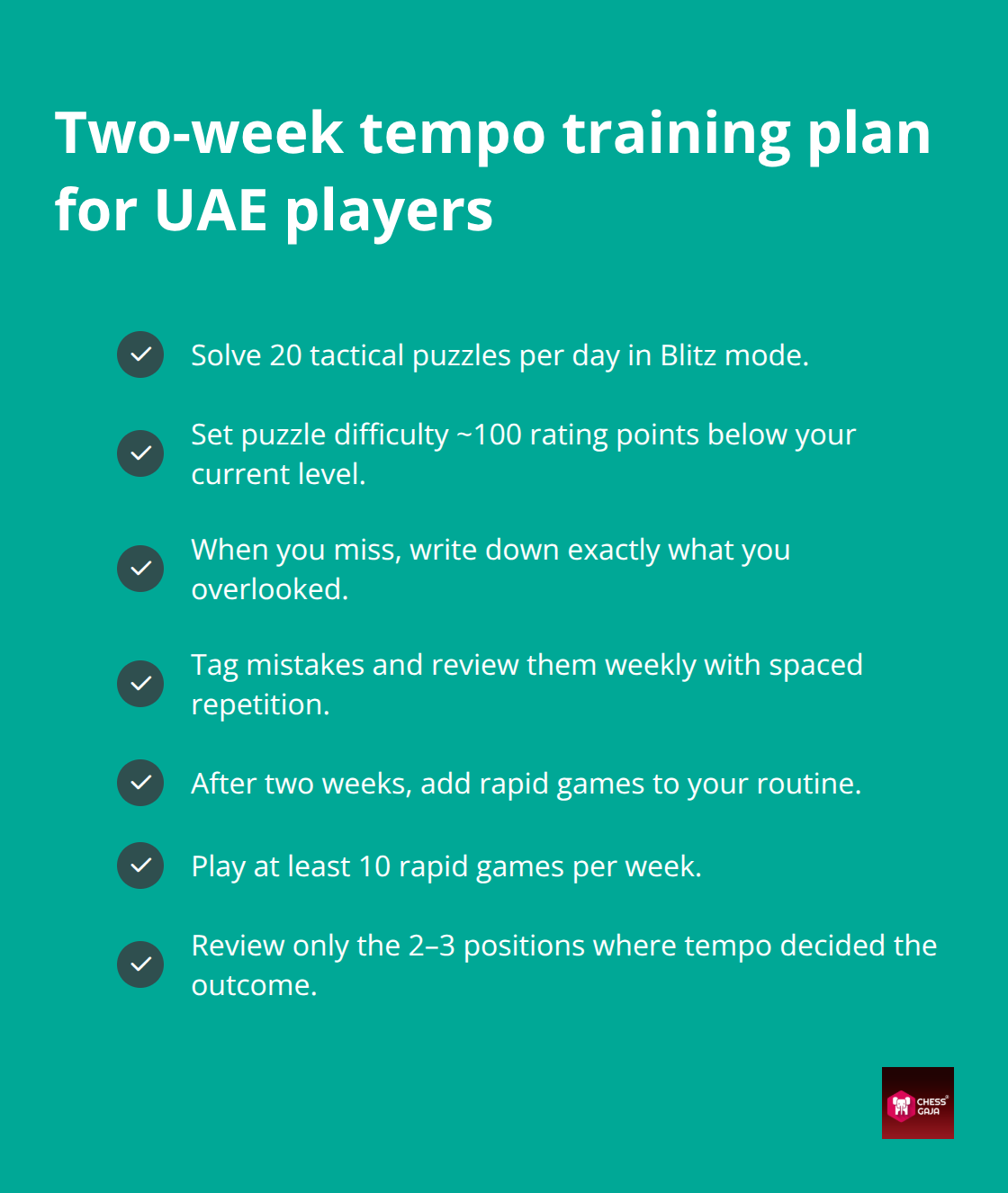
Your chess tempo tactics training should follow a clear structure: start with 20 puzzles per day on Chess Puzzle apps in Blitz mode, targeting difficulty 100 rating points below your current level, and when you miss a puzzle, write down exactly what you overlooked. Tag these mistakes and return to them weekly using spaced repetition, because this focused approach beats solving 100 random puzzles without reflection. After two weeks of consistent puzzle work, add rapid games to your routine and play at least 10 rapid games weekly, reviewing only the 2–3 positions where tempo decided the outcome.
Consistency matters more than intensity: a player who solves 20 puzzles daily and reviews three games weekly improves faster than someone solving 200 puzzles once per week. If you prefer structured guidance with personalized feedback, Chess Gaja offers group classes and private coaching from FIDE-rated coaches who specialize in helping players recognize tactical patterns and convert advantages. Start today, track your progress, and watch your tactical vision sharpen.


