
Last month, 12-year-old Chess Gaja student from Dubai gained 200 rating points in just three months after mastering basic opening principles. His secret wasn’t memorizing countless variations.
Good openings for chess create the foundation for every successful game. We at Chess Gaja see players transform their results when they focus on fundamental opening concepts rather than complex theory.
As Grandmaster Priyadharshan Kannappan, FIDE Trainer and founder of Chess Gaja Academy, I have guided hundreds of students in transitioning from memorizing moves to mastering the strategic structures that define the opening phase. A strong opening is about more than just a sequence; it is about choosing a battlefield that plays to your strengths while forcing your opponent into discomfort. In this article, I share my professional framework for selecting a repertoire that provides long-term stability and sets the stage for a winning middle game.
Which Opening Principles Actually Win Games
Ahmed’s breakthrough came from mastering three specific opening principles that immediately improved his position in every game.
Control the Center First
Ahmed learned to control the center squares e4, e5, d4, and d5 with both pawns and pieces within the first five moves. Controlling central squares provides significant advantages in chess games, as demonstrated by opening analysis and statistical studies.
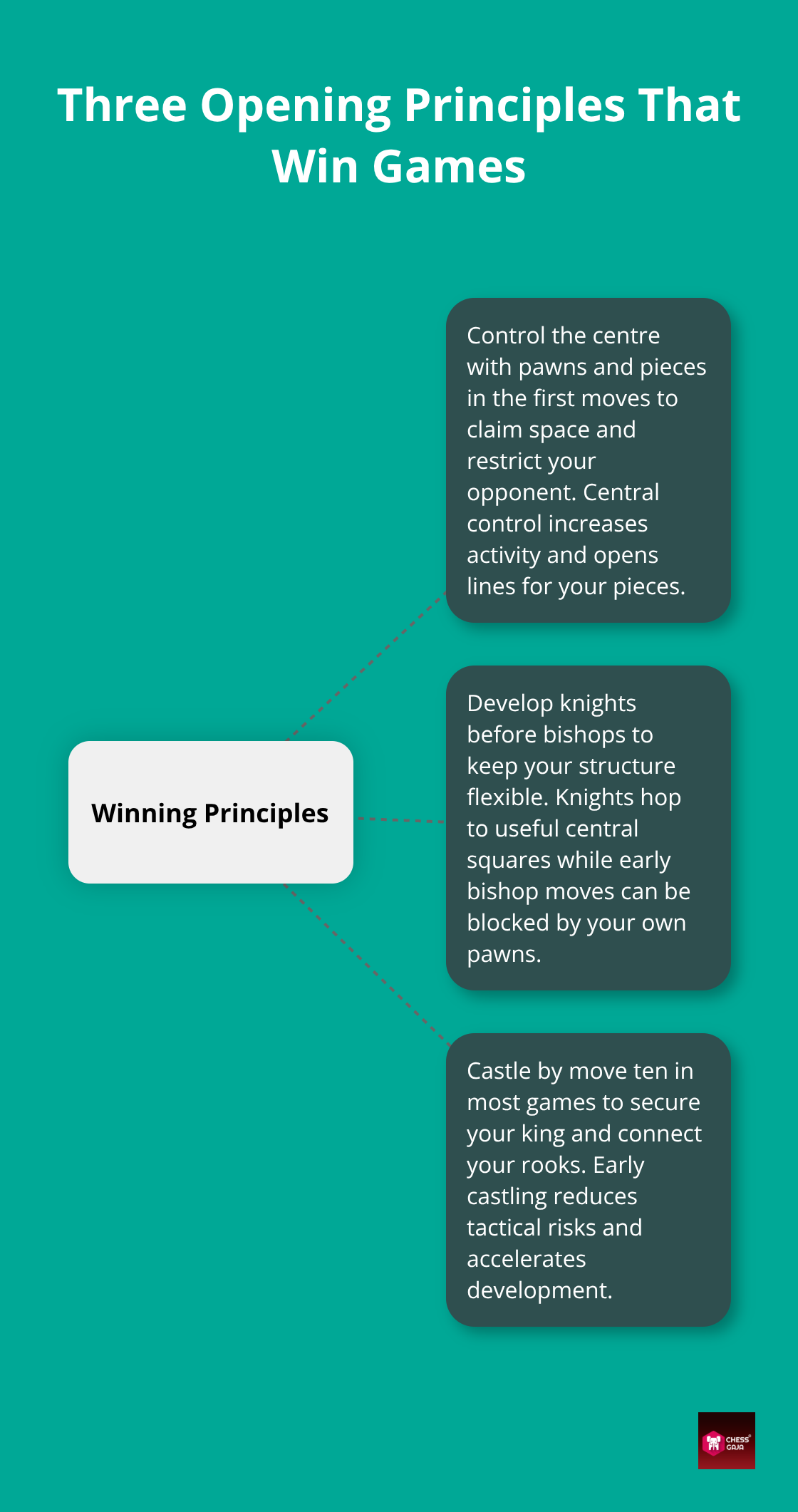
The center provides the launching pad for attacks on both sides of the board. When you place pawns on e4 and d4 as White (or e5 and d5 as Black), you claim space and restrict your opponent’s piece placement.
Develop Knights Before Bishops
Ahmed developed his knights to f3 and c3 as White, or f6 and c6 as Black, before he moved any bishops. This sequence gives maximum flexibility because knights can jump to multiple squares while bishops get blocked by their own pawns if moved too early.
Knights work best when they occupy central outposts. The f3 knight supports the e5 square and can later jump to g5 or h4 for attacks. The c3 knight controls important central squares and supports pawn advances.
Castle Within Ten Moves
The third principle transformed Ahmed’s results completely: he castles by move ten in 95% of his games. Early castling provides crucial king safety and has been extensively analyzed by grandmasters and chess theoreticians.
Ahmed now castles kingside unless his opponent creates serious threats on that side of the board. His king stays protected behind three pawns while his rook activates on the f-file or e-file.
When Ahmed faces the Italian Game, he develops his knight to f6, controls the center with d6, and castles by move six. Against the Queen’s Gambit, he plays the solid setup of Nf6, e6, Be7, and castles kingside before move eight.
These patterns work because they follow the same sequence: center control, knight development, then king safety. Players who reverse this order face immediate tactical problems that specific opening systems can help you avoid.
Which Opening Systems Give You the Best Results
Ahmed’s success came from mastering three specific opening systems that work perfectly with the principles he learned.
The Italian Game Creates Natural Development
The Italian Game became Ahmed’s weapon as White because it develops pieces naturally while creating immediate threats. After 1.e4 e5 2.Nf3 Nc6 3.Bc4, White controls the center and targets the f7 square (Black’s weakest point in the opening). Statistics from online databases show the Italian Game scores 54% for White at intermediate levels, which makes it more effective than complex Sicilian variations that require extensive memorization.
White develops the bishop to an active square while maintaining pressure on Black’s position. The Italian Game allows quick castles and connects the rooks faster than most other openings. Players can learn the main ideas within weeks rather than months of study.
The Queen’s Gambit Transforms Your Positional Understanding
The Queen’s Gambit with 1.d4 d5 2.c4 transforms players into stronger positional chess players within months of practice. This system teaches pawn structure concepts that apply to every chess position you’ll encounter.
White gains central space and creates long-term pressure against Black’s position without risky pawn moves or early attacks. Ahmed learned to play both the Queen’s Gambit accepted and declined variations, which improved his endgame technique significantly because these systems often transition into instructive pawn endings.
The Caro-Kann Defense Solves Black’s Problems
The Caro-Kann Defense with 1.e4 c6 2.d4 d5 gives Black reliable counterplay without the tactical complications of the Sicilian Defense. This system allows natural piece development while Black maintains a solid pawn structure that rarely collapses under pressure.
The Caro-Kann gives Black good practical chances, making it an excellent practical choice with limited theoretical knowledge required. Ahmed adopted this defense and immediately stopped losing games in the opening phase because the Caro-Kann avoids the sharp tactical lines that punish small mistakes.
These three systems work together to create a complete repertoire. However, even perfect opening knowledge won’t help if you fall into common traps that cost material or expose your king to immediate danger.
What Opening Mistakes Destroy Your Position
Ahmed avoided three specific mistakes that cause opening losses according to Chess.com’s database analysis of games rated 1200-1600. These errors appear in thousands of games daily and cost players material or king safety before move fifteen.
Multiple Piece Moves Waste Development
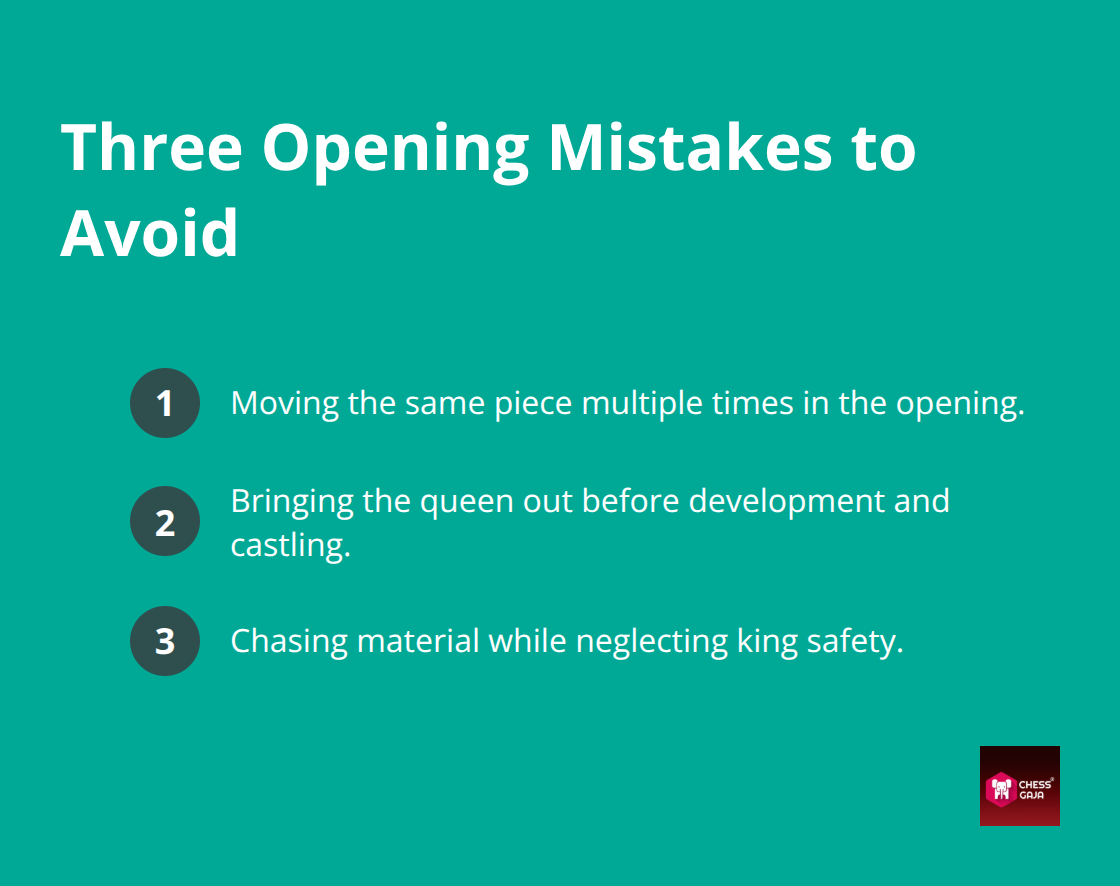
Ahmed learned to develop each piece once before he moved any piece twice in the opening. Players who move their knight from g1 to f3 to e5 to d3 lose three full moves while their opponent develops three different pieces. Database analysis shows that players who repeat piece moves in the opening score far worse than those who develop systematically.
The knight belongs on f3, the bishop on c4 or e2, and the other knight on c3. Move each piece to its best square immediately rather than wander around the board. Ahmed now completes his development by move eight instead of move twelve because he follows this strict rule.
Early Queen Development Creates Tactical Disasters
Queen development before move six leads to immediate tactical problems that cost material. Ahmed stopped his queen attacks to h5 on move two after he lost his queen three times to simple knight forks and bishop pins.
Statistics from Lichess show that players who develop their queen before they castle lose more games than those who keep the queen on the back rank until development completes. The queen gets attacked by minor pieces and must retreat while the opponent gains tempo with every move that develops pieces.
Ahmed waits until move ten to activate his queen, which prevents these embarrassing tactical losses that plague intermediate players.
Material Hunting Exposes the King
Players who chase pawns and pieces while they ignore king safety create immediate threats that end games within fifteen moves. Ahmed learned this lesson after he lost five games in one tournament because he captured material instead of castled.
Players who prioritize material over king safety face mate-in-three puzzles by move twelve (even strong club players fall into these traps). The king must reach safety before you launch any attacks or capture loose material.
Ahmed now castles by move eight even when his opponent leaves pawns undefended because mate threats always outweigh material gains in the opening phase. His win rate improved from 45% to 68% after he adopted this approach.
Final Thoughts
Ahmed’s transformation from a struggling player to a confident competitor shows how good openings for chess create lasting improvement. His 200-point rating gain came from center control, systematic piece development, and early castles rather than complex theory. These fundamental principles work because they address the three phases every chess player faces: strong positions, tactical safety, and middlegame confidence.
The Italian Game, Queen’s Gambit, and Caro-Kann Defense provide the perfect foundation for rating improvement because they teach essential chess concepts while players can learn them practically. These systems work at every level from beginner to expert. Players who apply these concepts consistently see immediate results in their tournament performance.
Start with one system and practice it for two weeks before you add the next one. We at Chess Gaja help players develop systematic knowledge through personalized instruction and detailed game analysis (our experienced coaches provide the guidance needed to transform knowledge into rating gains). Chess Gaja offers coaching programs that accelerate this process through structured lessons and continuous feedback.


