

What does a chess rating mean? If you’ve heard people talk about “ratings” or “Elo,” you might wonder: What is a chess rating system? This simple guide explains how chess ratings work, what they measure, and why they matter. If a five-year-old can understand it, so can you!
I am Priyadharshan Kannappan, a Chess Grandmaster and FIDE Trainer. My peak FIDE rating of 2554 was achieved in August 2018. My current FIDE rating is 2553. In this article, I will explain how the chess rating system works and give you a very simple logic on FIDE ratings.
- What is a Chess Rating System?
- Why Chess Ratings Matter
- The Two Main Chess Rating Systems
- How the Chess Rating System Works
- What Do Different Chess Ratings Mean? Rating Beginner Guide
- Understanding Grandmaster Ratings What's a Grandmaster?
- How to Get a Chess Rating
- How Ratings Change Over Time
- The ELO Rating vs. FIDE Rating: What's the Difference?
- How to Improve Your Chess Rating
- FIDE Rating vs. Online Rating: Which Is Better?
- Become a Grandmaster: The Rating Journey
What is a Chess Rating System?
A chess rating system is like a report card for chess players. It measures how strong you are at chess.
Simple way to think about it:
- 🎮 Video games give you points or levels
- 📚 Schools give you grades (A, B, C)
- ♟️ Chess gives you ratings (1000, 1500, 2000, etc.)
Your rating shows how good you are at chess compared to other players.
Why Chess Ratings Matter
For Beginners
Ratings help you:
- See if you’re improving (your number goes up!)
- Know who to play against (someone at your level)
- Stay motivated (watching your rating grow is fun!)
For Advanced Players
Ratings help you:
- Get paired in tournaments with similar-strength players
- Track progress toward becoming a Grandmaster
- Qualify for professional tournaments
- Build your reputation in the chess world
The Two Main Chess Rating Systems
There are two big rating systems worldwide:
1🔹 USCF Rating (The US Standard) Uses the Elo mathematical model, administered by the US Chess Federation. Used primarily within the United States for domestic tournaments.
What it stands for: Elo comes from Arpad Elo, the person who invented it!
Where it’s used:
- United States (USCF = US Chess Federation)
- Some online platforms
- Casual chess communities
US Chess (USCF) Range: 400–2900+
2️⃣ FIDE Rating (The International Standard)
What it stands for: FIDE = Fédération Internationale des Échecs (International Chess Federation)
Where it’s used:
- Worldwide official chess
- International tournaments
- Professional play
- Most serious players
FIDE Range: 1400–2850+
Fun fact: Both systems use the Elo mathematical model! FIDE also uses Elo’s formula; the differences are mainly in player pools, rating floors, and update policies, not in the calculation method itself. They just started at different times and places!
How the Chess Rating System Works
The Basic Idea
When you play a game of chess:
- You win: Your rating goes UP ⬆️
- You lose: Your rating goes DOWN ⬇️
- You draw: Your rating stays about the same if the result is against a similar rated opponent
But here’s the twist: The amount it changes depends on your opponent’s rating!
The Formula (Made Simple)
If you beat a stronger player: Your rating jumps UP a lot! 📈
If you beat a weaker player: Your rating goes up, but not as much 📈
If you lose to a stronger player: Your rating drops less 📉
If you lose to a weaker player: Your rating drops more 📉
Why This Makes Sense
It’s fair! The system rewards you more for beating strong players and punishes you less for losing to strong players.
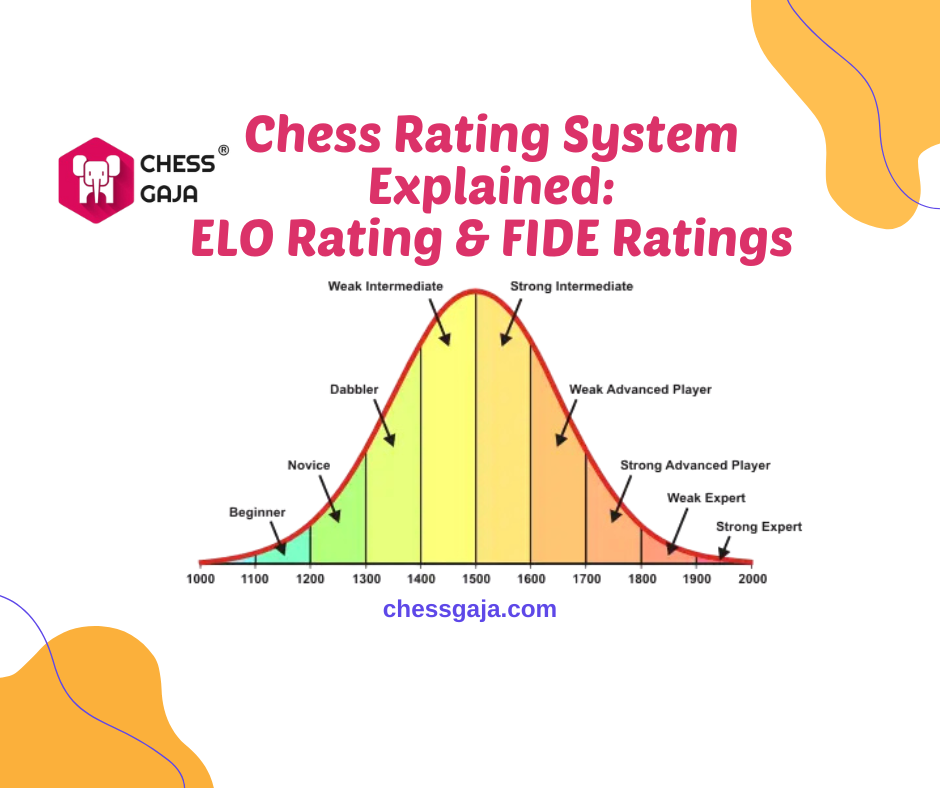
What Do Different Chess Ratings Mean?
Rating Beginner Guide
| Rating | Level | What It Means |
| Under 1200 | Beginner | Just learning chess, don’t know all the rules yet |
| 1200-1600 | Novice | Knows the rules, plays casually |
| 1600-2000 | Intermediate | Plays regularly, understands strategy |
| 2000-2200 | Advanced | Very strong, plays in tournaments |
| 2200-2300 | FIDE Master | Strong club player, nationally recognized |
| 2300-2400 | FIDE Master / IM candidate | Approaching international title level |
| 2400-2500 | International Master | Professional player, plays internationally |
| 2500-2700+ | Grandmaster | World-class player, plays internationally |
Understanding Grandmaster Ratings
What’s a Grandmaster?
To become a Grandmaster, a player must:
- Achieve a published or live FIDE rating of at least 2500
- Earn three GM norms (each requiring a performance rating of 2600+ across a minimum of 9 rounds in FIDE-approved international tournaments, against eligible titled opposition)
- Be recognized by FIDE
Grandmaster is the highest title in chess!
Famous Players’ Ratings
Let’s see what the strongest players rate:
- Magnus Carlsen (all-time peak): 2882 (highest rating ever achieved in chess history)
- Garry Kasparov (retired): ~2851 (legendary!)
- Fabiano Caruana: ~2800
These are the absolute top players in the world. Their ratings are crazy high!
Your Ratings Can Be Different
Important fact: You can have different ratings on different platforms!
Why?
Each platform uses its own system:
- Chess.com rating: For games on Chess.com
- Lichess rating: For games on Lichess
- FIDE rating: For official tournaments
- USCF rating: For US tournaments
Your Chess.com rating might be 1800, but your FIDE rating could be 1500 — both are normal!
How to Get a Chess Rating
Method 1: Online Chess
Play on websites like:
- Chess.com
- Lichess
- Chess24
Your rating updates after each game!
Method 2: Tournament Chess
Play in official tournaments:
- Register with your country’s chess federation (FIDE, USCF, etc.)
- Play tournament games
- Your rating updates after the tournament
Official ratings are more “real” because they’re recognized worldwide!
How Ratings Change Over Time
Rating Changes Example
Let’s say you’re a 1400-rated player:
Scenario 1: You beat someone rated 1600
- You’re expected to lose
- “When you win, you gain a significant amount, often between +20 to +30 points depending on your K-factor!
- Your new rating: ~1420 to 1430
Scenario 2: You beat someone rated 1300
- You’re expected to win
- When you win, you gain only +8 rating points
- Your new rating: ~1408
Scenario 3: You lose to someone rated 1600
- You’re expected to lose
- Losing costs you only around -8 to -10 rating points
- Your new rating: ~1390–1392
The ELO Rating vs. FIDE Rating: What’s the Difference?
| Aspect | Elo (USCF) | FIDE |
| Where Used | USA mainly | Worldwide |
| Starting Rating | Provisional (~400–800 for new players) | Typically 1400+ |
| Update Frequency | Monthly | Monthly |
| Accuracy | Good for casual play | Official, recognized globally |
| Games Counted | Online or tournament | Tournament only |
Which should you use? If you’re serious about chess, get a FIDE rating!
What this means:
- A 2000 rating today might equal a 1800 rating from 20 years ago
- But ratings are still the best measure of skill available!
How to Improve Your Chess Rating
Tip #1: Play Real Games
Your rating only improves if you play rated games!
- Blitz (3 min per side)
- Rapid (10–60 min per side)
- Classical (60+ min per side)
Tip #2: Play Stronger Opponents
Playing people better than you makes your rating go up faster (if you win!)
Tip #3: Learn from Losses
Analyze your losing games. What went wrong? How can you avoid it next time?
Tip #4: Study Tactics
Solving puzzles helps you spot winning moves during games!
Tip #5: Get a Coach
Expert coaching is the fastest way to improve your rating! A good coach shows you:
- Your weaknesses
- Strategies to win
- How to prepare for games
- How to handle pressure
Understanding Your Current Rating
What Your Rating Says About You
If your rating is 1200: You’re learning! Focus on understanding chess basics.
If your rating is 1600: You’re doing great! You understand strategy and can beat most casual players.
If your rating is 2000: You’re excellent! You play in tournaments and beat most players.
If your rating is 2400+: You’re a master! You’re recognized as a serious player.
Rating Plateaus (Getting Stuck)
Many players plateau—their rating stops improving for months!
How to break through:
- Study new openings
- Work with a coach
- Play longer time controls
- Analyze your games more carefully
- Face stronger opponents regularly
FIDE Rating vs. Online Rating: Which Is Better?
FIDE Rating (Official):
- ✅ Recognized worldwide
- ✅ Required for official tournaments
- ✅ More respected
- ✅Updated Monthly
Online Rating (Like Chess.com):
- ✅ Updates every game
- ✅ Play anytime, anywhere
- ✅ Great for practice
- ❌ Not official
- ❌ Different players use different platforms
Answer: Have BOTH! Use online ratings to practice and improve, then get an official FIDE rating when you’re ready!
Become a Grandmaster: The Rating Journey
Want to reach Grandmaster? Here’s the rating journey:
- Beginner (Start): 800-1200
- Developing (First goals): 1200-1600
- Intermediate (Playing seriously): 1600-2000
- Advanced Player (Tournament regular): 2000-2200
- Master (Recognized player): 2200-2400
- International Master (IM): 2400+ published FIDE rating, plus three IM norms (each requiring a performance rating of 2450+ in FIDE-approved tournaments)
- Grandmaster (GM): 2500+ official FIDE rating
This journey takes years of dedication, but it’s possible!
Learn Chess Rating Strategy at Chess Gaja
Understanding your chess rating system is important. But improving your rating is even more important!
Why Choose Chess Gaja?
- Coaches available across all rating levels, from beginner to GM
- Advanced Learning Management System (LMS) for instant feedback, mobile alerts, and effortless tracking of classes
- Monthly parent-teacher meetings with GM Priyadharshan for progress updates
- Open to students of all ages worldwide
- Exclusive student newsletter with latest chess insights and tips
- Multiple monthly online tournaments to test skills in competitive settings
- Dedicated WhatsApp support team for quick assistance
- Over 5000 students from more than 40+ countries
With Chessgaja’s fully online platform, students can train comfortably from home, choosing times that fit their schedule without any travel hassles. This flexible, expert-driven approach delivers unmatched value and results for chess learners worldwide.
Contact Chessgaja: https://chessgaja.com/contactnew/
Website: https://chessgaja.com🏆
Frequently Asked Questions
What’s a good chess rating?
1200-1400 is average for casual players. 1600+ is good. 2000+ is excellent. 2500+ is Grandmaster level.
Can my chess rating go down?
Yes! Every loss lowers your rating. But it’s okay—losing games teaches you how to improve!
Is FIDE rating or Elo rating better?
FIDE is the official worldwide standard. But both are good ways to measure skill!
How fast can I improve my rating?
With good coaching and practice, beginners can gain 200+ rating points in a year!
What’s the difference between rapid and blitz ratings?
Rapid: 10–60 min per player. Blitz: under 10 min per player. Your rapid rating is usually higher because you have more time to think!
Can I have multiple ratings?
Yes! You can have Chess.com rating, Lichess rating, FIDE rating, USCF rating—all different!
Your Rating Journey Starts Now!
You now understand how the chess rating system works! You know:
✓ What ratings measure
✓ How they change
✓ What different ratings mean
✓ How to improve yours
Next step: Start playing rated games and watch your rating grow!