

Last month, a 12-year-old student at our academy jumped from 1200 to 1450 rating in just eight weeks. His secret? Mastering tactical patterns through focused daily practice.
Chess tactics strategy forms the backbone of every strong player’s game. We at Chess Gaja have seen countless students transform their results by learning these fundamental patterns.
The difference between spotting a winning combination and missing it often determines your rating growth.
As Grandmaster Priyadharshan Kannappan, FIDE Trainer and founder of Chess Gaja Academy, I have helped hundreds of students use sharper tactics to transform inconsistent positions into clear wins, and in this article I will share a step‑by‑step strategy to train your tactical vision so it directly boosts your overall game performance.
Which Tactical Patterns Win Material Most Often
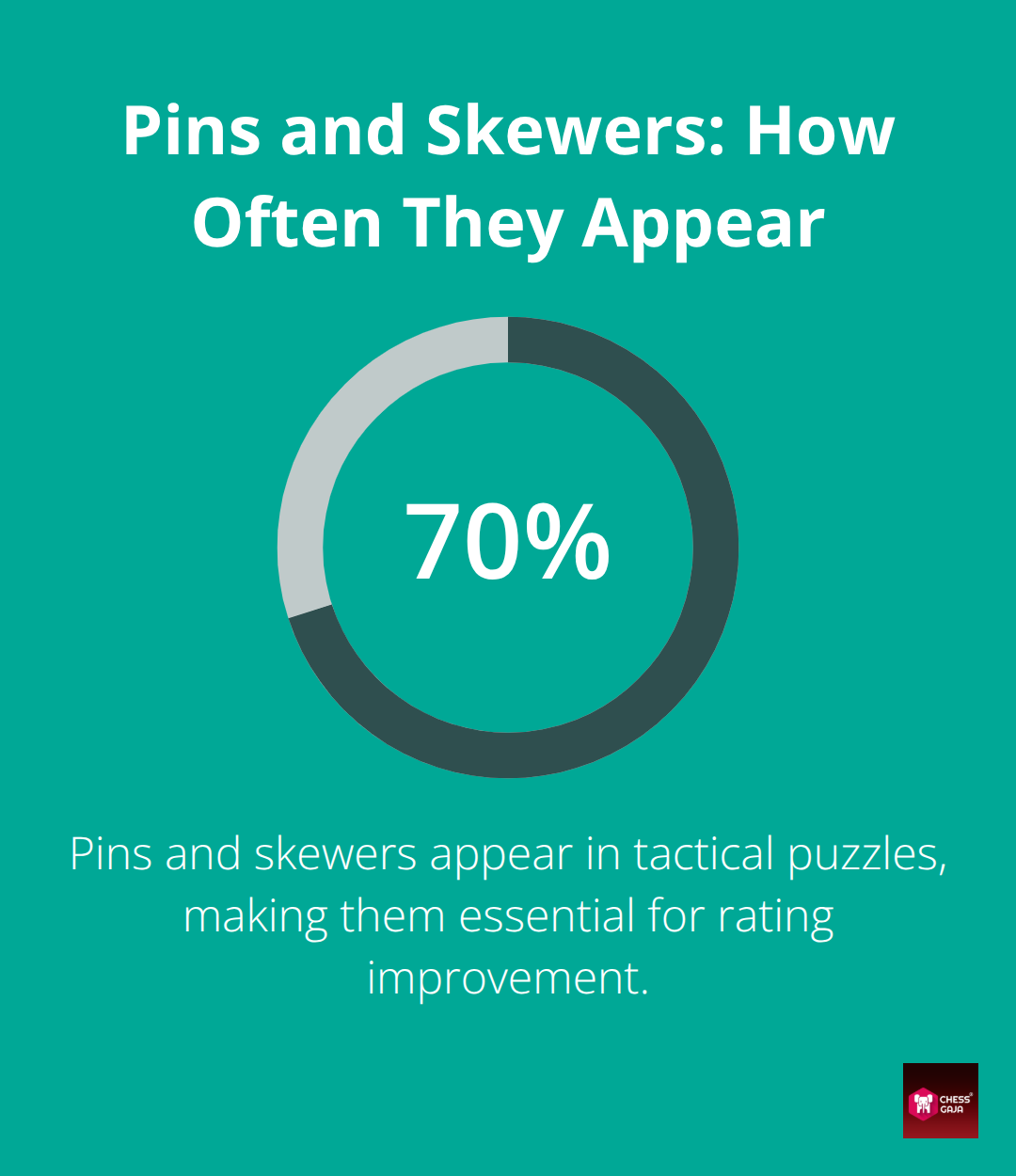
Pins and skewers dominate material-winning positions because they exploit piece relationships along ranks, files, and diagonals. A pin restricts movement when a less valuable piece shields a more valuable one from attack, while skewers force valuable pieces to move and expose weaker ones behind them.
The classic knight fork targets king and queen, winning material instantly. Magnus Carlsen’s tactical awareness contributes to his status among the world’s top players.
Absolute Pins Create Immediate Opportunities
Absolute pins against the king create immediate tactical opportunities since the pinned piece cannot move without exposing the monarch to check. Relative pins against queens, rooks, or other valuable pieces offer material gains because the pinned piece cannot move without exposing an even more valuable target behind it.
Fork Patterns Target Multiple Pieces
Knight forks prove most effective because they attack squares that other pieces cannot reach simultaneously. The royal fork (targeting king and queen) wins material instantly and appears frequently in games below 1500 rating. Pawn forks attack two pieces on adjacent diagonals and often trap bishops or knights in cramped positions. Practice fork recognition by studying positions where your pieces can attack two enemy pieces at once.
Double Attacks Multiply Your Threats
Discovered attacks unleash devastating power when moving one piece reveals another’s attack path. The moving piece often captures material while the revealed piece creates additional threats. Double checks force kings to move since blocking or capturing both attackers proves impossible. These patterns require precise calculation but reward players with significant material gains when executed correctly.
Advanced tactical combinations build upon these fundamental patterns to create even more powerful attacks against your opponent’s position.
How Do Advanced Tactics Create Rating Breakthroughs
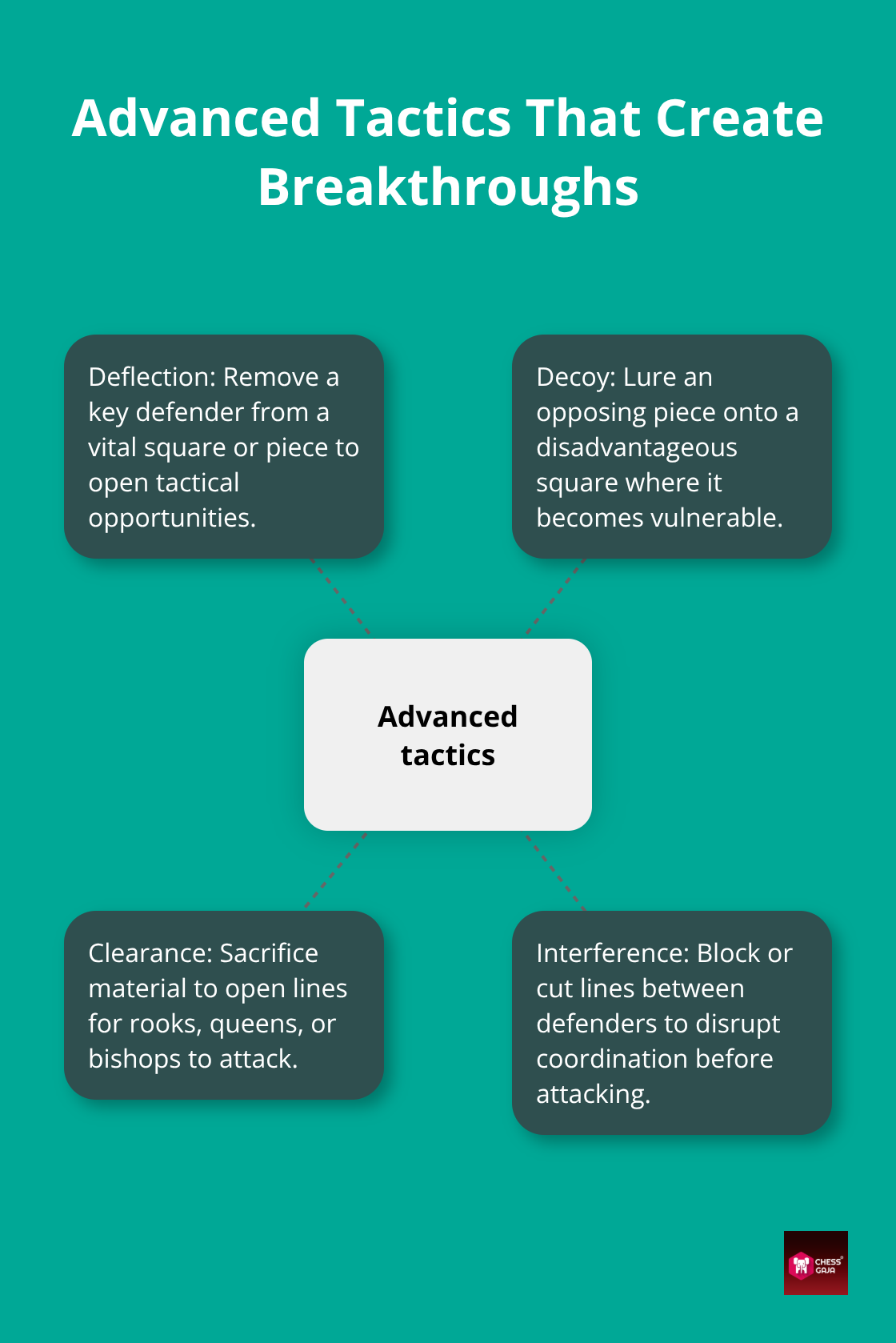
Deflection and decoy sacrifices force opponent pieces away from critical defensive roles, which creates tactical opportunities that basic patterns cannot achieve. Deflection removes a defender from an important square or piece, while decoy sacrifices lure pieces to disadvantageous squares where they become vulnerable. These advanced combinations appear frequently in higher-rated games and separate intermediate players from beginners.
Interference tactics block opponent pieces from critical squares and often precede devastating attacks.
Sacrifice Patterns That Win Games
Material sacrifices work when they lead to forced mate or significant material recovery within three to four moves. The most effective sacrifices target the f7 square before the opponent castles, or the h7 and g7 squares once the king has castled kingside. Masters like Paul Morphy excelled at shattering uncastled positions, while Mikhail Tal later perfected intuitive sacrifices against castled kings, proving that early material investment creates overwhelming attacks.
Back Rank Vulnerabilities Create Instant Wins
Back rank mates occur when kings lack escape squares while they face rook or queen attacks along the first or eighth ranks. These patterns appear most frequently when players castle without luft squares for their kings (such as creating escape squares on h2 or g2 for White by moving the h or g-pawn). Position your rooks on open files and coordinate them with queens to exploit back rank weaknesses systematically. The combination of activating rooks via open files to dominate the seventh rank, followed by back-rank pressure, wins material in the majority of middlegame positions where opponents neglect king safety.
Clearance Tactics Open Attack Lines
Clearance sacrifices remove your own pieces from key squares to unleash more powerful attacks from other pieces. These tactics prove most effective when you sacrifice a minor piece to clear a path for your queen or rook to deliver mate. The classic clearance sacrifice involves a bishop or knight that blocks your queen’s attack on the enemy king. Master players recognize clearance opportunities instantly because they visualize how piece removal transforms static positions into dynamic attacks.
These advanced tactical weapons require precise calculation and pattern recognition, which daily practice develops through systematic puzzle work and game analysis.
Which Training Methods Deliver Fastest Rating Gains
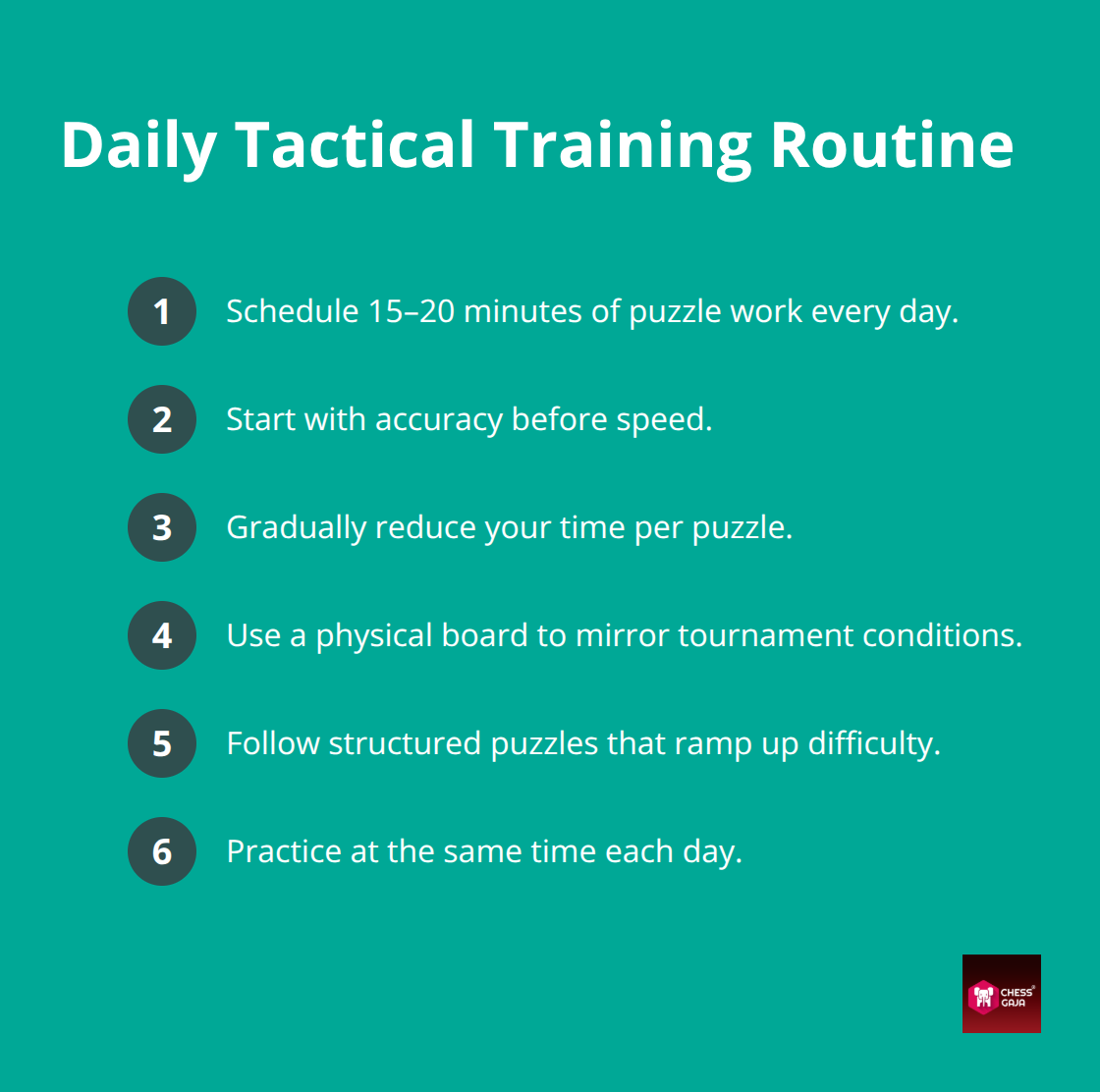
Tactical vision sharpens through specific daily routines that target pattern recognition and calculation speed. Tactical puzzles provide structured training that builds pattern recognition through consistent practice. ChessTempo and Chess.com offer structured puzzle sequences that increase difficulty progressively and force your brain to recognize patterns faster under time pressure. Set a fixed 15-20 minute daily schedule for puzzle work, preferably at the same time each day to build consistent habits. Focus on accuracy over speed initially, then gradually reduce your time per puzzle as patterns become automatic. While digital apps offer incredible speed for pattern repetition, solving complex positions on a physical board develops the deep visualization skills you need during over-the-board competitive play.
Repetition Creates Automatic Pattern Recognition
Master-level players recognize tactical patterns within 2-3 seconds because they have seen similar positions thousands of times. Repeat the same tactical themes multiple times rather than jump between different puzzle types randomly. Spend one week with exclusive focus on knight forks, then move to pins and skewers the next week. This concentrated approach builds stronger neural pathways than scattered practice across multiple themes. Spaced repetition enhances pattern recognition and tactical speed through focused practice on specific patterns. Create a tactical notebook where you record positions that confused you, then revisit these positions weekly until recognition becomes instant.
Game Analysis Reveals Your Tactical Blind Spots
Upload every game you play to chess engines like Stockfish or Lichess analysis board within 24 hours after play. Look specifically for moves marked with question marks or blunders, as these often indicate missed tactical opportunities. Players typically overlook 30% of available tactics during games due to time pressure and emotional stress (tournament conditions amplify this percentage). Focus your analysis on positions where the engine suggests moves you never considered, then practice similar positions through targeted puzzle work. The combination of immediate post-game analysis followed by specific tactical training addresses your personal weaknesses rather than generic pattern practice.
Physical Board Practice Builds Tournament Skills
Tournament players must visualize moves without computer assistance, which makes physical board practice essential for rating improvement. Set up tactical positions on a real board and solve them without moving pieces until you find the solution. This method develops the same visualization skills you need during competitive play. Studies show that players who practice exclusively on screens struggle with board vision during over-the-board tournaments. Alternate between digital puzzle apps (for convenience and variety) and physical board work to develop complete tactical skills.
Final Thoughts
Your chess tactics strategy improvement depends on consistent daily practice rather than sporadic intensive sessions. The most successful players we work with at Chess Gaja dedicate 15-20 minutes daily to tactical puzzles and focus on accuracy before speed. This approach builds automatic pattern recognition that transforms your game within months.
Create a structured monthly schedule where you dedicate an entire week to a single tactical theme. Week one focuses entirely on pins and skewers, week two on forks, and week three on discovered attacks. This systematic rotation prevents tactical tunnel vision while deeply reinforcing each pattern.
Your next step involves the selection of one primary tactical training platform and commitment to it for at least three months (consistency beats variety when you build tactical foundations). Review your blunders immediately after your sessions to catch missed tactical opportunities. We at Chess Gaja have guided students through this exact process and helped them achieve significant rating improvements through structured tactical training.