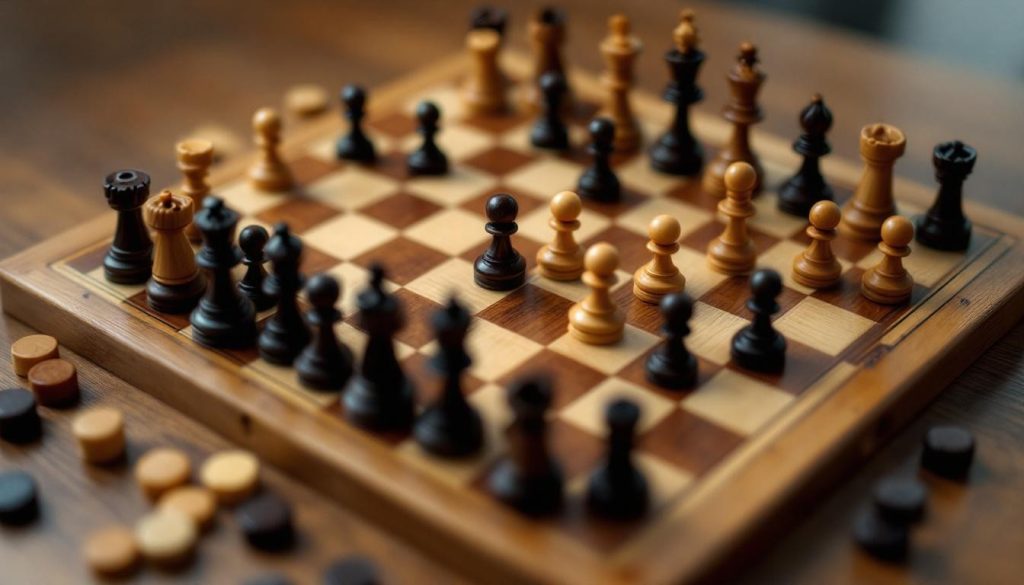
Last week, a 12-year-old student at Chess Gaja played a game where she sacrificed her queen-and won. Her opponent panicked because he saw only the immediate loss, missing her plan to deliver checkmate three moves later.
That moment captures everything about chess. You need both the big picture and the sharp tactical eye. Chess strategy and tactics aren’t separate skills-they’re two sides of the same coin, and mastering both is what separates winners from everyone else.
At Chess Gaja Academy, I’ve observed that the most successful players aren’t just good at one thing; they know exactly how to blend long-term planning with short-term strikes. I’m Grandmaster Priyadharshan Kannappan, and I believe that strategy sets the stage, but tactics deliver the final blow. In this article, I’ll show you how to identify strategic weaknesses in your opponent’s position and use precise tactical patterns to exploit them, giving you a complete blueprint for converting advantages into consistent wins.
What’s the Difference Between Strategy and Tactics
Strategy is your long-term roadmap for the game. It answers the question: where do I want to be in ten moves, and what weaknesses can I exploit? Tactics are the sharp, immediate moves that cash in on those weaknesses right now. A 1500-rated player who understands this distinction wins far more games than someone who flails between random aggressive moves and passive waiting. Strategy without tactics leaves you with a beautiful plan that never materializes. Tactics without strategy turn you into a gambler who wins material but walks into a back-rank mate. The student who sacrificed her queen had both at once: she possessed a strategic vision (checkmate in three moves) and the tactical precision to execute it. That’s what separates winners from players who plateau.
Strategy Builds Your Position Slowly
Your strategic goal in the opening and middlegame is to control central squares like d4 and e4, develop your pieces to active squares where they do real work, and identify weaknesses in your opponent’s camp that you can attack later. If you play the opening without a plan, you’ll waste tempo and hand your opponent a free advantage. After you develop your pieces efficiently-usually within the first 10 to 12 moves-you should know which of your opponent’s pieces is weak, which squares are undefended, and where their king is vulnerable. At 1500 rating, common strategic mistakes include neglecting development, making random pawn moves, and playing anti-positional moves that weaken your own structure. A solid strategic approach means spending the first phase of the game building a position where tactics can flourish. Your opponent’s isolated queen on d8, their undefended knight on f6, their weak light squares on the kingside-these aren’t accidents. They’re the result of your strategic choices.
Tactics Capitalize on Weaknesses Right Now
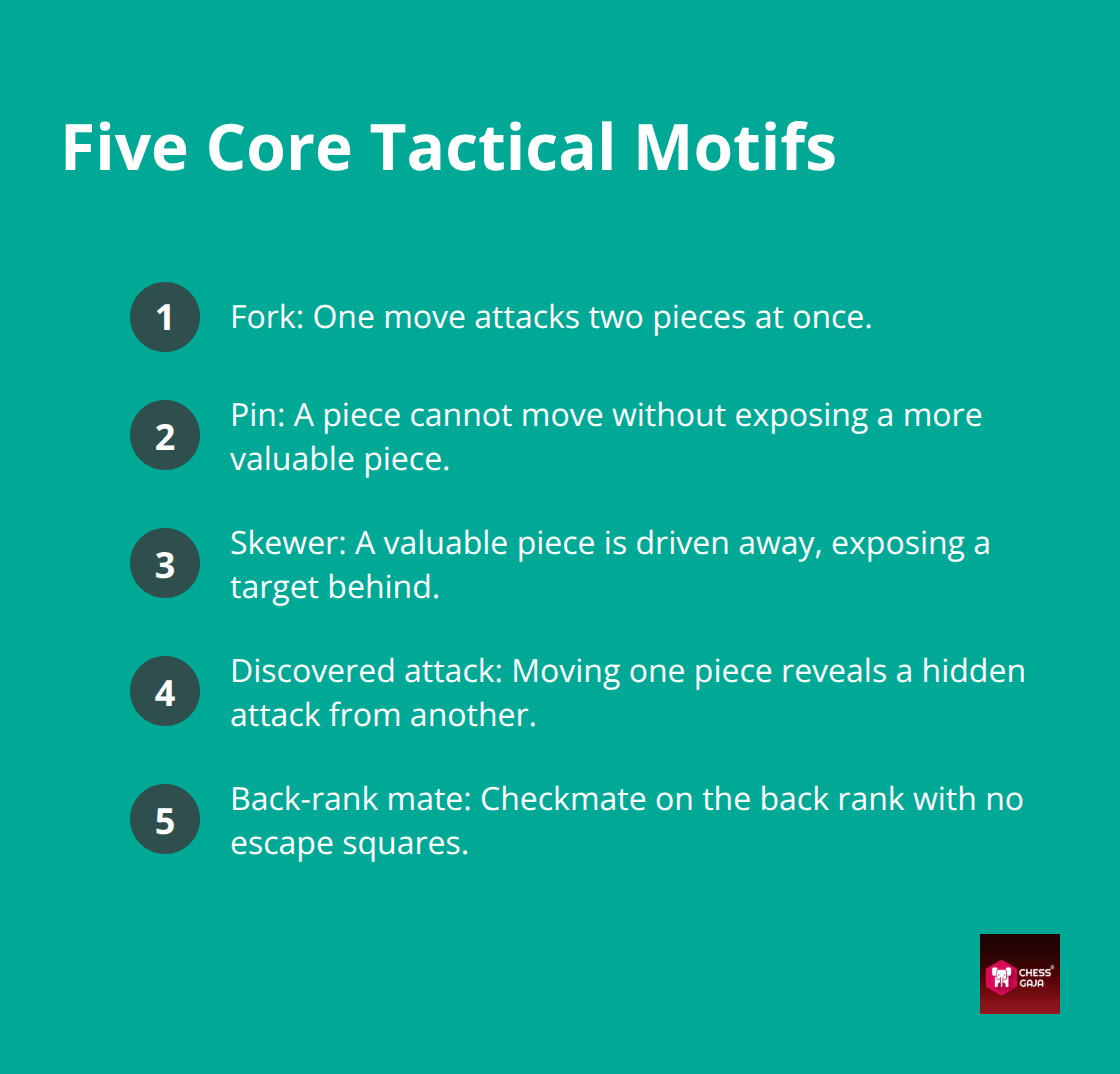
Once your strategic position is sound, tactics are the tools that win material or deliver checkmate. A fork forces your opponent to lose a piece because two of their pieces are attacked simultaneously and they cannot defend both. A pin paralyzes a piece because moving it exposes something more valuable. A skewer forces a high-value piece to move, revealing a lower-value target behind it. A discovered attack happens when you move one piece and reveal a devastating threat from another piece that was hidden behind it.

These five core tactical motifs appear in nearly every winning combination at every level. Players who regularly solve tactics puzzles improve their tactical vision and reduce blunders significantly. The difference between a 1500 player and a 1800 player often comes down to pattern recognition. An 1800 player spots a fork three moves deep because they have solved thousands of puzzles. A 1500 player misses it because the pattern is unfamiliar. Tactics are learnable. They are not talent. They are pattern recognition, and pattern recognition improves with deliberate practice.
Strategy and Tactics Feed Each Other
Strategy without tactics is a sterile plan. You control the center, develop your pieces, and create weaknesses in your opponent’s position-but if you cannot see the tactical blow that wins material or checkmate, your beautiful position means nothing. Conversely, tactics without strategy turn you into a one-move player. You see a fork, you take it, and suddenly you are down material because your opponent had a devastating counter-tactic you missed. Winners combine both. They build a position where tactics become inevitable. They know that if they push their knight to d5, it attacks two pieces and threatens a fork on f4. They know that if they exchange rooks on e5, they remove their opponent’s defender and expose a back-rank weakness.

At 1500 rating, most losses happen because a player either played too passively (no tactical threats) or too aggressively (no strategic foundation).
From Theory to Your Next Game
The real test comes when you sit down at the board. You need to think strategically first-what is my plan for the next five to ten moves?-and then execute tactically. This means you must train both skills separately before you combine them. Tactics puzzles sharpen your pattern recognition. Strategic study of master games shows you how strong players build positions. When you practice both, you start to see how your strategic choices create the tactical opportunities that win games. The next section shows you exactly how to build a winning strategy framework that makes tactics inevitable.
Building a Winning Strategy Framework
The Opening Lays Your Foundation
The opening is not where you win. The opening is where you build the foundation for winning. Your job in the first 10 to 12 moves is to place your pieces on squares where they control space, attack weak points, and restrict your opponent’s options. At 1500 rating, most players waste the opening by moving pieces aimlessly, playing random pawn moves, or neglecting development entirely. You cannot win tactics if your pieces sit on their starting squares.
The center of the board-d4, e4, d5, e5-is where the game is decided. When you control the center with your pieces and pawns, you limit your opponent’s space and force them onto passive squares. A simple rule: develop your knights before your bishops, move them to squares where they attack the center or threaten your opponent’s pieces, and complete your development before you launch any attack. If your opponent has three pieces developed and you have seven, you have already won the game because your pieces create threats faster than they can defend.
Identify Weaknesses and Attack Them
After development, look for weaknesses. An undefended piece is a target. A weak pawn on f7 or f2 is a launching point for tactics. A king trapped in the center is checkmate waiting to happen. These weaknesses do not appear by accident-they are the result of your opponent’s poor opening choices or your own strategic pressure.
Once you identify a weakness, attack it with multiple pieces so your opponent cannot defend everything at once. This is where strategy becomes tactical. You move your rook to an open file, your bishop to a long diagonal, your knight to an outpost-and suddenly your opponent faces three threats and can defend only two. That moment is when tactics explode.
Activity Beats Aggression
Many 1500 players confuse activity with aggression. They push pawns forward, launch wild attacks, and lose material because they never secured the foundation. Activity means your pieces control key squares and create real threats. Aggression without activity is just noise.
Control the center first. Develop your pieces to active squares-not the edges of the board, not passive defensive positions, but squares where they exert pressure. A knight on d5 is infinitely stronger than a knight on h3. A bishop on c4 is stronger than a bishop on e2. Place your rooks on open files where they control the fifth, sixth, or seventh rank and threaten your opponent’s pieces or pawns.
Exploit Your Advantage Methodically
Once your position is solid and your pieces are coordinated, identify the weakness you want to exploit. Is it the f7 pawn? The e5 square? The undefended rook? Then attack it with overwhelming force. Your opponent will be forced to make concessions-they will trade pieces unfavorably, move their king into danger, or leave material hanging. That is when you strike tactically.
The difference between a 1500 player and a 1700 player is that the 1700 player knows exactly which weaknesses matter and which ones are distractions. They do not attack every weakness at once. They attack the one that forces their opponent into the worst position. Study games from strong players and notice how they build positions methodically. They do not sacrifice pieces randomly. They sacrifice only when the position demands it because they have already secured the foundation (the center, developed pieces, and coordinated threats).
Your next game will feel different once you adopt this mindset. Instead of hunting for tactics on move five, you will build a position that makes tactics inevitable by move 15. This foundation is exactly what you need to recognize and execute the tactical patterns that turn winning positions into victories.
Mastering Essential Tactical Patterns
Tactics are patterns, and patterns are learned through recognition. At 1500 rating, mastering five core tactical motifs will transform your results more than any opening study ever will. A fork attacks two of your opponent’s pieces simultaneously, making it impossible to defend both. A pin paralyzes a piece because moving it exposes a more valuable piece behind it. A skewer reverses this: a high-value piece moves first, exposing a lower-value target. A discovered attack happens when you move one piece and unleash a hidden threat from another piece behind it. A back-rank mate traps your opponent’s king on the back rank with no escape squares. These five patterns appear in nearly every decisive game at your level.
Why Pattern Recognition Beats Talent
Strong players win more often not because they are smarter or have better intuition. They win because they have solved thousands of tactics puzzles and trained their eyes to spot these patterns instantly. Tactics puzzles improve your rating through consistent training. The pattern recognition is mechanical. It is not talent. It is training.
The most dangerous mistake 1500 players make is assuming they already know these patterns and skipping tactics training. They have seen a fork before, so they think they understand it. Then in a real game, they miss a fork three moves deep because they never trained their brain to calculate multiple candidate moves simultaneously.
How to Train Patterns Effectively
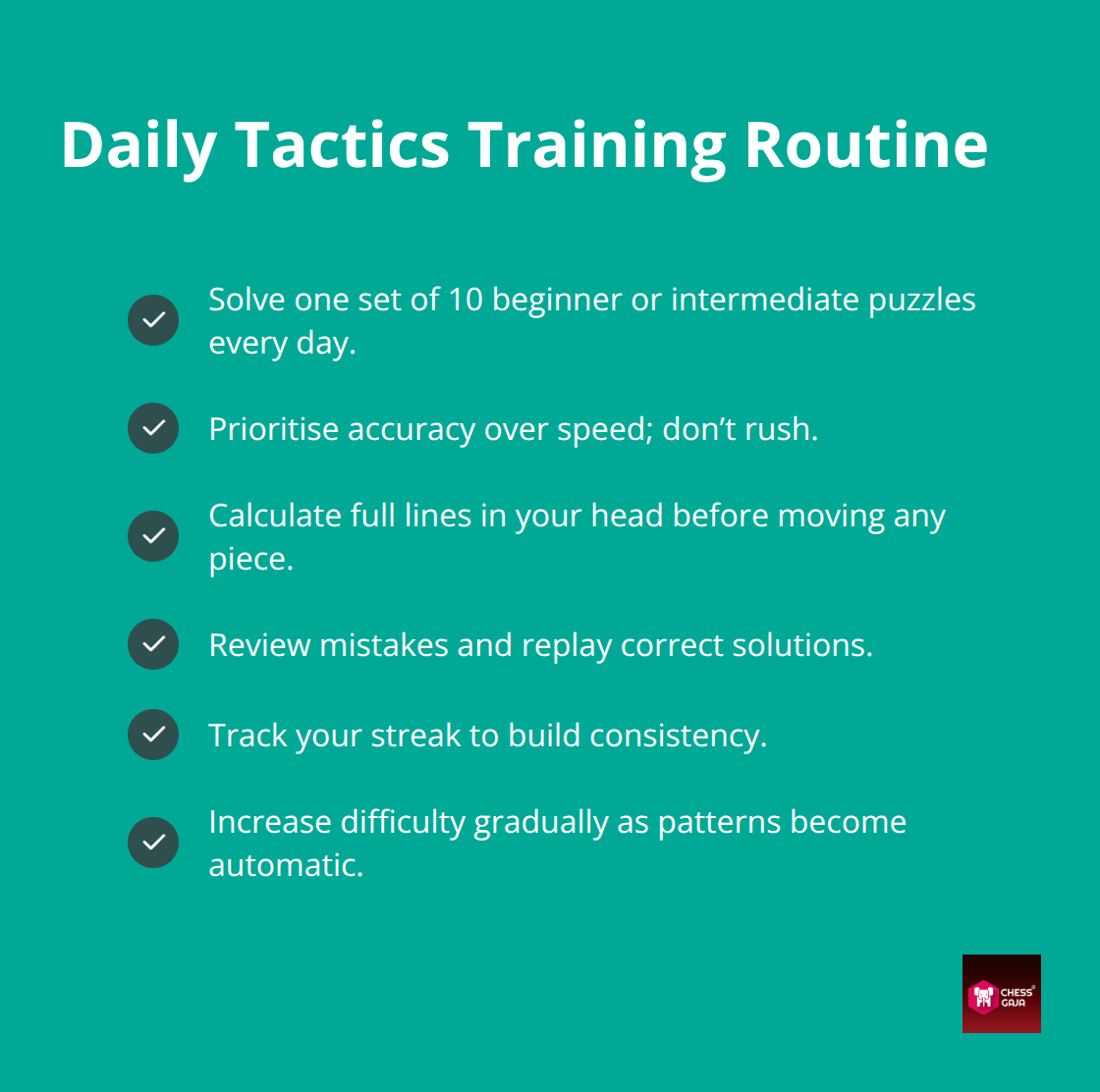
Your job is not to memorize these patterns in theory. Your job is to train until you spot them instantly in positions that look messy and complicated. Solve at least one set of 10 beginner or intermediate tactics puzzles every single day. Do not rush through them. For each puzzle, calculate the entire sequence in your head before you move a single piece.

This trains your working memory and forces your brain to hold multiple pieces and threats in mind at once.
After you solve puzzles for two weeks consistently, you will notice something strange happening in your games. Tactics you would have missed before suddenly jump out at you. A fork that was invisible becomes obvious. A pin that seemed like a minor detail becomes a winning opportunity. This is pattern recognition at work. Once your brain recognizes the pattern, execution becomes automatic.
The Rating Gap Comes Down to One Habit
The difference between a 1500 player and a 1700 player often comes down to this single habit. One player trains tactics daily. The other plays games and hopes to improve. One player wins material because they see the pattern. The other loses material because they miss it. The player who commits to daily puzzle training will pull ahead within months. Your opponents at 1500 rating do not expect you to spot a fork on move 18 or a pin hidden in a complex position. When you do, you win material they cannot afford to lose. This habit separates winners from players who plateau at your level.
Final Thoughts
Strategy and tactics work as one force, not two separate skills. Strategy builds the position where tactics become inevitable, and tactics execute the plan that strategy creates. The 12-year-old student who sacrificed her queen did not stumble into checkmate by accident-she had trained tactics puzzles for weeks, so she recognized the pattern instantly, and she had studied how strong players build attacking positions, so she knew her sacrifice would work.
Your improvement accelerates when you train both skills consistently. Spend 10 to 15 minutes daily solving tactics puzzles to sharpen your pattern recognition and tactical eye. Study games from strong players to understand how they build positions methodically, control the center, and create weaknesses before they attack. When you combine these habits, your rating climbs because you stop missing tactics and start building positions where your opponent has no good moves.
Play your next game with a clear strategic plan for the first 10 to 12 moves-control the center, develop your pieces to active squares, identify one weakness in your opponent’s position, and attack it with multiple pieces. If you want structured guidance to accelerate your progress in chess strategy and tactics, Chess Gaja offers personalized coaching with FIDE-rated coaches who analyze your games and teach you exactly which strategic and tactical habits will push your rating higher.