
Your opening choice shapes your entire game. Whether you’re a beginner learning your first moves or an advanced player refining your strategy, the most popular chess openings offer proven paths to success.
At Chess Gaja, we’ve guided thousands of players through opening selection based on their skill level and playing style. This guide breaks down the openings that work, from foundational systems to grandmaster-level complexity.
When I’m coaching at Chess Gaja Academy, I often see students get paralyzed by the sheer number of opening names they encounter. I’m Grandmaster Priyadharshan Kannappan, and I want to remind you that the “most popular” openings aren’t just trends—they are systems that have survived the test of time because they work for everyone from club players to World Champions. In this guide, I’m cutting through the complexity to highlight the core openings that define the modern game, helping you understand why millions of players choose these specific battlegrounds and how you can pick the one that feels like home for your style.
Which Openings Give Beginners the Best Foundation
The Italian Game: Learning Through Principles
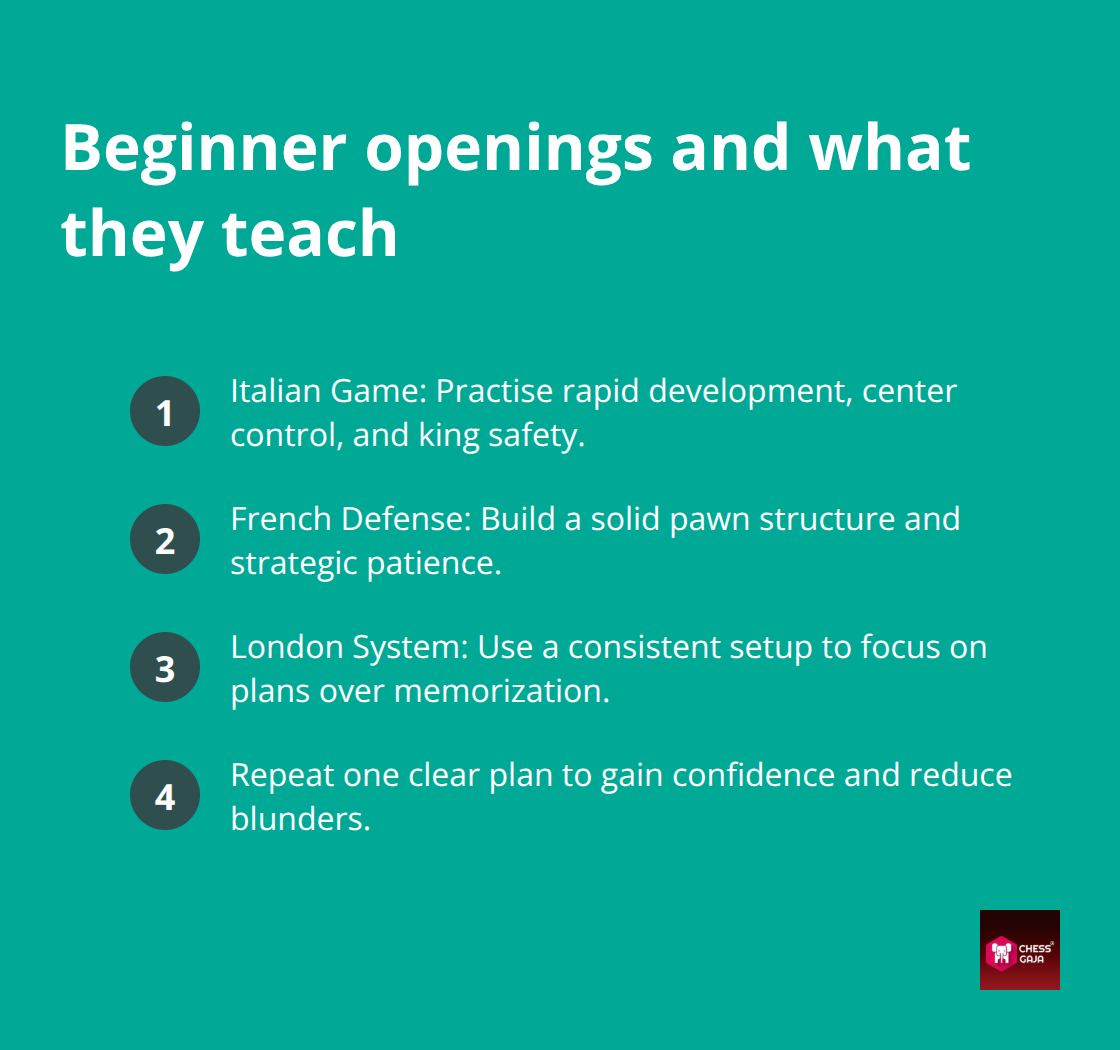
Beginners need openings that teach sound principles rather than memorized lines. The Italian Game does exactly this by focusing on rapid development, center control, and king safety. After 1.e4 e5 2.Nf3 Nc6 3.Bc4, White’s pieces move purposefully toward the center and kingside, avoiding the trap of aimless shuffling. This opening rewards understanding over memorization, which is why it appears in beginner curricula across 40+ countries. The Italian Game also avoids the theoretical depth of 1.e4 e5 2.Nf3 Nc6 3.Bb5, the Ruy Lopez, which demands knowledge of dozens of move sequences.
Solid Defenses for Black Players
For Black, the French Defense offers a reliable framework that doesn’t collapse under tactical pressure. Starting with 1.e4 e6, Black accepts a slightly cramped position but gains a solid pawn structure positional understanding. Unlike openings that require precise calculation, the French teaches patience and strategic thinking. The London System for White provides an even simpler alternative, with a fixed pawn setup (pawns on d3, e3, f4, c3) that remains consistent across most games. A beginner playing the London System learns one plan deeply rather than memorizing ten different responses.
Real Results from Consistent Opening Play
Real progress happens when beginners see their chosen opening work repeatedly. Kanav, a student from Singapore who joined our programs in December 2024, improved from 1540 FIDE to 1800 FIDE and became Singapore U11 National Champion at the 2025 Singapore National Age Group Chess Championships through consistent opening choices. Aurik from Singapore earned Bronze at the same 2025 championship after settling on reliable, principle-based openings suited to his level. These players didn’t memorize trap lines or prepare theoretical novelties; they mastered the core ideas of their chosen systems and applied them consistently.
How Beginner Openings Shape Middlegame Plans
The Italian Game’s emphasis on d4, e4, and Nf3 translates directly to middlegame plans. The French’s setup teaches how a solid center supports piece activity. The London’s methodical arrangement shows that structure matters more than flashy tactics at the beginner level. Each opening gives a beginner permission to stop worrying about whether they’re prepared enough and start focusing on understanding the position. As players advance beyond these foundational systems, intermediate-level openings demand more tactical awareness and deeper preparation-a natural progression that builds on the principles beginners already know.
Intermediate Players: When and How to Upgrade Your Opening Repertoire
Intermediate players face a critical decision that beginners avoid: sticking with foundational openings limits upward mobility. The Sicilian Defense and Ruy Lopez deliver measurably better results at this level, and the data supports moving away from beginner systems. The Sicilian Defense scores Black’s most aggressive response to 1.e4, offering sharper positions where tactical alertness pays off. That performance gap matters when you compete in regional tournaments across UAE and Singapore where rating jumps of 50–100 points happen within months of consistent play. Intermediate Black players who abandon the French or Caro-Kann for the Sicilian gain access to positions where calculation skills determine outcomes.
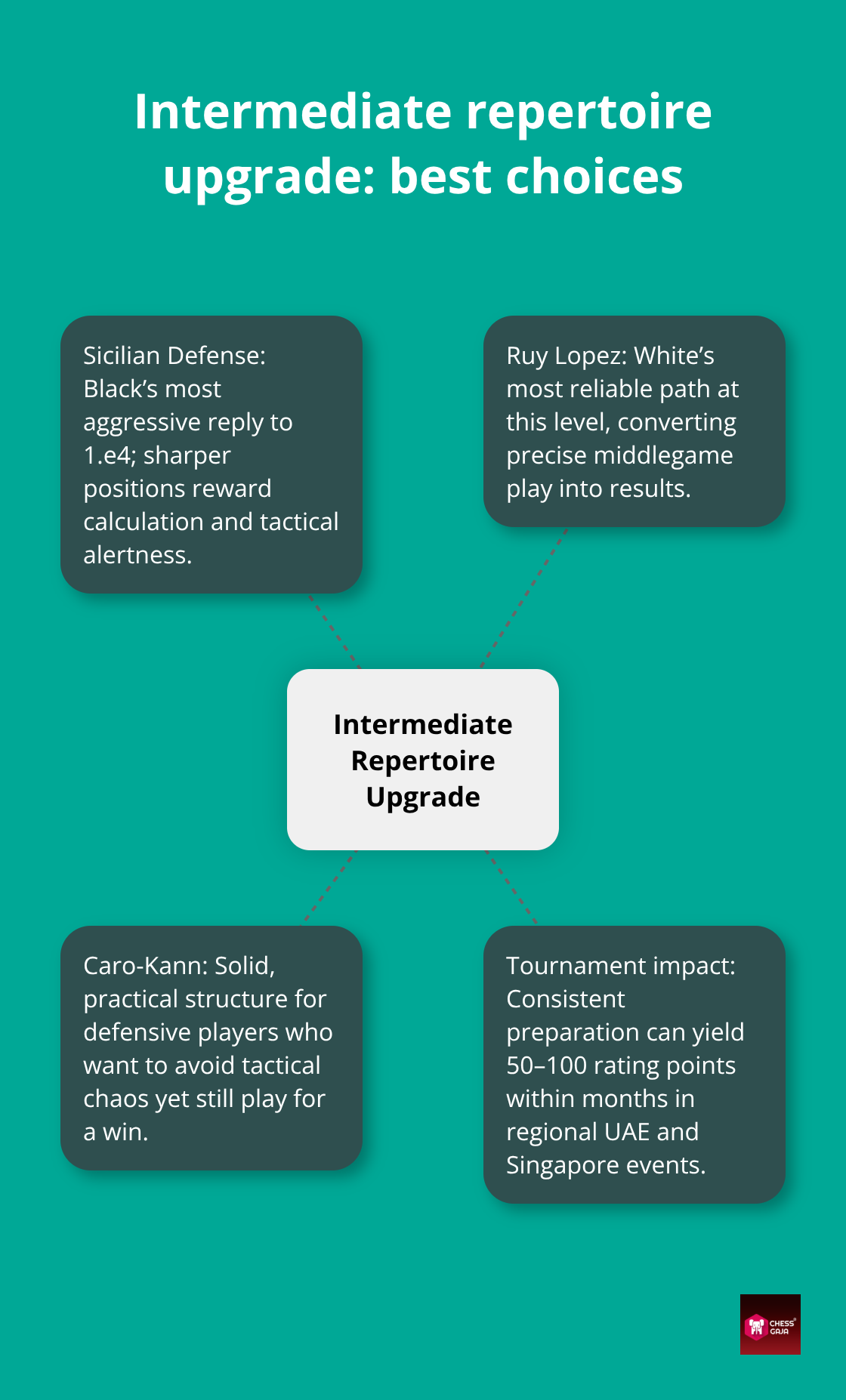
The Ruy Lopez performs as White’s most reliable opening at intermediate level, outperforming beginner-friendly systems by a significant margin. This reflects thousands of real games played by intermediate and advanced players. Abinav, an intermediate-level student, scored 3 out of 5 at the Vimana City 1st International Open after transitioning to a structured Ruy Lopez repertoire, gaining 63 rating points in a single tournament. The Caro-Kann Defense remains solid even against aggressive White setups, making it the practical choice for defensive players who want to avoid the tactical chaos of the Sicilian but still play for a win.
Sicilian Variations: Choose One Line and Master It
Intermediate players often assume they need to master every Sicilian variation. This misconception wastes thousands of hours. Instead, focus on one or two main lines that match your playing style and tournament schedule. The Open Sicilian (3.d4) leads to tactical battles where calculation skills matter more than memorized positions. The Closed Sicilian (2.Nc3) offers a quieter setup that suits players who prefer positional maneuvering. Choose based on your comfort level, not opening popularity. The critical actionable here is this: spend 80% of your study time on lines you will actually face in your next 10 tournaments, not on rare sidelines that appear once every five years. Intermediate players who prepare three solid responses to White’s main tries and understand the middlegame plans behind those responses outperform players who memorize 20 variations poorly. Test your chosen variation in rapid games first, then bring it into classical tournaments once you have played it at least five times. This approach mirrors how strong players actually prepare, and it accelerates your improvement faster than theoretical study alone.
Ruy Lopez: Building Winning Technique at Intermediate Level
The Ruy Lopez teaches a fundamental skill that intermediate players must master: how to maintain winning chances in positions where both sides play accurately. White’s opening performance reflects games where precise middlegame execution determines the outcome, not opening preparation alone. Intermediate White players should focus on understanding the typical plans rather than memorizing 25 moves of theory. After 1.e4 e5 2.Nf3 Nc6 3.Bb5, study how to build pressure on d5, how to coordinate your pieces after a6 and axb5, and what your advantage looks like in the resulting middlegame. Priyansh grew from 1325 USCF to 2260 USCF and earned the National Master title by building much of his early repertoire around sound Ruy Lopez principles rather than trap lines. The Caro-Kann serves Black’s intermediate players well because it sidesteps the Ruy Lopez entirely while offering a reliable structure. Black’s plan involves controlling d5, developing pieces systematically, and creating counterplay on the queenside or kingside depending on White’s setup. This statistic reflects real tournament outcomes where intermediate Black players hold drawing chances against stronger opposition and occasionally convert advantages when White overextends.
The Transition Point: When to Shift Your Repertoire
Intermediate players typically reach this transition around 1600–1800 rating points. At this stage, your opponents begin to punish imprecise opening play and exploit structural weaknesses that beginner systems create. The Italian Game and London System still work, but they no longer provide the same competitive edge. Your opponents know how to neutralize these systems, and you need openings that offer practical winning chances even against well-prepared opposition. Switching to the Sicilian, Ruy Lopez, or Caro-Kann signals that you have moved beyond learning chess and started playing chess at a higher level. These openings demand that you understand positions rather than follow memorized patterns, which is exactly what separates intermediate players from advanced ones. The next section explores how advanced players select openings that reflect their individual style and competitive ambitions.
Advanced Openings for Serious Players
Advanced players abandon the search for universally reliable openings and instead commit deeply to systems that reward precise calculation and pattern recognition. The Najdorf Sicilian, Berlin Defense, and Marshall Attack represent three fundamentally different approaches to chess that separate club players from competitive tournament regulars. At this level, opening choice reflects not just playing strength but also psychological readiness for specific types of positions. Yugan from Singapore finished in the top 10 at the 2025 National K-12 Grade Championship after mastering advanced variations that demand hours of preparation before each tournament.
How Advanced Players Prepare Differently
Advanced players do not study openings to avoid losses; they study openings to create winning chances where their opponents must find precise responses under time pressure. The Najdorf Sicilian (6…e5 variations) generates positions where Black’s counterplay emerges only through tactical acuity and deep middlegame understanding. White cannot simply follow beginner principles of rapid development because the position requires knowledge of specific move orders and pawn breaks that determine whether White maintains an advantage.

Advanced players must recognize that these openings require substantially different preparation methods than intermediate systems. The Najdorf demands studying specific engine evaluations of critical positions, not just understanding general principles. Competitive Najdorf players spend 20+ hours preparing before major tournaments, focusing on novelties that might appear in their specific rating band and region. Advanced players typically prepare five to ten specific variations per opening rather than the three to five variations intermediate players need.
The Najdorf Sicilian: Tactical Complexity Meets Counterplay
Advanced Black players who commit to the Najdorf gain access to positions where they generate practical winning chances even against higher-rated opposition. The resulting positions reward those who calculate accurately and recognize tactical patterns that emerge from the pawn structure. Each variation within the Najdorf system demands specific knowledge about move orders, and a single imprecise move can shift the evaluation dramatically. Players who master this opening invest significant time in understanding not just the opening moves but the middlegame plans that follow.
The Berlin Defense: Simplification and Endgame Mastery
The Berlin Defense (1.e4 e5 2.Nf3 Nc6 3.Bb5 Nf6) neutralizes White’s opening advantage entirely by forcing simplification into an endgame where Black holds genuine drawing chances or better. The Berlin requires less memorization but demands exceptional endgame technique because many lines simplify into 4v4 or 5v5 pawn endgames where one tempo determines the outcome.
The Marshall Attack: Aggression Through Sacrifice
The Marshall Attack (1.e4 e5 2.Nf3 Nc6 3.Bb5 a6 4.Ba4 Nf6 5.0-0 Be7 6.Re1 b5 7.Bb3 d6 8.c3 0-0 9.h3 Na5 10.Bc2 c5 11.d4 Qc7 12.ng5 exd4 13.cxd4) sacrifices material immediately to generate attacking chances where White’s initiative determines the outcome. Advanced White players who master the Marshall’s tactical patterns can convert the opening into decisive advantages when opponents miscalculate the resulting complications. This opening prioritizes tactical pattern recognition over memorization; advanced players study historical games where the attack succeeded or failed, identifying the precise moments where White’s initiative either converted or dissipated.
Tournament Context and Opening Selection
Advanced players recognize that opening selection at this level depends on tournament context. A player competing in rapid tournaments across the UAE might choose the Berlin because its solid, defensive nature produces faster draws in blitz situations where time pressure favors simplicity. A player competing in classical tournaments across Singapore might select the Najdorf because the resulting positions reward preparation and calculation time. The Marshall Attack suits players competing in smaller tournaments where psychological pressure and tactical complications favor aggressive preparation. These openings separate serious players from casual participants because they demand continuous updating as engine analysis evolves and new games emerge at the highest levels.
Final Thoughts
Your opening choice reflects your playing style, rating level, and competitive goals. Beginners thrive with principle-based systems like the Italian Game and London System because these openings teach sound thinking rather than memorized lines. Intermediate players gain measurable rating improvements when they transition to the Sicilian Defense and Ruy Lopez, where tactical awareness and deeper preparation separate advancing players from those who plateau. Advanced players commit to systems like the Najdorf, Berlin Defense, and Marshall Attack because these openings reward precise calculation and pattern recognition that emerge only through serious tournament experience.
The progression from beginner to advanced openings mirrors your overall chess development, and you cannot skip steps. A beginner who attempts the Najdorf wastes time memorizing positions they do not yet understand. An intermediate player who refuses to upgrade from the Italian Game limits their rating ceiling unnecessarily. The most popular chess openings at each level exist because thousands of real players have tested them in tournaments and found them effective-your job is to identify which opening matches your current level, master it thoroughly, and recognize when you have outgrown it.
At Chess Gaja, we guide this progression through personalized coaching that matches your skill level with appropriate opening systems. Our FIDE-rated coaches and Grandmaster-led curriculum across 40+ countries help players select openings that accelerate improvement rather than create confusion. Book a Paid Starter Class for a professional skill evaluation, and our coaches will assess your current level, identify which openings suit your playing style, and create a personalized learning path that moves you toward your rating goals.


