
Last month, a 14-year-old student in Dubai lost a winning position because he didn’t know how to convert his advantage quickly under pressure. This is a classic example of why mastering specific chess tempo tactics training methods is crucial for competitive success. Without a sharp sense of tempo, players move too slowly, allowing opponents time to organize counterattacks and slip away.
At Chess Gaja, we’ve seen this pattern countless times. Tempo-the ability to move faster and seize the initiative-separates players who win from those who don’t. This guide teaches you practical chess tempo tactics training methods that work, from puzzle solving to game analysis.
At Chess Gaja Academy, I see many players use chess puzzle apps for hours without improving. They are clicking, not calculating. I’m Grandmaster Priyadharshan Kannappan. I believe the secret to tactical growth isn’t just solving more puzzles. Instead, you must use the right training mode to fix specific blind spots. In this guide, I’ll show you how to utilize puzzle apps to build deep tactical muscle memory. This ensures you spot winning shots in seconds, not minutes.
What Tempo Really Means in Tactical Chess
Tempo means gaining moves on your opponent, forcing them to respond to your threats instead of executing their own plans. When you have the tempo, you dictate what happens on the board. A player with a one-move advantage creates threats faster than their opponent can defend. This dynamic often decides the outcome before the endgame even arrives.
Tempo connects directly to piece activity because active pieces create threats that demand responses. For example, gaining a tempo on a Scandinavian Defense Queen with 1.e4 d5 2.exd5 Qxd5 3.Nc3 immediately forces the queen to move again while developing your knight to an optimal square. Initiative and tempo work together: when you have the initiative, your pieces are active, and your opponent is pinned down to pure defense.
The Tactical Patterns That Exploit Tempo
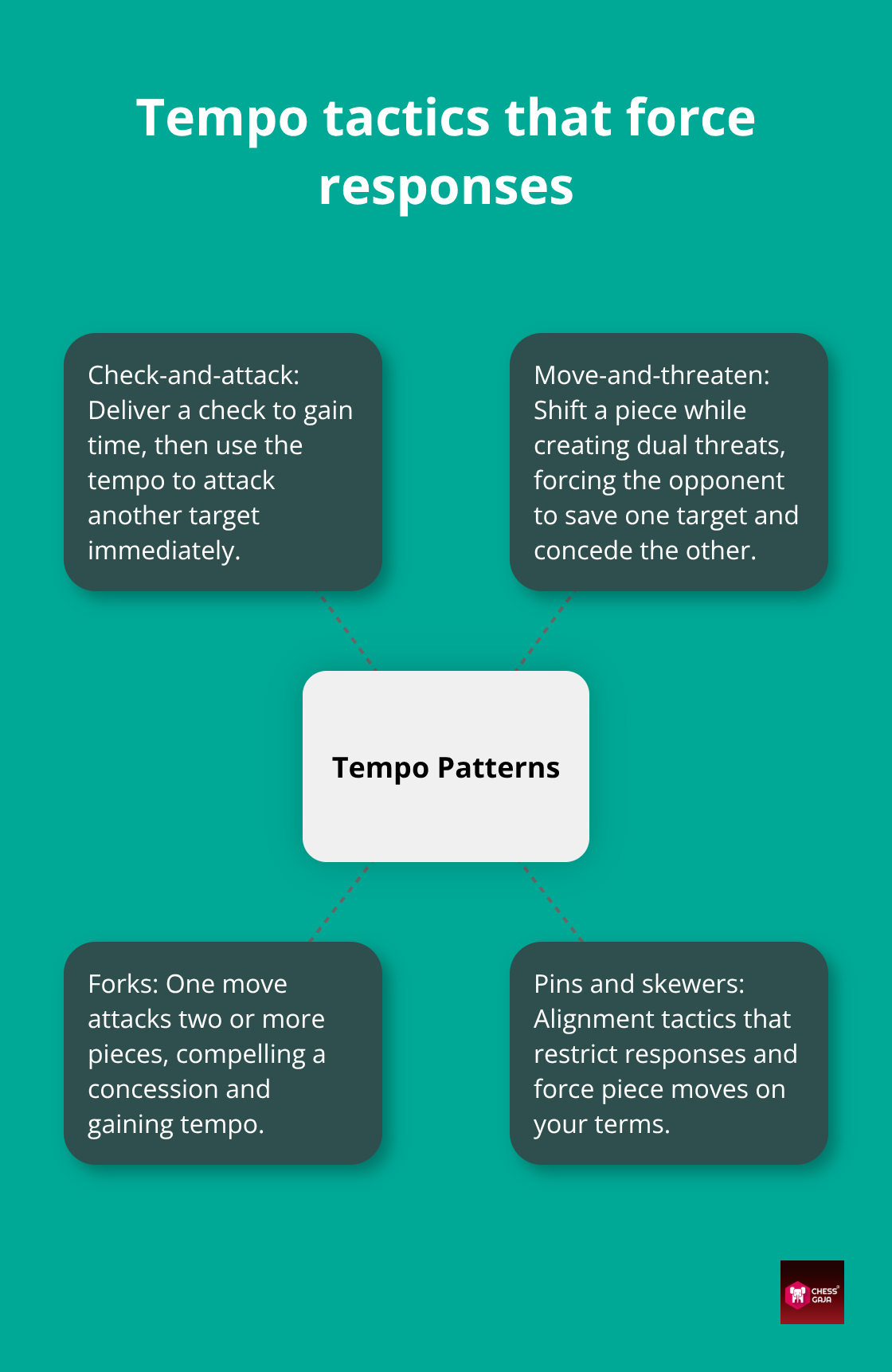
Common tactical patterns exploit tempo by hijacking the opponent’s right to execute their own plan. The check-and-attack sequence works because a check legally forces an immediate response, buying you time to execute a secondary threat.
Another vital pattern is the zwischenzug (in-between move). Instead of playing an expected, passive recapture, you insert a forcing threat that gains a crucial tempo, altering the entire tactical outcome before the forcing sequence concludes.
Why Puzzle Training Differs from Real Games
Many club players solve puzzles based on these patterns but miss them in real tournament games. The difference is that in puzzles, the tactical advantage already exists, and you simply have to execute it. In a real game, you must spot when a tempo advantage becomes available. There is no hint screen telling you a win exists in the position.
This gap between puzzle performance and game performance reveals why recognizing forcing patterns under pressure matters more than raw calculation speed.
How to Train Tempo Tactics Effectively
Solving Puzzles with Purpose and Reflection
Solving tactical puzzles under time pressure works only if you train with strict discipline. On chess puzzle platforms, utilizing Blitz or speed modes forces you to find the best move within seconds, mirroring real tournament time-scarcity. To build deep muscle memory for these quick patterns, you should target an 80% to 90% success rate on a high volume of lower-difficulty puzzles.
Save the challenging, above-your-rating puzzles—where a 50% success rate is normal—for deep, untimed calculation sessions where you can thoroughly map out all candidate moves.
When you solve a puzzle incorrectly, read the problem comments and write down exactly what you missed. A player who solves 20 puzzles per day and writes explanations for five failures learns significantly faster than someone solving 100 puzzles and ignoring their mistakes.
Identifying and Eliminating Your Mistake Patterns
The mistake categories that hurt players the most are failing to consider the opponent’s defensive resources and failing to search for all candidate moves. After you identify which type of error you made, tag that puzzle with a personal label and return to it using spaced repetition.
A systematic approach works because you stop treating puzzles like a game of chance and begin targeting your specific tactical blind spots.
Learning from Your Own Games
Analyzing your own games reveals tempo mistakes that puzzle training alone cannot catch. When you lose a game, look for moments where your opponent gained the upper hand.
Did your opponent check your king to force a move, then attack an undefended piece while you were still recovering? Did you have the chance to launch a double threat but played a passive, single-threat move instead? Compare these moments against the puzzle patterns you have studied to quickly bridge the gap between training and tournament play.
Advanced Tempo Strategies in Competitive Play
Sacrificing Material for Real Tempo Gains
Sacrificing material sounds reckless until you understand the positional return on your investment. In competitive play, a tempo sacrifice means giving up a pawn or a piece to force your opponent into a passive position where they cannot execute their own threats.
An intermediate player can sacrifice a pawn to open lines and gain consecutive forcing tempos. This allows you to continually develop pieces with active threats. The key isn’t just giving random checks. Every forcing move must restrict the enemy’s coordination. This brings your remaining forces into the attack faster than they can defend.
As a rule of thumb: if you cannot identify at least two concrete forcing moves that justify the sacrifice, do not make it.
Defensive Tempo Play Against Superior Positions
Defensive tempo play matters as much as attacking play. When your opponent has the initiative and attacks multiple pieces, your first job is to find a move that forces them to respond instead of continuing their onslaught.
Another vital defensive technique is the counter-threat. Instead of defending passively, create a threat on their king or an undefended piece that forces them to pause their plan. The difference between a 1400-rated player and a 1600-rated player is simple. Stronger players look for forcing countermoves under pressure instead of moving reactively.
Building Pattern Recognition Through Rapid Games
Blitz and rapid games reveal your true skills. They show which tempo patterns you have internalized versus what you only understand in theory. Play at least 10 rapid games per week on a platform like Chess.com or Lichess.
After each game, spend 15 minutes reviewing only the 2–3 critical positions where tempo decided the outcome. Do not waste time analyzing the entire game. This targeted review trains your brain to recognize the specific pattern faster next time.
Final Thoughts
Tempo in tactical chess strategy comes down to one core principle: forcing your opponent to respond to your threats instead of executing their own plans.
Your chess tempo tactics training should follow a clear structure:
- Start with 20 puzzles per day on Chess Puzzle apps in Blitz mode, targeting an 80% to 90% success rate to build speed.
- Log and tag your mistakes, reviewing them weekly using spaced repetition.
- Play at least 10 rapid games weekly, reviewing only the critical moments where the initiative shifted.
Consistency matters more than intensity. If you prefer structured guidance with personalized roadmaps, Chess Gaja offers group classes and private coaching from FIDE-rated coaches who specialize in helping players recognize tactical patterns and convert advantages. Start tracking your progress today, and watch your tactical vision sharpen.