

Last month, one of our students at Chess Gaja struggled with the Sicilian Defense, forgetting key moves after just two games. This happens to most players who try to memorize chess openings without a proper system.
Effectively memorizing chess openings and implementing chess opening strategies requires a balance of core principles and targeted memory techniques. Choosing structured learning over random memorization will save you months of frustration. Choosing structured learning over random memorization will save you months of frustration.
As Grandmaster Priyadharshan Kannappan, FIDE Trainer and founder of Chess Gaja Academy, I have helped thousands of students fix their opening problems, and in this article I will share a step‑by‑step system to memorize chess openings that actually stick in real games.
Understanding Chess Opening Principles vs Pure Memorization
Most players make the same mistake our student made with the Sicilian Defense—they try to memorize move sequences without understanding why those moves work. While memorizing openings offers quick familiarity, understanding principles builds a stronger foundation.
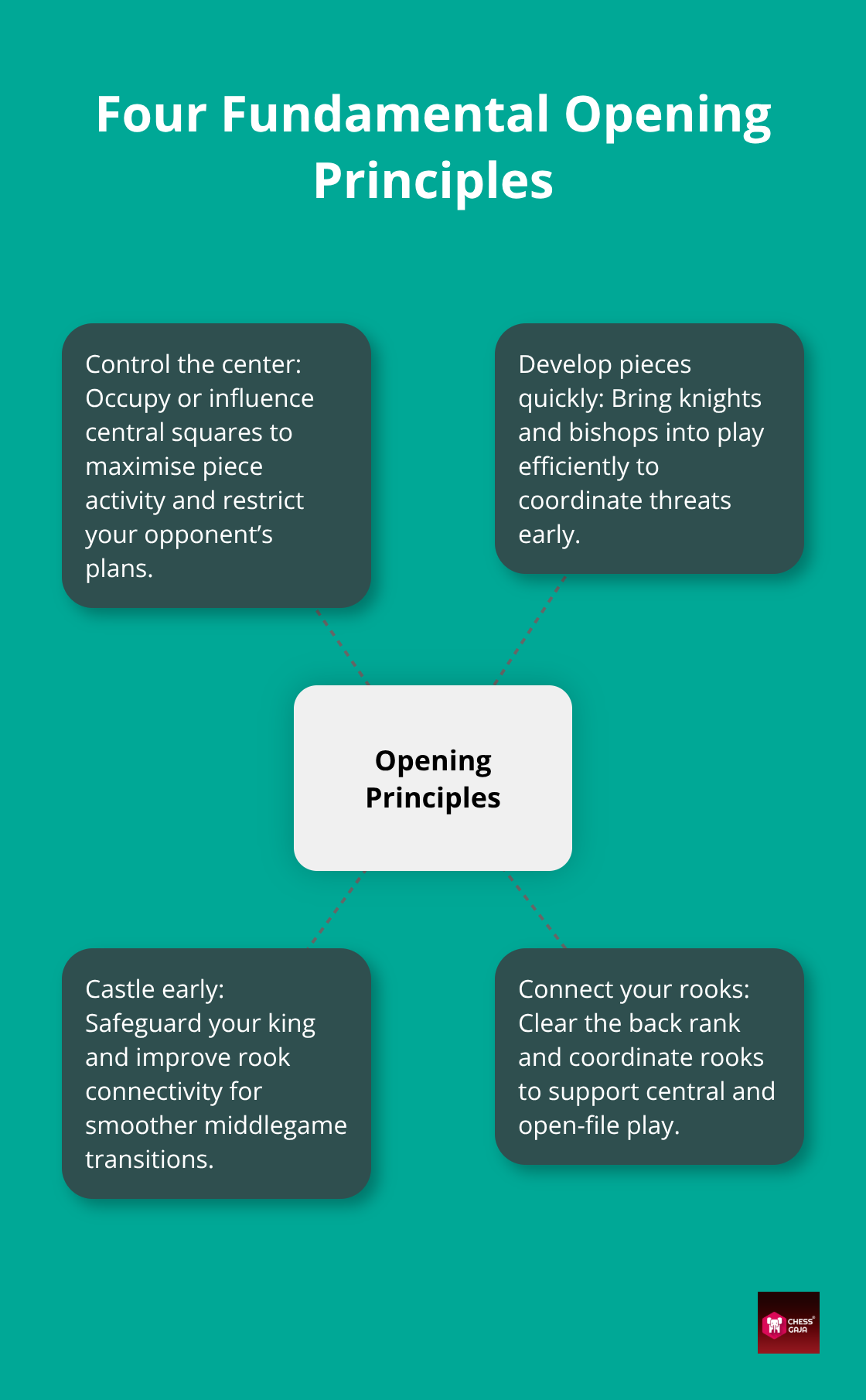
The four fundamental opening principles—control the center, develop pieces quickly, castle early, and connect your rooks—form the essential bedrock.
However, for a complex opening like the Sicilian, you must transition from these basic rules to recognizing specific pawn structures and dynamic counter-attacking plans to make the memorization actually stick.
Focus on Key Opening Principles First
Strong players rated above 1800 typically understand these principles so well they can play decent openings even in unfamiliar positions.
Understanding that 1.e4 controls the center and opens lines explains why it appears in thousands of games. This conceptual understanding is exactly what guides you forward when an opponent inevitably deviates from your memorized lines early in the game.
Statistics reveal that a whole lot of club-level games feature early deviations from main theoretical lines. This makes principled play more valuable than perfect memorization for most players at your level.
When Memorization Becomes Important
Knowing when to deepen your opening memorization becomes a powerful asset once you cross the 1500–1600 threshold.
Below the 1200-1400 level, focus strictly on a classical, principle based opening selection. As you climb toward 1500 and face opponents with deeper theoretical knowledge, building a narrow, well-understood repertoire is exactly what helps you cross the 1600 threshold.
Balancing Understanding with Memory Work
Remembering exact lines must build on solid principles—.studying the Marshall Attack not just to memorize Black’s forcing, aggressive pawn sacrifices, but to understand the overarching goal of seizing a kingside initiative.
Similarly, White players shouldn’t memorize Anti-Marshall moves blindly. They need to understand the slow-burning positional battle. This strategic approach completely sidesteps Black’s forced gambit lines.
Players who combine both approaches show improved performance in tournament games compared to those who rely on either method alone.
The key lies in choosing which lines deserve your memory effort and which positions you can handle through pure principle-based play.
This strategic approach to opening study leads us to the specific techniques that make memorization both efficient and lasting.
Proven Techniques to Memorize Chess Openings
Spaced repetition transforms opening memorization from random drilling into systematic learning. Chessable users who practice openings with spaced repetition have been said to show better retention rates compared to traditional study methods according to the platform’s internal data.
The software presents moves just before you forget them, which creates stronger neural pathways. Set up your opening repertoire in Chessable or similar apps, then dedicate 15-20 minutes daily to review flagged positions.

This method requires discipline but produces results within 4-6 weeks of consistent practice.
Visual Pattern Recognition Through Position Training
Train your brain to recognize key squares and piece configurations rather than memorize isolated moves. Strong players identify patterns instantly—whether it’s the intense tactical piece pressure on the f7-square in sharp lines of the Italian Game, or the concrete e6-d5 pawn structures and locked center typical of the French Defense Advance Variation.
Practice this method when you study master games in your chosen openings, and focus on piece placements and pawn structures that repeat frequently.
Lichess opening explorer shows that players who recognize these visual patterns make faster, more accurate opening decisions.
Spend 10 minutes after each session to examine typical middlegame positions from your openings without pieces in motion.
To use the cognitive science concept of chunking—the ability to group individual pieces of data into familiar, cohesive patterns—stop memorizing isolated square coordinates like 1.Nf3 or 2.d6. Instead, focus on grouping data into familiar, cohesive patterns.
For instance, a Grandmaster doesn’t see four distinct pieces on the kingside; they chunk the typical fianchetto setup as a single cohesive unit: (Pawn g6 + Bishop g7 + King g8 + Rook f8).
How to practice opening chunking:
- Isolate the Pawns: Clear all the pieces off the board on a physical board or digital editor, leaving only the pawn structure of your opening. Memorize the skeleton first.
- Name the Standard Squares: Recognize the anchor squares for your pieces (e.g., in the French Defense, the light-squared bishop’s restriction on c8 or d7 is a structural chunk you must recognize).
When your brain recognizes the ‘chunk’ rather than treating every piece as a separate entity, you drastically reduce your cognitive load, freeing up immediate mental processing power to calculate the actual tactics of the live position.
Once you learn to recognize these structural chunks, you can begin organizing them into a personal, structured digital repertoire.
Building Systematic Opening Trees
Create opening trees that branch from main lines to important variations, and limit depth to positions you actually encounter. ChessBase statistics show that club players face the same opening positions in most of their games.
Start with your main response to 1.e4 or 1.d4, then add one side line per week based on your recent games.
Use a simple folder system with separate files for each major variation (this prevents confusion when you review later).
This targeted approach prevents information overload while ensuring it covers your actual practical needs on the board.
Memory Reinforcement Through Active Practice
Test your ability to memorize chess openings in rapid games where you can apply lines under time pressure.
My personal experience makes me strongly believe that players who regularly practice their openings in rapid format retain move sequences longer than those who only study theory.
Play 5-10 rapid games weekly with focus on your prepared openings, then analyse positions where you deviated from known theory.
This active practice bridges the gap between theoretical knowledge and practical application, but avoid the common mistake of playing too fast to think about the positions you reach.
Common Mistakes That Slow Down Opening Learning
Most players sabotage their opening development when they spread their efforts across too many different systems.
This is exactly what happened to our student. They were trying to juggle the Sicilian, the King’s Indian, and the Grünfeld all at once. This chaotic approach slows down progress. It is far better to master a single opening thoroughly.
When you juggle too many completely unrelated opening systems, you overload your brain with conflicting structural chunks, stalling your memory retention. This explains why narrow, well-understood repertoires produce much better results for developing players climbing toward the 1800–2000 threshold.
The Pitfalls of Over-Memorizing Multiple Openings
Players who scatter their attention across multiple opening systems never develop the deep familiarity that wins games. Tournament data confirms that club players who master the Italian Game completely outperform those who know bits of five different 1.e4 openings.
The Italian Game player recognizes typical piece placements. They understand when to push the d-pawn or route the b1-knight via d2 and f1 to the g3-square, and they know how to handle Black’s main defensive setups. Meanwhile, the player with superficial knowledge of multiple openings struggles when opponents deviate from main lines.
Focus your study on mastering one solid opening against 1.e4 and one against 1.d4 as you build your foundation, gradually expanding your repertoire as you climb toward higher rating milestones.
Neglecting the Strategic Goals Behind the Moves
Players who memorize moves without understanding strategic goals hit walls when opponents deviate from main lines. Students who blindly memorize a 12-move deep line of the Ruy Lopez find themselves completely clueless on move 7 when their opponent plays a random side-line.
Those who play without understanding why White might exchange on c6 early on, or how the structural pawn weaknesses influence the endgame, will struggle in these practical positions.
Transitioning from Memory to Middlegame Plans
Study 3-4 model games for each opening line you memorize, and focus on typical middlegame plans and pawn structures. Strong players know that memorizing 1.e4 e5 2.Nf3 Nc6 3.Bb5 means nothing without understanding the fight for central control and piece development that follows.
Pitfalls When You Memorize Chess Openings Without Testing
The biggest mistake when you try to memorize chess openings involves practicing without a systematic review of mistakes and missed opportunities.
Players who drill opening moves on apps but never analyse their actual games miss critical learning opportunities.
Chess databases show that the average club player repeats the same opening errors across multiple games, yet most never review these patterns.
Set up a simple system where you analyse every opening phase from your games, identify deviations from your preparation, then drill those specific positions the following week.
This targeted approach fixes real problems rather than random theoretical knowledge, and tournament results improve within 2-3 months of consistent application.
Final Thoughts
A sustainable opening repertoire demands patience and systematic practice. Start with one solid opening against 1.e4 and one against 1.d4, then expand gradually as your rating improves.
This focused approach prevents the confusion that derails many players who attempt too much too quickly.
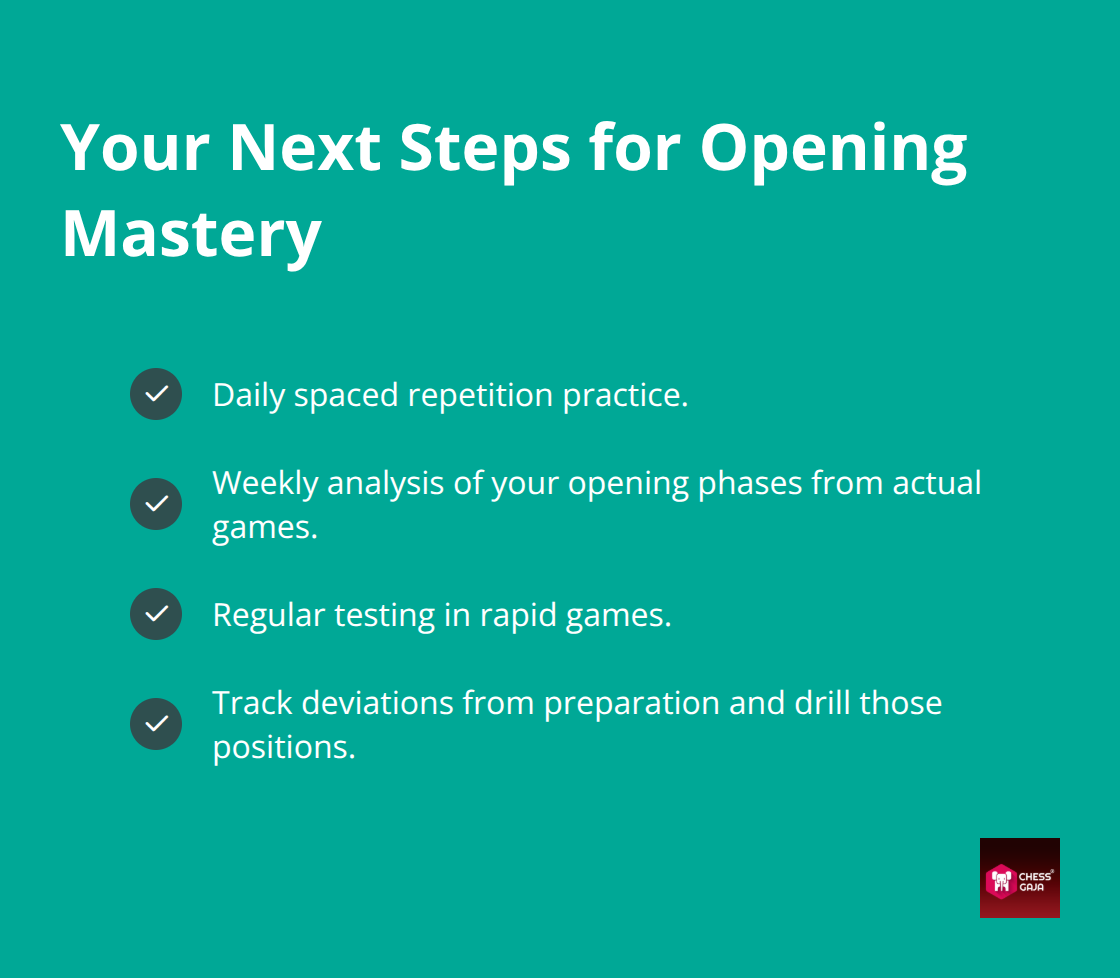
Your next steps should include daily spaced repetition practice, weekly analysis of your opening phases from actual games, and regular testing in rapid games. Track positions where you deviate from preparation and drill those specific scenarios.
This targeted review cycle transforms theoretical knowledge into practical strength.
Players who master chess opening techniques develop pattern recognition skills that improve their entire game.
Strong opening preparation saves time on the clock, builds confidence, and creates favourable middlegame positions (which often determine the outcome of club-level games).
We at Chess Gaja help students develop personalized opening repertoires through detailed game analysis and systematic instruction.