

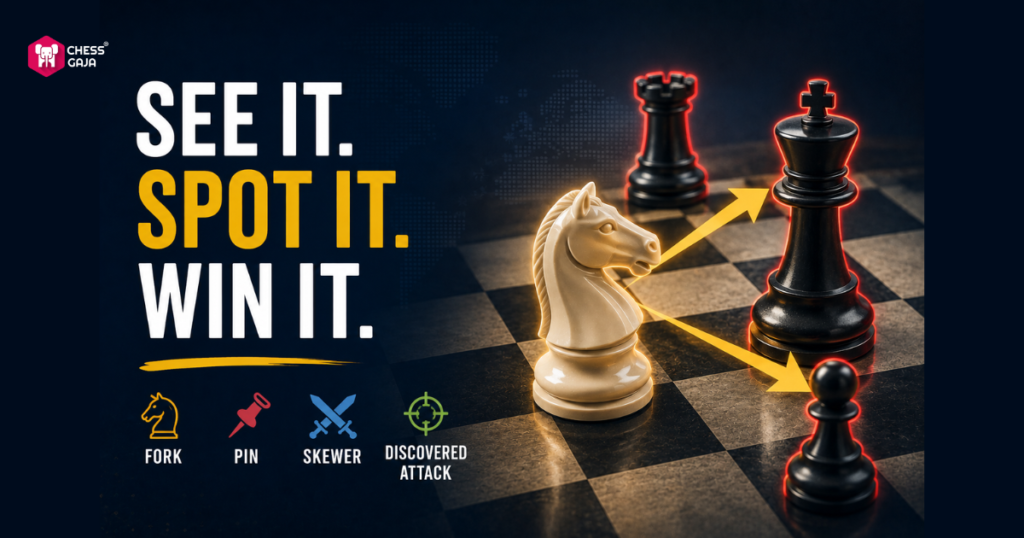
Tactical patterns win chess games. Whether you’re competing in a youth tournament in Singapore, playing in a regional championship in the UAE, or advancing through your school league in the USA, spotting these patterns faster than your opponent is what separates winners from the rest.
At Chess Gaja, we’ve taught common tactical motifs explained to thousands of students across 40+ countries. In this guide, we break down the four patterns that appear most often in real games-and show you exactly how to exploit them.
What Is a Fork and Why It Wins Material Fast
The Fork: Your Fastest Path to Winning Pieces
A fork occurs when one piece attacks two targets simultaneously. Unlike complex tactics requiring setup, a fork is straightforward: move, attack twice, and win material. This is why forks appear in nearly every beginner tournament and why players rated 600–900 miss them constantly. At the 2026 European School Chess Championship in Croatia, coaches tracked under-12 early-round losses. They noted that undefended pieces falling to simple knight or queen forks were among the leading causes of defeat. This pattern repeats across scholastic tournaments in the USA and UAE. Young players focus heavily on their own plans, leaving two targets undefended and losing material in one move.
Why Knights and Queens Fork Most Effectively
The knight fork is the most dangerous because it jumps in an L-shape and is hard to spot. For instance, a knight jumping to c7 can simultaneously check a king on e8 and attack an undefended rook on a8. Queen forks work from any direction—striking two targets simultaneously across different ranks, files, or diagonals. Pawns can also fork, pushing forward in endgames to threaten two targets at once.
Train Your Eye to Spot Forks in Real Time
The key to spotting forks is training your eye to see undefended pieces and target squares. Spend 10 minutes daily scanning positions and asking: where can my knight jump to hit two pieces? Where can my queen move to threaten two targets? Practiced consistently, this habit builds fast pattern recognition under time pressure—often the difference between victory and defeat.
Players who solve fork drills on platforms like Chess.com or Chess Tempo show measurable improvement within weeks. Tournament players in Singapore and the UAE report spotting forks much earlier in games. Once you master the fork, you are ready to learn how pins immobilize your opponent’s most valuable pieces.
How Pins Trap Your Opponent’s Best Pieces
A pin is a silent killer. Unlike a fork that forces an immediate trade, a pin locks a piece in place by making it too costly to move. Move that piece, and you expose a more valuable target behind it-usually your king. This is why pins appear constantly in tournament play and why they’re harder to defend against than most players realize. Match analysis from the 2026 European School Chess Championship showed that sub-1200 players routinely missed pins. In fact, they failed to exploit them in most games where pins occurred.
This stems from a simple issue. Spotting a pin requires seeing two aligned pieces and evaluating what happens when the front piece moves. Young players in the USA, UAE, and Singapore often see the pin but fail to act. They leave it on the board instead of playing forcing follow-up moves.
The Two Types of Pins and Why One Is Stronger
An absolute pin paralyzes a piece completely because moving it exposes the king to check. For example, if your bishop on b5 pins an enemy knight on c6 to the king on e8, that knight cannot move legally. A relative pin is weaker—the piece can move, but doing so exposes a higher-value target behind it.
Relative pins occur far more often in practical play. In an absolute pin, your opponent’s piece sits completely frozen. In a relative pin, you must follow up aggressively before your opponent unpins and escapes. Strong players know that spotting a relative pin is only half the battle; you must immediately create a second threat to force a winning trade.
Creating Pins and Exploiting Them in Real Games
To create a pin, align your bishop, rook, or queen with two target pieces on a file or diagonal. For instance, a bishop on a2 pins an enemy knight on c4 to a rook on f7 along the a2–g8 diagonal. Once established, your opponent faces constant pressure and loses positional flexibility.
After establishing a pin, always ask what second threat you can create. Advance a pawn or bring another piece to pile pressure on the pinned target before it escapes. Coaching at Chess Gaja emphasizes this core principle: spotting a pin is good, but playing a forcing follow-up move is what wins games.
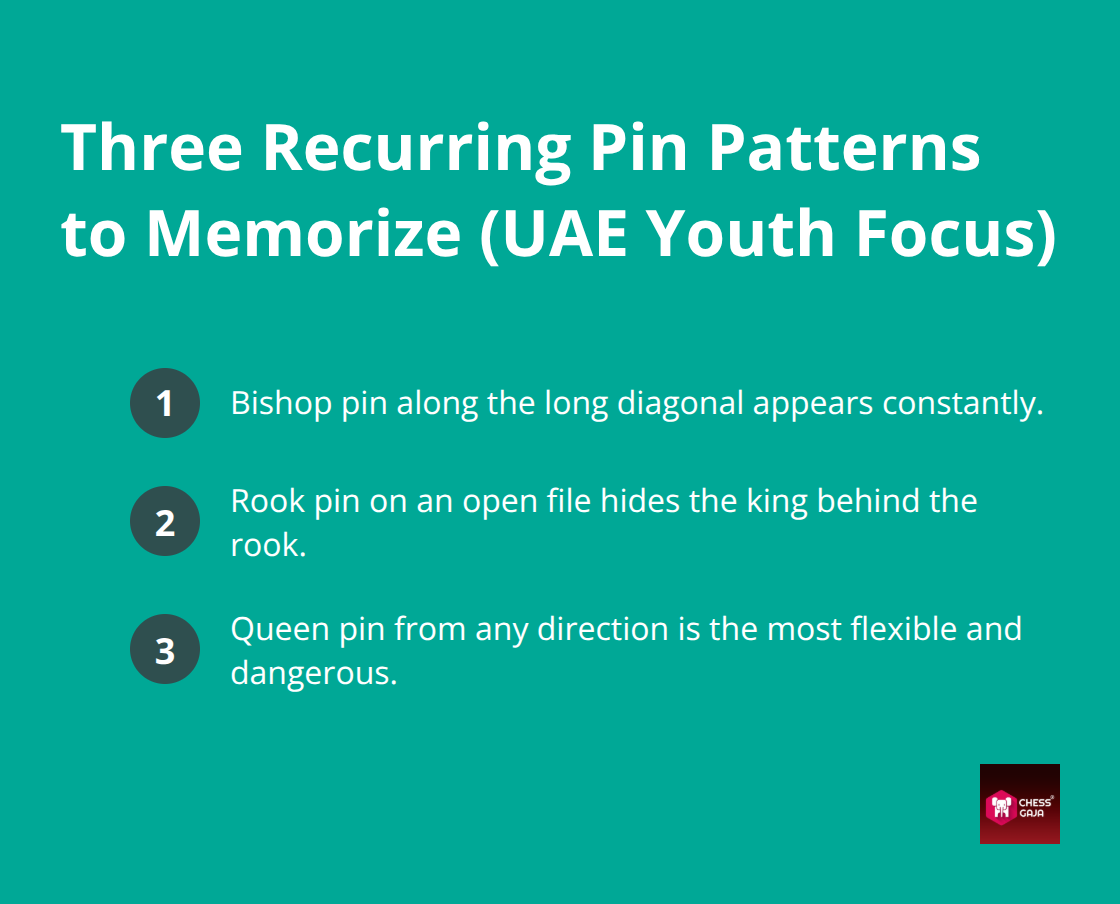
Pin Patterns You Will Face Over and Over
The diagonal bishop pin is one of the most common pins in real games. For example, your opponent’s bishop sits on h5, pinning your knight on f3 to your queen on d1. You will see this pattern dozens of times in tournament play.
Another recurring pin is the rook pin on an open file—such as a White rook on e1 pinning an enemy knight on e5 to the king on e8. Beginners often miss this because they forget the king sits behind it. Queen pins serve as the third major pattern, offering maximum flexibility across ranks, files, and diagonals.
In youth tournaments across the USA and UAE, players rated 700–1000 face these three patterns repeatedly. Build sharp recognition by spending 5 minutes daily scanning pinned positions to identify the target, the piece behind it, and the consequence of moving.
Developing this habit speeds up pin recognition in tournament play where seconds count. Players who practice regularly spot pins two or three moves early, gaining a decisive time and strategic advantage under clock pressure.
Moving Beyond Pins to Discover Tactical Combinations
Once you master pins, you unlock a deeper layer of tactical play. The next motif-the skewer-works like a pin in reverse, and when combined with pins, it creates devastating tactical combinations that your opponent cannot defend against.
Skewers and Discovered Attacks Win Games Faster Than Pins
How Skewers Reverse the Pin
A skewer inverts the pin entirely. Instead of attacking a weaker piece to paralyze a stronger one behind it, you attack a strong piece to force it to move and expose a weaker piece behind it for capture. In a pin, the trapped piece cannot move. In a skewer, the attacked piece must move, allowing you to take what sits behind it. This distinction matters enormously because skewers often win material with no follow-up required.
Players in youth tournaments frequently confuse these two motifs, which costs them wins. For example, a queen on e1 attacking an enemy king on e7 with a queen on e8 behind it is a skewer—the king is forced to step aside, allowing you to capture the queen behind it. By contrast, a bishop on a3 attacking a knight on c5 with the king on e7 behind it is a pin, locking the knight in place because moving it would expose the king to check.
Why Skewers Remain Underutilized in Youth Play
At the 2026 European School Chess Championship, sub-1400 players were far less likely to spot existing skewers compared to pins. Spotting a skewer requires scanning along a direct line to identify a high-value target with a less-defended piece behind it.
Although calculating lines becomes second nature for many young players, they still miss skewers by failing to scan systematically. Because most training focuses heavily on pins, students often develop a noticeable gap in their tactical library. Addressing this gap requires regular practice with skewer-focused puzzles on platforms like Chess.com or Chess Tempo. Spend 10 minutes daily on three or four skewer positions. Focus on identifying the valuable target first, then locate the undefended piece behind it. Players who practice this consistently report spotting skewers two moves earlier than opponents who rely on intuition alone.
Discovered Attacks Create Multiple Threats at Once
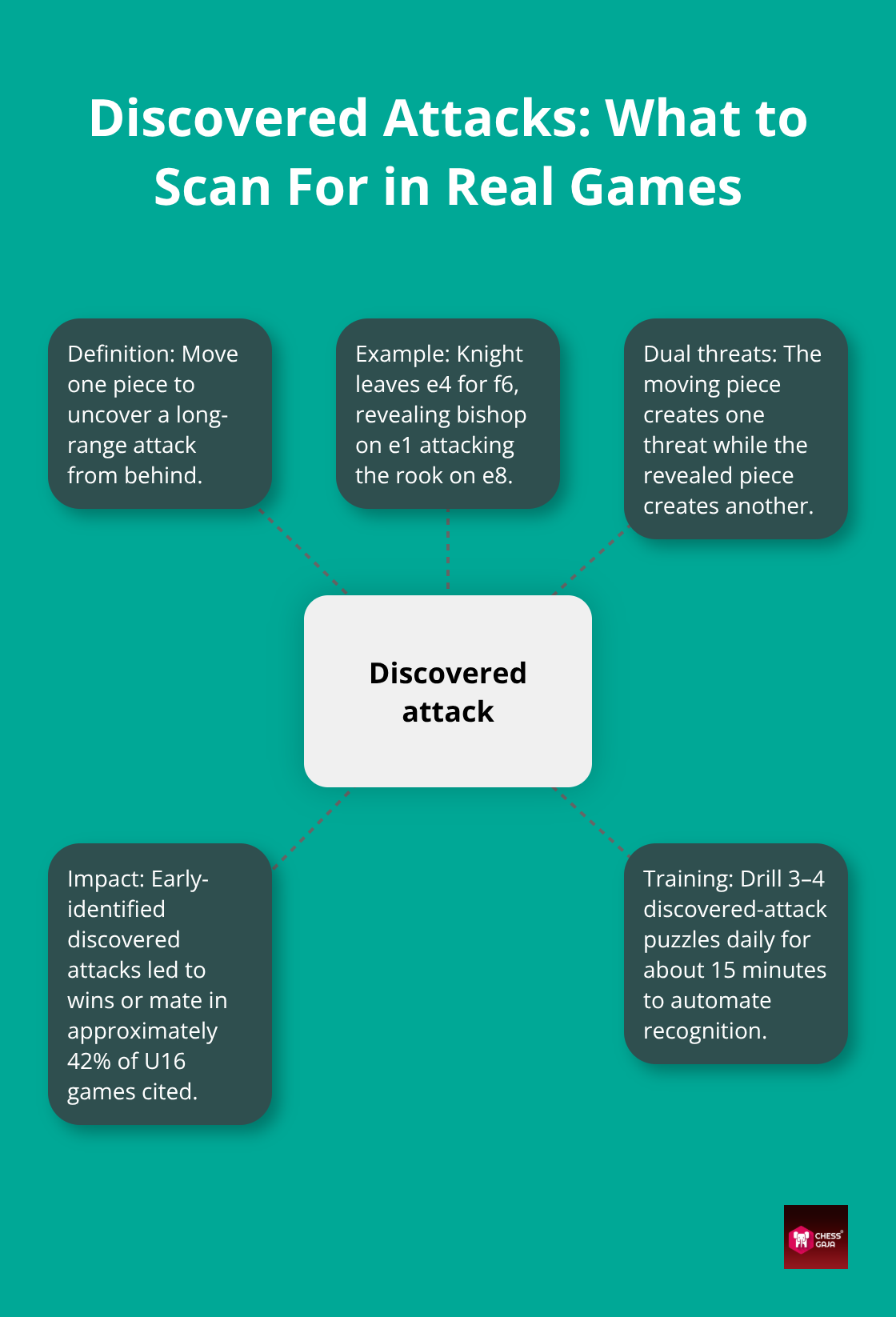
Operating on a completely different principle, this motif creates multiple threats simultaneously and is far more dangerous than a skewer. A discovered attack occurs when moving one piece uncovers a hidden threat behind it. For example, imagine a White rook on e1 and a White knight on e4, lined up against an enemy queen on e8. When the knight jumps to d6 with check, it uncovers a direct attack from the rook onto the queen.
The opponent cannot defend against both threats at once. These combinations are uniquely dangerous because your moving piece creates one threat while the unmasked piece creates another, forming an unstoppable double attack.
At the 2026 FIDE World Youth Championship in Italy, coaches tracked discovered attacks in the under-16 section, noting that spotting the motif early consistently led directly to material gain or checkmate. The same players who missed discovered attacks lost those games decisively.
Training Discovered Attacks for Competitive Advantage
Grandmaster-level coaching emphasizes discovered attacks because they appear constantly in sharp middlegame positions and endgames. To train discovered attacks effectively, solve puzzles where you must move a piece and uncover a devastating attack from behind it. Both Chess Tempo and Chess.com offer extensive discovered attack puzzle sets.
Spend 15 minutes daily on three or four discovered attack positions, focusing on forcing lines where your opponent cannot defend. Players who practice this consistently report winning material faster than opponents relying solely on intuition. In tournament play, this leads directly to shorter games and fewer defensive chances for your opponent.
Combining Skewers and Discovered Attacks Into Tactical Combinations
Combining skewers with discovered attacks makes your tactical toolkit far more dangerous. For example, your rook skewers an enemy queen against a rook behind it. Once the queen moves and you capture the rook, moving your knight on the next turn uncovers a hidden check from your bishop behind it.
These combinations appear frequently at the 1200+ rating level. Train both motifs separately until you recognize them instantly, then practice positions where both appear together. This layered approach accelerates your ability to calculate multi-step winning lines.
Final Thoughts
Spotting tactics in real games requires consistent, deliberate practice. The gap between knowing a pattern and recognizing it under clock pressure is where most players lose games. Solve tactical puzzles for 15 to 20 minutes daily, focusing on one motif at a time. Platforms like Chess.com and Chess Tempo allow you to filter by motif, giving you full control over what you practice while building speed for high-pressure decisions.
Once your puzzle session ends, hop into blitz games to test your recognition under time pressure and build real tournament confidence. Always review your games right after playing to catch missed forks or unexploited pins, logging every error to review the next day. Dedicated students across the USA, UAE, and Singapore combine daily puzzles with game analysis. As a result, they spot tactics much faster and routinely turn draws into wins.
Our Grandmaster-led coaching at Chess Gaja integrates tactical training into every session with personalized study schedules that match your rating and goals. Book a Paid Starter Class with us to receive a professional skill evaluation and a customized tactical training plan designed for your competitive level.