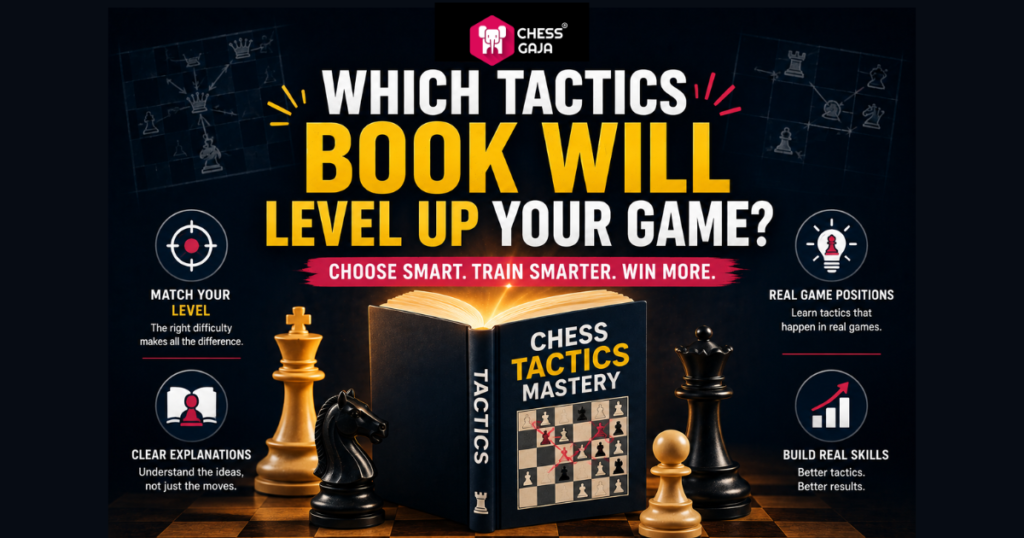
Picking the wrong chess tactics book wastes months of your study time. At Chess Gaja, we’ve seen students struggle because they chose books that were either too basic or impossibly difficult. Finding the right resource can greatly enhance your understanding of the game. Selecting the best chess books by grand masters can provide insights that elevate your strategy and tactics. These titles often include detailed analysis of famous games, making them invaluable for serious players looking to improve their skills.
The right tactics book matches your skill level, teaches clearly, and gives you puzzles you can actually use in your games. This guide shows you exactly what to look for.
What Separates Good Tactics Books From Wasted Money
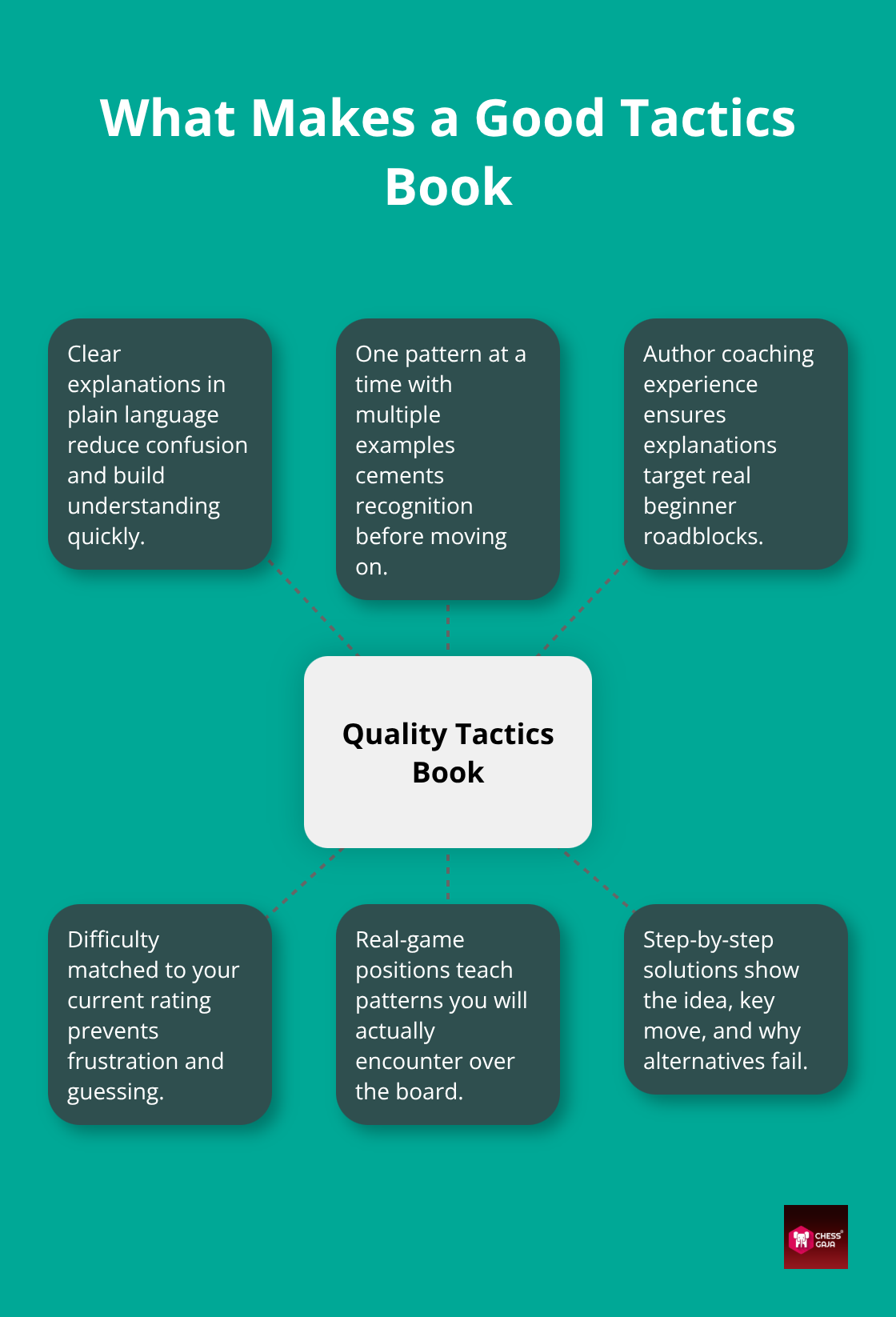
A tactics book must explain moves clearly. Many authors assume you know advanced concepts before explaining the basics. Jumping straight into notation without showing a pin in a real position leads to confusion. The best books teach one tactical pattern at a time with clear examples.
Look for authors with deep coaching experience. Susan Polgar and GM Murray Chandler write for beginners learning core tactics. In contrast, Yakov Neishtadt focuses on intermediate and advanced calculation depth (1600+ FIDE).
Check the table of contents and read a sample chapter before buying. If the explanations feel rushed or skip steps, the book will slow you down instead of speed you up.
Difficulty Must Match Your Current Rating
A book rated above 1600 FIDE will frustrate an 1100 player online. Likewise, a beginner book wastes the time of a 1500-rated player. Keep in mind that online ratings differ from official FIDE or USCF standards. Traditional chess books base their difficulty on official FIDE standards.
Maksim Blokh’s Combinative Motifs organizes over 1,200 core positions by difficulty level and motif. This structure helps you start at the right tier. If you are around 1100 Rapid on Chess.com (or ~1400 on Lichess), pick books targeted at the 900–1200 FIDE range. Doing so ensures puzzle complexity matches your visualization capacity. After three months of practice, move to the next tier.
Real Puzzles Beat Theoretical Positions
A great tactics book uses real game positions. Every puzzle needs clear solutions explaining why a line wins. Solutions must also explain why alternative defenses and sidelines fail. Without verbal reasoning, students memorize lines instead of evaluating candidate moves and calculating variations. Susan Polgar’s books build visual accuracy for beginners. Yakov Neishtadt’s problem sets train deep calculation for intermediate players (1600+ FIDE). Study thematic books first before tackling mixed tests.
Author Credentials Matter More Than You Think
An author with coaching experience structures material differently than an active tournament player writing for an elite audience. Experienced coaches anticipate where club players lose the thread. They break down critical candidate moves clearly. When evaluating a book, check the author’s coaching background alongside their FIDE title. A book written by an experienced FIDE Trainer offers far clearer explanations than one compiled purely for entertainment.
What to Actually Check Before You Buy
Coaching Experience Trumps Tournament Rating
Coaching experience beats tournament rating every time. A coach who has taught hundreds of students knows exactly where beginners get stuck. A 2700-rated Grandmaster who never taught might skip key steps. Basic concepts feel too obvious to them.
When you research an author, look for their coaching background first, then their playing strength. Authors like Susan Polgar work well for beginners because she understands core pattern confusion. Works by Yakov Neishtadt reflect decades of structured instruction for club players.
Check an author’s background on their publisher’s site or coach profile. If an author has no teaching history listed, that is a red flag. The best books come from coaches who know how to explain tactical motifs in plain language.
Puzzle Diversity Beats Raw Quantity
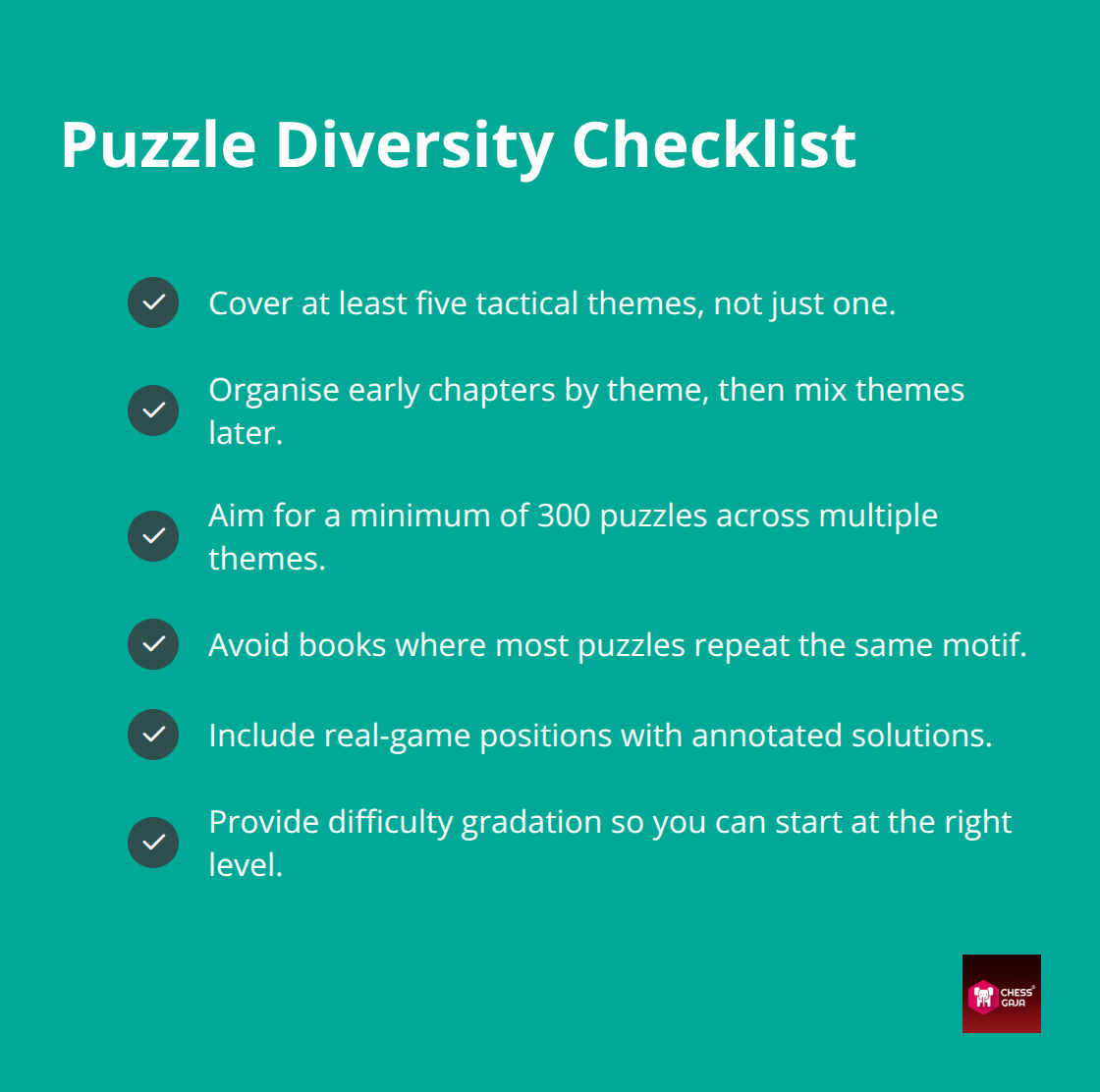
Puzzle diversity matters far more than sheer quantity. A book with 500 puzzles where 400 are pins teaches you pins well but leaves you unprepared for the mixed positions you face in real games.
Players improve fastest when they practice puzzles covering diverse tactical themes before mixing them in random order. Choose books that organize puzzles by theme first. Look for core patterns like pins, forks, skewers, deflections, decoys, and in-between moves (Zwischenzüge). Once you master each pattern thoroughly, practice books that mix them in random tests. Missing an in-between move is one of the most common reasons club players blunder tactics.
Maksim Blokh’s Combinative Motifs includes over 1,200 core positions meticulously organized by difficulty and tactical motif.
When you read reviews on Chess.com or New in Chess, ask whether the puzzles feel repetitive or genuinely varied. Repetition teaches one pattern; variety teaches you to recognize which pattern applies in each new position.
Solutions Separate Skill-Building From Wasted Time
Solutions separate books that build real skill from books that waste your time. A solution with only the winning move teaches you very little. Great solutions explain the main idea in one sentence. They show the winning line and explain why other defenses fail.
The best solutions explain the key idea in one sentence. They show the winning line and clarify why defensive sidelines fail. This approach teaches you how to calculate moves step-by-step.
Read three random puzzle solutions before buying a book. If solutions skip steps, the book will frustrate you. If they walk through calculations methodically, you found a great resource.
Polgar and Neishtadt both provide clear solutions consistently. Poor solutions cause beginners to memorize positions. In contrast, good solutions develop real tactical vision.
Next, learn how to use your tactics book effectively. Structure your practice so puzzles transfer directly to your games.
Making Your Tactics Practice Actually Work
Owning the right tactics book means nothing without consistent practice. The fastest-improving players do not read the thickest books. Instead, they solve puzzles on a strict daily schedule.
Set a daily practice window of 30 to 45 minutes, five days per week. This timeframe builds pattern recognition without burnout. Puzzle timing depends on your focus. For basic pattern recognition, spend 1 to 3 minutes per position. For deep calculation, spend 5 to 8 minutes generating candidate moves and calculating their forcing lines before checking the solution. Calculating five positions deeply beats racing through 20 puzzles with guessing.
Time Yourself and Build Tournament Pressure
Time yourself during practice, just as you would in a tournament. This pressure teaches your brain to calculate under stress, which directly transfers to your games. After you solve each puzzle, read the full solution even if you found the right move.
Many players skip this step because they think finding the key move is enough. However, you must understand why alternatives fail. This reasoning process separates tactical skill from guessing.
Track Your Weaknesses and Adjust Difficulty
Track which themes give you trouble. If you miss pins, spend extra sessions on them until they feel automatic. Adjust difficulty benchmarks based on your specific goals:
- Pattern Building (Speed & Intuition): Aim to solve almost every puzzle correctly with minimal effort. High consistency helps your brain store clear tactical patterns, allowing you to spot them instantly in rapid games.
- Deep Calculation: Aim to solve roughly half to two-thirds of the positions correctly. Studying at this level stretches your visual limits and builds calculation stamina. Solving almost all deep calculation puzzles effortlessly means they are too easy to grow your rating.
Combine Book Puzzles With Online Training
A common mistake is treating book puzzles and online trainers as isolated methods. In reality, they serve two distinct roles.
Books excel at themed pattern storage and screen-free calculation endurance. They prevent the urge to guess moves. Meanwhile, online platforms excel at testing unannounced motifs under timed conditions.
Combine both methods effectively. Use your book for deep thematic study during main sessions. Then, use online mixed tactics as a daily 10-minute warm-up to test instant pattern recognition under game pressure.
Connect Puzzle Training to Your Real Games
The final step is game review. After each week of puzzle practice, analyze one of your own games. Look for moments where you missed a tactic or played a weak move. Find the exact point where tactical awareness changes the outcome. Connecting puzzle training to real games makes study matter. Without this step, you are just solving puzzles for fun. Your tactics book delivers results only when you apply what you learn in actual matches.
Final Thoughts
Choosing the right chess tactics book comes down to three decisions. First, match the difficulty to your FIDE or USCF rating. Second, pick an author with real coaching experience. Finally, choose books with solutions that explain the reasoning behind moves, not just raw notation lists.
Tactics training forms the backbone of chess improvement under 2000 FIDE. The key to mastery is spaced repetition. Finish your tactics book once, then solve it a second time at double speed. Do this before moving to a harder tier. This locks patterns into your memory. Soon, pins, forks, and double attacks will become second nature in your games.
Need help selecting the right tactics book for your level? Chess Gaja offers a free Level Check to assess your current strength and recommend a tailored study plan. Our FIDE-rated coaches have trained over 5,000 students across 40+ countries. Book a Starter Class today to get a professional skill evaluation and a customized roadmap for your chess development.