

You’ve hit a plateau in your games, and you know something’s missing. The difference between average players and strong ones isn’t luck-it’s mastery of positions, tactics, and endgames.
We at Chess Gaja have coached thousands of students through this exact transition. This guide breaks down the advanced tips for chess that separate competitive players from the rest, with step-by-step lessons you can apply immediately.
Position Your Pieces Where They Matter Most
Not All Squares Are Equal
Positional mastery starts with a simple rule: not all squares carry equal weight. A knight on the rim stays weak. However, an idealized central knight on d5—an outpost—controls up to eight key squares and severely restricts your opponent’s activity.
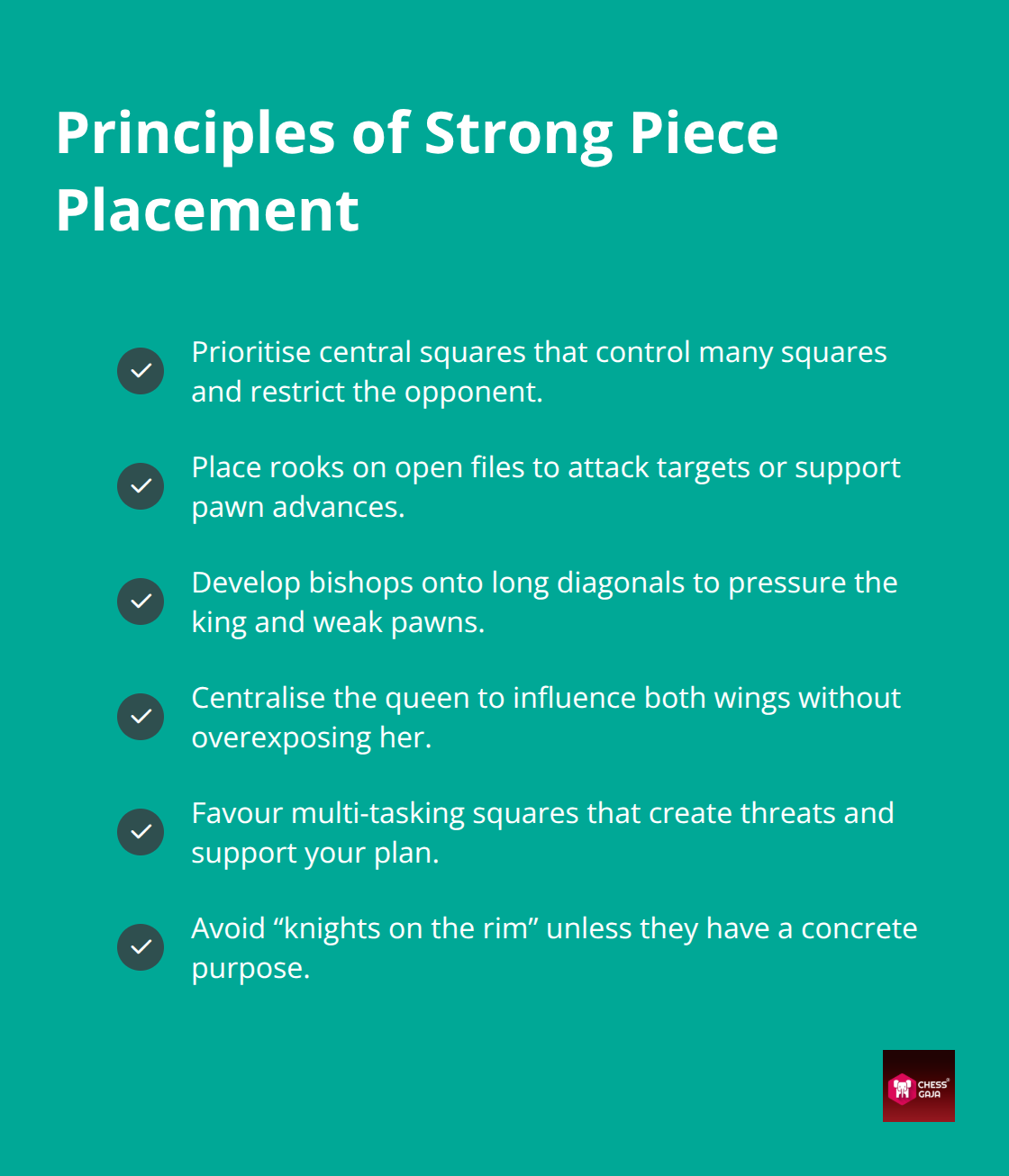
The difference between a 1400 and a 2000-rated player comes down to multi-purpose placement. Stronger players select squares that handle multiple jobs at once:
- Rooks belong on open or semi-open files, and ideally on the 7th rank (2nd rank for Black) to attack pawns and cut off the enemy king.
- Bishops thrive on long, open diagonals where they can pressure weak pawns or target the enemy king’s shelter.
- Queens dominate from centralized, safe squares where they cannot be harassed by minor pieces or enemy pawns.
This is not abstract theory. Instead, it is about square control that wins material or forces passive defense.
When evaluating a move, ask if your piece serves a clear plan. A move that advances one square without doing anything else is rarely best.
How Strong Players Think About Piece Placement
In tournament play, players rated above 1800 spend time ensuring every piece has a job. They do not move pieces randomly. Instead, they position them on squares that create threats, support teammates, or control critical territory.
The central squares—d4, e4, d5, and e5—matter because pieces stationed there influence both flanks. However, the center is not always the best square for every piece on every turn.
In rook endgames, controlling key squares near the opponent’s king often decides the outcome.
Consider the classic games of World Champion Anatoly Karpov. As a master of outpost strategy, Karpov routinely secured central knight outposts on d5 or e5. He fixed his opponent’s pawn weaknesses first, suffocated their piece activity, and smoothly converted positional edges into wins.
Identifying and Exploiting Weak Squares
For instance, suppose White advances both their c-pawn and e-pawn to the fourth rank (c4 and e4). Because pawns cannot move backward, the d4-square can no longer be defended by White’s pawns. This makes d4 a permanent, unguardable outpost for Black’s pieces.
Similarly, when Black advances their g-pawn (e.g., g6), the f6 and h6 squares permanently lose pawn protection, creating dark-square weaknesses around the king. These holes become prime targets for your knights and queen. These weaknesses are permanent because pawn moves cannot be undone. These weaknesses don’t exist by accident-they’re created by pawn moves that can’t be undone.
Once you find a weak square, occupy it fast. A knight on a central outpost is hard to remove without an opposing bishop or pawns to attack it.
Likewise, an active rook on the seventh rank gives huge positional value. It ties down enemy pieces and traps the king.
Building Your Weak-Square Recognition Habit
The practical skill here is recognizing these patterns in your own games. After each loss, review the final position carefully. Ask where your opponent’s pieces dominated the board. Where did they land pieces that you could not challenge?
That square was likely a weak point in your structure. Your opponent simply recognized it first and exploited it.
In your next game, identify your opponent’s weak squares before move 15 and build a plan around occupying them. This single habit-finding one weak square and placing one piece there-raises your rating faster than memorizing opening theory. Once you master piece placement and weak-square exploitation, you’re ready to sharpen your tactical vision and spot the combinations that turn positional advantages into wins.
Turning Weak Squares Into Tactical Wins
Positional advantages mean nothing without concrete gains.
When you occupy a weak square, your opponent faces heavy pressure. A knight on d5 creates immediate threats like forks, pins, and discoveries. Pressure forces defensive errors, and calculation finishes the game.
Calculate Forcing Moves First
Players rated above 1600 recognize that weak squares trigger forcing sequences. These moves limit your opponent’s options.
Look three to five moves ahead in forcing lines. Identify which enemy pieces carry too many defensive duties. This tells you whether to strike immediately or maintain pressure.
Stronger players do not see more moves. They simply calculate the right moves—the ones that matter most.
Do you have an outpost knight while the enemy king lacks luft (escape squares)? First, look for direct checks and mate threats.
Next, look for forcing captures. A sharp check forces an immediate response. Therefore, it restricts enemy choices and keeps your calculation simple.
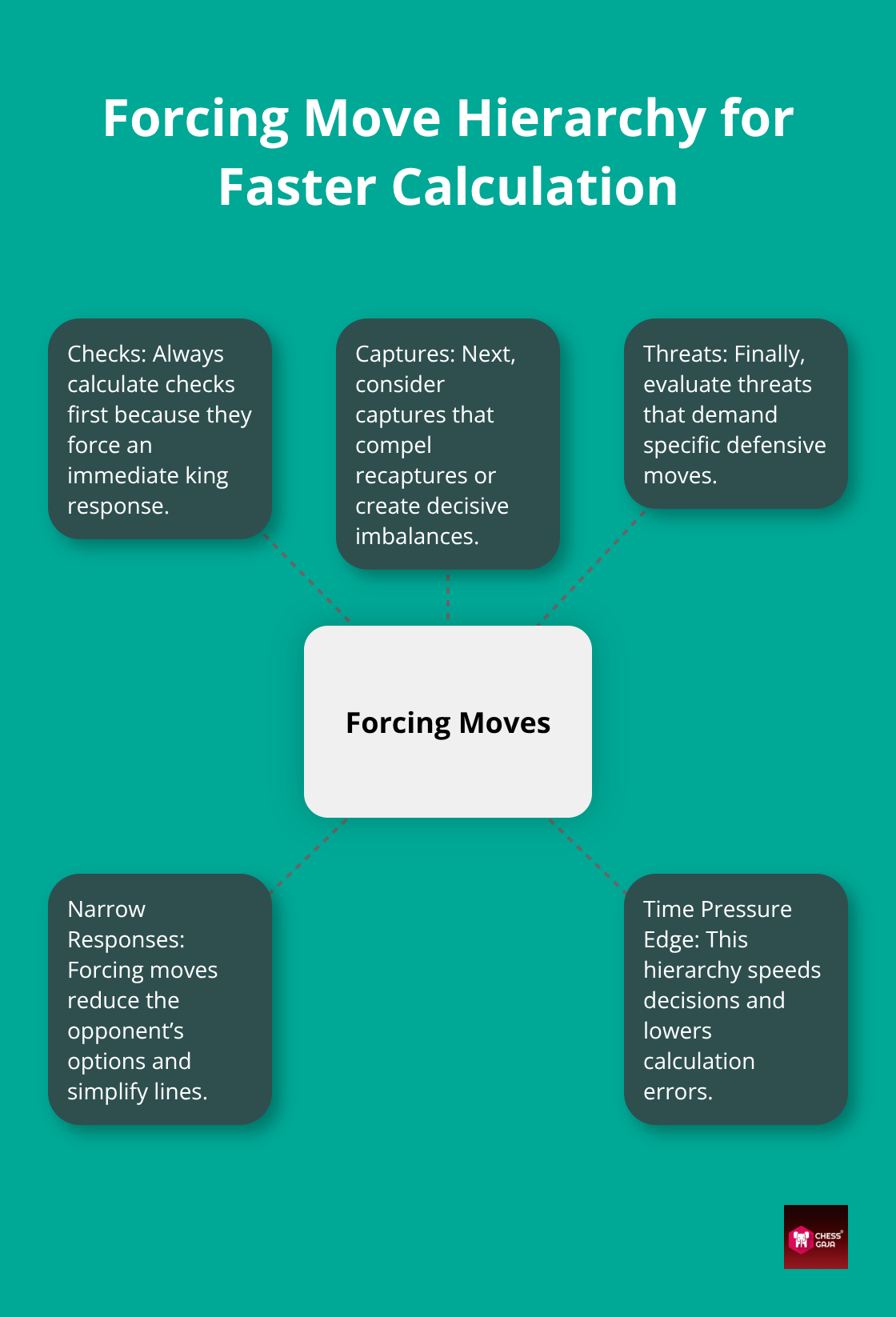
In tournament games across the USA, rated players consistently report that focusing on forcing moves-checks first, then captures, then threats-reduces calculation errors and speeds up decision-making under time pressure.
The Three-Move Calculation Rule
Club-level tactics often come from outposts. For instance, a central knight outpost on d5 controls the c7 and f6 squares, creating immediate threats to jump into c7 for a devastating king-and-rook fork or f6 to shatter the pawn structure.
The process is simple and systematic. Evaluate a weak square before occupying it. Ask yourself: does this square lead to an immediate tactic, or does it permanently restrict enemy pieces?
An outpost without an immediate 3-move combination can still win the game. It squeezes your opponent’s space and forces passive defense until a tactical opening appears.
Coaches emphasize this calculation discipline to stop players from wasting moves.
Overall, the winning approach pairs position with tactics. Find weak squares first. Then, verify that they create real tactical shots before moving pieces.
Spot What Your Opponent Leaves Undefended
Opponents miss tactics when they stop looking. They focus on their own plans—advancing pawns or moving rooks—and ignore your threats.
Combine a seventh-rank rook with a long-diagonal bishop. This creates mate threats, discoveries, and skewers. Therefore, your opponent must defend or lose material.
Spotting hidden tactics starts with one question after every move: “What did this move leave undefended?”
Suppose your opponent moves a rook to support a pawn. The square it left behind loses its main defender.
Check if this leaves back-rank pieces exposed. Look for new tactical targets on the board.
Take ten seconds after every move. Scan for undefended pieces, weak back ranks, and overloaded defenders.
Exploit Overloaded Defenders
An overloaded piece guards two targets at once.
Suppose a knight protects both a rook and a king escape square. Attack either target, and the knight must abandon the other.
Force the defender to move to win material or start a mate attack. Scanning for overloaded pieces catches tactics that opponents overlook.
Executing tactics under time pressure requires calm decision-making.
Once you gain a tactical edge, convert it in the endgame. In simplified positions, a single tempo or active king decides the outcome.
Where Endgames Win or Lose Your Rating
The Endgame Separates Strong Players From Memorizers
The endgame separates real understanding from memorized openings. You can outplay an opponent for 30 moves and still lose. This happens when players ignore basic king moves and pawn rules.
Strong tactical players lose to solid endgame technique. This happens because they skip the fundamentals.
King and pawn endgames seem simple.
However, they demand precise calculation. Without a doubt, one lost square turns a winning game into a loss. In fact, having the opposition or placing your king one square closer to a key square frequently decides the entire outcome.
Rook Endgames Reward Active Pieces
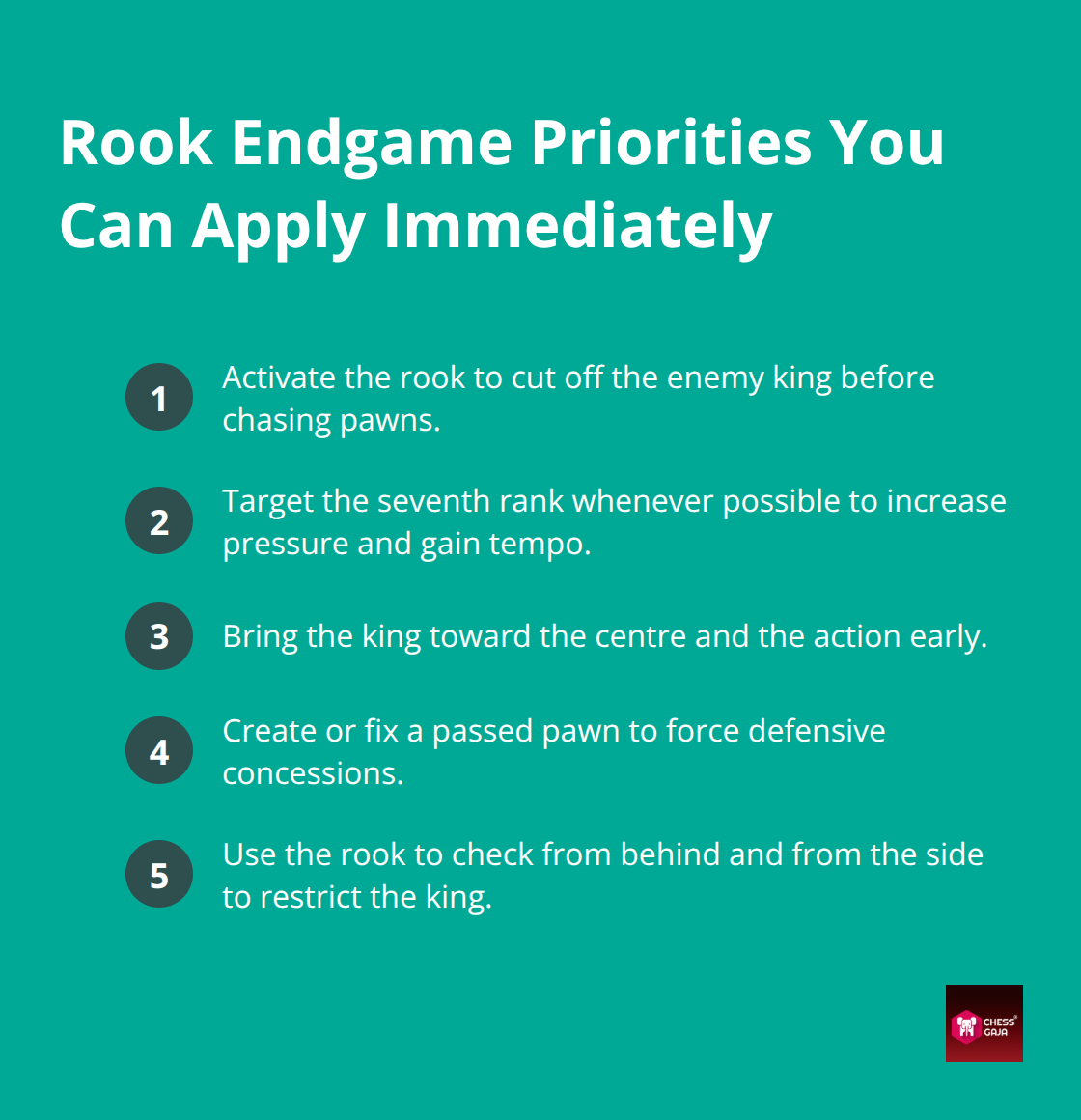
In rook endgames, piece activity is paramount. Specifically, an active rook cuts off the enemy king and attacks weak pawns. As a result, it ties down enemy pieces to defensive duties, restricting their mobility and often forcing passive responses.
For example, players under 1800 often misjudge these positions because they focus purely on pawn count. However, an active rook on the 7th rank easily makes up for a missing pawn.
The difference between a 1600 and a 2000-rated player is simple. The stronger player knows when to activate their king, push pawns, and create unstoppable passed pawns.
Always study your endgame losses. Did you move your king passively? Did you let the enemy rook dominate? Or did you miss a chance to create a passed pawn?
Endgame technique turns simplified positions into clean wins. Players who master essential rook patterns convert winning positions into real victories instead of accidental draws.
Assess Material and King Placement First
Apply this knowledge in your games without delay.
First, count the material. Then, check if you have a winning advantage, a draw, or a lost game. Material count alone does not decide endgames.
For example, a Rook and 2 pawns versus a Rook and 3 pawns on the same side of the board is frequently a theoretical draw, provided the defender maintains an active rook and cuts off the enemy king.
Next, assess king activity carefully. Is your opponent’s king active or passive? In addition, do passed pawns exist?
Above all, active king placement wins endgames.
Imagine your king actively centralized on e4 supporting passed pawns while the enemy king is trapped passively on the back rank. Your king dominates the board and guarantees a smooth pawn promotion.
Push pawns aggressively when your king is active. Do not waste moves. In rook endgames, the player who activates their king first wins most of the time.
Create Passed Pawns to Force Decisions
Do you have a rook endgame with no passed pawns? First, create one fast. Then, advance pawns on one side until your opponent must block them.
Next, shift your king and rook to attack the opposite flank. This simple distraction wins endgames that seem tied.
The endgame merges tactics and positional understanding into concrete results. Weak squares disappear, tactical opportunities turn into pawn promotions, and mistakes become irreversible. With fewer pieces on the board, poor play cannot be hidden.
Final Thoughts
These advanced chess tips work best when applied consistently in real games. Positional mastery, tactical calculation, and endgame technique function as one connected system.
A weak square means nothing without a tactical follow-up. Likewise, a tactical win fails if you mishandle the resulting endgame.
Players who gain rating points fastest practice all three elements together. Crucially, they analyze their losses within 24 hours while positions stay fresh in their minds.
Professional guidance accelerates your progress dramatically. At Chess Gaja, our FIDE-rated coaches analyze your games to provide targeted feedback tailored to your goals.
Our students gain 100–200 rating points within three months. Instead of studying alone, they follow a clear roadmap under Grandmaster Priyadharshan Kannappan’s expert framework.
Book a Paid Starter Class with us to receive a professional skill evaluation. Our coaches will analyze your recent games, identify your biggest gaps in positional understanding, tactical vision, and endgame technique, and create a focused plan to address them.