


The middle game is where most chess players lose their games. You spot a tactic too late, miss a defensive resource, or simply don’t see the pattern unfolding on the board.
At Chess Gaja, we’ve coached thousands of students through this exact struggle. The good news: chess middle game tactics follow predictable patterns that you can learn and apply immediately.
Understanding the Core Principles of Middle Game Tactics
When Does the Middle Game Actually Start
The middle game doesn’t announce itself. Most players wait for a clear signal when the opening ends and tactics begin. However, chess transitions happen gradually.
Recognizing this shift matters because your strategic goals change immediately. The middle game starts once both players finish developing their pieces. At this stage, following memorized theory gives way to finding concrete moves based on the exact board setup.
While classical setups transition around moves 12 to 16, sharp tactical openings like the Sicilian Defense can launch into tactical battles by move 8.
A youth tournament player from Singapore told us that identifying this transition helped her stop playing on autopilot and start thinking independently.
Weak Squares and Piece Placement Win Games
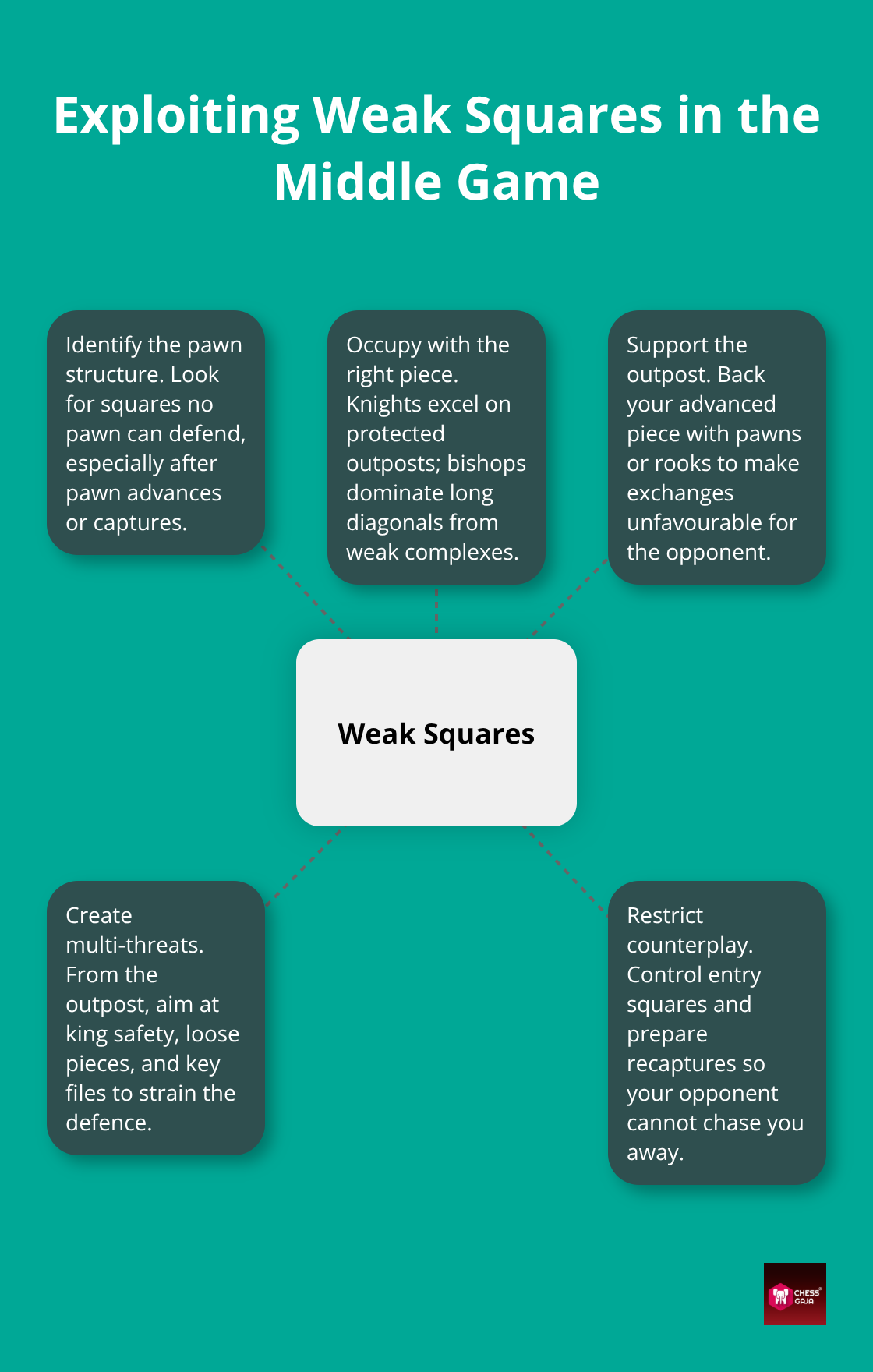
Weak squares are empty board spaces that enemy pawns can no longer defend. A square becomes weak when the pawn that guarded it advances or gets captured.
These squares become permanent outposts for your attacking pieces. For instance, if your opponent pushes pawns to e4 and g4 without an f-pawn, the f4 square becomes permanently weak.
Placing a Knight or Bishop on f4 creates a dominant outpost that pawns cannot challenge. Top players constantly hunt for weak squares because anchored pieces drain enemy positions.
In UAE tournaments, players who occupied weak squares won far more often. Place pieces on squares your opponent cannot attack to win key games.
Tempo and Initiative Determine Who Attacks
Tempo refers to the number of moves needed to execute a plan. Initiative means making direct threats that force your opponent to defend rather than attack.
In practical games, initiative dictates who controls the board. When you create threats, your opponent wastes time defending instead of improving their setup.
Tournament players in the USA often underestimate how valuable the initiative is once development finishes. You can sacrifice material temporarily to seize control, provided your threats remain direct and forcing.
Vague attacks that your opponent can ignore will not help you win. Strong tactical players create multiple threats at once so the opponent cannot defend everything.
Essential Tactical Patterns Every Player Should Know
Forks, Pins, and Skewers Create Immediate Threats
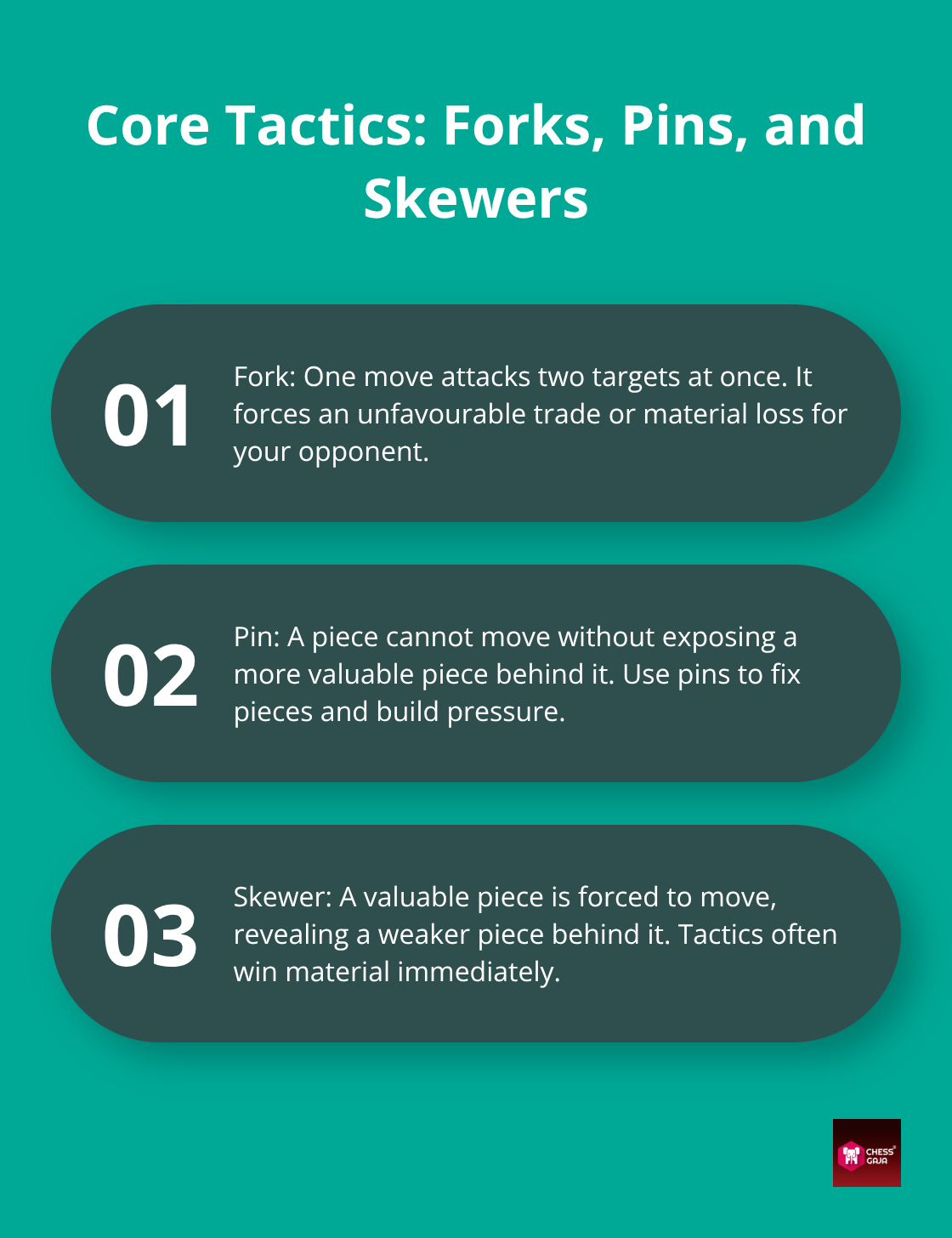
Forks, pins, and skewers use simple piece alignment to trap enemy forces. A fork occurs when a single piece attacks two or more enemy targets simultaneously. A pin restricts a piece from moving because doing so would expose a more valuable piece—or the King—behind it.
These patterns appear constantly in tournament play, and recognizing them separates competitive players from casual ones.
In scholastic games, players who spot forks and pins quickly win far more often. The real skill is not learning these ideas on paper. You must train your eyes to spot them on the board.
When you review your games, mark every missed fork, pin, and skewer. Ten games of focused review will boost your vision. Consistent tactical training builds ratings much faster than memorizing opening theory.
Discovered Attacks and Double Attacks Multiply Your Power
Discovered attacks and double attacks double your attacking power. A double attack happens when one move creates two threats.
A discovered attack is a type of double attack. You move one piece to create a threat while unmasking a line-of-sight piece (such as a Rook, Bishop, or Queen) behind it.
Your opponent can only defend against one threat per turn. Thus, these moves win material quickly.
Players who use double attacks in the middle game win far more often than those who play passively.
Success comes down to timing: identify the exact moment an attack breaks through, then strike with calculation rather than hope.
Sacrifice Patterns Break Through Defensive Walls
Tactical sacrifices break enemy pawn walls or remove key defenders. You give up material briefly to launch a direct attack or force checkmate.
Unlike positional sacrifices, tactical sacrifices need exact calculation. If your follow-up moves lack forcing power, you simply lose material.
Study annotated master games to see when a sacrifice breaks through. Timing matters as much as the move itself.
Pattern recognition paired with calculation separates strong players from weaker ones. Once you know these patterns, you can apply them in real games before your opponent spots the same chances.
Applying Tactics Through Real Game Analysis
Study Tournament Games at the Right Level
Studying real tournament games is the fastest way to improve your middle game. Master games show you when the attack shifts and how top players calculate tactics.
Study games between 1600–2000 players or classics from Paul Morphy and Capablanca. Avoid complex modern Super-GM battles.
In classical master games, tactical themes remain clear and mistakes are instructive. You can easily grasp the logical flow of the attack without relying on a computer engine.
Pick one game each week and work through it on a real board. Note down key moments before checking engine evaluations.
This method trains your brain to spot patterns faster. Analyzing one game weekly builds vision much faster than solving monthly puzzles. It connects tactics directly to real game decisions.
Recognize When Tactical Opportunities Expire
Tactical opportunities have a lifespan. A weak square exists only until your opponent either defends it or you occupy it. A pin lasts only until the pinned piece moves or you capture it. Initiative evaporates once your opponent creates counter-threats you must address.
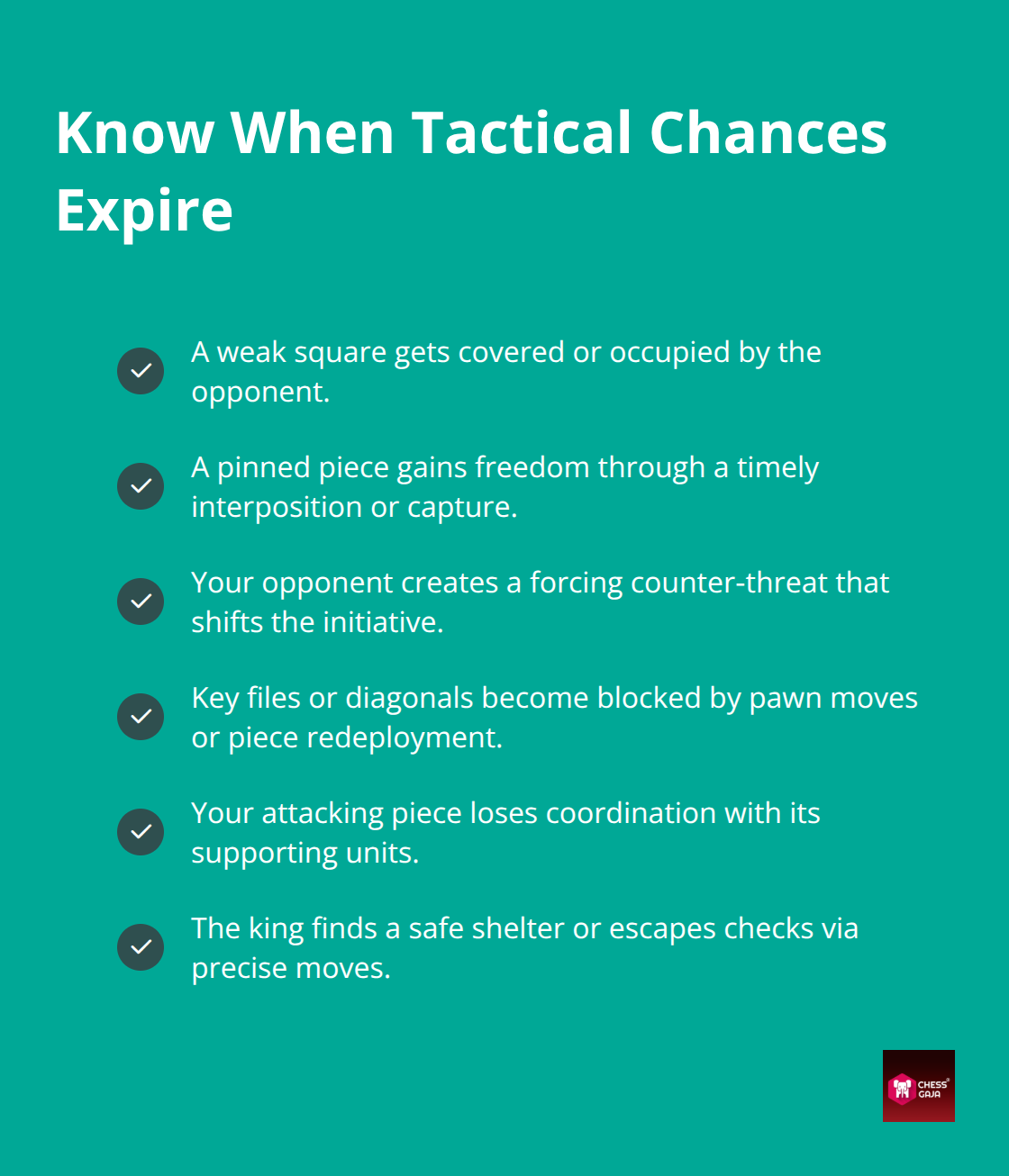
This is why timing separates strong players from weak ones. A move that wins material on move 18 might be useless on move 20 because your opponent’s position has changed.
In scholastic tournaments across Singapore and the UAE, strong players track when tactics expire. They avoid executing a planned move if the board shifted earlier.
When you review your games, mark the exact moment a tactical chance closed. Note if a weak square became defended or if a pin broke.
Act Decisively Before Conditions Change
Act decisively when conditions favor your attack. Strong players move fast because hesitation turns winning positions into equal ones.
Review your next five games for three critical tactical moments. Check whether you struck immediately or allowed a defensive move.
Final Thoughts
Tactical mastery boosts your rating faster than any other skill. Focused middle game study helps players gain 200–300 rating points quickly.
Tactics win games immediately. Opening advantages fade once your opponent reaches a playable position.
Self-review has limits. You need feedback from an expert to spot hidden mistakes.
At Chess Gaja, FIDE-rated coaches analyze your games to fix middle game mistakes. As Founder, Grandmaster (GM) and FIDE Trainer, Priyadharshan Kannappan offers offers Chess Gaja’s 1-on-1 coaching to help you win more games.
A Paid Starter Class provides a full game review. A coach checks your recent games, finds blind spots, and builds a clear training plan.
Learn which patterns to practice and how fast you can grow. Book your evaluation today to master middle game tactics.