

Last month, a 12-year-old from Dubai won her first regional tournament by spotting a fork her opponent missed in move seven. She didn’t have superior strategy-she simply recognized the tactical pattern faster.
At Chess Gaja, we coach thousands of players. They come from the USA, UAE, and Singapore. We see the same pattern everywhere. Opening tactics separate rising players from those who stagnate.
What Separates Tactics from Opening Strategy
Tactics and strategy operate on different timelines. Mixing them up costs rating points. Strategy is your long-term plan. It controls space and improves piece placement. Tactics are immediate threats. They win material or deliver checkmate within a few moves. Most players fixate on memorizing opening moves. What actually matters is spotting when your opponent leaves a piece undefended.
A 13-year-old in Singapore lost to lower-rated players. She focused on textbook pawn structures and missed basic tactical shots. Once she shifted her attention to spotting pins and forks every single move, her rating jumped 150 points in three months. The difference wasn’t better strategy. She recognized that tactical patterns cluster most densely in the first 15 moves of chess. In this phase, you encounter forks, pins, and removals of the defender far more often than anywhere else.
Why Patterns Appear Early in Chess Games
Tactical patterns explode in the opening because both players develop pieces rapidly and often without perfect coordination.
When White develops a knight to f3 and Black brings out a knight to c6 or a bishop to g4, pieces quickly enter each other’s lines of sight, creating immediate tactical opportunities.
A skewer becomes possible when valuable pieces line up on the same diagonal, file, or rank. A fork emerges when one piece attacks two targets simultaneously.
In tournaments across the UAE and USA, young players miss these patterns because they think about what opening system they should play rather than what threats exist on the board right now. The opening is your chance to win material before the middlegame even starts.
Young players who train to spot these patterns in moves 5 through 12 typically gain rating points within their first competitive season. This is backed by feedback from coaches using proven curricula across more than 40 countries.
How Pattern Recognition Accelerates Your Tactical Growth
Opening tactics follow predictable sequences. A pin on the c-file or e-file happens similarly whether you play the Sicilian Defense or the Italian Game.
Once you recognize that sequence in three or four real games, your brain automatically flags it when you encounter it again. This pattern recognition is trainable, measurable, and the single fastest way to improve your tactical sharpness before the middlegame arrives.
The next step is to identify which specific patterns appear most frequently in your chosen openings and train your eye to spot them instantly.
The Four Patterns That Win Material in the Opening
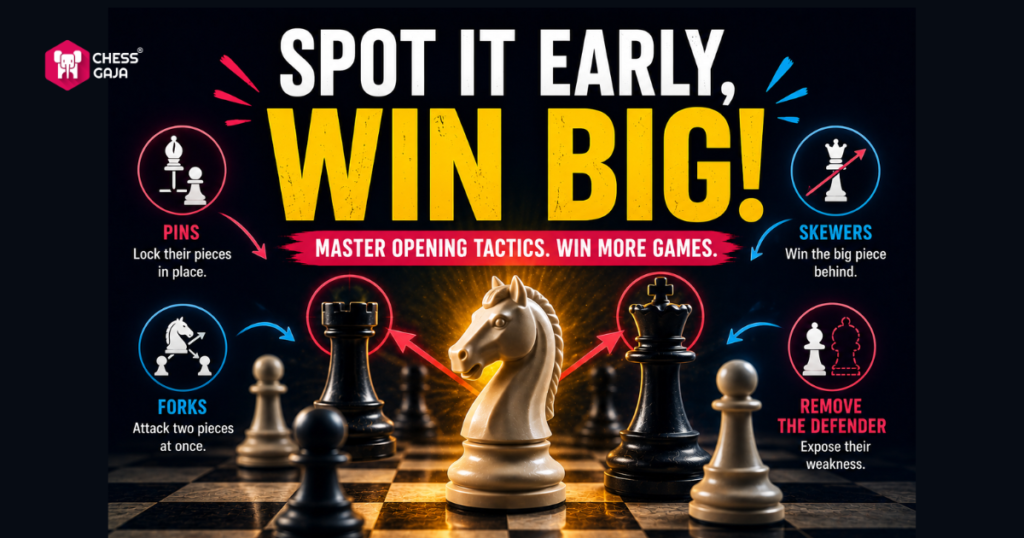
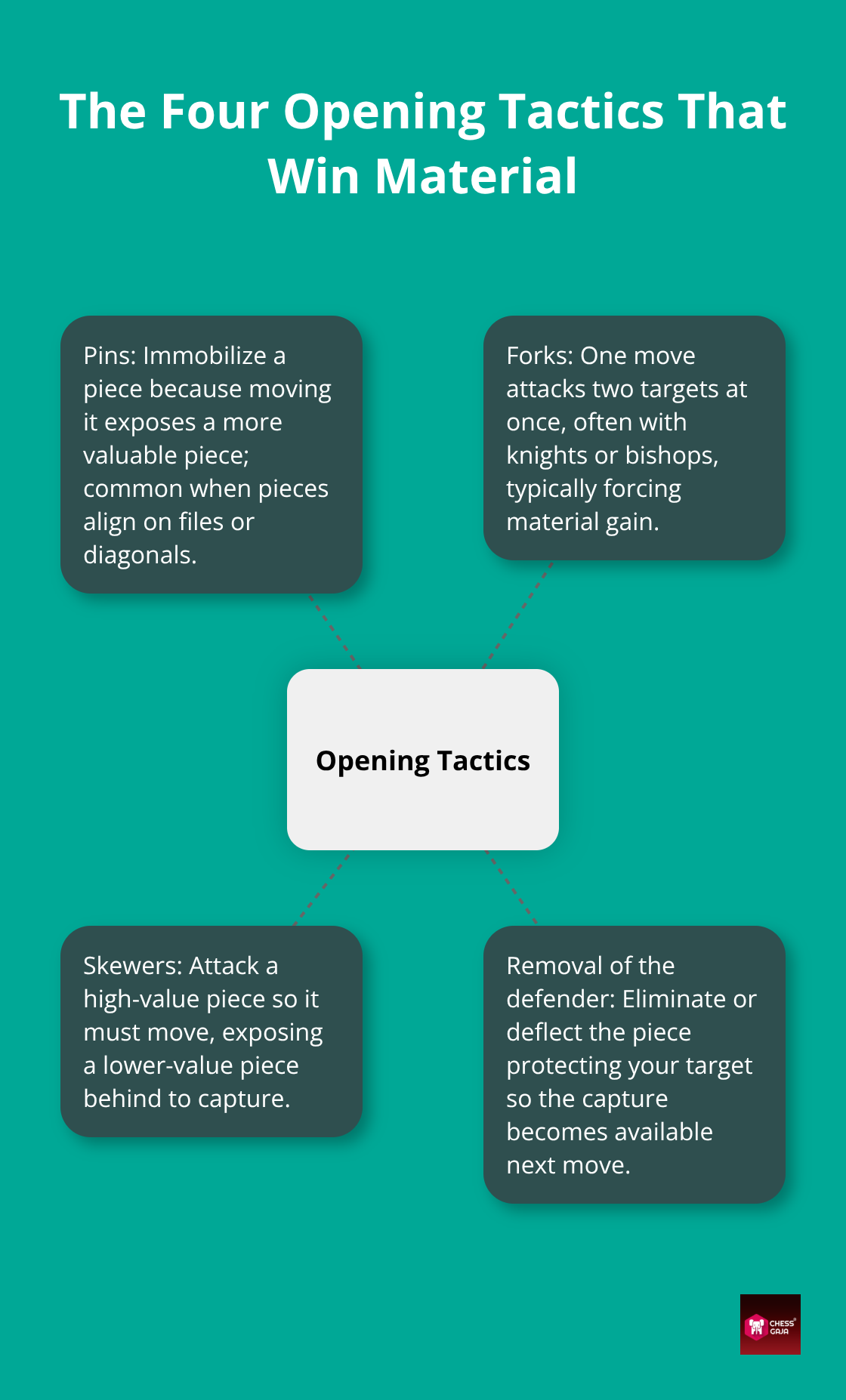
Pins, forks, skewers, and removal of the defender are essential tactical patterns in the opening phase. A pin locks a piece in place because moving it exposes a more valuable piece behind it. A fork attacks two pieces at once, forcing your opponent to lose material. A skewer works like a pin in reverse: the valuable piece moves along a diagonal, file, or rank, exposing a less valuable piece behind it to capture. Removal of the defender eliminates the piece protecting something you want to attack.
Where Pins Strike Most Often
In practical play, pins appear most frequently in moves 6 through 12, especially along files and diagonals where pieces cluster naturally. A 14-year-old from Houston spotted a pin on the e-file in move eight of her game against a 1650-rated opponent and won a rook outright. She didn’t memorize the position; she simply knew that when two enemy pieces align on the same file in front of a valuable target or the King, a pin exists. That single tactical awareness jump gave her a winning position before move ten.
Training Forks and Double Attacks
The fastest way to train these patterns is not to memorize positions but to play out real games where they occur. Solve one tactical puzzle daily that features a pin or fork in an opening context, then play a practice game and actively hunt for the same pattern on the board.
Most beginners miss forks because they focus on one piece at a time rather than asking: where can my knight land to attack two pieces simultaneously? Where can my bishop move to create a double attack?
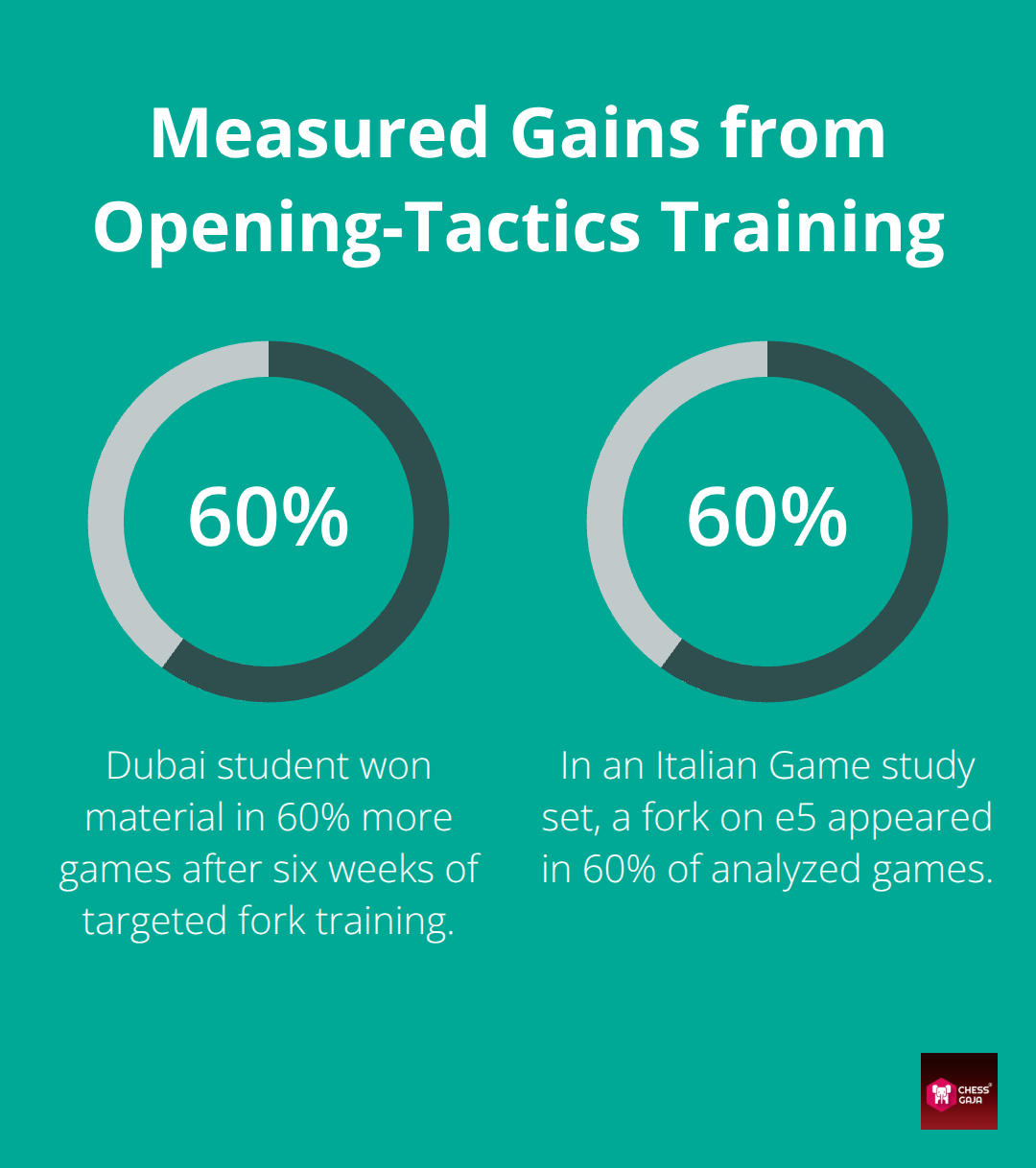
A student in Dubai who trained this way for six weeks reported spotting forks three moves earlier than before, which directly translated to winning material far more consistently in her games.
Removing the Defender in Italian and Sicilian Lines
Removal of the defender works differently: instead of creating a new threat, you eliminate the piece that guards your target. If an opponent’s Knight on f6 defends their Bishop on e7 (or central pawn on e5), eliminating or forcing that Knight away leaves the target undefended and ready for capture. This pattern appears constantly in the Italian Game and Sicilian Defense because pawn structures naturally create defender relationships. Grandmaster-led coaching at academies across 40+ countries emphasizes drilling these four patterns in isolation first, then spotting them in real game positions.
The Progression That Builds Speed
The progression matters: learn the pattern in a puzzle, see it in a grandmaster game, then hunt for it in your own games. Players who follow this sequence typically identify these tactics two to three moves faster than players who only study theory. Once you master spotting these four patterns in the opening, you’re ready to apply them against specific opponents and openings-which is where your preparation truly accelerates your results.
How to Train Opening Tactics Without Wasting Time
Young players often solve random puzzles. These puzzles have nothing to do with their actual openings. A 15-year-old from Singapore spent three months on a tactics app. Her puzzle rating hit 1900. Yet her tournament rating stayed flat at 1400.
The disconnect happened because she trained forks and pins in positions that never appeared in her games. She switched to studying tactics from grandmaster games in the Sicilian and Italian defenses. Her tournament results improved within weeks.
Match Your Training to Your Actual Openings
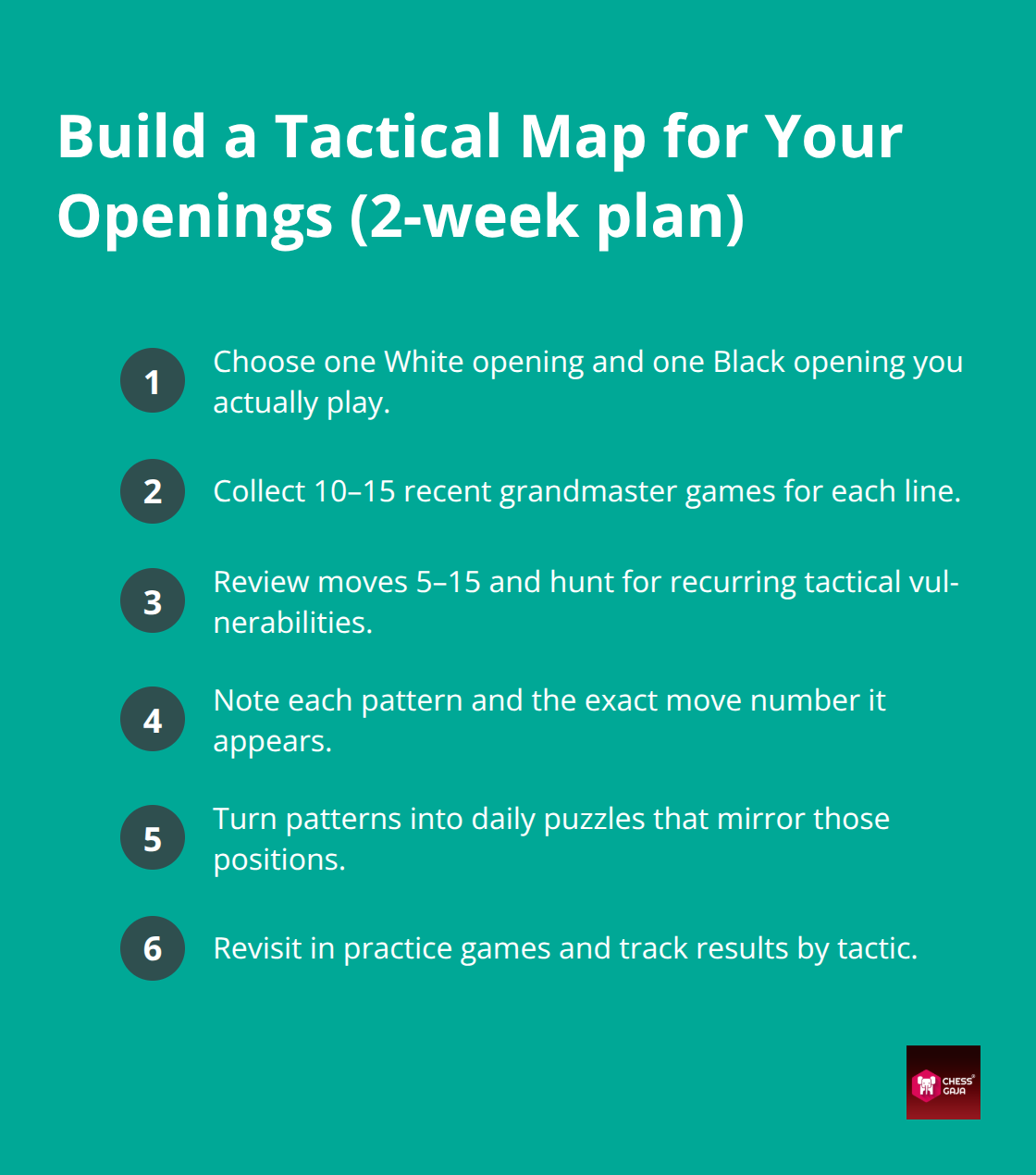
This is the core principle. Your tactical training must mirror the positions you actually face. Start by selecting one opening for White and one for Black. Spend two weeks collecting ten to fifteen grandmaster games in each opening from the past three years. Chess.com’s game database and the World Chess Federation’s event records contain thousands of recent games.
As you review each game, pause at moves five through fifteen and ask yourself: where is the tactical vulnerability? Can White execute a fork against the King and Rook or win material with a double attack? Does Black have a pin on the long diagonal? Write down every tactical pattern you spot, then note the exact move number where it appears. This creates a personalized tactical map for your openings.
A student in Dubai who did this discovered that in the main line of the Italian Game, the classic pawn fork on d5 (the famous fork trick) appeared in a majority of the games she studied. Once she knew this pattern was likely, she started looking for it in her own games and won material three times in her next five tournaments.
Solve Puzzles That Match Your Opening Lines
After you identify the patterns in grandmaster games, solve one tactical puzzle daily that features the exact same pattern in a similar position. Spend five to ten minutes maximum on each puzzle, not thirty minutes hunting for the perfect move. The goal is speed, not perfection.
A coach working with intermediate players across forty-plus countries shared a key finding. Students who trained this way improved their opening tactics recognition by an average of three moves within six weeks.
Hunt for Patterns in Practice Games
Play practice games against opponents within 50 rating points of your own. Actively hunt for your chosen patterns. Most players lose because they wait for tactics to appear. Go search for them instead.
After each game, spend ten minutes reviewing moves five through fifteen. Ask yourself two questions: Did I spot the fork when it was available? Did I see the pin before my opponent exploited it?
This three-step cycle of studying tactical pattern training in grandmaster games, solving targeted puzzles, and playing against peers at your level compresses months of improvement into weeks. The specificity matters more than the volume. Fifty puzzles tailored to your openings will improve your results faster than five hundred generic puzzles.
Final Thoughts
For instance, a 12-year-old from Dubai won her regional tournament—not because she grew stronger overnight, but because she became faster at spotting what mattered. As a result, tactics compress timelines and force immediate reactions.
To achieve this, students follow a simple three-step cycle: first, study grandmaster games; second, solve targeted puzzles; and third, play practice games. Consequently, doing this typically earns them a significant rating boost within their first competitive season.
To get started, pick one opening for White and one for Black. Then, spend two weeks studying grandmaster games for tactical patterns. Next, solve one daily puzzle matching those patterns, and finally, play practice games to hunt for your chosen tactics. This method works because coaches across 40+ countries use it, thereby removing guesswork.
At Chess Gaja, we coach thousands of young players. They come from the USA, UAE, and Singapore. We see a clear trend. Opening tactics separate players who climb ratings from those who stagnate. Success is not about raw talent. It comes from knowing which patterns to look for. It comes from knowing when to strike.
Our FIDE-rated coaches analyze your games and identify your tactical blind spots. We build custom training plans around the patterns in your openings. Book a Paid Starter Class for a professional skill evaluation. Discover where your next rating jump comes from.