

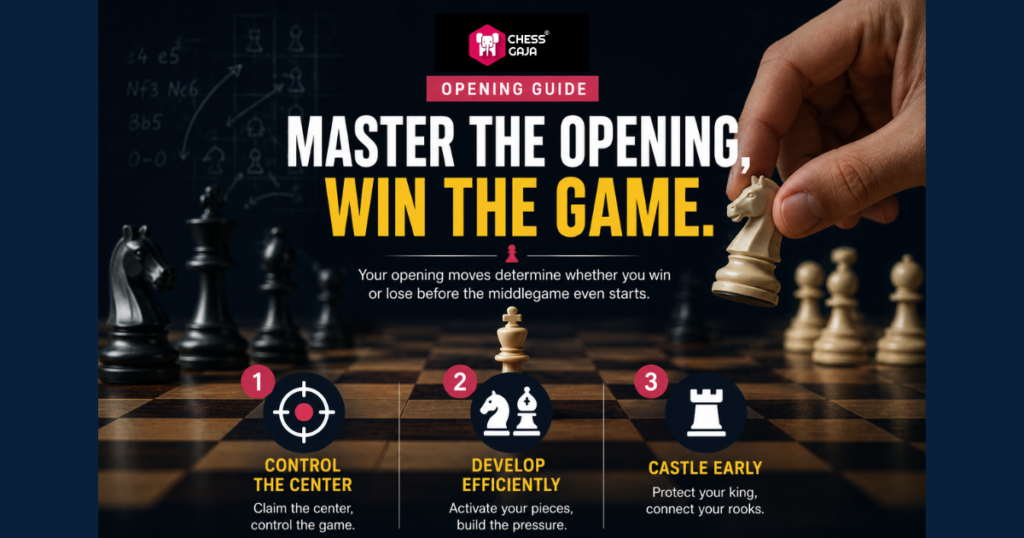
Your opening moves determine whether you win or lose before the middlegame even starts. Most beginner players waste their first ten moves on random piece shuffling, then wonder why stronger opponents dominate them.
At Chess Gaja, we’ve coached thousands of students across 40+ countries, and we’ve seen one pattern repeatedly: players who learn solid & reliable opening principles build sustainable long-term rating growth compared to those who simply memorize lines. This blog post shows you exactly how.
Three Opening Principles That Actually Work
Control the Center-Your Foundation
The center is where chess games are won or lost early. A knight placed in the center (on d4, e4, d5, or e5) controls 8 squares and restricts enemy pieces. On the rim (edge a- or h-files), a knight controls only 3 or 4 squares, and in a corner (a1, a8, h1, h8), just 2.
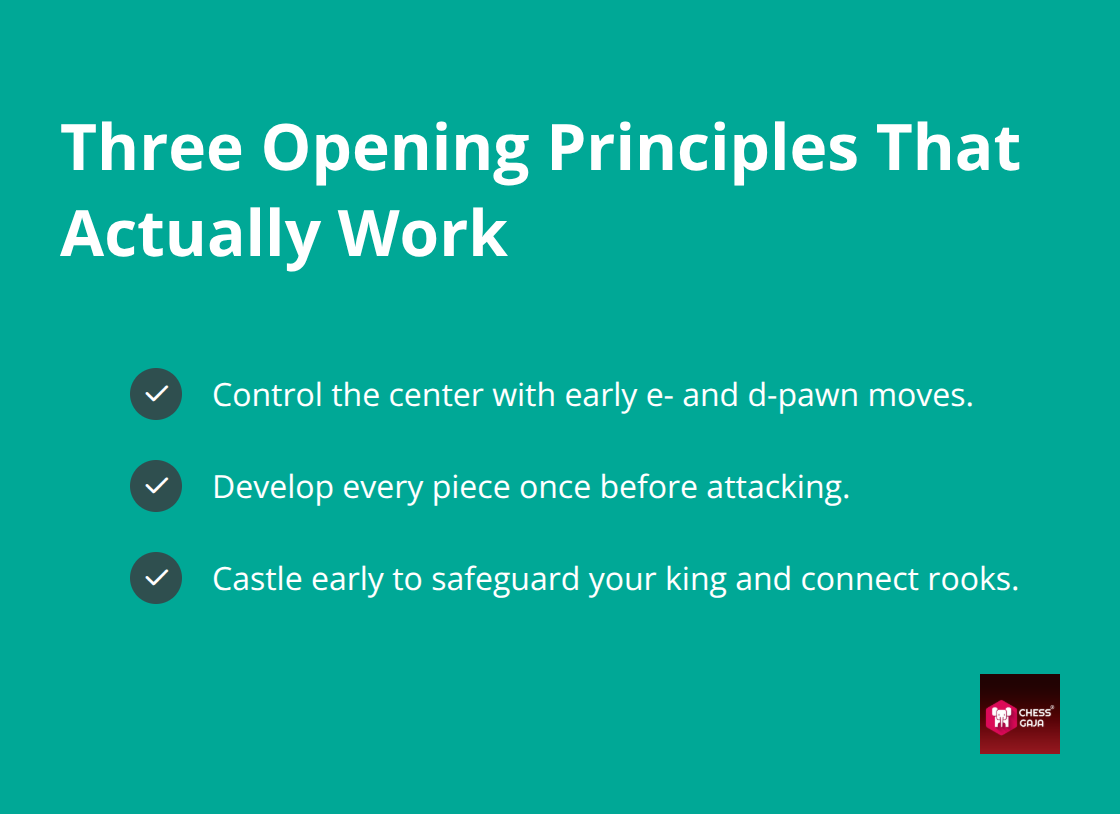
Push your e-pawn and d-pawn early to occupy or contest key central squares (d4/e4 for White, d5/e5 for Black). This controls the center and opens diagonals for your bishops. Avoid early flank pawn pushes that fail to control the center or aid development.
Players below 1800 often waste moves pushing side pawns. Meanwhile, their opponent takes the center and attacks. Control the center first to give your pieces room to move.
Prioritize Efficient Development Over Premature Attacks
Develop your minor pieces toward the center efficiently—typically developing knights to natural squares like f3 and c3 for White (or f6 and c6 for Black).
In addition, place your bishops on open diagonals to pressure the center. Hold off on queen moves until your minor pieces are out.
Instead, focus on developing all minor pieces and securing your king first. Fully developed pieces control far more space than a lonely queen sent out too early. Therefore, aim to castle your king within your first ten moves.
Oleg Korneev, a strong opening player in European opens, demonstrates this principle through aggressive but principled play-he develops quickly, castles early, and only then launches his attack.
Castle early-Protect Your King
The last step is getting your king off the center file where it becomes a target. Castling does two key things. First, it moves your king to safety. Second, it connects your rooks so they control open files. Most players should castle kingside (O-O) to secure the king quickly. Castle queenside (O-O-O) when planning an opposite-side pawn storm, activating the d-file rook immediately, or when the pawn structure favors queenside king safety.
These core three principles—controlling the center, rapid development, and king safety—form the foundation of every strong repertoire. They work for beginners rated 800, for club players rated 1600, and for grandmasters. The difference is that stronger players execute these principles faster and more precisely. Once you master these fundamentals, you are ready to explore which opening systems match your playing style.
Which Opening System Matches Your Playing Style
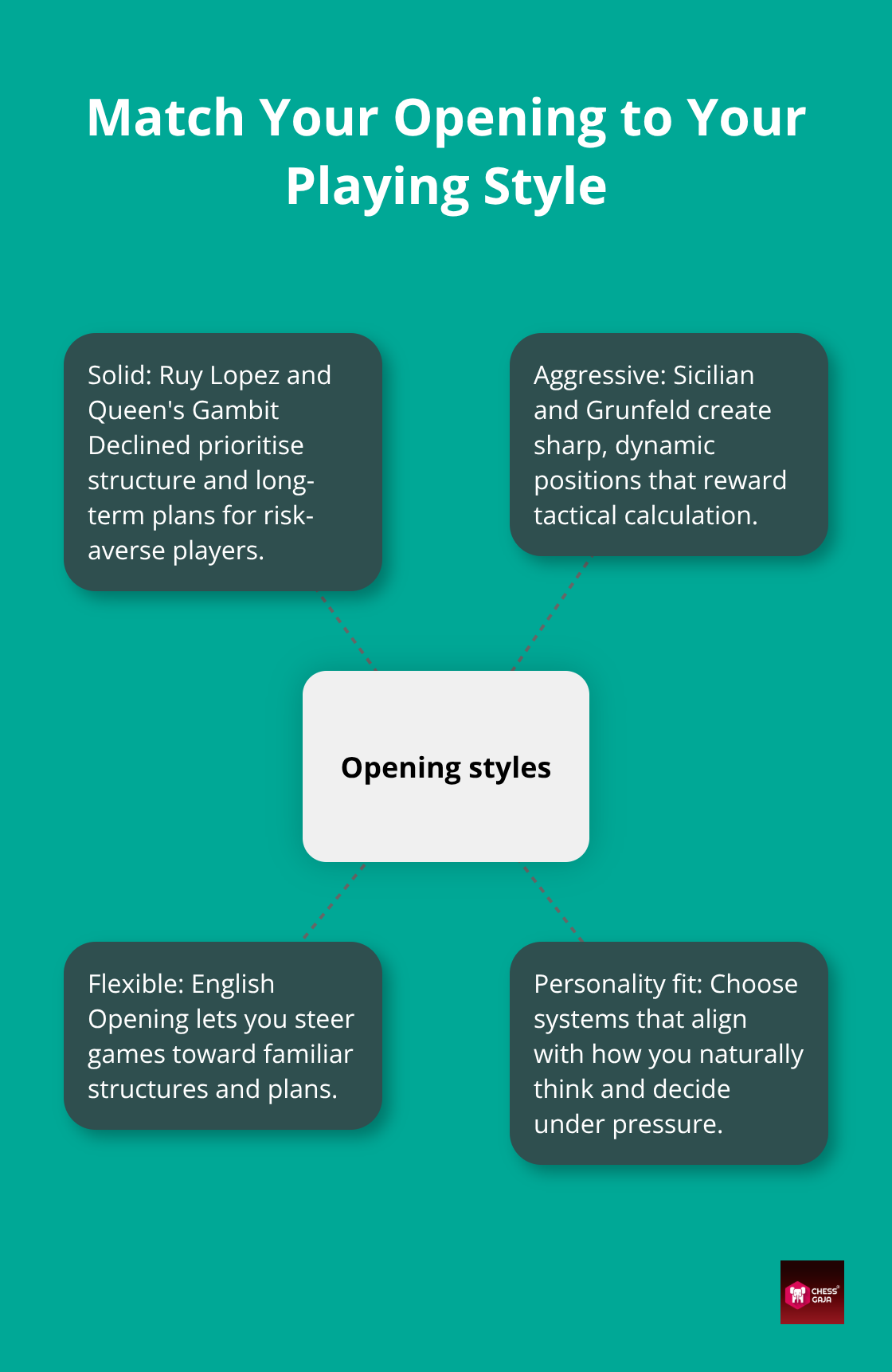
The three core principles work universally, but the specific opening you choose should reflect how you naturally play chess. A defensive player who loves solid positions will struggle with the aggressive Sicilian, just as a tactical player will feel suffocated by the slow maneuvering of the Slav. Your opening is not a costume you wear-it is an extension of your chess personality.
Solid Openings for Defensive Players
For instance, solid players thrive with the Ruy Lopez or Berlin Defense against 1.e4. Meanwhile, against 1.d4, the Queen’s Gambit Declined works best. Overall, these systems focus on pawn structure and long-term advantages rather than early tricks.
The Ruy Lopez (1.e4 e5 2.Nf3 Nc6 3.Bb5) offers White a balance between positional pressure and sharp tactics. Against 1.d4, the Queen’s Gambit Declined (1.d4 d5 2.c4 e6) allows Black to maintain a solid structure and strike back with central pawn breaks like …c5 or …e5. These openings reward patience and clear thinking over memorization.
Aggressive Openings for Tactical Players
Tactical players need openings that create fast complications. For instance, the Sicilian Defense creates sharp, double-edged positions where tactics flow naturally.
Similarly, against 1.d4, the Grünfeld Defense lets White build a big center. Black then attacks it with dynamic piece play. Overall, this fits players who love high-tension games.
These openings require deep calculation rather than rote memorization. Switching to an aggressive system often boosts your rating, as it rewards your natural strengths.
Flexible Openings for Adaptable Players
Adaptable players should consider the English Opening (1.c4). It controls the central d5 square from the flank, allowing White to avoid forced theoretical lines and transpose into familiar structures.
This style helps in tournaments. Opponents cannot easily prepare for you. Pick a system, then study grandmaster games to see key plans.
Building Your Opening Repertoire That Actually Works
Select One Opening and Master It First
Choosing the right opening means selecting lines you will play fifty times, not five.
For instance, a Singapore student spent months learning complex lines and lost confidence. She switched to the Classical Sicilian and gained 40 rating points.
The secret was simple repetition. When you play one line often, your intuition sharpens and pattern recognition becomes automatic.
To begin, pick one opening for White and one for Black. Next, test your primary choice in five serious games before adding a second option. As a result, this prevents learning six openings poorly instead of two well.
Grandmaster Alexander Delchev illustrates this well. He relies on a focused repertoire, frequently employing the English Opening (1.c4) as White and the Taimanov Sicilian (1.e4 c5 2.Nf3 e6 3.d4 cxd4 4.Nxd4 Nc6) as Black. This setup relies on deep facts, not online trends.
Match Your Opening to Your Calculation Speed
Your opening should match your speed and comfort level. Do you think slowly or struggle under time pressure? Avoid sharp lines like the Grünfeld or Sicilian. Instead, pick solid setups like the Berlin Defense or Queen’s Gambit Declined. These systems reward steady thinking over fast calculation.
Test your openings against opponents rated 100 to 200 points higher. Do not test them against much weaker players. This reveals real gaps in your play instead of false confidence.
Study Model Games and Identify Patterns
Study real games from masters rated 2400+. Focus on 3 to 5 model games where the opening turns into the middlegame. Note key pawn breaks, piece placements, and plans.
Club players rely on memorized lines and simple traps. In contrast, grandmasters win through positional play and pattern recognition.
Practice in Rapid Before Classical Time Controls
First, practice your opening in rapid formats (10+0 or 15+10) before playing classical games. Rapid gives you enough time to think through the opening plans without the time-trouble randomness of blitz. This is because rapid games show which positions cause delay and which feel natural.
Positions that feel hard need more study. In contrast, positions that feel easy show you have learned the opening well.
Many club players waste months on rare lines they never reach in real games. Focus on key positions you see every tournament, not engine sidelines.
Track Results Across Twenty Games
Track your results over a solid sample of games. Focus on whether your positions feel comfortable and evaluate your performance trends as both White and Black. If your performance drops, review key tactical or strategic mistakes before abandoning the line.
This simple tracking prevents emotional decisions after a few losses.
Final Thoughts
The gap between beginners and strong players narrows when you stop memorizing lines like puzzles.
Players master solid chess openings through structured repetition, not by cramming lines before a game.
Follow three simple steps. First, apply the core principles in every game. Next, pick one opening that fits your style and test it over 20 games. Finally, study model games from grandmasters before playing in tournaments.
Practice reveals patterns that engines cannot teach you. Playing the same opening repeatedly sharpens your calculation and boosts confidence.
Rating jumps happen when you internalize the core logic, not just memorize theory.
At Chess Gaja, we guide students using a proven coaching process. Our FIDE-rated coaches provide custom analysis and opening plans tailored to your goals.
Book a Paid Starter Class with our coaches. We will assess your skills, find openings that fit your strengths, and build a winning repertoire for your next tournament.