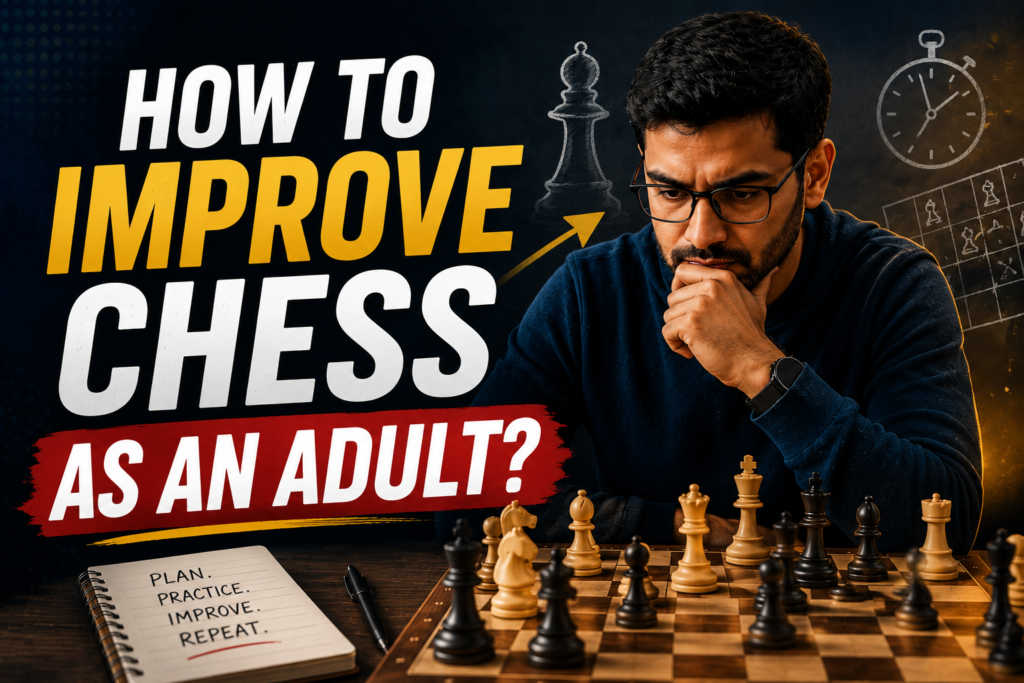
Most adult chess players hit a wall within their first year. They assume they’re too old to improve or that they lack the time serious players need.
We at Chess Gaja have coached thousands of adults who proved this wrong. The ways to improve chess skills as an adult look completely different from how children learn, and that’s actually your advantage.
Why Adult Chess Players Learn Differently
Adult chess learners face a fundamentally different challenge than children, a reality often overlooked by training resources for adults. Children absorb patterns through repetition over thousands of hours. Adults have less time but sharper analytical tools—you can understand the why behind a move in ways children cannot. The real problem is not age or time scarcity; it’s that adults try to learn like children do. Too many players memorize opening lines instead of grasping core principles. Others solve random puzzles rather than studying tactical patterns that appear in their actual games. Finally, many waste hours on complex theory books instead of mastering the three or four endings they’ll actually face over the next six months.
Misconceptions That Derail Adult Progress
The biggest lie adults believe is that they need to catch up to where they started as children. You don’t. A 35-year-old beginner doesn’t need to reach 2000 Elo; they need a realistic rating target aligned with their actual available hours. Someone playing 5-10 games weekly can reasonably expect to gain 100-150 rating points per year with structured study.
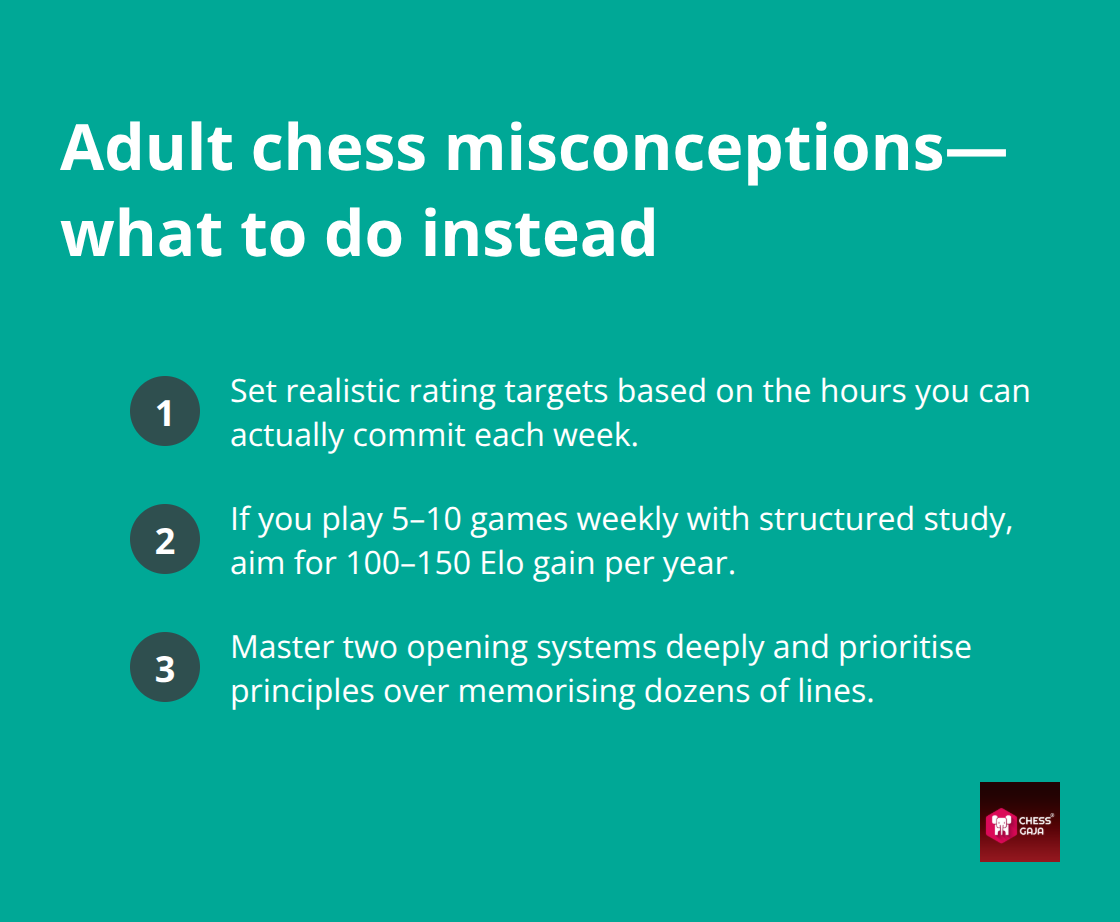
That’s measurable progress. The second misconception is that adults must memorize openings deeply. Wrong. A 1400-rated adult player gains far more from mastering two opening systems completely than from knowing 20 opening lines poorly. When studying openings, spend almost all of your opening study time on the first 15 moves—understanding pawn structures, piece placement, and typical middlegame plans—not memorizing move 15 in a sideline you’ll rarely face.
Time Constraints Demand Ruthless Prioritization
Adults have competing demands: work, family, fitness, sleep. You cannot train 8 hours daily like a young prodigy. Instead, your advantage is that every study minute can be highly intentional. A 45-minute focused session beats a scattered 3-hour day. The data supports this: adults who commit to deliberate practice show consistent rating gains with structured study. Two tactical puzzles analyzed deeply-where you calculate three moves ahead and understand why the solution works-outperform solving 30 puzzles mechanically. Try a concrete goal: reach 1600 Elo in 18 months, or win your first club tournament this year. Vague ambitions like “get better” fail because you never know if you’re improving.
How Adult Brains Actually Learn Chess
Your adult brain learns through immediate application and feedback loops. A child may study a rook endgame and forget it. You study a rook endgame, play a game where you face it, lose due to a specific mistake, and that lesson sticks. This is your edge. The second edge is pattern recognition in chess learning. Adults spot recurring tactical motifs faster than children because you’ve lived long enough to recognize patterns in other domains. A fork, a pin, a back-rank mate-these connect to logic you already understand. The third edge is motivation. A child trains because a parent says so. You train because you chose to. That intrinsic drive compounds over time.
Building Consistency Through Micro-Habits
The challenge is consistency. Life interrupts training plans. A missed week cascades into a missed month. Adults who improve fastest build micro-habits: 15 minutes of tactics before breakfast, 20 minutes analyzing one of your own games twice weekly, one serious game against a rated opponent every Sunday. This routine survives life’s chaos better than rigid weekly schedules. These small, repeatable actions (not grand plans) create the foundation for steady progress. When you face the middlegame in your next tournament, you’ll recognize patterns you’ve studied dozens of times in your morning puzzle sessions. That recognition translates directly into better moves and higher ratings.
Foundational Skills That Drive Adult Progress
Master Opening Principles Over Memorization
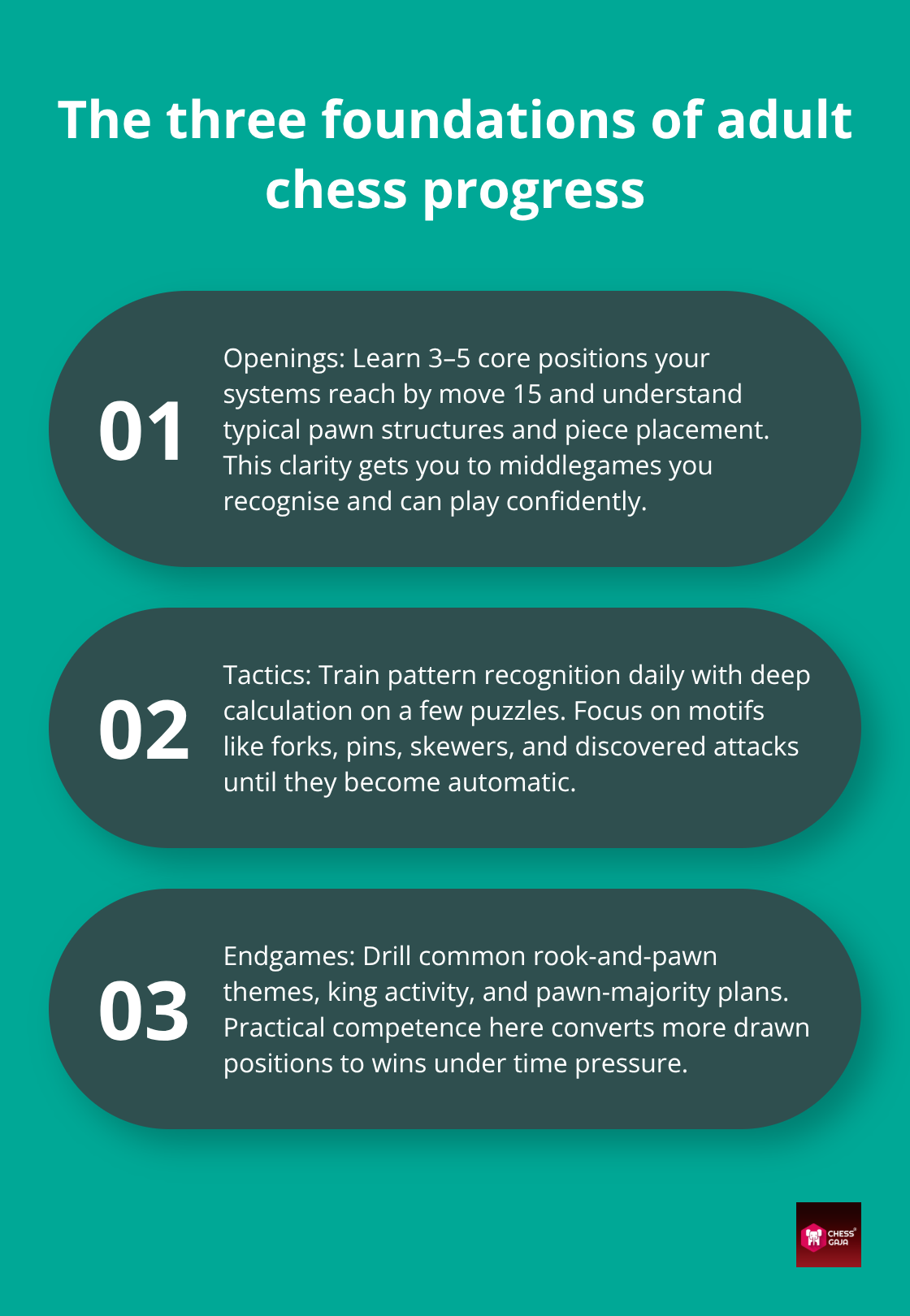
Opening play matters far more than most adults realize, but not in the way you think. Adults waste hundreds of hours memorizing move sequences that vanish the moment an opponent deviates. Instead, you need to understand the three to five core positions your chosen openings reach by move 15. If you play 1.e4, learn the typical pawn structures in the Italian Game and Ruy Lopez, as well as the common structures Black creates in the Sicilian Defense. Focus on these specifics: where your pieces belong, which pawns to push or hold, and what the middlegame battle looks like.
You’ll recognize positions faster, make confident early moves, and enter the middlegame with a clear plan rather than scrambling to remember move 12. Focus your preparation on reaching playable middlegames safely rather than chasing deep engine lines you will rarely encounter on the board.
Recognize Tactical Patterns With Speed and Precision
Tactical pattern recognition is where adults accelerate fastest because you can see the logic behind motifs that children memorize blindly. Forks, pins, skewers, discovered attacks, and removing the defender form the foundation—study these core tactical motifs in isolation until you spot them instantly in any position. The difference between solving 30 random puzzles and solving 5 puzzles deeply is enormous. When you work through a puzzle, calculate three moves ahead, understand why the solution works, and identify which pattern it demonstrates, that lesson transfers directly to your games.
Adults who improve 200+ rating points in a year typically spend 15-20 minutes daily on focused tactical work, not sporadic marathon sessions. Choose one platform-Chess.com Tactics Trainer or Lichess Puzzles-and build consistency. Track which patterns trip you up most: if you miss back-rank checkmates repeatedly, drill them specifically until they become automatic. Within three months of daily tactical work, you’ll notice a measurable difference in your game analysis and move quality.
Build Endgame Competence as Your Competitive Edge
Endgame fundamentals separate competitive players from casual ones, yet most adults ignore them entirely. You don’t need to memorize 200 endgame positions. Start with basic rook-and-pawn endings, key King and pawn endgame concepts, and passed pawn creation. These fundamentals appear regularly in adult games and will improve your practical play far more than studying exotic theoretical setups.
Spend 10-15 minutes twice weekly drilling these specific endings until you recognize winning and losing positions instantly. When you reach an endgame in your next tournament, this preparation will translate into points you wouldn’t have earned otherwise. The psychological advantage matters too: knowing you’ve studied the ending you’re facing builds confidence and reduces time pressure mistakes. Adults who add structured endgame training gain measurable rating improvements within months simply because they stop losing drawn positions and convert more winning ones.
This foundation in openings, tactics, and endgames positions you to tackle the next challenge: building a training routine that actually fits your life.
Creating a Sustainable Training Routine for Adults
The single biggest mistake adults make is treating chess study like a hobby instead of a skill to develop. You need a weekly structure that fits your actual life, not a fantasy schedule you’ll abandon after two weeks. Start by auditing your honest available hours. Not the hours you wish you had-the hours you genuinely control after work, family, and sleep. If you have five hours weekly, that’s realistic for someone aiming to reach 1600 Elo within 18 months. If you have ten hours, you’re positioned for faster progress. Once you know your real capacity, allocate it ruthlessly across three categories: games, puzzles, and analysis.
Allocate Your Study Time Across Games, Puzzles, and Analysis
Games should consume nearly half of your study time. Play one serious game against a rated opponent every week—this could be a classical club game, a rapid game on Chess.com, or a Lichess classical event. One game weekly forces you to apply everything you’ve studied and creates the feedback loop adults need.
Puzzles should take a quarter of your time, but quality matters far more than quantity. Fifteen minutes daily of focused tactical work beats three-hour weekend binges. Set a specific goal: reach 1800+ rating on Chess.com Tactics Trainer within three months. Analysis of your own games should consume about a third of your study time. Review one of your own losses every week using an engine like Lichess analysis or Chess.com’s built-in tools. Identify exactly where you went wrong-was it opening preparation, a tactical miss in the middlegame, or an endgame error?
Track Mistakes to Guide Your Next Month’s Focus
Track these categories in a simple Google Sheet with columns for date, opponent rating, result, and the primary mistake type. After four weeks, patterns emerge. You’ll see that you lose most games to back-rank mates or that your King’s Indian Defense setups consistently reach difficult positions by move 15. This data guides your next month’s focus. If back-rank mates dominate your losses, spend next week drilling them specifically. If your openings are weak, shift significantly more time to opening study temporarily. This systematic approach transforms vague study into targeted skill-building that addresses your actual weaknesses.
Build Consistency Through Short, Daily Sessions
The second critical principle is consistency over intensity. An adult who studies 45 minutes daily outpaces someone who studies six hours once weekly. Your brain consolidates tactical patterns and opening principles through repeated exposure, not marathon sessions. Spacing study across multiple short sessions produces superior retention compared to massed practice. Build your routine around non-negotiable time blocks. If you commit to 15 minutes of tactics before breakfast and 45 minutes analyzing a game on Tuesday and Thursday evenings, that’s roughly two and a half hours of targeted study weekly. Add one 90-minute classical or rapid game on Sunday, and you have a complete 4-hour training cycle that comfortably fits into a busy schedule.
Protect Your Baseline When Life Interrupts
When a work deadline hits or family demands spike, you still protect your 15-minute morning session. A missed week doesn’t cascade into a missed month because your baseline habit remains intact. Track progress monthly using two metrics: your rating on Chess.com or Lichess, and your average blunder count per game over a 10-game sample. After three months of consistent study, you should see measurable movement—typically 50–100 rating points gained, depending on your starting level and available hours. If you’re not improving, your routine needs adjustment. It could be that you’re analyzing games too quickly without calculating deep lines. In other cases, puzzle difficulty might be too easy, leading to mechanical solving. Alternatively, playing excessive blitz games often causes speed to replace real calculation. Make one small change at a time and measure the impact over the next month.
Final Thoughts
Adult chess improvement follows a clear path when you stop trying to learn like a child and start leveraging your actual strengths. You’ve learned that opening principles matter more than memorization, that tactical pattern recognition compounds through daily consistency, and that endgame fundamentals separate competitive players from casual ones. The real breakthrough comes when you build a sustainable routine aligned with your actual available hours, track your mistakes systematically, and adjust your focus based on measurable data. Most adults who improve chess as an adult do so not because they suddenly have more time, but because they study smarter.
Professional coaching accelerates this journey dramatically. A coach identifies your specific weaknesses within the first session, designs a personalized study plan tailored to your rating and goals, and holds you accountable to consistent progress. At Chess Gaja, our FIDE-rated coaches work with 5,000+ students across 40+ countries and understand the psychology of adult learning and competitive performance in ways self-study cannot replicate. Your coach catches bad habits early, prevents wasted study time on irrelevant material, and provides the feedback loop that accelerates rating gains by months or years.
Your next step is straightforward: book a Paid Starter Class with Chess Gaja to receive a professional skill evaluation. During this session, a coach will assess your current level, identify your primary weaknesses, and outline a concrete path forward aligned with your available hours and competitive goals. Visit Chess Gaja today to schedule your first session and begin your structured journey toward competitive progress.