
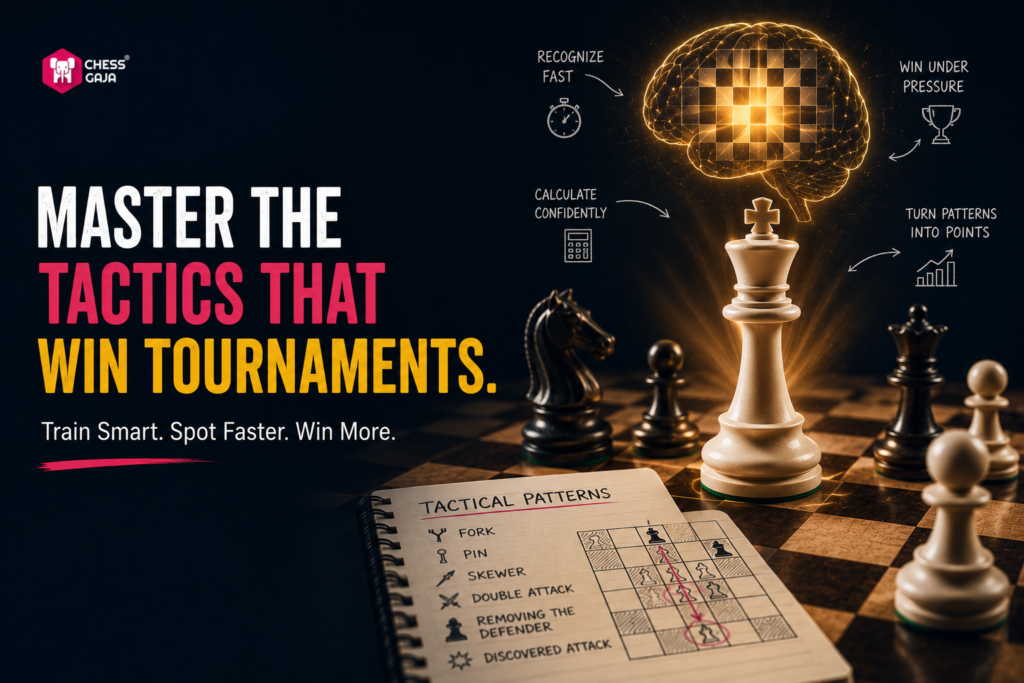
Last month, a 12-year-old student from Houston won her state tournament. Her secret was simple. She spotted tactical patterns much faster than her opponents instead of memorizing long openings.
At Chess Gaja, we’ve coached thousands of young players across the USA, UAE, and Singapore. We’ve learned that chess tactic mastery through systematic training separates winners from those stuck at the same rating for years.
This post shows you exactly how to build tactical instinct that works under tournament pressure.
Why Your Brain Learns Tactics Differently Than Openings
Your brain stores chess tactics differently than opening moves. Opening memory builds a fixed sequence for specific games. In contrast, tactical patterns work across all positions.
In 1973, researchers Chase and Simon studied top chess players. They found that experts see board positions in pattern chunks instead of looking at single pieces one by one.
A fork or pin triggers instant recognition on move 5 or move 35. Because of this, the Houston player had a huge edge.
The Gap Between Puzzle Solving and Real Games
Solving online puzzles differs from spotting tactics in real games. In puzzle training, you know a tactic exists. You actively search for it. In a real game, you must spot the opportunity on your own.
Many beginners achieve high puzzle accuracy but miss those same patterns over the board. They skip pattern-spotting practice and stagnate within six months.
You need deliberate pattern exposure in low-pressure drills before entering tournaments. Use Chess.com or Lichess Tactics with a 2-minute limit per puzzle. Short time limits train quick pattern recognition. They help you instantly spot tactical triggers before calculating the variations.
Why Structured Pattern Training Stops the stagnate
Players stagnate because they practice randomly. Solving 50 puzzles on Saturday after skipping three days fails to build a durable pattern library.
Cognitive research supports spaced repetition. Revisit key motifs at spaced intervals. Reviewing forks, pins, and skewers cements patterns into long-term memory.
A structured plan with 15–20 minutes of daily drills yields fast results. Many players gain 100–150 rating points in three months. They achieve this simply by eliminating obvious missed tactics.
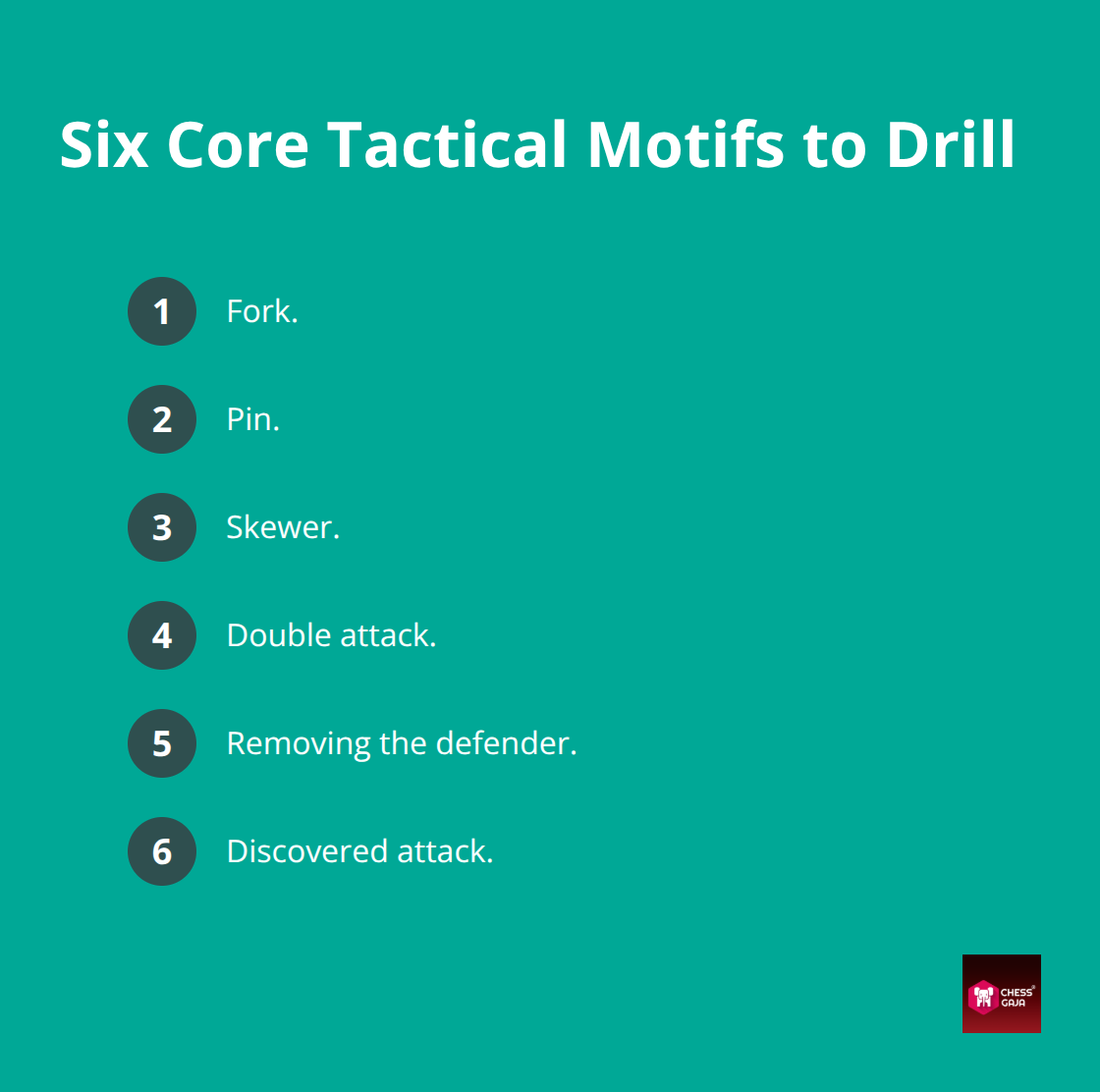
Without structure, a player might see 500 puzzles over six months but never truly master any single motif. Students with a systematic plan advance 3 to 4 times faster. Casual puzzle practice produces much slower results.
How Time Pressure Transforms Pattern Recognition
Adding a clock to your puzzle training changes everything. Your brain shifts from slow analysis to fast pattern recognition.
Setting a 2–5 minute limit per puzzle forces you to trust your instinct. Without pressure practice, players often freeze during real games. Therefore, time constraints build true tactical instincts.
Write down the motif and key idea after each puzzle. This habit transforms passive observation into active knowledge.
The Bridge From Drills to Tournament Pressure
Structured training creates a clear path. Start with simple 2–3 move tactics. Later, advance to longer sequences. This method builds deep calculation skill.
Keep a tactics journal to track common mistakes and recurring weaknesses. In addition, use a “tactics ladder” approach. Only advance to harder puzzles after you master easier ones.
Link motif study to your opening prep. For example, study games by Mikhail Tal or Garry Kasparov. Combining drills with master game study builds sharp tactical awareness.
The Three-Stage Progression From Puzzles to Tournaments
Stage 1: Building Your Pattern Library With Focused Drills
Moving from puzzles to tournament wins is hard. Most players skip key steps. They either stay stuck in drills or jump into tournaments unprepared.
At Chess Gaja, we see this pattern often. Successful players follow three clear stages.
Stage 1 focuses purely on pattern drills without tournament pressure. Keep a strict 30- to 60-second limit per puzzle. This tight boundary forces fast pattern recognition rather than deep calculation
Start with Custom Puzzles in the 800–1200 range. Solve each puzzle and label its main motif, such as a pin or skewer. Aim for consistency over speed. Solve 20–30 puzzles daily for 4–6 weeks. Reach 75% accuracy before you move to harder levels.
This stage feels slow initially. However, that slow pace builds a strong pattern library for real games.
Track your puzzle rating directly on the platform. The rating reflects your pattern recognition growth. Most consistent beginners gain 200+ puzzle rating points in six weeks.
Stage 2: Applying Patterns Under Real Game Pressure
Stage 2 adds time pressure through 10-minute or 15-minute rapid games. Now, apply your Stage 1 patterns to real games. Tactics hide among 32 pieces against active opponents.
Play 8–12 rapid games weekly. Review every loss using Stockfish to identify missed tactical motifs. Log the position and missed motif in a simple journal.
Consistent rapid play helps you spot tactics faster. Within 4–6 weeks, your rating often climbs 50–100 points.
This stage links puzzles to tournaments. You face real positions with low stakes. Rapid play teaches you to trust your instincts over endless calculation.
Stage 3: Tournament Play Where Tactics Decide Outcomes
Stage 3 is tournament play. Enter a local rated event or a national chess tournament.
Play 8–10 classical games over 2–3 months while practicing daily. Longer time controls give you room to calculate deeply. In addition, they test your tactical alertness.
Players who follow all three stages improve through tactical pattern recognition, accurate calculation, consistent game review, and disciplined training. The tournament results validate everything the puzzle training taught them. Your tactical instinct no longer feels like a guess-it becomes a reliable weapon that works when it matters most.
These three stages form a continuous cycle. First, tournament losses reveal gaps in your pattern library. Then, you return to Stage 1 drills to fix those gaps. Finally, Stage 2 rapid games keep your instincts sharp. This cycle keeps you improving month after month.
Three Tactical Traps That Cost Beginners Rating Points
Most beginners hinder their progress without realizing it. They follow the three-stage method, practice daily, yet wonder why tournament results lag.
Three specific habits undermine their growth. At Chess Gaja, We see these errors in most players below 1400 online rating. Fixing them drives immediate improvement.
Trap 1: Mechanical Puzzle Solving Without Real Analysis
Often, a beginner solves a fork puzzle in 90 seconds, gets it right, and moves to the next one. However, they never pause to ask why the fork worked or what made it possible. As a result, their brain registers the pattern as a vague shape rather than a concrete idea. After two weeks, they have seen 300 puzzles but learned nothing transferable.
The fix requires basic discipline.
After each puzzle, write two short sentences:
- Identifying the motif
- Noting the opponent’s key weakness.
A fork attacks two pieces at once. Similarly, a pin restricts a piece so it cannot move without losing a key target.
This analysis takes just 30 extra seconds per puzzle. It transforms passive solving into active learning.
Players using this habit gain 150+ puzzle rating points in four weeks. They stop viewing puzzles as random drills. Instead, they treat them as lessons.
Your brain requires clear feedback on why patterns work. Finding the correct move is only the first step.
Trap 2: Ignoring Defense and Opponent Threats
Players often solve a knight fork puzzle successfully in practice. However, they miss that same fork in real games when opponents find unexpected defenses.
Tournament opponents react actively and defend stubbornly. They rarely sit passively while you execute a tactic. For example, a fork fails if your opponent has an intermediate check or a stronger counter-threat.
Thus, the fix requires integrating defensive tactics into your puzzle training.
Focus on solving defensive puzzles on Chess.com to improve your defensive strategies in chess rather than just attacking ones. Lichess also offers puzzle sets for defense. Dedicate 20–30% of your training to defense. Therefore, you will learn to spot opponent threats early.
This ratio feels counter intuitive initially. Attacking puzzles feel more exciting. However, defensive training helps you spot opponent threats early.
Players who balance attack and defense make fewer blunders. They routinely calculate their opponent’s candidate moves and forcing replies before launching an attack.
Trap 3: Never Reviewing Your Own Tournament Losses
A beginner plays a tournament game, loses because they missed a fork, then moves on to the next tournament without ever studying that position again. Six months later, they miss the identical fork in a different game. This cycle repeats endlessly. Players treat losses as disappointments to forget. Instead, they should treat them as clear feedback signals to learn from.
The fix is non-negotiable. After every tournament loss, spend 15–20 minutes analyzing the game with a chess engine.
Record each missed tactic in a simple spreadsheet. List the position, missed motif, and correct move. After 10 games, review your sheet to spot recurring patterns.
For example, missing five forks shows a clear weakness. This data tells you where to focus your drills. Players who review losses stop repeating identical mistakes.
Therefore, apply these three core fixes together. Analyze every puzzle, balance attack with defense, and reviewing tournament losses.
As a result, beginners typically gain 200+ rating points within three months. These habits turn basic puzzle practice into effective skill building.
Your Path Forward
A 14-year-old student from Dubai gained 180 FIDE rating points in eight months. A 10-year-old from Singapore placed second in her regional tournament after six weeks of practice. A teenager from Texas also won his state championship by applying defensive tactic drills to real games.
We have coached over 5,000 students across 40+ countries. The pattern is clear. Players who commit to structured drills improve far faster than those who train randomly.
Discipline makes the difference between a 1200 rating and a 1600 rating. For instance, 15–20 minutes of daily training beats solving 100 puzzles on weekends.
First, label the core motif after every puzzle. Next, play regular rapid games to test your skills under pressure. Finally, review every tournament loss with an engine to turn mistakes into clear growth.
A good coach speeds up your progress. They find your main weaknesses and keep you on track toward your goals.
Our FIDE-rated coaches offer personalized starter classes. We assess your pattern recognition and spot weak motifs. Then, we build a tailored study plan. Book a Paid Starter Class today to get your 90-day roadmap.