
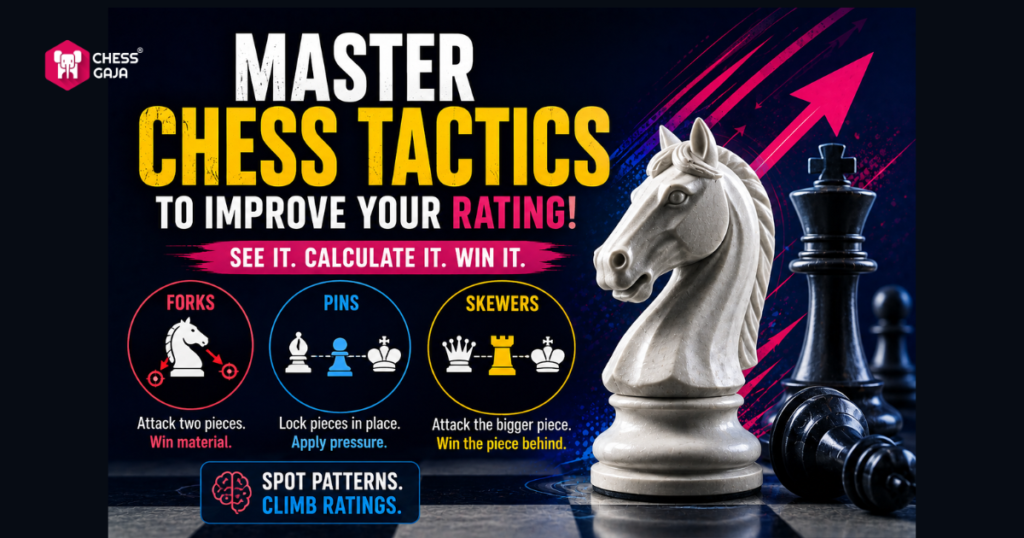
Your rating plateaued at 1200, and you can’t figure out why. You’re playing decent openings, but games slip away in the middlegame when your opponent finds a fork or pin you completely missed.
At Chess Gaja, we’ve coached thousands of students through this exact frustration. The difference between stagnating and climbing ratings comes down to one thing: spotting tactical patterns before your opponent does. This blog post shows you the specific strategic chess tactics to improve rating that separate advancing players from those stuck at their current level.
The Three Tactics That Win Material Fast
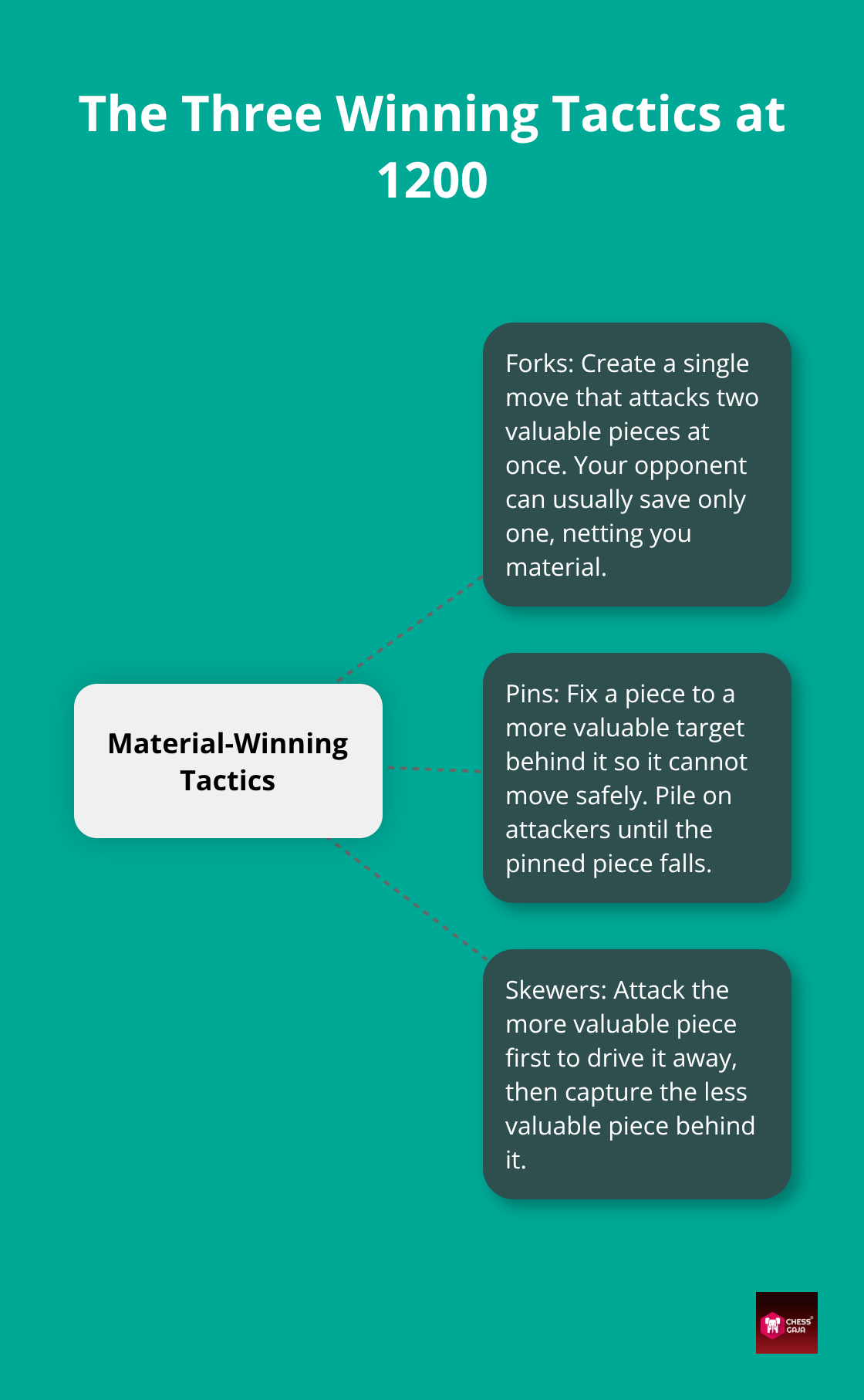
Forks: Attacking Two Pieces at Once
Forks dominate at the 1200 rating level. Most players simply forget to scan for double threats.
A fork attacks two pieces at once, but your opponent can only save one. For example, a knight jumping to f7 attacks the king on g8 (giving check) and the rook on h8 (or queen on d8). Your opponent must move their king out of check, abandoning the attacked piece.
Place a piece where it threatens two targets. Then, capture whichever piece your opponent leaves behind. Daily practice on Chess.com or Lichess builds this vision. The goal isn’t just memorizing shapes. You must train your eyes to look for double attacks on every single move.
Pins: Immobilizing Your Opponent’s Pieces
A pin happens when an attack lines up two opponent pieces. Pins immobilize targets. Moving the front piece exposes a bigger target behind it.
Shielding the king creates an absolute pin, where moving the pinned piece is strictly illegal under the rules of chess. Shielding another high-value piece (like a queen or rook) creates a relative pin, where moving the pinned piece is legal but leads to heavy material loss.
Beginners often miss pins. They focus on the front piece and ignore the line behind it. Always trace diagonals, ranks, and files before moving.
Once you spot a pinned piece, apply pressure. Attack it multiple times. The defender cannot move away to safety.
Skewers: Forcing Your Opponent to Abandon Material
Skewers work in reverse. Attack the high-value target first (like a king or queen).
When the higher-value piece moves to safety, it exposes the lower-value (or undefended) target. Unlike pins, skewers strike the bigger threat first, forcing the defender to step aside and surrender what lies behind.
Train yourself to spot these setups. Ask yourself: Which valuable piece sits directly in front of another target on the same line?
Once you spot this setup, the tactic executes itself.
Building Pattern Recognition Into Your Play
Players who master these three patterns-forks, pins, and skewers-stop losing material carelessly and start accumulating small advantages that compound into wins. The next step moves beyond recognizing these patterns in isolation; you need to practice spotting them under the pressure of real games.
How to Build Tactical Vision Faster Than Your Competition
Solve Puzzles With Accuracy, Not Speed
Daily puzzle training works. However, most 1200-rated players solve them incorrectly.
They rush through problems and guess the first move. They never verify full lines. This habit feels productive, but it stalls your growth. You end up training speed instead of accuracy.
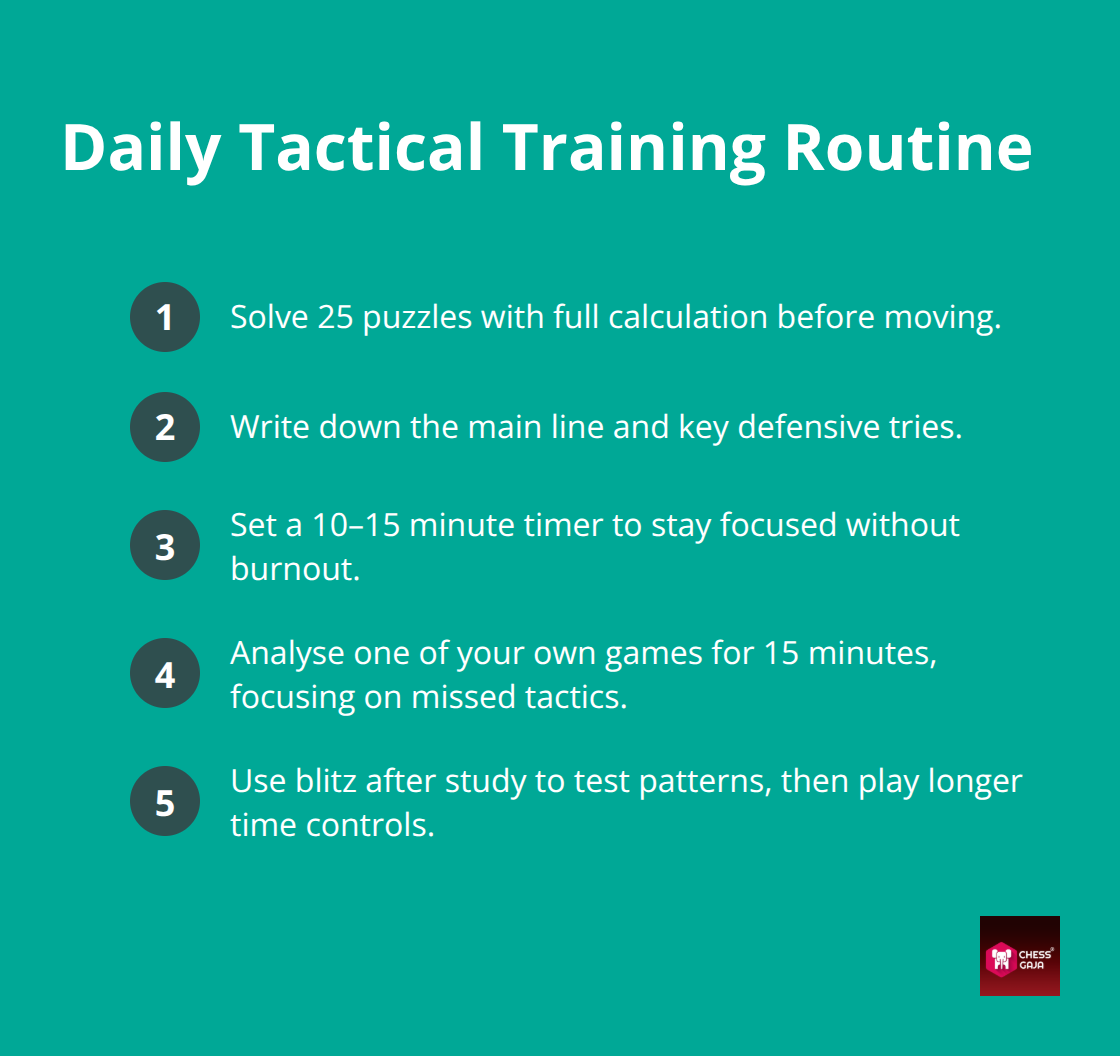
Try solving 25 puzzles daily on Chesspuzzle.net. Calculate every line fully before touching a piece. Write down the main line and key defenses.
Accuracy beats speed every time. Players using this method gain 100–150 rating points within four months. It builds real calculation skills, not just quick guesses.
Set a timer for 10–15 minutes per session so you finish without burnout. When you miss a puzzle, bookmark it and redo it three days later. Missed puzzles reveal gaps in your pattern recognition, and repeating them until they feel obvious accelerates improvement far more than solving new puzzles constantly.
Learn From Your Own Games, Not Generic Puzzles
Analyzing your own games matters more than solving puzzles because you face the exact patterns that trip you up in real play. After each game, spend 15 minutes reviewing what happened in the middlegame when tactics erupted. Look specifically for moments where your opponent won material or created a decisive threat you didn’t see. Ask yourself: what piece was hanging? What tactical motif did I miss? Write down the pattern so you recognize it next time.
Players who log their missed tactics this way improve faster than those who study generic puzzle collections because the patterns feel personal and urgent. The patterns you encounter in your own games stick in your memory far longer than abstract positions from a puzzle database.
Use Blitz as a Testing Ground, Not Your Main Training
Playing blitz games trains speed, but speed without accuracy teaches bad habits that carry into rapid and classical games where calculation matters more. Play blitz only after you’ve solved your daily puzzles and analyzed a recent game; use blitz as a testing ground for the patterns you just studied, not as your primary training tool. The sequence works like this: study tactics with puzzles and analysis, then test your improvements in blitz, then play longer time controls where real rating points come.
This three-step progression (study, test, compete) ensures that you apply what you learn under realistic pressure. Once you establish this routine, you’re ready to explore how structured coaching accelerates your tactical development even further.
Common Tactical Mistakes Beginners Make
Ignoring Your Opponent’s Threats
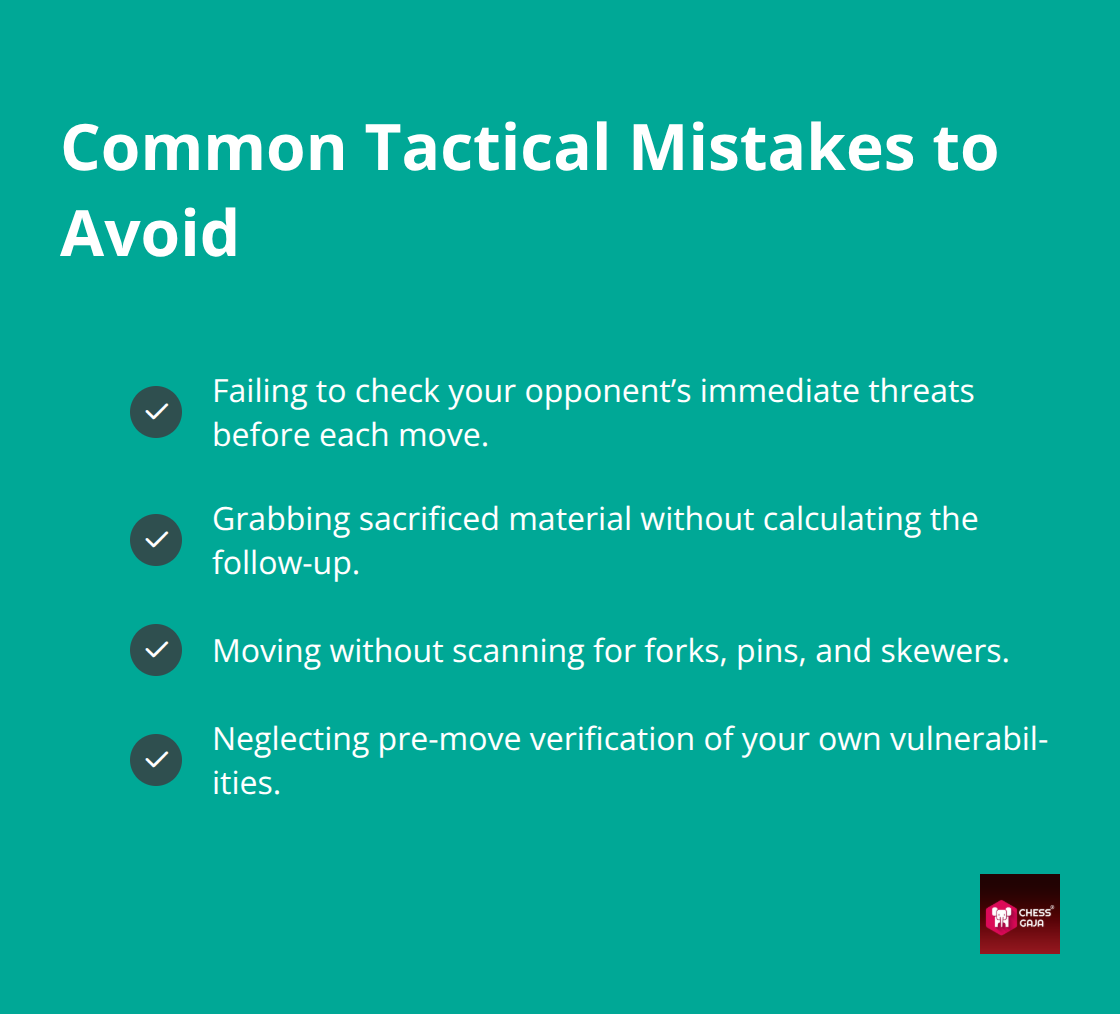
Players at 1200 rarely lose to brilliant moves. They lose because they skip one critical question: What is my opponent threatening right now?
At this level, almost every move carries a threat. It could be a hanging piece, a mating net, or a sharp tactical blow.
For instance, you might attack a knight with your queen. However, you miss their back-rank mate threat. Suddenly, you must give up a rook to survive.
The fix is mechanical. Before you move, pause. Scan for your opponent’s threats first. Only then should you calculate your own attack.
Beginners often make moves without checking if they work. This habit loses games at every level.
Calculate threats before risking material, and you’ll stop the bleeding immediately. Players who develop this discipline jump from 1200 to 1350 within two months because threat awareness prevents blunders.
Falling for Obvious Traps and Sacrifices
Your opponent offers a free pawn. You take it without thinking. Suddenly, they land a fork or a mating attack that wins back heavy material.
Fixating on free material creates huge blind spots. Stronger players know that every sacrifice carries a purpose. Your opponent expects compensation.
Always calculate before accepting material. If you cannot defend against the follow-up threat, do not take the bait. Refusing unsafe sacrifices prevents a large portion of avoidable losses below 1300. Develop your pieces safely instead.
Moving Without Checking Your Own Position
Imagine your bishop and knight land on squares where a single enemy pawn can advance between them. Your opponent spots the geometric alignment and plays a simple pawn fork, winning material instantly.
Pre-move verification prevents these disasters. Check if your pieces share the same rank, file, or diagonal. Identify targets vulnerable to forks, pins, or skewers.
This check takes only 30 seconds per move. It cuts tactical losses in half. Preventing blunders keeps positions stable, allowing you to outplay opponents cleanly.
Final Thoughts
Tactical mastery drives rating growth because every point you gain comes from converting small advantages into wins. The patterns you’ve learned-forks, pins, and skewers-appear in nearly every game you play, and spotting them before your opponent does wins material consistently. Players who master chess tactics to improve rating typically jump 150 points within four months because they stop bleeding pieces and start accumulating advantages that compound into decisive positions.
Your next step involves building the daily habit that separates advancing players from those stuck at their current level. Solve 25 puzzles with full calculation, analyze one of your own games, and play blitz only after you’ve studied—this targeted 45-minute routine produces measurable results within weeks. Track your progress by playing rated games at local clubs in your area, whether that’s the Charlotte Chess Center in the USA, clubs across the UAE, or Singapore’s active tournament circuit.
At Chess Gaja, we’ve built a curriculum used in 40+ countries that accelerates tactical development through personalized coaching and structured analysis.
Our FIDE-rated coaches work with students at your exact level, identifying the specific patterns you miss most often and drilling them until they become automatic. Book a Paid Starter Class for a professional skill evaluation, and our coaches will review your recent games, pinpoint your tactical blind spots, and create a personalized plan to push your rating forward.