
Most chess players stick to the same openings their entire lives. At Chess Gaja, we’ve seen countless students break through plateaus by learning unorthodox chess openings that catch opponents off-guard.
The players who win tournaments aren’t always the ones with the deepest preparation in mainstream lines. They’re the ones who understand how to think differently and adapt when their opponent’s knowledge runs out.
Why Unconventional Openings Win Games
For example, when a student from Singapore played in the Youth Championship, her opponent prepared heavily for the Sicilian Defense. However, she opened with 1.b4 instead. Consequently, her opponent spent fifteen minutes thinking on move one. Thus, she executed a drilled plan and won in 28 moves.
Indeed, this scenario happens constantly in tournaments worldwide. Unorthodox chess openings exploit the gap between what opponents expect and what they can handle under time pressure.
Typically, most players memorize 10 to 15 main lines deeply. Therefore, when you deviate early, their memorized moves collapse quickly. Furthermore, at the club level, playing Bird’s Opening (1.f4) or the Orangutan lets you bypass entire categories of prepared tactics.
Your Opponent’s Clock Becomes Your Weapon
Your opponent’s clock becomes your best ally. Research on chess terms andnd time management shows that players spend significantly more time calculating moves on unfamiliar setups. When facing an offbeat flank opening like 1.b3 or 1.g3, even strong players slow down. The position lacks the sharp lines they know.
As a result, they hesitate, re-check safe moves, and burn clock time. Therefore, pressure builds quickly. A player confident in standard theory suddenly feels lost. This mental friction matters most in rapid and blitz games. Ultimately, you follow a prepared plan while your opponent struggles under time pressure.
Tournament Results Prove Unconventional Play Works
Unconventional openings appear regularly in professional play as practical weapons. Top GMs like Magnus Carlsen play 1.b4 in rapid events to skip heavy theory.
At club level, players gain rating points by playing offbeat lines. A player who knows one unusual line beats opponents who only study main theory.
Lines like Bird’s Opening create unique pawn structures. These positions reward players who know long-term plans over move lists. Our students at Chess Gaja gain points faster in new setups.
Disciplinein your chosen line gives you a big mental edge in key games.
Practical Unconventional Openings for Different Skill Levels
Beginner Systems: Simple Plans Over Memorization
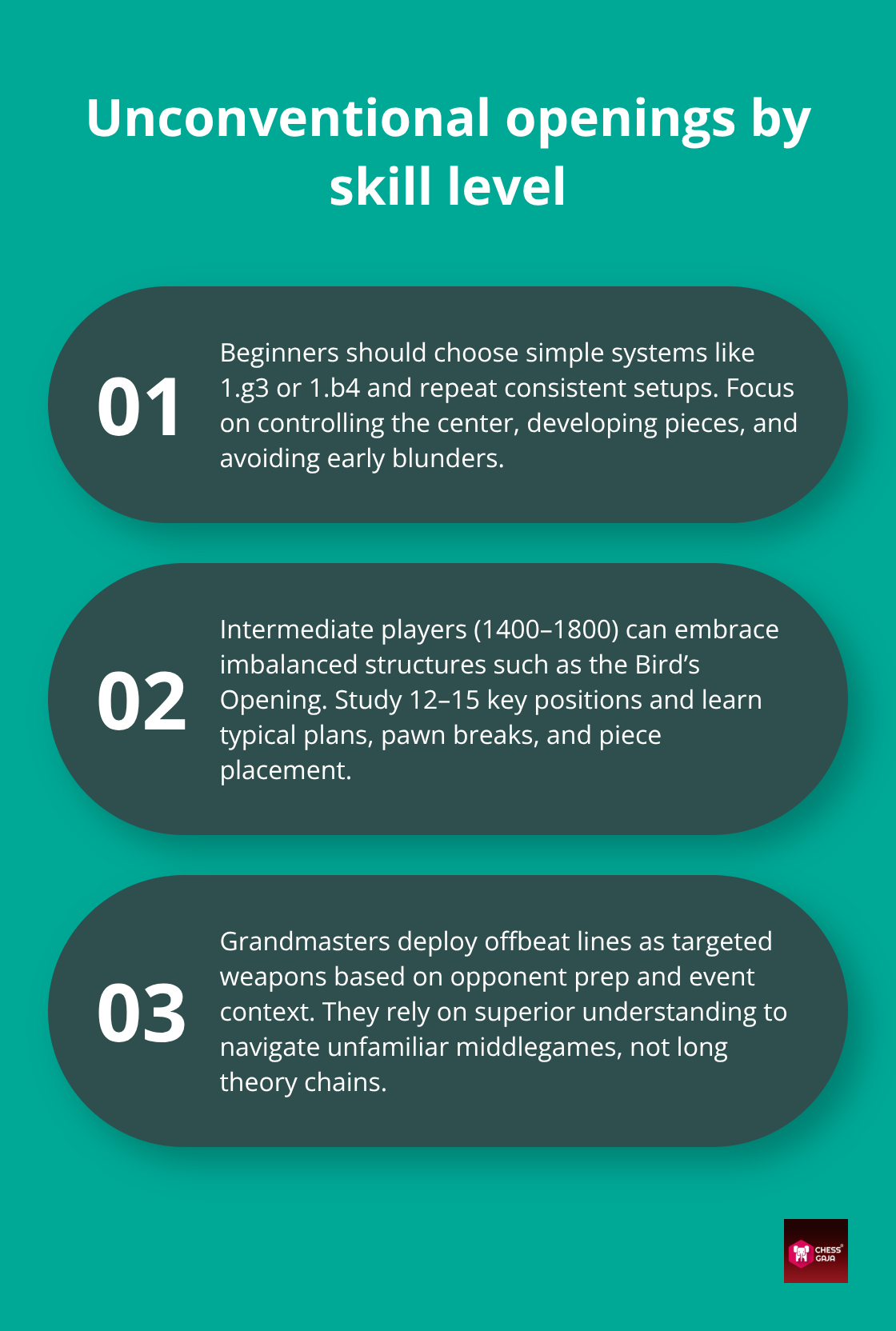
Beginners often waste time memorizing long lines instead of learning key ideas. For instance, a 900-rated player learning the Orangutan (1.b4) does not need 20 moves of theory.
They just need a clear plan. For example, after 1.b4 e5 2.Bb2 Bxb4 3.Bxe5, White gives up a flank b-pawn to eliminate Black’s central e-pawn. White then uses a fianchetto structure on b2 to exert long-term pressure down the a1-h8 diagonal against Black’s kingside. The main goals are simple: control key squares, activate pieces quickly, and avoid blunders.
Beginners benefit from lines like 1.g3 or 1.b3. These systems follow clear principles in every game. For instance, a player using 1.g3 learns the same layout repeatedly. This builds pattern recognition without deep theory.
The practical advantage is clear. Opponents at 900 to 1200 rating rarely study these moves. Most spend ten to fifteen minutes thinking on move one.
Intermediate Play: Complexity and Middlegame Understanding
Intermediate players handle extra depth well. The Bird’s Opening (1.f4) creates unique pawn setups. Here, plans matter more than exact moves. A 1600-rated player must understand how controlling and anchoring the e5-square builds long-term kingside pressure. Learning 12 key setups beats memorizing long move trees.
Most club players know basic openings.
Thus, playing 1.f4 or 1.b4 catches them off guard. Still, they spot basic tactics, so avoid loose play. Learn simple plans: place your rooks well, open key lines, and block counterplay. Clear plans separate winners from losers.
Grandmaster Strategy: Weapons for Specific Moments
Generally, grandmasters rarely rely on a single offbeat system. Instead, they choose them strategically based on tournament context and opponent preparation.
For example, a 2500+ GM might play 1.b4 against an opponent with deep 1.e4 prep. Consequently, the GM relies on superior middlegame understanding rather than theory. At this level, offbeat openings act as practical weapons.
Indeed, the key difference between skill levels is depth of understanding. First, a beginner needs one clear plan. Next, an intermediate player needs plans for different responses. Finally, a grandmaster understands why a plan works against a specific opponent.
Thus, working with experienced coaches speeds up your progress. Targeted instruction gives you the exact tools needed for your level.
How to Study and Master Unconventional Openings
Select Your Lines and Commit to Depth
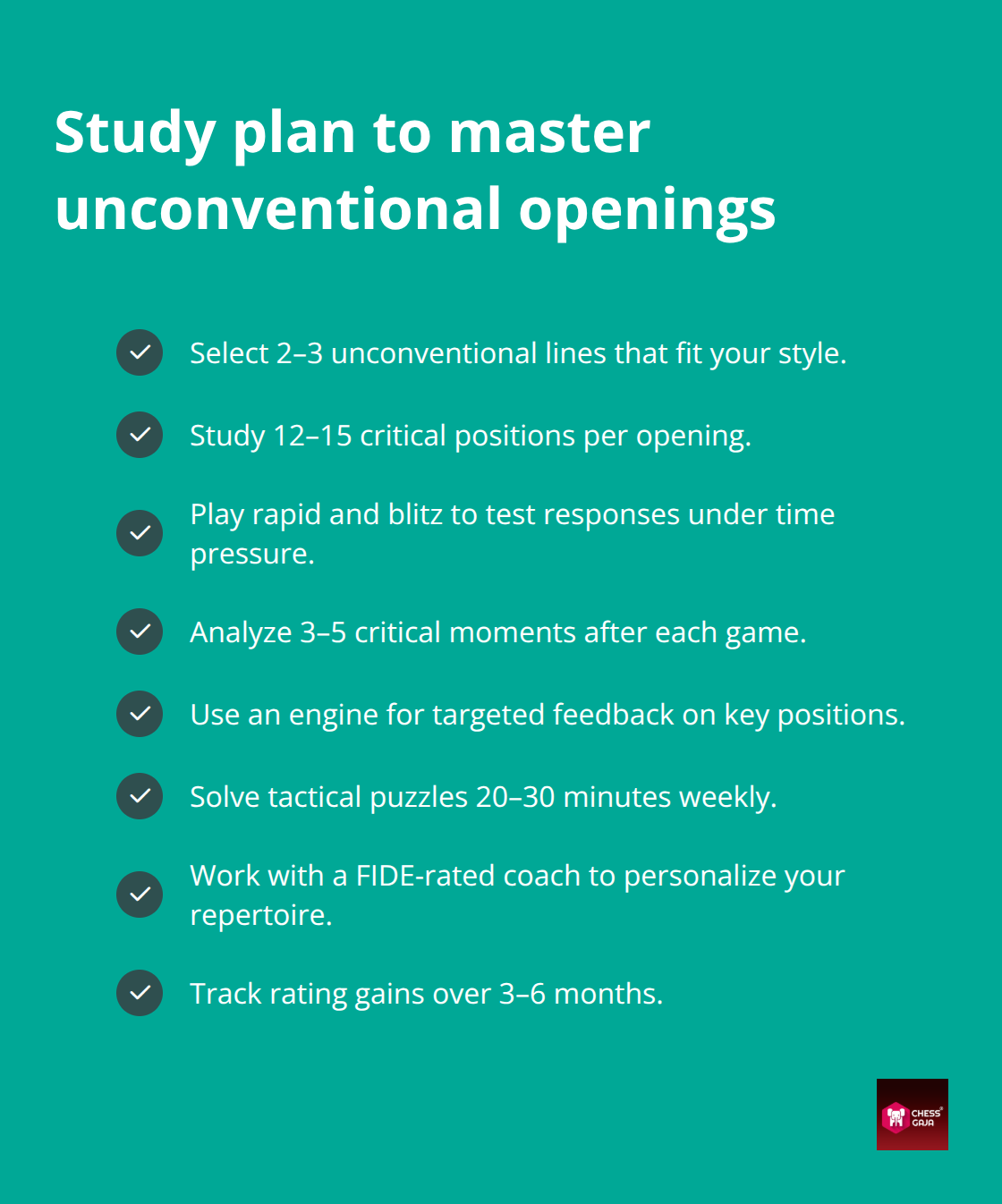
First, pick two or three offbeat lines that match your style. For example, if you prefer early queenside expansion, the Orangutan (1.b4) fits well. However, if you prefer controlling the critical e5-square right from move one, Bird’s Opening (1.f4) works best. Next, use databases to study 12 key setups per line. This focused work builds pattern recognition much faster than general principles.
Understand Middlegame Plans Over Move Sequences
First, focus on key plans rather than move orders. Learn where your pieces belong and how to stop counterplay.
In addition, an intermediate player should study annotated games from grandmasters who play these lines. Pay close attention to piece placement. Fortunately, platforms like Chess.com let you filter master games easily. As a result, studying these games speeds up your learning curve and builds deep intuition.
Practice Against Real Opposition and Analyze Strategically
First, play online rapid games on Chess.com or Lichess against real opponents. As a result, this helps you encounter diverse setups and build intuition outside standard theory.
Second, after each game, use an engine to review key moments. However, do not waste time looking at every single move. Instead, focus only on three to five key positions. Ultimately, this targeted feedback loop fixes actual mistakes fast.
Build Pattern Recognition Through Tactical Training
Spend 20 to 30 minutes each week solving puzzles from your chosen lines. This trains your brain to spot tactical shots when opponents struggle in new setups.
Working with a coach speeds up your growth. Our FIDE-rated coaches at Chess Gaja help students build custom plans. Through personalized game analysis, we fix errors in your flexible thinking under pressure.
This simple method builds true adaptability. Players using this system gain 100 to 150 rating points in 3 to 6 months. They learn core concepts instead of memorized moves.
Final Thoughts
Overall, offbeat lines work best when matched to your opponent. In rapid and blitz games, unorthodox chess openings deliver immediate value. Opponents burn clock time in new setups. Similarly, in classical games, offbeat systems work well if you know the middlegame well. Thus, top players pick lines based on what opponents expect.
In addition, your playing style should guide your opening choice. For instance, if you like queenside space, the Orangutan (1.b4) fits you well. On the other hand, if you prefer controlling the e5-square, Bird’s Opening (1.f4) suits you better. Furthermore, players who gain rating points fast pick openings that match their style.
At Chess Gaja, our coaches help you build a custom repertoire. Our FIDE-rated team guides students across 40+ countries. We teach core middlegame plans that turn good setups into wins.
Through Personalized game analysis, we fix errors in your play under pressure. Book a Paid Starter Class with us today. Find which offbeat lines fit your style and start gaining rating points fast.