


The Sicilian Defense stops most 1.e4 players cold. Black gets active piece play, White struggles to find clear plans, and games become messy fast.
At Chess Gaja, we’ve coached thousands of players through versus Sicilian strategies. This guide breaks down exactly how to play both sides with confidence, using real examples from top grandmasters and practical moves you can use in your next tournament.
Why Black Chooses the Sicilian Over Other Defenses
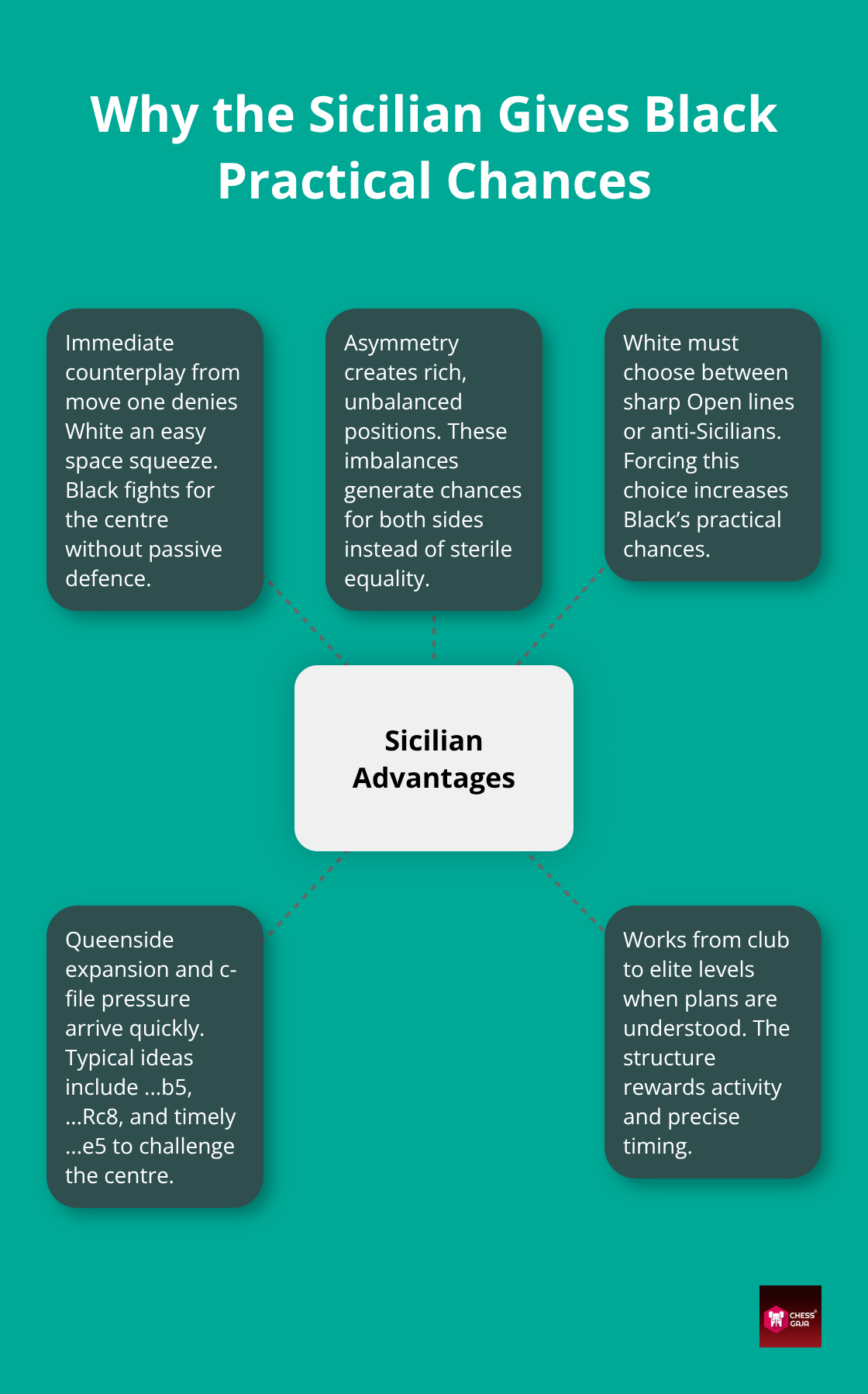
The Sicilian Defense (1.e4 c5) dominates at every level. It gives Black something other 1.e4 responses cannot: immediate counterplay instead of passive defense.
When you play 1…c5, you contest the d4-square with a wing pawn. This forces White into unbalanced positions where both sides have realistic winning chances. This asymmetry matters enormously because Black controls the flow of the game. White cannot simply push for a quiet positional advantage and expect an easy win.
Instead, White faces a choice. They can enter sharp tactical battles in the Open Sicilian, or sidestep theory with anti-Sicilian setups like the Alapin (2.c3) or Closed Variation (2.Nc3).
Neither option guarantees White an easy path. That is precisely why top players from Bobby Fischer to Magnus Carlsen rely on the Sicilian against 1.e4. When they need a dynamic defense, the Sicilian delivers reliable winning chances.
White’s Main Strategic Goals
White faces a fundamental problem: Black’s c5-pawn cramps White’s classical central setup. In the Open Sicilian, White plays 3.d4 to open the center, recapturing on d4 after Black’s 3…cxd4. White then develops pieces toward attacking kingside squares.
The goal is to create concrete threats before Black organizes queenside counterplay. In the Najdorf Variation (1.e4 c5 2.Nf3 d6 3.d4 cxd4 4.Nxd4 Nf6 5.Nc3 a6), White often sets up the English Attack with Be3, Qd2, and f3. This pressures Black’s kingside while Black prepares …e5 or …e6 with queenside expansion.
Against the Dragon Variation (featuring …g6), White typically castles queenside. White then launches a pawn storm with f3, g4, and h4 while Black counters on the queenside.
Alternatively, the Closed Sicilian avoids this theoretical minefield. White plays 2.Nc3, followed by g3, Bg2, d3, and Nge2. This flexible setup allows White to expand gradually without committing to sharp lines. It scores particularly well for club players because it reduces theoretical memorization and encourages strategic play.
Black’s Counterplay on the Queenside
Black’s main task is simple: stop White’s center and block the kingside attack.
After Black trades the c-pawn on d4 (3…cxd4 4.Nxd4), Black plays …e6 or …e5 to stake a direct claim in the center.
In the Najdorf, …a6 serves triple duty. It stops Nb5 or Bb5 tricks. It prepares …e5 in the center. Finally, it supports queenside expansion with …b5.
In the Dragon, Black plays …g6 to fianchetto the dark-squared bishop on g7. This creates immediate threats along the long diagonal and c-file. Black’s pieces activate quickly: while the f6-knight controls central squares, the queenside knight (from c6 or d7) often reroutes via Na5 or Ne5 toward the dominant c4 outpost. Black then uses the c-file for pressure or tactical breaks like …Nxe4.
Why Black Stays Competitive
Black does not defend passively. Instead, Black creates counterplay to neutralize White’s space advantage.
Achieving …e5 or …b5 often balances the game. In fact, Black frequently takes the initiative despite White’s space.
This is why the Sicilian dominates at all competitive levels. It offers Black genuine chances to outplay White in the middlegame. You play to win, not just survive to an endgame.
How White Wins in the Open Sicilian
In the Open Sicilian, White’s winning strategy hinges on one principle: convert early space advantage into concrete threats before Black’s queenside counterplay arrives. The sharpest lines require that you understand pawn structures and piece placement, not just memorize moves. After 1.e4 c5 2.Nf3 d6 3.d4 cxd4 4.Nxd4, White controls the center and can choose between aggressive kingside attacks or flexible maneuvering depending on Black’s setup.
Najdorf Strategy and Timing
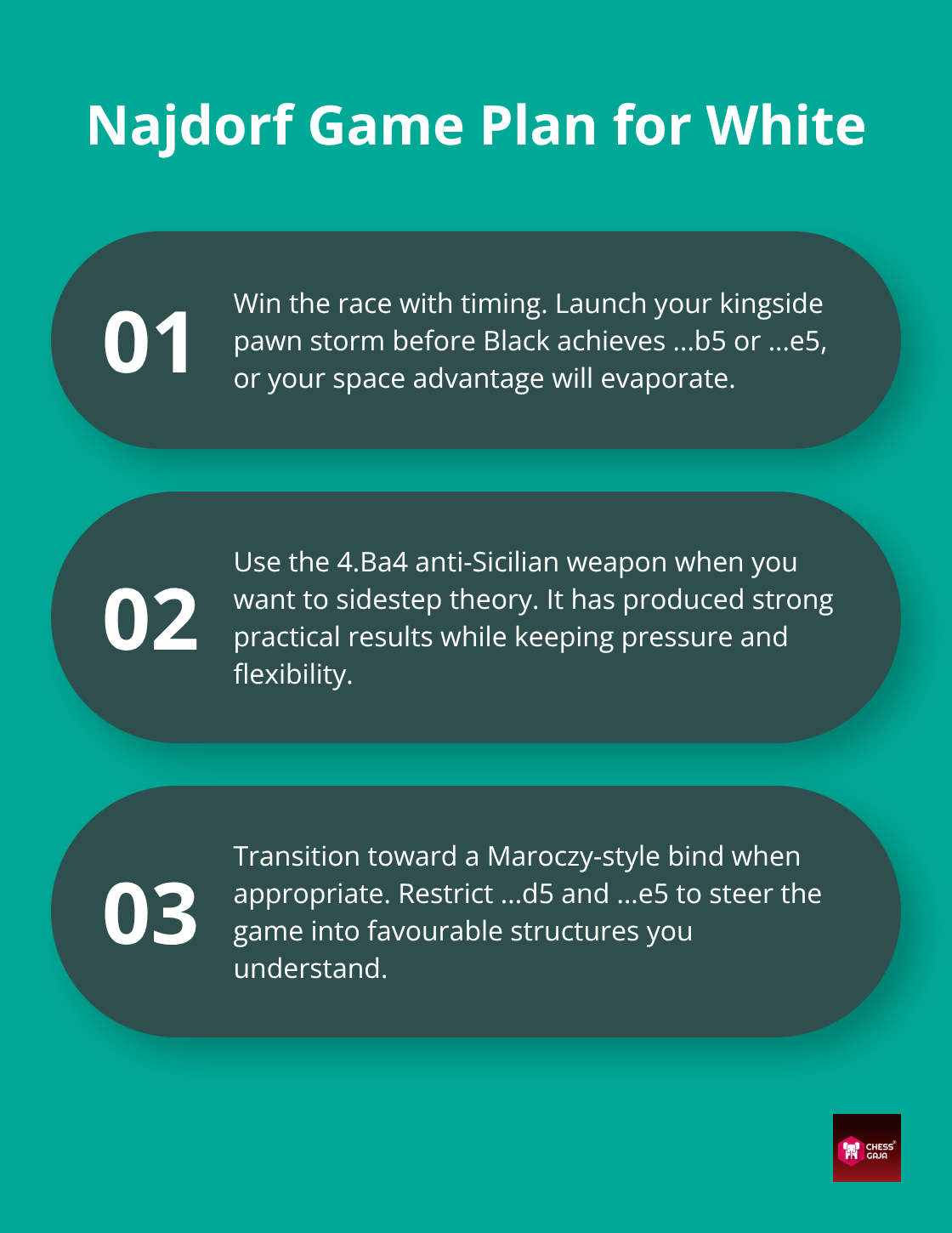
In the main-line Najdorf, White typically targets the kingside with Be3, Qd2, f3, and 0-0-0, launching a pawn storm while Black races for queenside counterplay with …e5 or …b5. The key insight is timing: if White delays the attack, Black breaks through with …b5 or …d5, neutralizing White’s space advantage.
To avoid these main-line theoretical duels altogether, White can opt for Anti-Sicilian setups. For example, Grandmaster Max Illingworth reported a 9 out of 10 blitz score against 2500+ rated players using 3.Bb5+ Nd7 4.Ba4 in the Moscow Variation. By sidestepping standard Najdorf theory, this setup prepares c4 to build a Maroczy Bind structure, restricting Black’s d5 and e5 breaks and forcing Black into Spanish-like positional maneuvering rather than sharp Sicilian chaos.
Top-level players including Maxime Vachier-Lagrave and Gawain Jones have built entire repertoires around this approach, signaling that you do not need the most forcing, theoretical lines to achieve results.
Dragon Attack and Queenside Defense
The Dragon Variation (1.e4 c5 2.Nf3 d6 3.d4 cxd4 4.Nxd4 Nf6 5.Nc3 g6) demands pure attacking chess from White. Black plays …g6 to fianchetto the dark-squared bishop on g7 and castles kingside, so White must castle queenside and launch f3, g4, and h4 before Black’s rook and queen invade along the c-file or long diagonal. Slow play costs you the game outright because Black’s pieces become too active. Against the Dragon, White cannot afford patience; direct, forced attacks with Bc4, Qd2, and Bh6 are essential to break down Black’s kingside shelter before Black’s queenside counter-punches land.
Preparation That Produces Results
Most club players lose in the Sicilian because they study too many variations without mastering a single line. Instead, commit to two concrete setups:
- One main Open Sicilian line (like the Najdorf or Dragon)
- One anti-Sicilian option (like the Alapin 2.c3 or Closed 2.Nc3)
Study the first five to eight moves deeply. Focus on understanding the resulting pawn structures and typical piece placements. Then, review master games from those specific positions rather than browsing random databases.
When analyzing your own games, note which middlegame positions appear most often. This targeted approach beats endless variation study. Players who learn one line and play ten practice games improve much faster than those who memorize twenty lines without playing them. The goal is confidence, not memorization.
Your preparation strategy directly shapes how Black responds to your setup. Understanding Black’s defensive resources and counterattacking patterns becomes essential as you move forward-which is exactly what the next section covers.
How Black Breaks Through White’s Attack
Black’s Active Counterplay Strategy
Black’s counterplay in the Sicilian is not a passive holding operation. It is an active race where Black forces White to choose between consolidating the center and launching an immediate attack. If White hesitates, Black’s pieces penetrate decisively. The most common entry point for Black’s counterattack comes from the c-file and queenside expansion. In the Najdorf, after White plays f3, Be3, and Qd2 with kingside intentions, Black responds with concrete moves like …e5, forcing the knight to retreat, or …b5, advancing on the queenside and opening lines for the rook.
The timing is critical. Black cannot afford slow play because White’s kingside threats arrive first. Instead, Black sacrifices material or accepts slightly worse pawn structures to generate immediate threats that force White’s hand. For example, in sharp Najdorf lines, Black often plays …Nxe4 at the right moment, breaking central tension and opening lines for immediate counterplay with tactics like a …d5 central fork. The key insight for Black players is this: your defense succeeds only when it creates genuine threats, not when it simply survives.
Dragon Variation Tactics and Piece Activity
In the Dragon Variation, Black’s strategy shifts. Black plays …g6 to fianchetto the dark-squared bishop on g7 and castles kingside. Black accepts that White will castle queenside and attack.
Black’s compensation lies on the long diagonal and the c-file. The dark-squared bishop exerts massive pressure across the board.
Typically, Black plays an early …Rc8 and posts a knight on a5 or c4. This attacks White’s light-squared bishop and disrupts White’s queenside setup. Black watches for tactical blows like …Nxe4 or exchange sacrifices like …Rxc3.
The Dragon demands precise calculation. One slow move loses to White’s h-pawn storm. Thus, it remains the ultimate opening for aggressive, sharp tactical players.
Responding to the Closed Sicilian
Against the Closed Sicilian, Black’s approach changes again. White’s setup with g3, Bg2, and d3 is patient and flexible, so Black cannot rely on early central trades. Instead, Black creates pressure through piece activity and pawn breaks: playing …e5 or …e6, challenging White’s center with …d5, or expanding on the queenside with …Rb8 and …b5–b4. The Closed Sicilian allows White to bypass heavy main-line theory while denying Black the usual forcing counterattacks of the Open Sicilian.
Choosing Your Black Repertoire
Building a winning repertoire utilizing Sicilian Defense strategies as Black means selecting variations that match your calculation strength and willingness to play sharp positions. If you excel at tactics and enjoy forcing play, commit to the Najdorf or Dragon and study the critical attacking lines where White pressures your kingside. If you prefer strategic play with fewer forced variations, Taimanov or Kan setups (2…e6) or solid lines against the Moscow Variation (3.Bb5+) offer more flexibility and less memorization. The absolute mistake is to play different Black setups in every game hoping one will work. Instead, master two or three lines deeply enough that you understand the resulting pawn structures and typical piece placements after move twelve. Then study ten to fifteen master games in each position, focusing on how strong players handle the middlegame transition rather than memorizing opening moves.
Data-Driven Preparation and Testing
When playing training games, track which middlegame positions appear most often. Take note of which structures yield the best winning chances. This data-driven approach reveals which variation truly suits your playing style.
Many Black players waste time studying lines they rarely reach on the board. Instead, play your chosen variation in ten consecutive training games. Face opponents rated within 200 points of your rating, then analyze where you struggled.
Adjust your preparation based on real results rather than pure engine analysis. The most successful players are not those with encyclopedic theoretical knowledge. They are the players who understand strategic goals and know exactly when to shift from defense to counterattack.
They know the pawn structures so well that they can play by feel rather than memorization, and they recognize tactical patterns that repeat across multiple games in the same variation.

Final Thoughts
Understanding Sicilian strategy concepts in theory differs from executing them under tournament pressure. Real mastery comes from studying positions you actually reach. Avoid memorizing lines that rarely appear on the board.
Study games by legends like Viswanathan Anand and Vladimir Kramnik in your chosen variation. Notice how they choose between options. Understanding why they reject alternatives builds true intuition.
Digital tools accelerate this learning process. Use Chess.com or Lichess to play training games. Then, review your choices against engines and master databases. Spend ten minutes after each game analyzing the opening phase. Identify where you deviated and adjust for future matches.
Common opening mistakes usually follow three patterns:
- Studying too many variations without mastering one.
- Memorizing moves without understanding pawn structures.
- Ignoring game results and repeating underperforming lines.
The solution is straightforward. Commit to two or three concrete setups and study them deeply. Test them in real games, then adjust based on your actual results.
Ready to elevate your opening repertoire? Book a Paid Starter Class today for a professional skill evaluation and a customized plan to master your chosen Sicilian variation.