Adult beginners often think they’ve missed their window to learn chess seriously. That’s simply not true. We at Chess Gaja have coached thousands of working adults who picked up the game in their 30s, 40s, and beyond-and many reached competitive ratings within months.
This guide walks you through everything you need: the fundamentals that actually matter, a realistic practice routine that fits your schedule, and a clear path to your first tournament.
Why Adults Actually Progress in Chess
Adult Learners Move Faster Than You Expect
Adults often underestimate how quickly they can improve at chess. The reality is that adult learners progress faster than younger players in the first 12 months. You bring discipline, pattern recognition, and focused practice habits that children lack. A working adult who trains 30 minutes daily can consistently reach a 1000–1200 rating within 6 months and target 1400+ within 12 to 18 months.
This speed comes from understanding strategic concepts immediately rather than learning through trial and error. You grasp why controlling the center matters, why king safety is non-negotiable, and why protecting pieces prevents material loss. These logical principles align naturally with how you solve problems professionally.
The Competitive Ratings Adults Actually Achieve
Adult beginners starting from scratch can reach 1200 to 1400 ratings within their first year of consistent practice. Reaching 1400 to 1600 becomes realistic within 18 to 24 months by combining daily practice with tournament play and coaching feedback. These patterns repeat consistently across our adult students worldwide.
Playing 50 to 75 serious games per year while reviewing losses yields steady rating gains every 8 to 12 weeks. Focus each month on one area: tactics, endgames, or opening principles. The main difference between adults who stagnate and those who advance is systematic game review.
How Your Professional Background Accelerates Learning
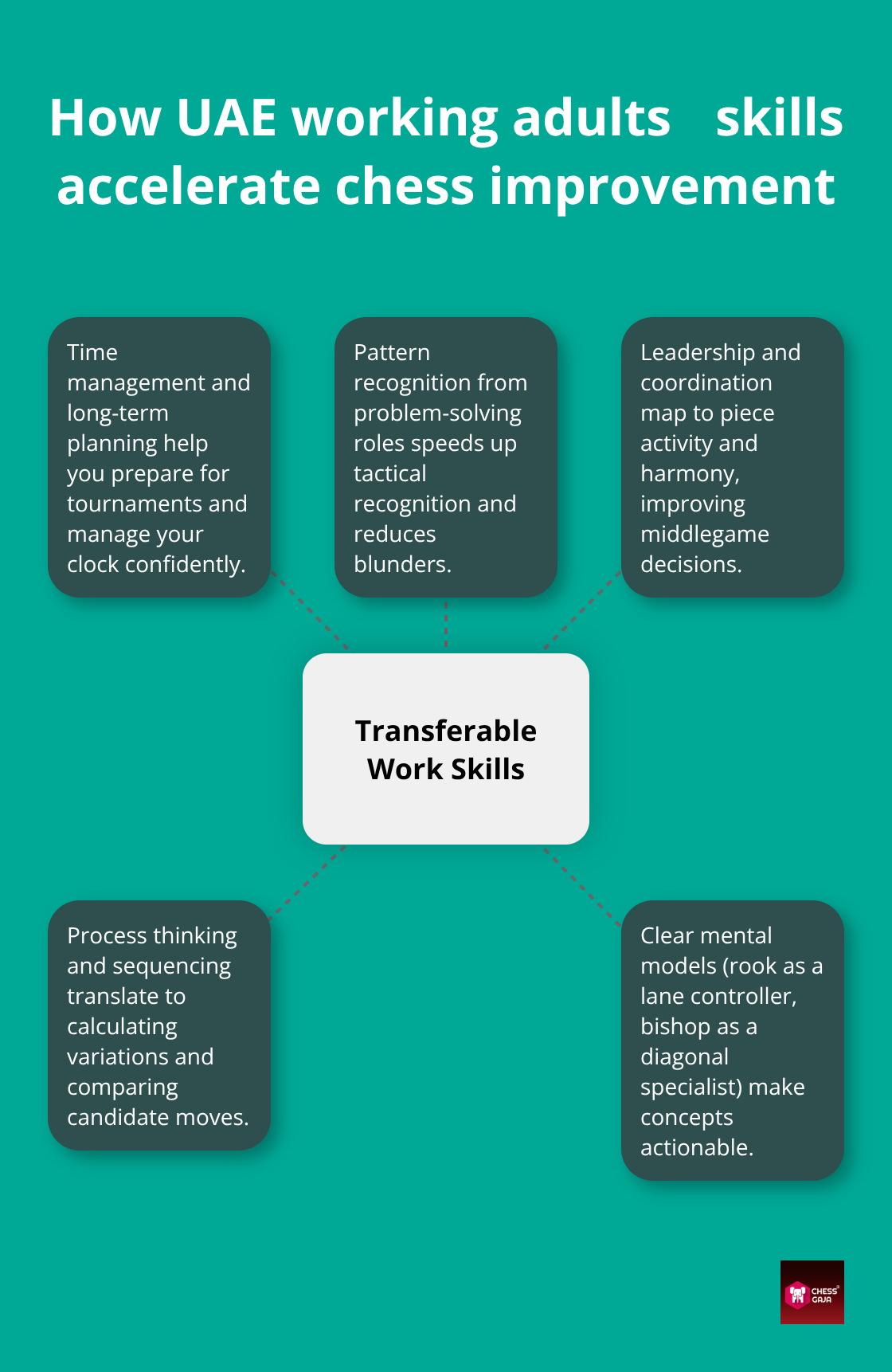
Your work experience gives you an unfair advantage in chess. Project managers easily grasp game-clock management and long-term planning during tournament preparation. Problem-solvers naturally think in patterns and sequences, which accelerates tactical vision. Meanwhile, team leaders intuitively grasp positional structure and piece coordination.
These transferable skills mean you don’t start from zero; you start with a cognitive foundation that children must build. The adults who progress fastest are those who consciously connect chess concepts to skills they’ve already mastered. Think of your rook as a team leader that controls key lanes, or your bishop as a specialist that dominates long diagonals-these mental models make abstract chess ideas concrete and actionable.
What Separates Fast Improvers From Stalled Players
The adults who advance consistently share one habit: they review their games within 48 hours. Analyzing losses while fresh in memory reveals the exact moment your strategy broke down. You spot the missed tactic, undefended piece, or violated opening principle. Skipping this step leads to repeating mistakes and quick plateaus.
Fast improvers also focus on one weakness at a time rather than tackling everything at once. Spend a month on endgame fundamentals, the next on tactical patterns, and the following on opening principles. This focused approach compounds over time, producing measurable quarterly rating gains for adults climbing to 1600+.
Your First Tournament Sits Closer Than You Think
You now have the foundation to understand why adults progress so quickly in chess. Your professional experience, your ability to focus, and your capacity to learn from mistakes position you to advance faster than you imagined. The next step is building a practice routine that actually fits your schedule-one that doesn’t require you to quit your job or abandon your family. That’s where the real transformation happens.
What Fundamentals Actually Matter for Your First Tournaments
Center Control Wins Games Immediately
Most adult beginners waste months studying theory that won’t help them win games. The fundamentals that matter are far more specific: knowing exactly which squares to control, which opening moves work repeatedly, and which tactical patterns appear in a vast majority of your games. Board control isn’t about memorizing piece values or learning complicated systems—it’s about understanding that the center four squares (d4, d5, e4, e5) determine who has tempo and space. Control means occupying or contesting the center with a pawn (such as 1.d4 or 1.e4 for White, or 1…d5 or 1…e5 for Black) in the opening moves. That single habit—one concrete action—shifts the balance of power immediately.
Five Opening Moves That Work in Real Games
The second fundamental is learning core opening moves that work in real games, not memorizing 20 moves of theory. For White, play 1.e4 (the most direct path to central control). When facing 1.e4 as Black, stick to 1…e5. Avoid complex defenses like the Sicilian Defense (1…c5), which require deep theoretical memory. Focus instead on basic open-game principles: develop your knights and bishops toward the center, castle within the first 10 moves, and secure your king. Adults who follow this simple sequence and reach move 10 safely win a vast majority of their games against opponents rated below 1400.
Four Tactical Patterns That Appear Constantly
The third fundamental is recognizing four tactical patterns: the back-rank mate threat (where a trapped king has no escape squares on the back rank), the pin (a piece cannot move without exposing a more valuable piece behind it), the fork (one piece attacks two or more target pieces simultaneously), and the skewer (attacking a high-value piece directly, forcing it to move and exposing a weaker piece behind it). Spending 20 minutes daily on tactical patterns in chess puzzles for 30 days will train your eye to spot these patterns in most of your real games.
Adults who complete 150 puzzles focused on these four patterns drastically reduce one-move blunders and spot winning tactics within seconds during real games.
Why Tournament Players Still Rely on These Fundamentals
Tournament players rated 1600 to 1800 still rely on center control, simple openings, and pattern recognition as their foundation. The difference is they execute these fundamentals faster and more accurately. The mistake most adult beginners make is treating these fundamentals as stepping stones to something deeper. They’re not. Focus on three core areas during your first three months. Play 50 games aimed entirely at central control by move four. Master your five opening moves, and solve 10 tactical puzzles daily. Track which games you win and which you lose, then review the losses to identify which fundamental you violated. Ask yourself if you lost center control early in the game. Check whether you played an unfamiliar opening move. Look closely for any missed tactical patterns. This targeted approach produces measurable results: adults following this path reach 1200 to 1400 ratings within 16 weeks.
The Fast Track: Avoid Distractions and Stay Focused
Avoid the trap of reading complex opening treatises, advanced endgame theory books, or passively watching hours of YouTube lectures. Those resources matter later, but right now they distract you from the three actions that win games. The adults making the fastest progress are those who stay ruthlessly focused on these fundamentals and measure progress by wins and losses, not by how much theory they’ve absorbed. Once you’ve played 50 games with center control as your primary focus and solved 150 tactical puzzles, you’ll notice something shift: positions that looked confusing now feel familiar, and you spot tactical opportunities before your opponent does. This confidence carries you into your first serious tournament-where the real test begins.
How to Build a 30-Minute Daily Chess Routine That Actually Works
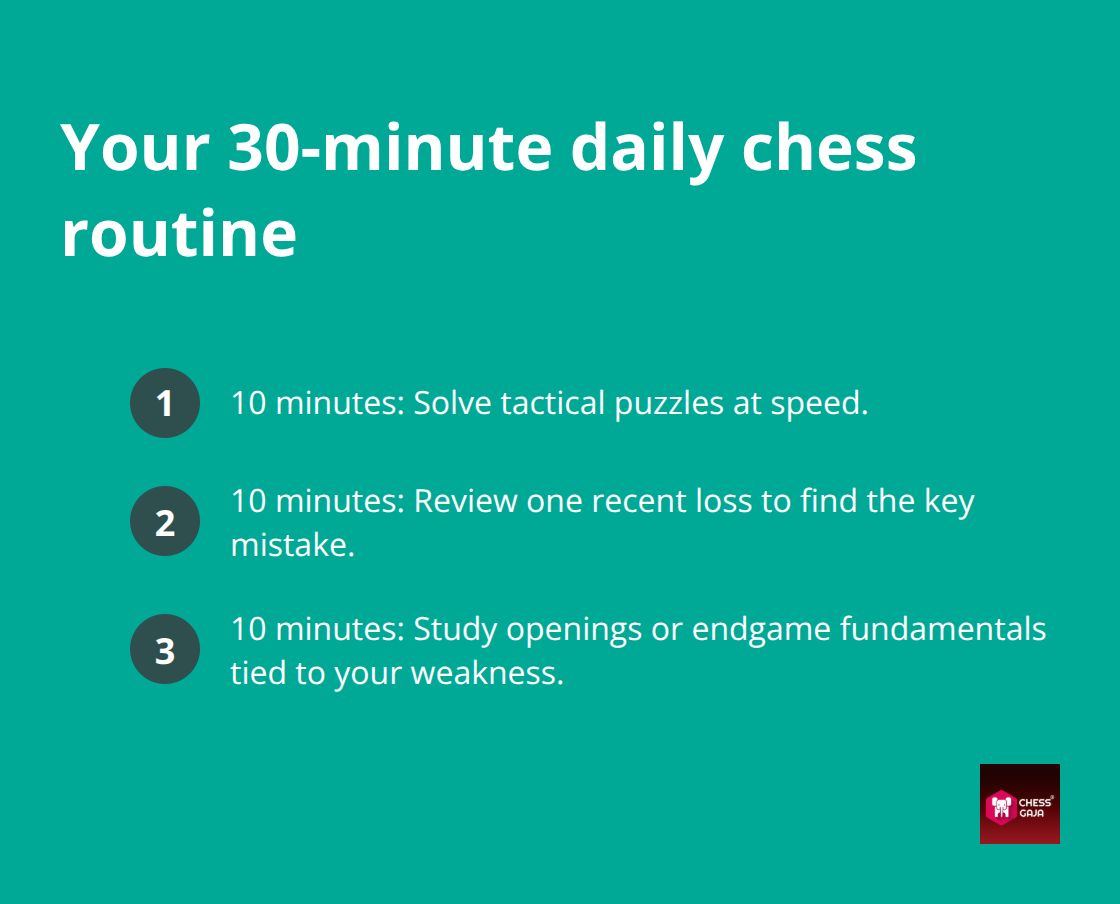
Working adults rarely have hours to spare, so your practice structure must be ruthlessly efficient. The adults reaching 1400+ ratings in under a year don’t practice longer than you can manage-they practice smarter. Your 30 minutes should split into three focused blocks: 10 minutes on tactical puzzles, 10 minutes on game review, and 10 minutes on opening study or endgame fundamentals.
Start With Tactical Puzzles When Your Mind Is Sharpest
Tackle tactical puzzles first while your mind is sharpest. Aim for 15 to 20 puzzles daily on Lichess or Chess.com. Try solving each puzzle in under 30 seconds.
Your goal is not perfection; it’s speed and accuracy under time pressure. Adults who complete 10 puzzles daily build strong tactical accuracy within 8 weeks, while those who learn chess tactics effectively master high-level pattern recognition in the same timeframe.
Review One Loss to Identify Your Exact Weakness
After puzzles, spend 10 minutes reviewing one loss from the past week. Open your game, play through it move by move, and identify the exact moment your position collapsed. Write down the blunder in a single sentence—perhaps losing a piece to a fork, ignoring a back-rank threat, or playing an unfamiliar opening move. This written record becomes your weakness list, which you address in future study sessions.
Rotate Your Focus Monthly to Build Depth
Use the final 10 minutes for your main weakness. If endgames trip you up, study basic checkmate patterns like King and Rook vs. Lone King. Master simple King and Pawn endings before tackling advanced theory. If you’re weak in the opening, spend those 10 minutes practicing your opening setup against Lichess or Chess.com bots set to a low-to-intermediate level (800–1200 rating) or analyzing your opening choices from your own recent games. Rotate your focus monthly—month one on tactics, month two on endgames, month three on openings—so you build depth in one area before shifting. This rotation prevents the scattered learning that causes plateaus.
Track Your Results to Spot Real Patterns
Many adult beginners fail because they practice inconsistently or choose inefficient tools. Choose a slower time control, such as 15 minutes with a 10-second increment per move. Increments are vital for real learning. Play three to five serious games weekly instead of blitzing 20 rapid games that build bad habits. Track your results: write down your opening, your rating, whether you won, and the reason you lost (if applicable). After 50 games tracked this way, you’ll see patterns-perhaps you lose consistently when your opponent plays a specific opening, or you blunder in positions after move 20. These patterns reveal your actual weaknesses, not imaginary ones.
Measure Progress Every 8 Weeks and Adjust Immediately
Set a milestone of reaching 1200 rating within 12 weeks if you start below 1000, then 1400 within 24 weeks. Measure progress every 8 weeks by playing 10 rated games and comparing your accuracy to previous sessions. Adults tracking their progress gain roughly 50 rating points every 8 to 12 weeks. Casual players who skip tracking often stagnate for months. The difference isn’t talent-it’s visibility into what’s actually working. If your 30-minute routine isn’t producing rating gains after 8 weeks, adjust immediately: increase puzzle difficulty, play more games, or shift your endgame focus to a weakness that appeared in your losses.
Final Thoughts
Your first tournament arrives sooner than you expect. After 12 weeks of consistent practice, you will have played 50+ games, solved hundreds of tactical puzzles, and reviewed your losses systematically. You walk into that tournament knowing you have built a foundation that works: center control, five opening moves, and pattern recognition. The experience itself teaches you more than any book can, as you learn how time pressure affects your decisions and which openings suit your style.
Finding the right community and coach matters more after your first tournament. You need feedback from someone who understands your specific position, not generic advice from YouTube. Chess Gaja serves 5,000+ students across 40+ countries, including the USA, UAE, and Singapore, with coaches who are FIDE-rated and trained by Grandmaster Priyadharshan Kannappan. Your coach from your starter class continues with you, so they understand your exact weaknesses and progress trajectory.
Moving from beginner to intermediate happens when you shift from memorizing fundamentals to applying them flexibly. At 1400 rating, you start recognizing when to break opening rules because the position demands it, when to sacrifice material for an attack, and when to play for a draw instead of pushing for a win. Book a personalized chess class with Chess Gaja to receive a professional skill evaluation and a personalized study plan that fits your schedule and goals.