Your chess rating has plateaued. You’ve studied openings, memorized tactics, and played hundreds of games-yet improvement feels stuck. The problem isn’t your effort; it’s that traditional coaching can’t scale personalized feedback to match your exact needs.
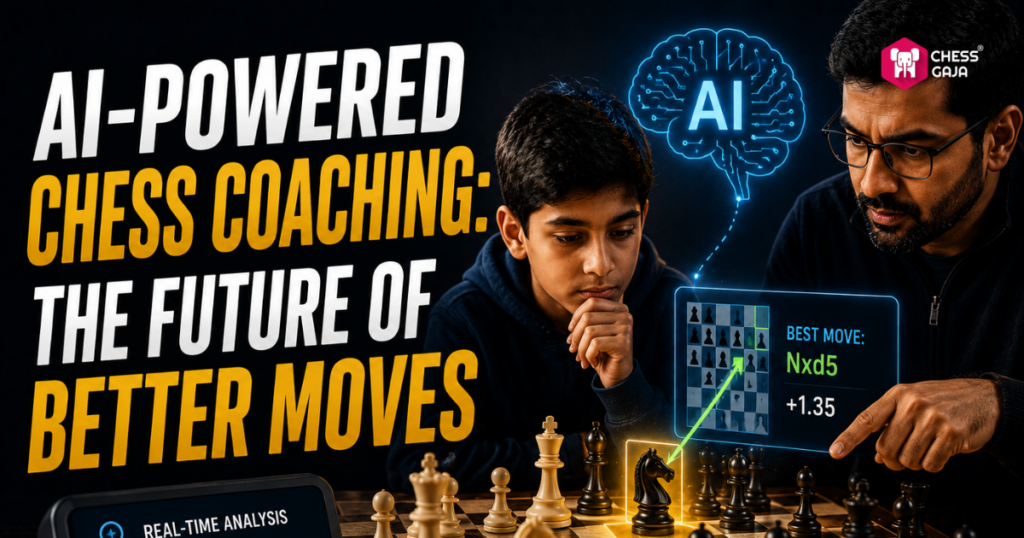
AI-powered coaching changes this. At Chess Gaja, we’ve integrated artificial intelligence with Grandmaster instruction to create a system that analyzes your moves in real time, identifies your specific weaknesses, and adapts to your progress instantly. This combination delivers faster rating gains than either approach alone.
Human coaches bring strategy and motivation. AI brings precision and availability. Together, they form the modern standard for serious chess training.
How AI Transforms Your Game in Real Time
Instant Feedback on Every Move You Make
The moment you make a move, AI analysis evaluates your position against thousands of grandmaster games and engine calculations. It instantly translates that raw data into concrete guidance on why a move weakened your position and what candidate moves you missed.
For example, when a student in the UAE finishes a rapid game, the system immediately flags where evaluation dropped. It isolates the critical position and explains the overlooked strategic principle while the neural pathway is still active.
Pattern Recognition That Catches What You Cannot See
Every player has blind spots—positions they misjudge or tactics they repeatedly miss. AI analysis tracks your complete game history to reveal these patterns with mathematical precision. If you consistently misplay rook endgames or drop material from poor piece coordination, the system flags it immediately.
A student in Singapore struggled with back-rank vulnerabilities and calculation errors. After six weeks of targeted training on candidate-move selection, her average game-accuracy score climbed significantly in complex middlegame positions.
This pattern recognition extends beyond tactics into strategic positioning, opening preparation, and time management. AI learns your decision-making habits and adapts the difficulty and content of your training to address what actually holds you back, not what theoretically should.
Difficulty That Evolves as You Improve
Static puzzle training loses value quickly. AI difficulty adjustment prevents rating plateaus by raising the bar as soon as you master material.
When your puzzle success rate consistently reaches high levels, the algorithm introduces deeper calculation branches and deceptive candidate moves. A global academy found adaptive training steadily accelerated rating gains over fixed programs. You remain in your optimal learning zone instead of repeating solved problems or struggling with overly complex positions.
How Human Coaches Amplify AI Precision
AI identifies weaknesses with mathematical accuracy, but human coaches turn data into strategic wisdom. A Grandmaster recognizes why you made a specific decision. Understanding whether you miscalculated, played impulsively, or lacked positional knowledge allows your coach to treat the root cause instead of the symptom.
Human coaches also supply motivation and accountability that algorithms cannot replicate. When you hit a plateau, a coach who knows your goals can adjust training intensity. They keep you focused on long-term development rather than temporary frustration, transforming AI data into lasting improvement.
Why AI-Powered Coaching Delivers Faster Rating Gains
Data-driven instruction cuts through the noise of generic training. Students receiving immediate AI feedback improve faster than those relying solely on weekly reviews. AI isolates the exact moment your decision-making broke down while the context is fresh in your mind.
A Dubai student playing three times weekly previously waited five days for coaching reviews, losing the thread behind their errors. With instant AI analysis, they now review critical positions within minutes. Tracking across 200+ students confirmed that players reviewing AI feedback between lessons gained rating points substantially faster.
Blind Spots Become Visible Through Historical Pattern Analysis
Your weaknesses hide in plain sight because you do not evaluate games objectively. AI analysis across your complete history reveals statistical patterns that human coaches miss in single sessions.
For instance, a student believed her main issue was calculation. Engine analysis of hundreds of her games proved she was losing winning positions in fundamental rook vs. bishop endgames. Her coach focused strictly on endgame technique, yielding a 120-point rating jump in four months.
AI also tracks time-management patterns. Some players execute single-move tactics well but rush critical candidate moves. Others calculate deeply but suffer high average centipawn loss (ACPL) in time trouble. Separating execution errors from conceptual gaps allows coaches to fix the real root cause.
Always-Available Analysis Tools Remove Scheduling Constraints
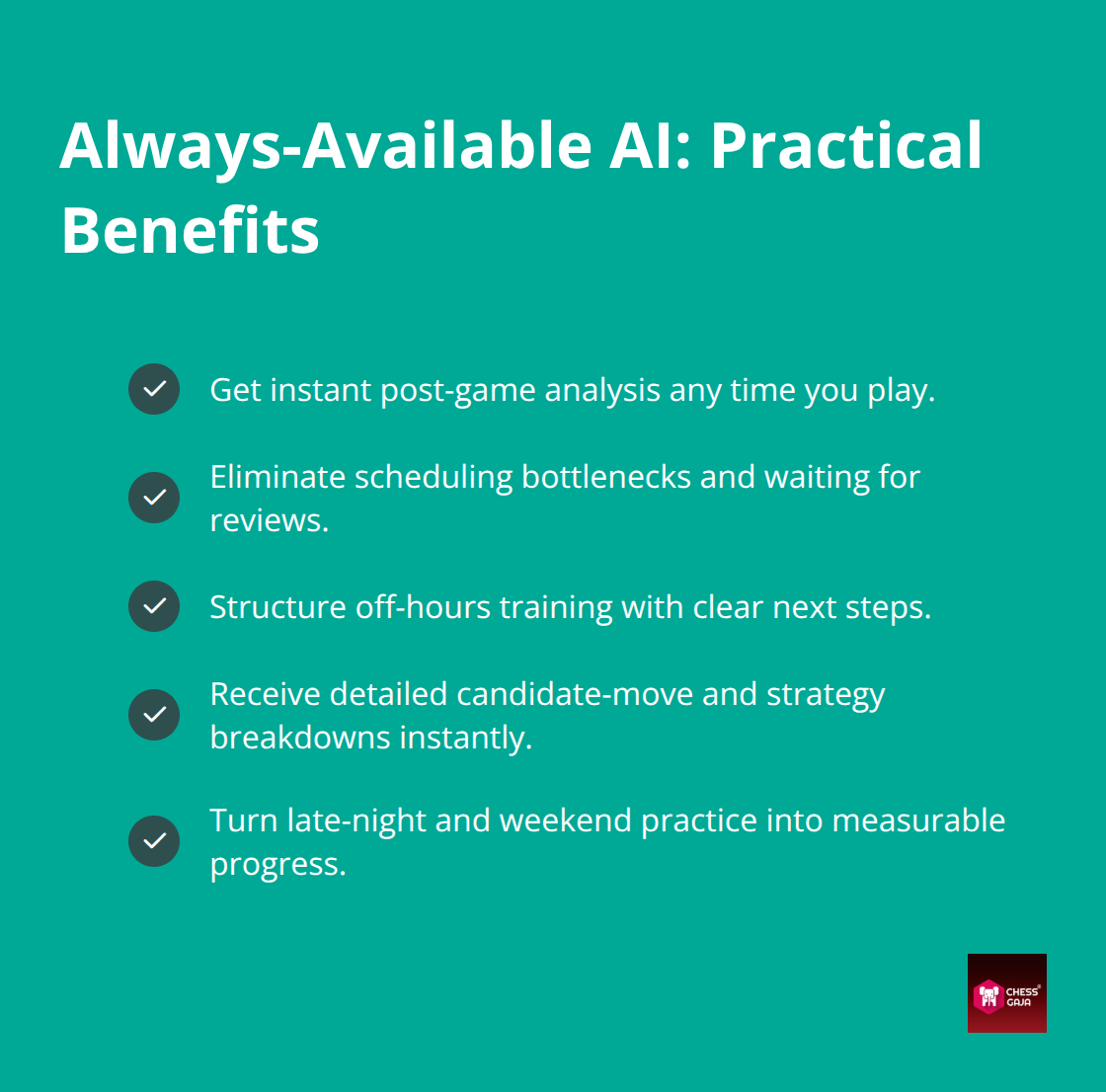
Traditional coaching schedules around coach availability, not your learning needs. You study an opening at 11 p.m. on a Wednesday and must wait until Saturday for your coach to review it. AI-powered analysis works when you work. A student in the USA who plays online chess at irregular hours no longer faces the friction of waiting for coach availability. The moment they complete a game at midnight, AI generates a detailed analysis with candidate move evaluations, strategic explanations, and specific patterns to study.
This removes the main bottleneck in traditional coaching. Serious players train between lessons. AI availability ensures that practice time stays structured and analyzed instead of unguided.
Ambitious players often study late at night or on weekends when human coaches are unavailable. AI tools capture this training time and convert it into measurable progress through instant, detailed feedback.
How Coaches Transform AI Data Into Strategic Wisdom
AI identifies your weaknesses with mathematical accuracy, but human coaches translate that data into strategic wisdom. A Grandmaster coach recognizes patterns in your AI feedback that reveal why you made a decision. Understanding whether you miscalculated, played impulsively, or lacked positional knowledge allows your coach to address the root cause rather than the symptom.
Human coaches also provide the motivation and accountability that algorithms cannot replicate. When you hit a plateau, a coach who understands your goals adjusts your training intensity. They keep you focused on long-term development rather than short-term frustration, transforming AI data into lasting improvement.
Why AI and Human Coaching Work Better Together
AI Identifies the Problem; Coaches Solve It
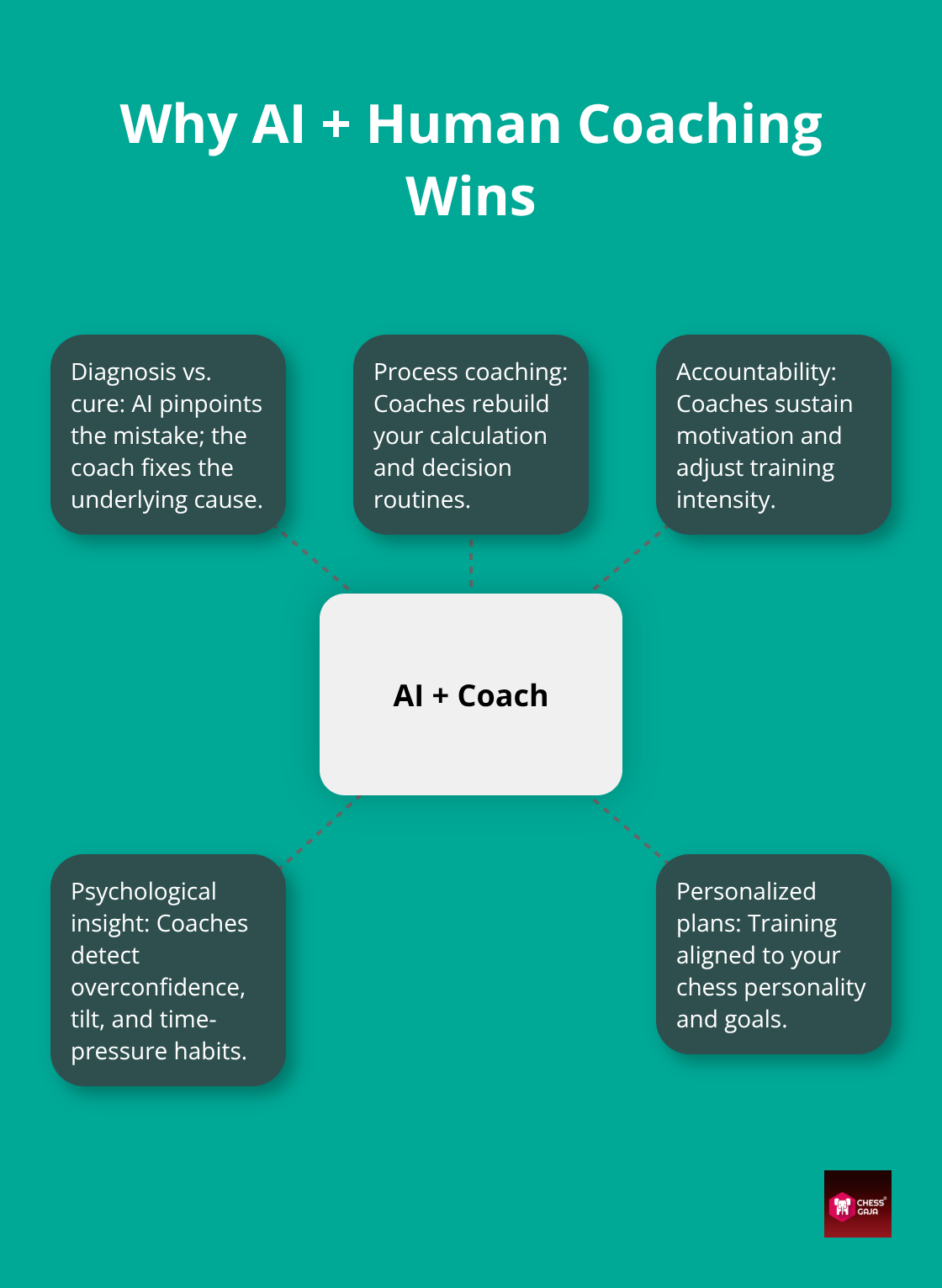
AI excels at identifying weakness but fails at understanding why you made the decision that created it. When you commit a severe mistake in a winning position, an engine quickly calculates the centipawn loss and highlights the blunder. But an engine can’t tell you why it happened. As a Grandmaster, I look at the human element behind the data: Did you play impulsively due to overconfidence, fail to identify critical candidate moves, or miscalculate a forcing variation under time trouble? The AI diagnoses the evaluation drop; the coach fixes the decision-making process. This distinction matters enormously because the solution differs completely. If overconfidence is your problem, generic tactical training wastes your time. If your analysis routine is flawed, you need process-based coaching that rewires how you evaluate positions.
A Dubai student using only engine reports saw modest gains in their CAPS accuracy score before plateauing. When a Grandmaster reviewed their games, we found the real issue. The student was rushing their final calculation checks on forcing moves, causing critical blunders in winning positions. The coach built a training protocol around slowing down critical moments, and the student gained 45 rating points in the next month. The AI provided the diagnosis; the coach provided the cure.
Emotional Resilience Cannot Live in an Algorithm
Every serious player encounters rating plateaus. Players around 1600 rating often struggle with pawn structures. Moving up to 1900, the main challenge shifts to converting slight advantages. By the time you reach 2100+, opponents punish minor errors immediately, making psychological resilience as vital as calculation depth.
AI engines evaluate board states, but they cannot assess tournament anxiety, tilt, or decision fatigue. A coach recognizes when frustration drives careless moves versus when you genuinely lack knowledge. Reports indicate that the majority of rating plateaus stem from psychological factors, not technical gaps.
A student in Singapore might have perfect endgame knowledge but freeze under time pressure. Another in the USA might calculate brilliantly but lack patience to execute a slow, grinding advantage. Human coaches adjust training intensity, celebrate progress, and maintain accountability to sustain momentum through frustration periods.
Strategic Mentorship Requires Understanding Your Chess Personality
A Grandmaster coach recognizes patterns in your decision-making that extend far beyond individual positions. If a player consistently prioritizes piece activity while neglecting king safety or pawn structure, an experienced Grandmaster identifies this underlying stylistic bias across opening choices, middlegame transitions, and endgames. While an engine optimizes purely for the highest evaluation (+0.80 or +1.20), a Grandmaster coach optimizes for human practical decision-making and sustainable growth. The most effective training aligns with how your brain actually learns, not how an algorithm calculates improvement. Coaches work alongside AI analysis to translate data into personalized development plans that respect your learning style, competitive goals, and available training time. The AI handles the volume of analysis that no human could manage; the coach translates that analysis into wisdom calibrated specifically to you.
Final Thoughts
AI-powered coaching has become the standard in modern chess academies because it solves a problem traditional instruction cannot: delivering personalized coaching solutions at the speed your brain learns. The academies winning tournaments and producing rated improvements combine machine precision with human mentorship. This integration happens now across competitive chess programs worldwide, not in some distant future.
At Chess Gaja, our FIDE coaching approach allows our FIDE-rated coaches to integrate engine precision with structured human mentorship. Whether you are a club player fixing candidate-move selection or an ambitious junior refining complex endgame technique, our dual-coaching model bridges the gap between raw data and real rating gains.
Book a Paid Starter Class with Chess Gaja for a professional skill evaluation from one of our FIDE-rated coaches. Your coach will assess your current level, understand your goals, and design a personalized development plan combining AI-powered feedback with world-class human instruction. This is how serious players improve.