

You’ve learned the basic moves. You know how pawns and pieces work. But when the game starts, you freeze-unsure which squares matter most or when to move your king to safety.
Finding opening principles is what separates players who memorize moves from players who understand chess. At Chess Gaja, we’ve coached thousands of students through this exact transition, and we know the path works: learn the principles first, then practice applying them in real games.
What Opening Principles Actually Are
Opening principles are concrete rules for your first 10–15 moves. They guide your strategy regardless of what your opponent plays. They are not memorized sequences or fancy tactics. Instead, they are decision-making tools that tell you which squares matter, when to move your pieces, and how to build a safe position. The three core principles are controlling the center (d4, d5, e4, e5), developing your pieces quickly, and castling at the right moment for king safety. These principles work at every level because they reflect how chess position value actually functions.
Control the center and develop five pieces in 12 moves. Doing so allows you to outplay opponents who rely solely on memorizing 20 opening moves. A 1600 FIDE player who applies these rules consistently will gain rating points faster. Skipping principles for sharp, theoretical lines slows down your progress. The difference between a 1200-rated player and a 1600-rated player is not superior memory-it is superior understanding of which squares matter and why. Your brain needs to understand the logic first, not the moves.
How Principles Change Across Skill Levels
Opening principles apply across beginner, intermediate, and competitive levels, but the execution changes dramatically. A beginner learns that you should castle by move 10 and keep your king tucked away. An intermediate player learns when to delay castling. Keeping the king in the center for two extra moves is correct if it wins material or creates a winning attack. A competitive tournament player knows that in closed positions or delayed systems like the King’s Indian Defense or certain Sicilian variations, delaying castling until move 10–12 is a deliberate choice because the center is locked and the king is not in immediate danger.
This progression shows that principles are not rigid rules-they are guidelines that strong players learn to bend intelligently. Students often play 1.e4 or 1.d4 after reading about center control. However, many still lack understanding of why these moves accomplish that goal. Theory tells you the move; practice teaches you the position.
Why Reading Theory Alone Falls Short
Reading an opening book is not enough to master principles. You can memorize that the Ruy Lopez involves e4, e5, Nf3, Nc6, Bb5, but if you do not understand that this move order controls the center, develops your knight before your bishop, and prepares to castle, you will make poor decisions when your opponent deviates. The only way to bridge the gap between theory and practice is to play the opening repeatedly in real games, then analyze what happened afterward.
Students in the USA, UAE, and Singapore who join structured coaching programs see this transition happen within 3–6 months of consistent practice. Applying principles in 50 real games builds strong pattern recognition. This practical experience far outweighs studying theory alone. This is where the real learning begins-not in books, but in the positions you face across the board.
Three Principles That Win Games
The opening is not about memorizing moves-it is about executing three concrete tasks that give you a winning position by move 12. Control the center, develop your pieces, and keep your king safe. Master these three tasks to win consistently. You will regularly beat players who rely solely on memorizing opening lines. Students who nail these three principles climb 200–300 rating points within their first year, while students who skip them and jump straight to theoretical memorization plateau around 1000–1200 FIDE rating and stop improving.
Why the Center Matters More Than You Think
The four central squares-d4, d5, e4, e5-are worth fighting for because they control more of the board than any other squares. A knight centralized on d4 or e4 controls eight key squares, whereas a knight on the edge of the board controls as few as two or four. In practical terms, this means your pieces are stronger, your opponent’s pieces are weaker, and you have more options on every turn. In real games between two 1400-rated players from Dubai or Singapore, the player who controls the center wins more often than the player who ignores it. The player who ignores the center and plays random developing moves wins only a fraction of those games.
Control e4 or d4 with a pawn on move one, then develop minor pieces that support or expand that control. For example, in the Ruy Lopez (1.e4 e5 2.Nf3 Nc6 3.Bb5), White plays 3.Bb5 to put indirect pressure on Black’s e5 pawn while clearing the path for immediate castling. Understanding this central logic prevents you from freezing when an opponent strays from standard book moves.
Developing Pieces Fast Wins Material
Development means moving pieces from their starting squares to squares where they attack the center or control key lines. A piece that sits on its starting square does nothing-it cannot defend your king, attack your opponent’s pieces, or control the board. Tournament players typically develop their knights by move 2 or 3, followed immediately by their bishops to active diagonals by moves 3 to 5. Beginners often move the same piece twice in the opening while leaving other pieces at home. This is a fatal mistake.
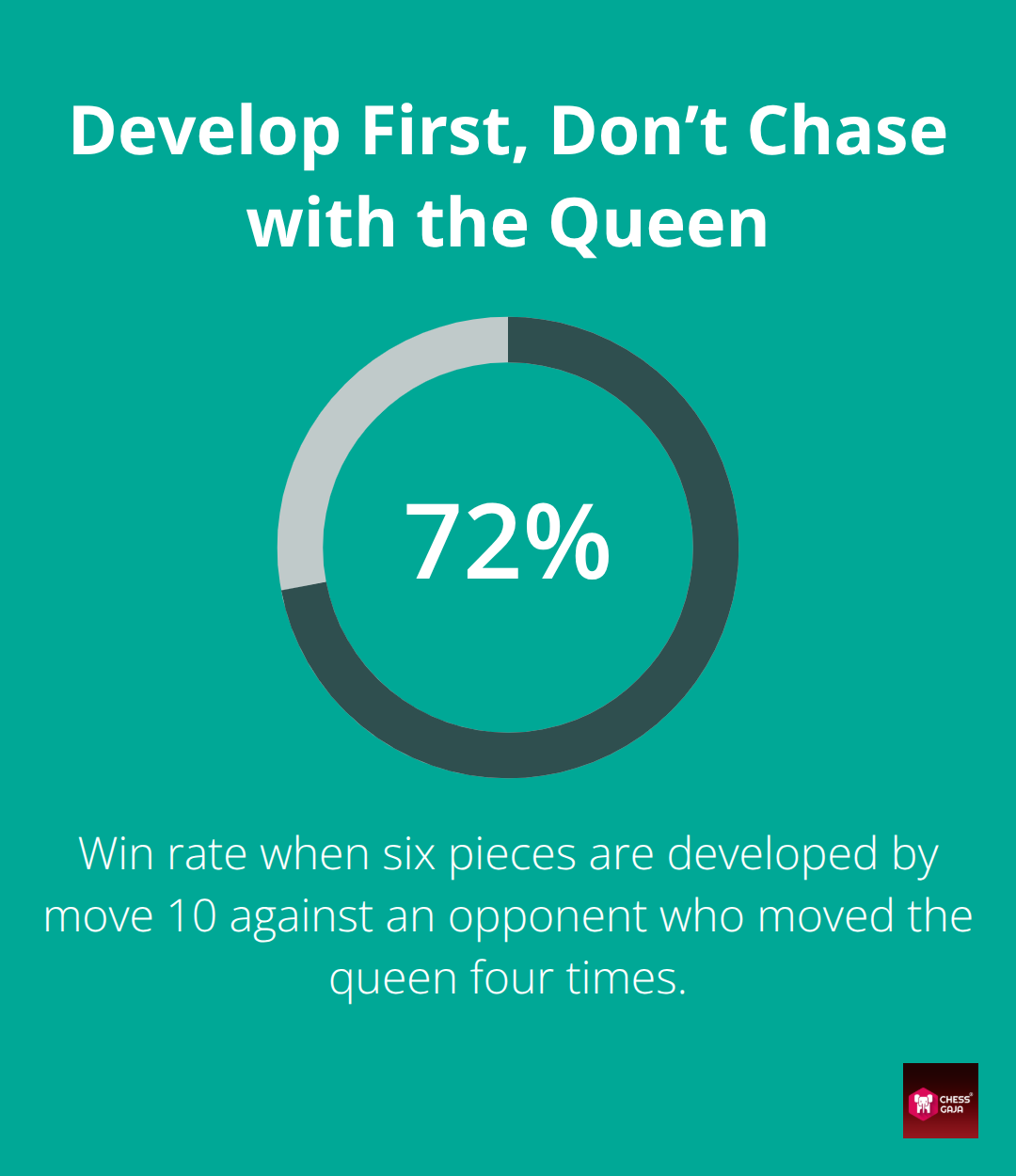
In a game between two 1300-rated players, the player who develops six pieces by move 10 wins significantly more often than an opponent who develops only three pieces and moves their queen four times. The queen is the strongest piece, but moving it early wastes time because your opponent can chase it with developing moves, forcing you to move it again while you fall further behind in development.
A simple rule works: develop minor pieces (knights and bishops) before your queen, clear the back rank, and castle before move 10. Follow this rule, and you will have more pieces in the game than your opponent by the middle of the opening. More pieces means more attacks, more defense, and more winning chances.
King Safety Is Not Optional
Your king is a target. In the opening, your king sits in the center of the board where it is vulnerable to checks, forks, and pins. Castling moves your king to the corner, away from danger. It also connects your rooks so they defend each other. Beginners often delay castling to move their queen or push pawns forward. This is wrong. Castling is one of the most valuable moves in chess because it solves two problems at once: it moves your king to safety and activates your rook.
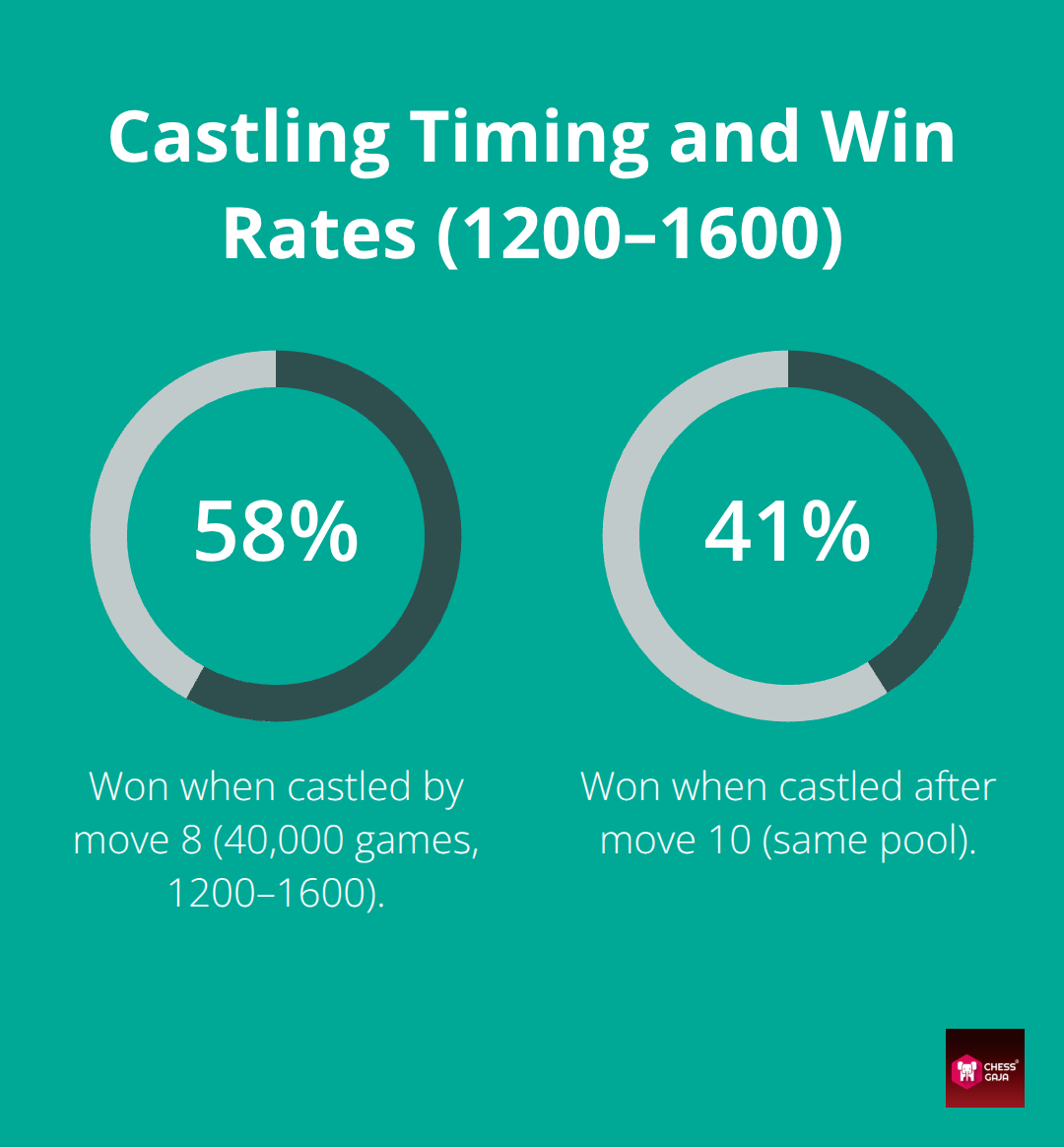
Kingside castling (O-O) requires three preparation steps: advance a central pawn to unblock your bishop, then clear your king’s knight and bishop off the back rank. Once those three preparatory moves are complete, castle immediately on move 4 or 5. Avoid delaying the move or pushing your h-pawn prematurely. Never move your queen three times before securing your king. Castle right away. According to online amateur game databases analyzing thousands of games between 1200–1600 rated players, players who castled by move 8 achieved a far higher win rate compared to those who delayed castling past move 10. The difference is that early castling gets your king safe while your opponent is still developing.
Late castling leaves your king exposed to attacks that come faster than you can defend.
These three principles-center control, piece development, and king safety-form the foundation of every strong opening. Once you understand why these tasks matter, you are ready to see how real players apply them in specific positions and what happens when you face an opponent who tries to stop you.
Phase Two: Applying Principles in Real Games
In your first tournament game, you learn an important lesson. Opening principles are not rigid laws; they are flexible guidelines that adjust to your opponent. A 1400-rated player from Singapore who memorizes basic central control will play 1.e4, then struggle when an opponent plays the French Defense (1…e6), preparing to counterattack the center immediately with 2…d5. The principle remains true, but the execution changes. In real games, castling on move 8 might lose material against a piece sacrifice. Sometimes moving your queen early is correct if it grabs a free pawn. Phase One principles build your foundation. Phase Two teaches you when to follow them strictly and when a position demands flexibility.
Rapid and blitz tournaments highlight the gap between theory and practice. In fast games, you lack time for deep calculation. A student from Dubai playing a G/15 rapid event (15 minutes per side) cannot afford to second-guess every move. Instead, they must have internalized the principles so deeply that pattern recognition takes over.
When an opponent plays an unusual move, react quickly. Your brain must instantly evaluate center threats, piece development, and tactical vulnerabilities. This recognition comes only from playing dozens of real games where you apply the principles repeatedly.
The difference between players who improve rapidly and those who stall is not superior memory-it is pattern recognition built through repetition in real games followed by analysis of what happened.
When to Break Principles and When to Hold Firm
Beginners make a critical mistake: they see one game where a strong player breaks a principle, then immediately assume they can do the same. A Grandmaster delays castling until move 12 after precise calculation. They see that the opponent’s king is exposed and their own attack will arrive faster. A beginner sees this and delays castling because they think it looks cool, then gets checkmated on move 15 because they have no idea how to defend. This is not applying a principle intelligently-this is recklessness disguised as understanding.
The rule is simple: follow the principles strictly until you can explain in concrete terms why breaking them helps you. If your opponent has played a move that threatens your center control, and moving a piece away from the center wins material or creates a winning attack, then break the principle. If you are simply moving your queen around because it feels active, you are making a mistake. In practical terms, this means beginners should follow the three core principles for their first 50–100 tournament games without exception. First, internalize solid center control, piece development, and king safety in real games. Only then should you experiment with breaking principles.
A student from the USA who played the London System—a setup-based opening that prioritizes solid pawn structures and consistent piece placement—learned the core patterns so thoroughly that they quickly recognized when an opponent’s premature attack left a weakness to exploit. When an opponent blunders material, pausing routine piece placement to calculate a tactical win isn’t a violation of principles—it is punishing your opponent’s mistake. The student had earned the right to break the principle through thousands of minutes of practical experience.
How Pattern Recognition Separates Strong Players From Weak Ones
Pattern recognition is the difference between a 1200-rated player and a 1600-rated player in the opening. A 1200-rated player analyzes every move individually. In contrast, a 1600-rated player instantly recognizes pawn structures, standard plans, and candidate moves. This recognition is not magical-it comes from seeing similar positions repeatedly.
The fastest way to build pattern recognition is to play the same opening system 20–30 times in real games. When you play the Colle System 25 times, you see how your opponent responds to your setup, where their pieces typically go, what attacks they typically launch, and how your principles translate into concrete moves. After 25 games, you no longer need to think about whether to play 1.d4, Nf3, e3, Bd3, and c3—you execute the setup fluidly because you understand how these moves secure your center. You have seen the resulting middlegame positions dozens of times. You know what happens when your opponent plays h6 or f6 or a6. This is pattern recognition, and it is worth more than theoretical knowledge.
A student in Singapore played the Ruy Lopez 30 times over three months. They climbed from 1350 to 1520 FIDE rating without studying new theory. They simply played the same opening repeatedly, analyzed their games, and learned the patterns. This is the practical path that works. Every Grandmaster or strong tournament player has played their main openings hundreds of times. Repetition builds genuine structural understanding. This repetition is not laziness or lack of ambition. It is the method that builds genuine understanding. You cannot fake pattern recognition. It comes only from repetition in real games followed with analysis of what happened.
The Common Mistakes That Stall Your Progress
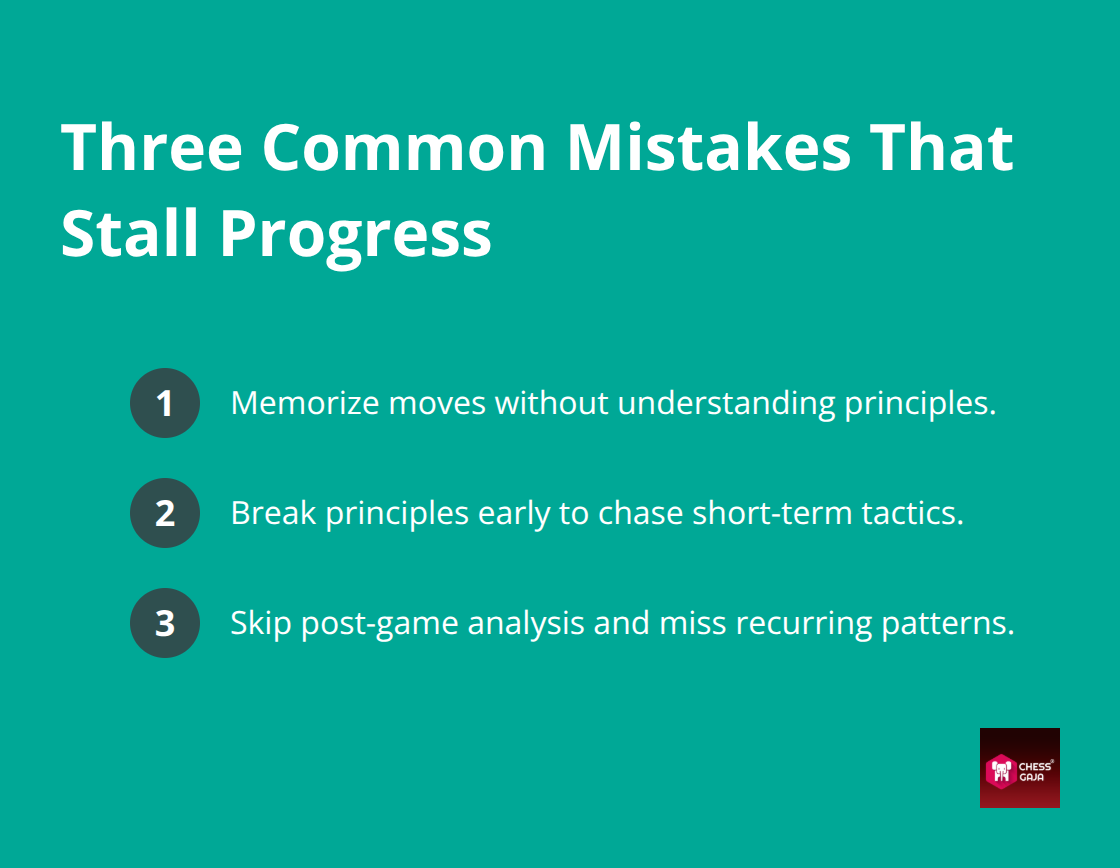
Most beginners make three predictable errors when they try to apply principles in real games. First, they memorize opening moves without understanding the principles behind them.
They play 1.e4 because books recommend it. However, they fail to grasp how 1.e4 controls central squares and opens diagonals. When their opponent plays an unusual response, they have no framework to evaluate the position and make a sensible move.
Second, they break principles too early because they see a short-term tactical opportunity. Your opponent leaves a pawn undefended, so you grab it with your queen instead of completing development. You gain a pawn, but your queen gets trapped on the edge. Meanwhile, your opponent develops three pieces and launches a winning attack against your uncastled king.
Third, they fail to analyze their games after they finish playing. A student plays 20 tournament games, loses 12 of them, and wonders why they are not improving. They never looked at a single game afterward. They never asked themselves: “Did I control the center? Did I develop my pieces? Did I castle at the right time?” Without this analysis, the games teach nothing. The repetition that builds pattern recognition requires conscious reflection on what happened and why.
Final Thoughts
Finding opening principles transforms your chess game. Real progress happens when you pair core theory with active tournament practice. The two-phase path works because it mirrors how strong players actually learn: you study the principles, then you apply them repeatedly until they become automatic. A student from Dubai who follows this path typically gains 200–300 rating points in their first year, whereas players who skip game analysis often plateau around the 1000–1200 level and wonder why memorized opening moves stopped yielding results.
Most beginners lack structured guidance. You need personal instruction to bridge the gap between learning theory and playing real games. Reading about center control differs entirely from having a coach watch your games, point out where you abandoned the principle, and explain why that decision cost you material.
At Chess Gaja, we work with 5,000+ students across 40+ countries. The results are clear: personalized coaching on opening principles yields faster improvement than studying alone.
Our roster features FIDE-rated coaches. The same coach guides your starter class and ongoing journey, keeping your opening preparation aligned with your rating goals.
Your next step is clear. Book a Paid Starter Class directly with Chess Gaja. A professional coach will evaluate your current opening knowledge. They will highlight key principles and create a personalized roadmap for your development. Whether you are in the USA, UAE, or Singapore, our time-zone-flexible scheduling means you can start this week.