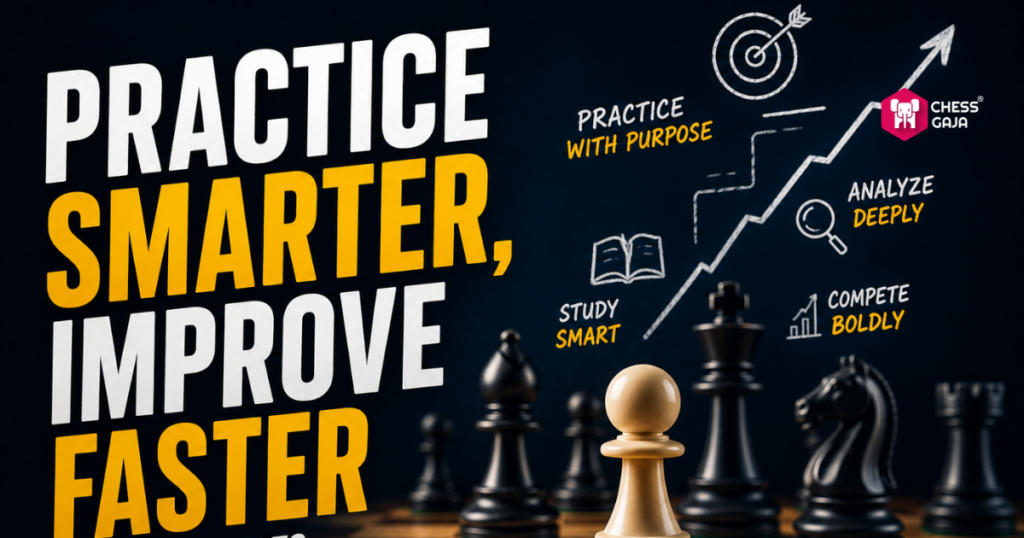
A student in Singapore just improved their rating by 200 points in six months. The difference wasn’t talent-it was how they practiced.
In my journey to becoming a Grandmaster and coaching thousands of players across 40+ countries at Chess Gaja, I’ve seen the exact same pattern repeatedly: players who practice with intention beat those who simply play more games. Improving chess through practice isn’t about grinding endless hours; it’s about training smarter.
How Practice Transforms Chess Ability
Pattern Recognition Develops Through Targeted Repetition
Pattern recognition forms the foundation of chess strength, and it develops only through targeted repetition. Solving 20 tactical puzzles daily trains your brain to spot tactics such as forks, pins, and skewers instantly. In contrast, playing 10 unanalyzed games weekly builds virtually no tactical vision. Students who commit to 15–30 minutes of focused puzzle training see measurable rating improvements within 4–6 weeks. Your brain stores pattern templates through repetition. When you encounter a similar position in a tournament game, you calculate faster and make better decisions. This isn’t mystical talent; it’s how neural pathways strengthen.
A student in the UAE increased from 1200 to 1400 rating in three months by solving puzzles daily and analyzing their own games immediately afterward, rather than playing endless rapid games. Time controls matter significantly here. Blitz games (3 minutes or less) help refine speed and test opening lines, but relying on them as primary practice prevents you from calculating deeply. Rapid games (10–25 minutes) and classical games (30+ minutes) force deep calculation and move planning. These core skills transfer directly to tournament play and higher ratings.
Structured Repetition in Specific Areas Drives Rating Gains
Structured repetition in specific areas produces the fastest rating gains. A player who works on endgame fundamentals for four weeks—practicing basic king-and-pawn endings, key concepts like opposition, and understanding positions involving zugzwang—converts more winning positions into victories and avoids unnecessary losses. The same principle applies to opening study. Avoid memorizing 20 opening lines superficially. Instead, study three openings deeply to understand core ideas like center control, development, and king safety.
Rating progression accelerates when you track what you improve. A player who maintains a simple training log-noting which positions they struggled with, which tactics they missed, which endgames cost them games-builds awareness and avoids repeating the same mistakes. After each game, spend 10–15 minutes analyzing the critical turning points. Compare your analysis with a chess engine or a coach’s feedback. This feedback loop is where growth happens.
Playing Against Stronger Opponents Sharpens Your Skills
Playing against stronger opponents is uncomfortable and essential. A 1400-rated player who only plays peers at their level plateaus quickly because they never face the ideas and techniques that stronger players use. Seeking out players rated 100–200 points higher forces you to adapt, learn new defensive resources, and sharpen your calculation. Tournament play accelerates this process because the stakes feel real and your decision-making sharpens under pressure.
These three elements-pattern recognition through puzzles, structured study in specific areas, and competition against stronger players-form the backbone of effective chess training. The next section examines the mistakes that derail progress and how to avoid them.
Common Practice Mistakes That Slow Progress
Most players waste months repeating the same mistakes without realizing it. You solve puzzles for an hour, play five blitz games, ignore your openings, and wonder why your rating stagnates. The problem isn’t effort-it’s direction. Three specific habits destroy progress faster than almost anything else, and fixing them produces immediate results.
Unanalyzed Blitz Games Yield Diminishing Returns
Playing blitz games without post-game analysis quickly leads to plateauing. A player who plays 20 three-minute games weekly without reviewing critical moments reinforces bad habits rather than building deeper calculation skills. Your brain needs time to process what went wrong. A 1300-rated player in the USA played 15 blitz games daily for two months without improving. Switching to five rapid games weekly with 15-minute analysis pushed them to 1500 within four months. The difference was analysis, not volume.
Rapid and classical games force deeper calculation, and analyzing critical moments afterward creates the feedback loop where learning happens. Blitz has a place-it builds speed and confidence-but treating it as your primary training tool is like practicing tennis by hitting balls without looking where they land.
Opening Study and Endgame Fundamentals Cannot Be Neglected
Opening study and endgame fundamentals get skipped because they feel less exciting than playing. Players memorize three moves of an opening, then wing it for 20 moves, making weak moves that experienced players punish instantly. Endgames get ignored entirely until a player reaches 1600 and suddenly loses won positions because they lack basic technique.
For instance, one of our intermediate students spent three weeks focusing specifically on rook endgames and key endgame concepts like opposition, which immediately led to converting two drawn positions into tournament victories. Opening study doesn’t mean memorizing 30 lines; it means understanding why you play your first 8–12 moves and what you’re trying to achieve. Spend two weeks on one opening, understand its strategic goals, then play games using that opening. Endgame study is non-negotiable. Spend 10 minutes daily on basic positions (king and pawn versus king, basic rook endgames, simple checkmate patterns). This knowledge saves rating points every single month.
Avoiding Stronger Opponents Keeps You Stuck at Your Current Level
Playing only against weaker or equal-rated opponents keeps you comfortable and prevents growth. A player rated 1450 who only plays peers at 1400–1500 never learns the defensive techniques, calculation depth, or strategic ideas that 1600-rated players use. Stronger opponents expose your weaknesses immediately. Challenge opponents 100–150 points higher and accept the losses. Analyzing those games with a coach or engine yields critical lessons that fuel real rating growth.
Tournament play accelerates this process because the pressure forces sharper decisions and real consequences. The next section shows how to build a practice routine that avoids these mistakes entirely and transforms your training into measurable rating gains.
Building Your Daily Practice Schedule
Structure Your Training Time for Maximum Results
A player rated 1350 in Dubai trains 90 minutes daily but gains only 25 rating points per month. Another player in Singapore trains 60 minutes daily and gains 50 rating points monthly. The difference isn’t work ethic-it’s structure. Effective practice requires a deliberate mix of puzzle training, game play, and review, with each component serving a specific purpose.
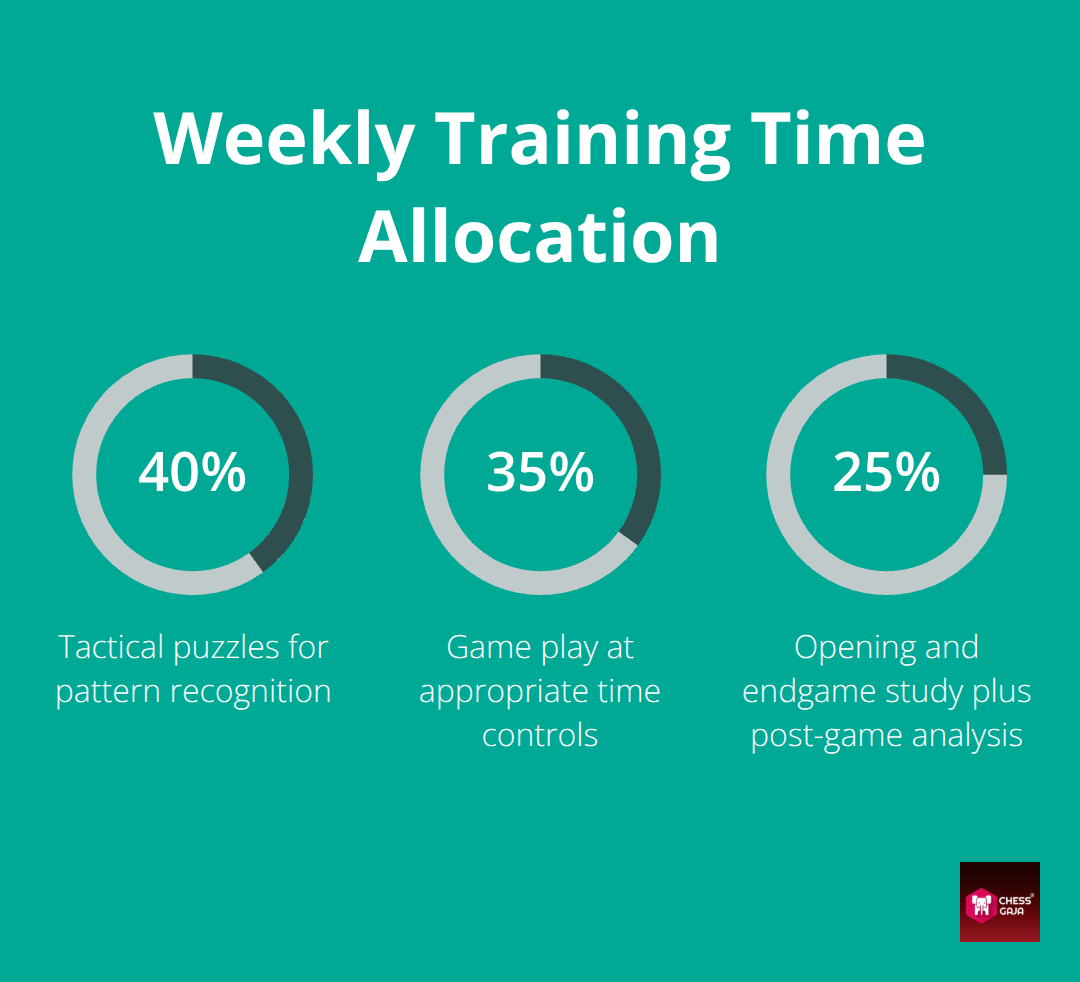
For most ambitious players, a practical weekly schedule dedicates the largest portion of training time to tactical puzzles, followed by regular game play across appropriate time controls, with the remaining time focused on opening and endgame study plus post-game analysis.
For a player training 60 minutes daily, this means spending ~25 minutes on puzzles and alternating the remaining 35 minutes between playing a quality rapid game one day and performing deep post-game analysis and study the next. This practical rotation forces you to train smarter, not longer.
Training 90 minutes without structure wastes precious time on unproductive activities. In contrast, spending 60 minutes with a clear allocation yields double the rating growth.
Puzzle Training Builds Pattern Recognition Fastest
Puzzles build pattern recognition faster than any other training method. A player who solves 30 puzzles daily for four weeks recognizes tactical motifs faster in real games than someone who solves five puzzles sporadically. The key is consistency and difficulty progression. Start with puzzles rated 100–200 points below your current rating to build confidence, then move to puzzles at your rating level, then 100–200 points above. This progression prevents frustration while forcing your calculation to improve.
Difficulty matters more than volume. Solving just 15 puzzles with full concentration and proper calculation easily outpaces rushing through 50 puzzles without thinking deeply. Slow down your puzzle work. Spend 2–3 minutes on each puzzle, calculate all variations, and verify your answer against the solution. This deliberate approach trains your brain to recognize patterns and calculate accurately under the time pressure of real games.
Choose Game Time Controls That Match Your Goals
Game play must match your goals. If you are training for tournament play, rapid games (10–25 minutes) build essential decision-making speed and tactical execution under pressure, serving as an ideal bridge to classical time controls. A player in the USA who switched most of their blitz play to rapid games gained 180 rating points in five months because rapid games taught real chess, not panic management.
Blitz can stay in your schedule—primarily for speed and confidence building—but treating it as serious training wastes months. Playing rapid time controls forces deep calculation and strategic planning. These essential skills transfer directly into tournament play. Classical games (such as 30+ minutes with increment or longer) develop even deeper calculation and strategic thinking, though they require a larger time commitment.
Study Openings and Endgames With Protected Time
Opening and endgame study requires protected time in your schedule. Spend two weeks learning one opening thoroughly. Play five games with it, then analyze where your preparation ended and where mistakes occurred. This focused approach teaches you the ideas behind your opening, not just memorized lines that fall apart after move 12.
Endgame study is non-negotiable; 10 minutes daily on basic positions (king-and-pawn endings, basic rook endgames, and fundamental checkmate patterns) helps convert winning positions into victories and save draws in difficult positions. For example, one intermediate player at Chess Gaja focused exclusively on king-and-pawn fundamentals and key concepts like opposition for three weeks, immediately converting three drawn positions into tournament victories. This knowledge saves rating points every single month and compounds over time.
Analyze Your Games and Track Your Progress
After every game, spend 10–15 minutes analyzing critical moments with an engine or coach feedback. This is where the real learning happens-not during the game, but in the analysis afterward. A player who checks their rating only quarterly misses critical feedback signals; checking monthly reveals whether your training structure is working. If your rating hasn’t moved in two months despite consistent training, your puzzle difficulty is too easy, your game analysis is too shallow, or your time control doesn’t match your goals. Adjust immediately.
Tournament results provide concrete feedback that online ratings sometimes hide. A player might gain 40 rating points online but finish in the middle of the pack at a local tournament because tournament conditions-longer time controls, distractions, pressure-expose different weaknesses. Competing in one tournament every 6–8 weeks forces you to test your preparation under real conditions and reveals exactly which areas need work.
Keep a simple training log: note your weekly puzzle count, games played, rating change, and one key lesson from your analysis. After four weeks, review the log to evaluate your rating growth, puzzle accuracy, and completion of opening study. This data-driven approach removes guessing from your training. One student in our coaching program maintained a training log for eight weeks. After noticing their rating stalled despite solving 200 puzzles weekly, they realized they were rushing calculations. Slowing down their puzzle work yielded a 60-point rating gain over the next six weeks. The log revealed the problem; without it, they would have blamed talent or time constraints.
Final Thoughts
The student in Singapore who gained 200 rating points in six months didn’t possess more talent than others-they built a practice system that worked. Every principle in this article compounds over time. Combining targeted puzzles, structured study, strong opponents, and post-game analysis creates steady rating growth. A dedicated player following a structured system can realistically push their rating up several hundred points over a year or two, while a player who trains randomly might spend three years stuck at the same level wondering why progress stalled.
Improving chess through practice requires one non-negotiable shift: stop measuring effort by hours spent and start embracing resultsdriven practice to focus on results gained. Unstructured 90-minute training sessions waste precious time. In contrast, a structured 60-minute daily routine yields double the rating growth. This is not motivation or talent; this is system design. At Chess Gaja, we’ve coached thousands of students across 40+ countries, and the pattern holds consistently: students who follow a structured routine make consistent, measurable rating progress every month, while students who train randomly quickly hit a plateau and stay stuck at the same level.
Your next step is clear: build a practice routine that divides your training time thoughtfully across tactical puzzles, quality games at appropriate time controls, and structured study and analysis. Track your progress monthly and adjust when results stall. If you want personalized guidance on building your practice routine and receiving a professional skill evaluation, book a Paid Starter Class with Chess Gaja. Our FIDE-rated coaches will assess your current level and identify weaknesses. From there, we design a study plan tailored to your rating and goals.