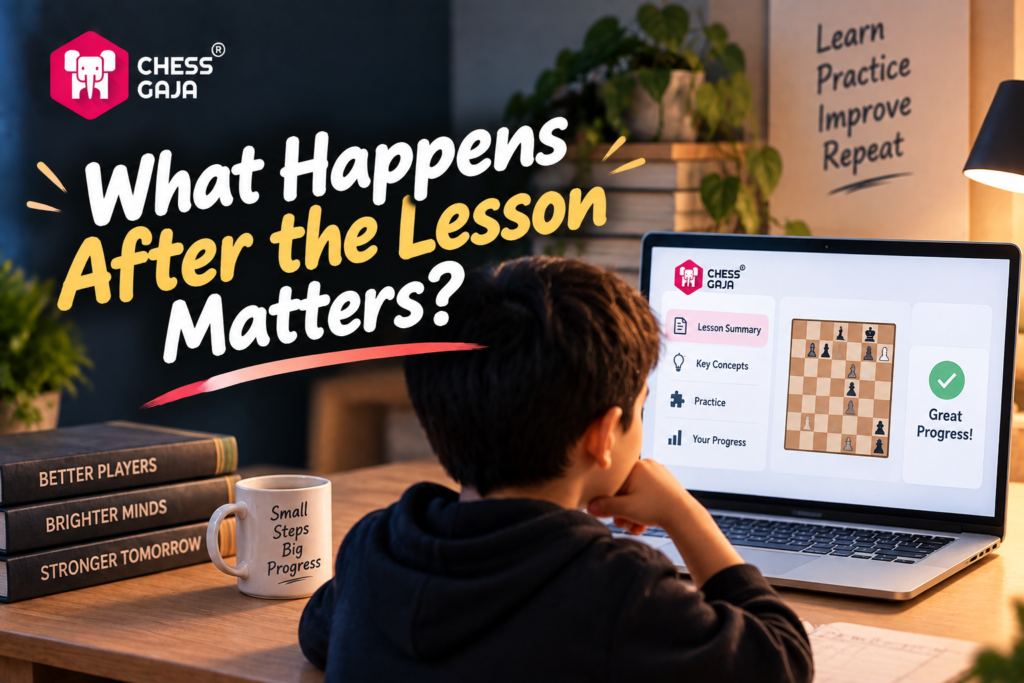
Most chess students finish a lesson and move on without reviewing what they learned. This gap between instruction and independent practice is where progress stalls.
At Chess Gaja, we’ve found that LMS post session summaries change everything. When students review key concepts, tactics, and personalized feedback right after class, their rating improvements accelerate significantly.
Why Your Child’s Rating Stalls Without Post-Session Review
The moment a student leaves a Chess Gaja class, the real learning should begin. Yet most young players finish their lesson and do nothing with what they learned.
This is why students who skip review stay stuck at their current rating for months. Those who review immediately gain 40 to 80 rating points over 6 to 8 weeks. The difference between stagnation and breakthrough is almost always what happens in the first 24 hours.
Immediate Reinforcement Locks In Pattern Recognition
When a student reviews key concepts within hours of learning them, their brain locks in the pattern recognition needed for chess. Research on memory retention shows that reviewing material within 24 hours significantly increases recall compared to skipping review entirely. In chess, this matters intensely. A tactic your coach taught you in class becomes muscle memory only if you see it again while the lesson is fresh.
Our AI-powered LMS summaries recap exactly what was covered, highlight the specific positions your child struggled with, and present them again for immediate practice. A student in Dubai who learns a back rank mate pattern in their 3 PM class receives a summary within minutes, works through three variations before dinner, and recognizes that same pattern in their next game. Without that summary, the tactic fades into background noise within 48 hours.
Post-Session Data Reveals Gaps Before They Compound
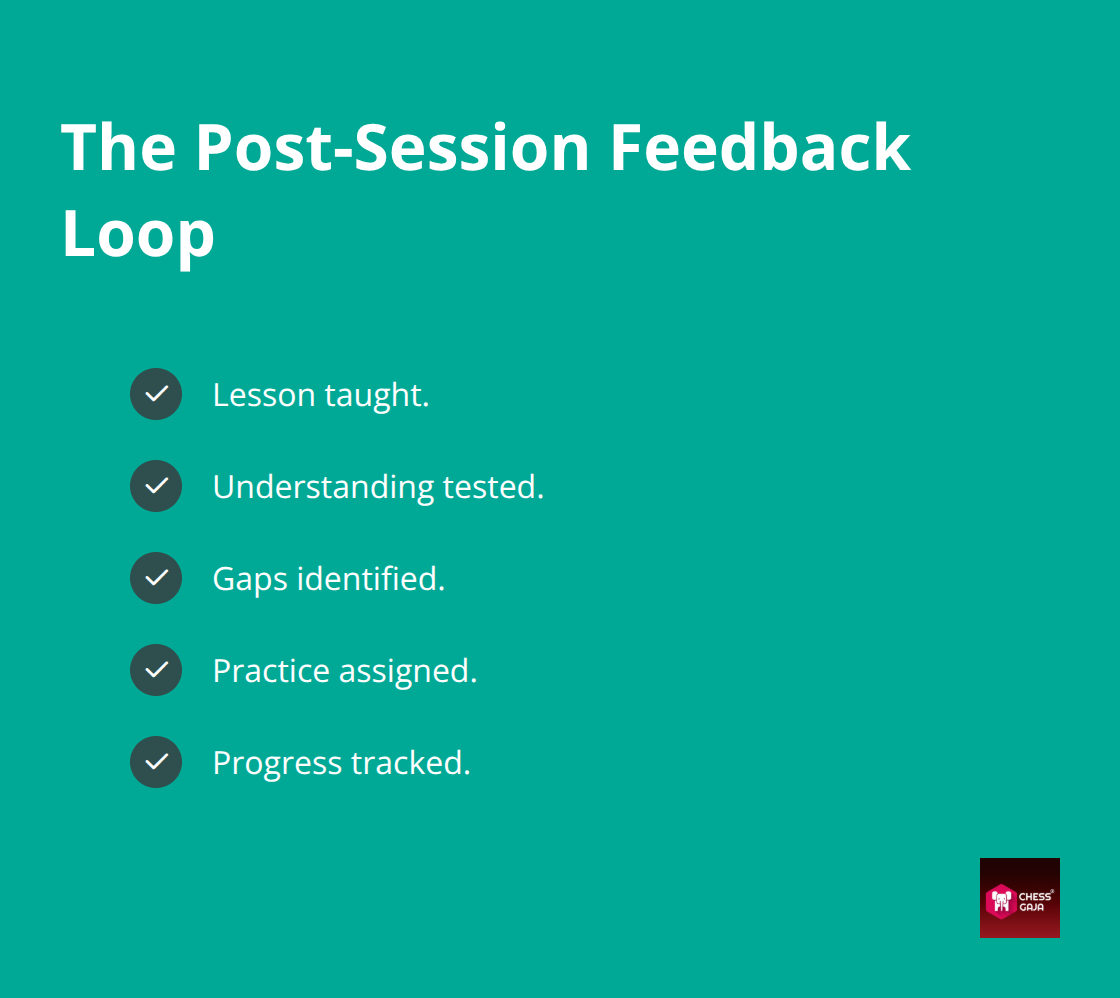
Post-session quizzes help identify where understanding breaks down. When a student completes a lesson quiz, their answers reveal which concepts didn’t stick.
A student in Singapore might control the center with pawns but struggle against a long-diagonal bishop. The summary flags this gap immediately. Your coach can then address it in the next session rather than assuming a solid foundation. This feedback loop transforms a single lesson into lasting skill development.
Your Child’s LMS Record Tracks Real Progress Over Months
Every summary creates a concrete data point. After 10 lessons, your child’s LMS record reveals clear learning patterns. A student who started shaky on knight forks now has proof of steady improvement. This record becomes invaluable for customizing future lesson plans.
If your child scores lower on endgames while excelling at tactics, the coach shifts focus to pawn structures and technical endgames. Parents can log in anytime to see what their child learned, where they struggled, and what comes next. After three months, students systematically close skill gaps and build on confirmed strengths.
How Mobile Notifications Activate Learning Between Sessions
Mobile alerts push your child back to their summary within hours of class. These notifications remind students to complete their personalized homework assignments and review flagged concepts before the next session. A notification arrives at 6 PM reminding a student in Singapore that they have three knight fork variations to practice. That single reminder often makes the difference between a student who practices once a week and one who practices five times. Consistency compounds. A student who practices their post-session homework four times per week absorbs material far faster than one who practices once. The notification system removes the friction of remembering to practice and transforms post-session review from optional to routine.
What Your Child Actually Gets in Every Post-Session Summary
Three Layers of Information in Every Summary
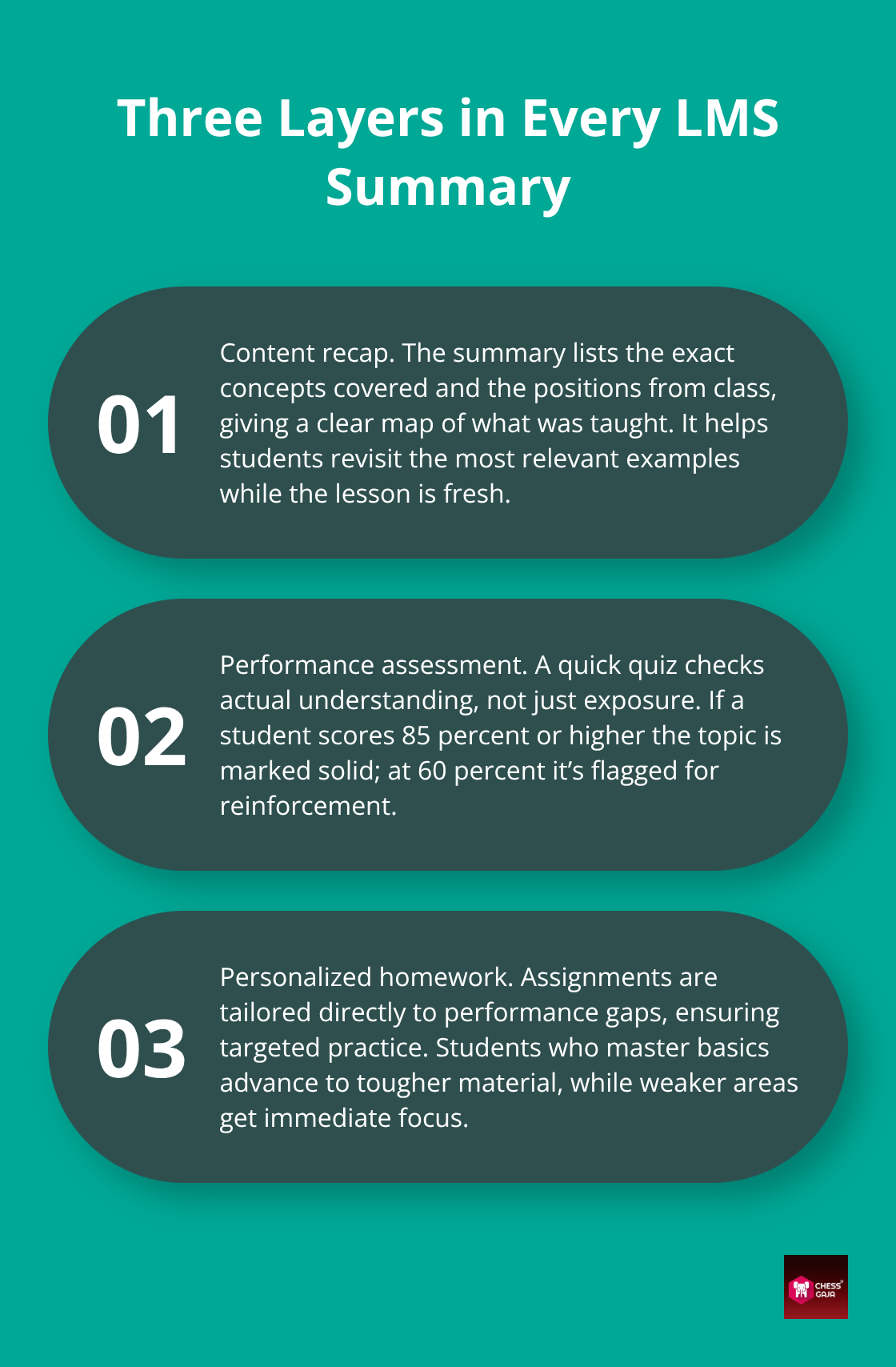
An effective LMS summary captures three layers of information that most chess platforms ignore entirely. First, it recaps the specific lesson content and tactical themes. It lists each concept covered alongside exact positions from class. A student in Dubai who spent 40 minutes on back-rank mate tactics receives a summary showing the three positions their coach demonstrated, ranked by difficulty. Second, the summary includes a performance assessment-a quick quiz that tests whether your child actually absorbed the material.
If they score high on back-rank patterns, the system marks that topic as solid. If they struggle with multiple test variations, the AI flags it as needing reinforcement. Third, the summary generates personalized homework assignments tailored directly to performance gaps. A student who struggles with basic bishop-and-pawn endgames gets three targeted technical positions to resolve before the next session, while a student who masters them moves on to complex opposite-colored bishop endgames instead. This is not generic homework-it is custom-built based on what your child demonstrated they need.
How Mobile Notifications Activate Learning Between Sessions
Mobile notifications transform these summaries from passive documents into active learning triggers. Push alerts arrive within two hours of class, reminding your child to complete their personalized homework assignments. A notification at 6 PM tells a student in Singapore they have four knight fork puzzles waiting, with a direct link that opens in the app. Research on learning retention shows that spacing practice sessions across multiple days improves long-term recall far more than cramming all practice into one block. A student who practices their post-session homework on Monday evening, Wednesday afternoon, and Friday morning absorbs material significantly faster than one who waits until Friday night to practice everything at once. The notification system removes friction-your child does not have to remember to log in or wonder what to work on next. The summary tells them exactly what to do, and the notification reminds them to do it.
Measurable Rating Gains From Consistent Post-Session Review
After six weeks of consistent review and mobile homework, a typical student shows measurable progress. Most see a 40 to 80 rating point gain. This progress compounds through an immediate feedback loop: the coach identifies key areas for growth, the system assigns targeted exercises, the student completes them, and the next session builds directly on confirmed strengths.
The structured data from these summaries also tells your coach exactly what to focus on in your next lesson, which means your next session starts with momentum rather than repetition. This is where the real acceleration happens-when post-session review stops being optional and becomes the engine that drives your child’s rating growth.
How Your Child’s Data Reveals What Actually Works
The real power of post-session summaries emerges over time. Instead of simple one-time reviews, they function as an ongoing measurement system. Each summary generates concrete data about what your child learned, where they struggled, and how their skills developed across specific areas of chess. After ten lessons, you have ten data points. After twenty lessons, patterns emerge that show you exactly whether your child is progressing toward their rating goals or spinning in circles. Students who track this data consistently reach their next major rating milestone faster than those who simply take lessons without systematic review. The difference is not the quality of instruction-it’s visibility into what’s actually working.
Rating Gains Appear in the Data Before They Show Up on the Board
A student might feel stalled at an 1100 rating for weeks, then jump to 1160 in a single weekend. This jump seems random until you examine their summary data. The reports show their back-rank mate recognition improved from missing basic mates to spotting them instantly.
These micro-improvements compound directly into rating gains over time. Without data, you might attribute a rating jump to luck or a good tournament run. With data, you see the exact sequence of skill development that made the jump inevitable.
Pattern Recognition Skills Develop Unevenly Across Different Game Positions
Chess improvement is rarely linear across all skill areas. A student might show strong growth in tactical puzzles while stalling on endgame positions. Another might recognize pins effortlessly but struggle with sacrifice patterns. The summaries flag these uneven development patterns immediately.
When a student scores high on tactics but struggles on endgames, your coach shifts focus right away. Moving forward without fixing core weaknesses costs months of wasted time. Drilling flagged topics for three weeks closes gaps far faster than rushing to new material.
Summary data also reveals whether a student truly understands a concept or simply got lucky. If a student solves a back-rank mate effortlessly one week but falters the next, the concept needs reinforcement. Consistency across multiple weeks signals genuine mastery—one strong quiz result does not.
Your Coach Adjusts the Entire Lesson Plan Based on What the Data Shows
The most underrated benefit of post-session summaries is that they give your coach the exact roadmap for your next lesson. Instead of following a generic curriculum, your coach reviews your child’s last three summaries to target specific weaknesses.
If recent data shows difficulty with closed positions or pawn breaks, the next lesson focuses entirely on those gaps. A student who masters basic pawn endgames moves straight to complex rook-versus-pawn endgames. This personalization ensures every minute of instruction addresses real needs.
Final Thoughts
Post-session summaries transform isolated lessons into continuous progress that compounds over weeks and months. When your child reviews key tactical themes within hours of learning them, completes personalized homework flagged by their coach, and receives mobile reminders to practice, their brain locks in patterns that stick. The rating gains follow naturally from this consistency, and LMS post session summaries make this cycle automatic rather than something you have to manage manually.
At Chess Gaja, we built these summaries directly into our coaching model. Our AI-powered system captures what was covered, identifies performance gaps, and generates custom assignments.
Your child’s coach uses this data to refine the next lesson. Every session builds on confirmed strengths rather than assumed knowledge. After six weeks of consistent review, rating gains become undeniable.
Your child’s rating growth depends far more on what happens between lessons than on lesson frequency.
If you are ready to accelerate your child’s progress through data-driven coaching, Chess Gaja offers a Paid Starter Class. Our FIDE-rated coaches evaluate your child’s current level, identify skill gaps, and build a personalized development plan.