
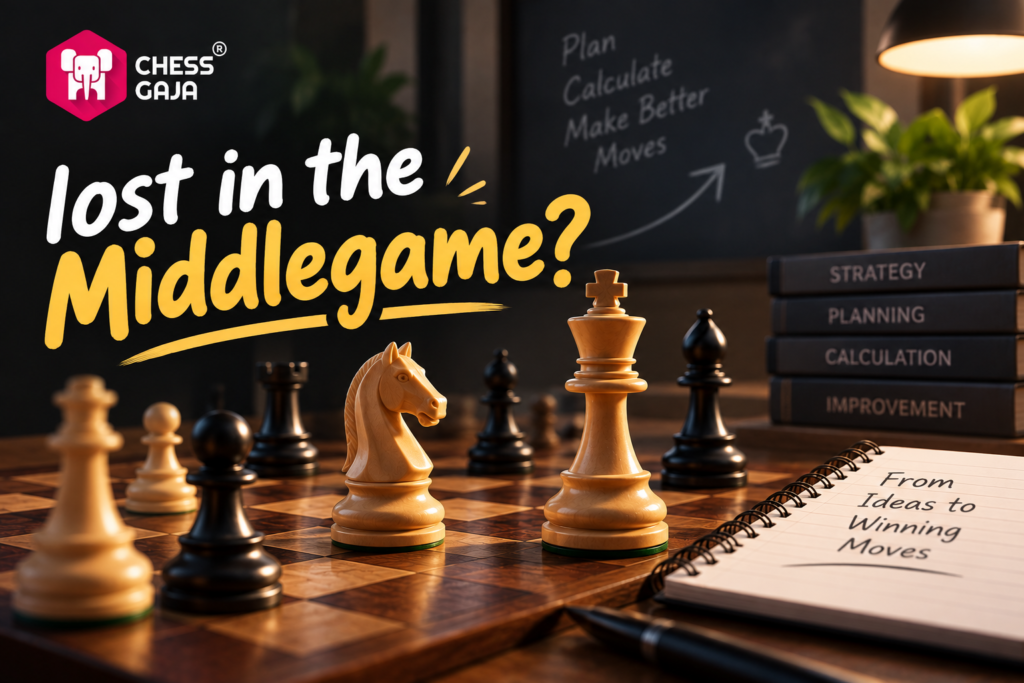
You’ve studied the opening, memorized the principles, and now you’re stuck in the middlegame. Your pieces feel aimless. Your opponent’s threats seem to come from nowhere.
At Chess Gaja, we’ve seen this pattern countless times with students across the USA, UAE, and Singapore. The difference between players who improve and those who plateau comes down to one skill: converting strategic ideas into moves that actually work.
What Makes a Position Worth Playing For
Diagnose What the Position Demands
The moment you finish your opening, you face a critical question: what are you actually trying to do? Most beginner players drift through the middlegame because they lack a concrete reason to move their pieces. Spotting an open square, they jump their knight onto it. Noticing an enemy pawn, they launch an immediate attack. This aimless approach is why improvement stalls. The strongest players at every level-from scholastic tournament winners in Singapore to competitive club players across the UAE and USA-start the middlegame by diagnosing exactly what the position demands.
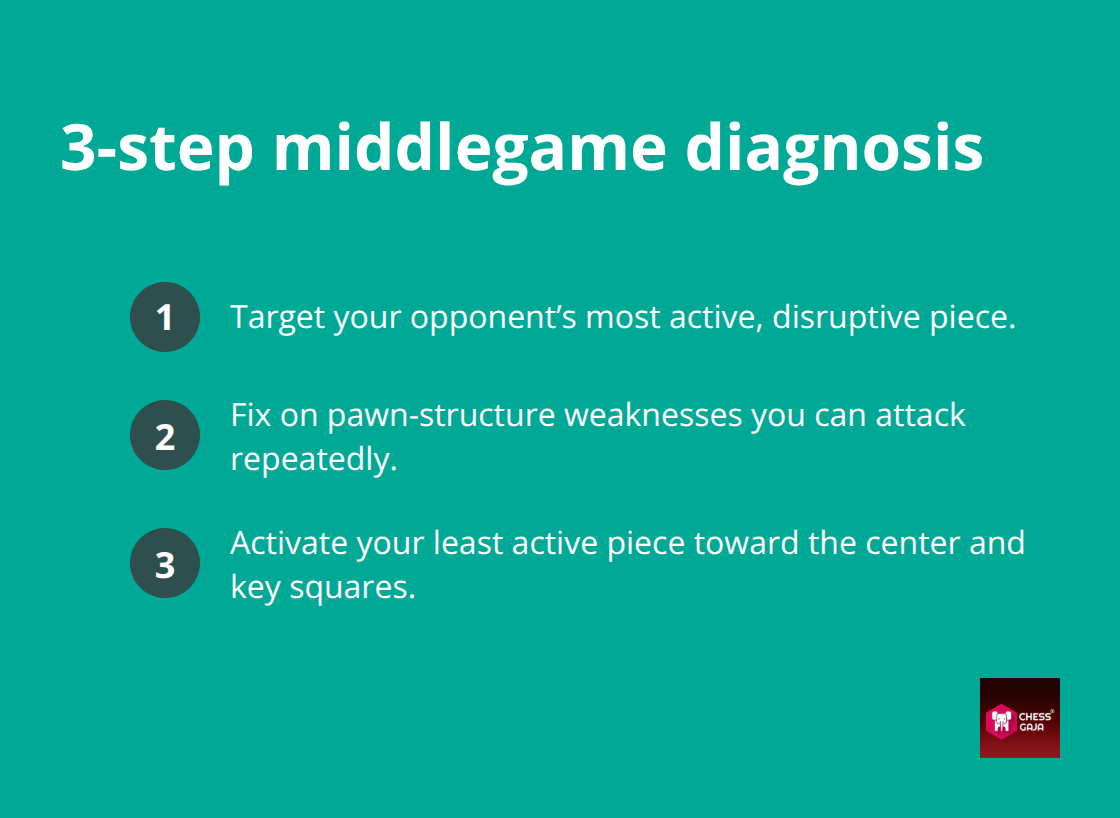
First, evaluate your opponent’s pieces. Find the single piece causing you the most problems—typically the one with the highest activity. If your opponent has a centralized knight on d5 controlling key squares, or a rook dominating an open file, that piece deserves your immediate attention. Your job is to either neutralize it through a forcing move, restrict its options, or exchange it for something less dangerous.
Identify Weaknesses in the Pawn Structure
Second, examine the pawn structure-both yours and your opponent’s. Weak pawns are targets. An isolated pawn on d5, a backward pawn on d6, or a doubled pawn on the c-file gives you a concrete target to build long-term pressure around. Plant a piece on an outpost near that weakness and you’ve created a positional advantage that forces your opponent into defense.
Activate Your Least Active Piece
Third, assess your own pieces and identify the least active one. If your rook sits on a1 with no open file, or your knight languishes on the rim far from the center, moving that piece toward the center or toward a key square is always productive. This approach transforms vague plans into actionable moves.
Convert Diagnosis Into Concrete Goals
Strong players ask a simple question before each move: what am I trying to accomplish in the next three to five moves? Am I building pressure on a specific weakness, improving my piece placement, or creating a tactical opportunity? This clarity prevents wasted moves and forces you to calculate with purpose. Players who identify their opponent’s worst piece, neutralize it, and improve their own piece coordination consistently outperform those who make reactive moves.
When you sit down for your next game, spend the first minute after your opening ends on structural assessment: where is my opponent weak, where are my pieces strongest, and what single piece improvement would give me the most control? That clarity transforms the middlegame from confusion into execution. Once you’ve answered these questions, you’re ready to convert your strategic vision into the tactical sequences that actually win games.
From Strategy to Moves That Work
The moment you diagnose your opponent’s weakness and identify your plan, you face the hardest part: translating that strategic vision into actual moves. This is where most beginner players fail. They know their knight should go to d5, but they don’t calculate whether it’s safe. They want to attack a weak pawn, but they don’t check if their own king becomes vulnerable. Players who calculate before moving outperform those who move first and think later.
Verify Safety Before You Commit to a Move
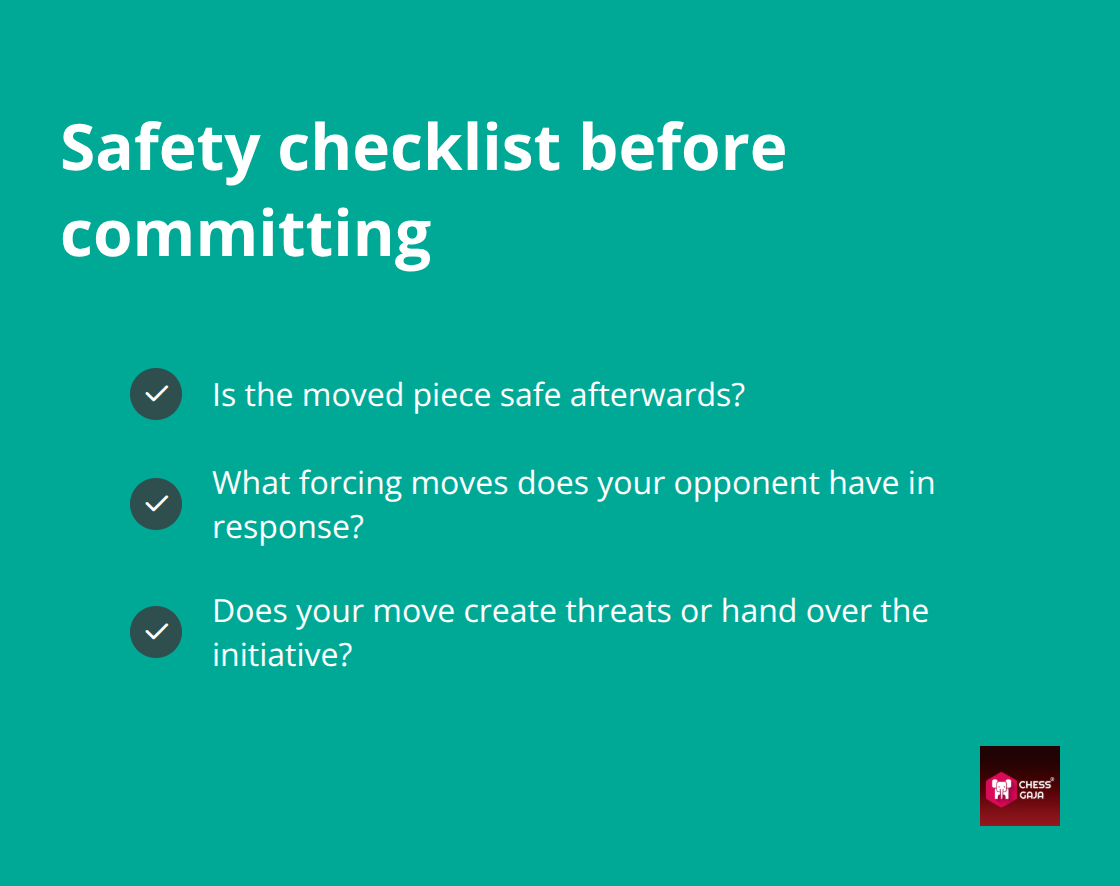
The biggest mistake beginner players make is moving a piece that looks active without verifying it’s actually safe. You move your knight to d5 because it controls key squares. However, your opponent responds with a queen on f3 or a bishop on c4. This creates a lethal double attack against your undefended knight and another piece. You’ve just lost material. Before committing to any move, ask yourself three questions: Is this piece safe after I move it? What forcing responses can your opponent generate? Will this action create threats that force a response, or simply hand over the initiative?
If your move doesn’t answer at least one of these questions favorably, it’s probably not the right move. In a Classical or long Rapid time control (such as 30+0 or 15+10), you have plenty of time to calculate three to five moves deep for critical positions. Use that time. Players who calculate three moves ahead consistently beat those who calculate one move ahead, even at the same rating level.
Balance Your Attack With King Safety
The second critical skill is balancing your attack with king safety. Many beginner players see an opportunity to attack their opponent’s king and push forward recklessly, weakening their own king in the process. This is how winning positions turn into losses. If you build an attack on your opponent’s kingside, your pieces must coordinate and your king must stay protected.
A practical rule: avoid pushing the pawns directly protecting your king unless it creates a necessary escape square (such as h3 or h6) or supports a concrete, fully calculated attack. Unjustified pawn pushes around your own king leave permanent structural weaknesses that strong opponents will immediately punish. Improve your piece placement, secure weak squares, or trade pieces to simplify. The strongest players know when to attack and when to build. They don’t attack because they feel like attacking; they attack because the position demands it and their king is safe.
Make Every Move Serve Your Strategic Goal
The third skill is consistency. Once you set a goal—say, rerouting your knight to d5 to pressure your opponent’s weak e6 pawn—every move you make should advance that goal or prepare for it. Don’t move your rook to a random square just because it looks slightly better. Every move must serve your plan.
If your plan is to control the center and restrict your opponent’s pieces, then moving your rook to an open file that supports that control makes sense. Moving your rook to the side of the board because it’s one square safer does not. This discipline separates players who improve rapidly from those who plateau.
Making three moves in a row that all serve the same strategic goal creates unstoppable pressure. Their opponent feels the noose tightening. By contrast, players who make random improvements never build momentum, allowing their opponent to shift strategies easily.
In real tournament games, the player with the clearer plan almost always wins because every piece move reinforces that plan. Once you master this skill-calculating safely, protecting your king, and maintaining strategic consistency-you’re ready to recognize the specific patterns that appear again and again in the middlegame.
Patterns That Repeat Across Every Tournament
The strongest players recognize repeating patterns and apply the same strategic logic across different board setups. A weak square on e6 in one game demands the same treatment as a weak square on d5 in another. A centralized knight outpost works the same way whether it’s on d5 or e5. Once you understand these core patterns, your decision-making accelerates dramatically because you solve each position faster.
Exploit Weak Squares Your Opponent Cannot Defend
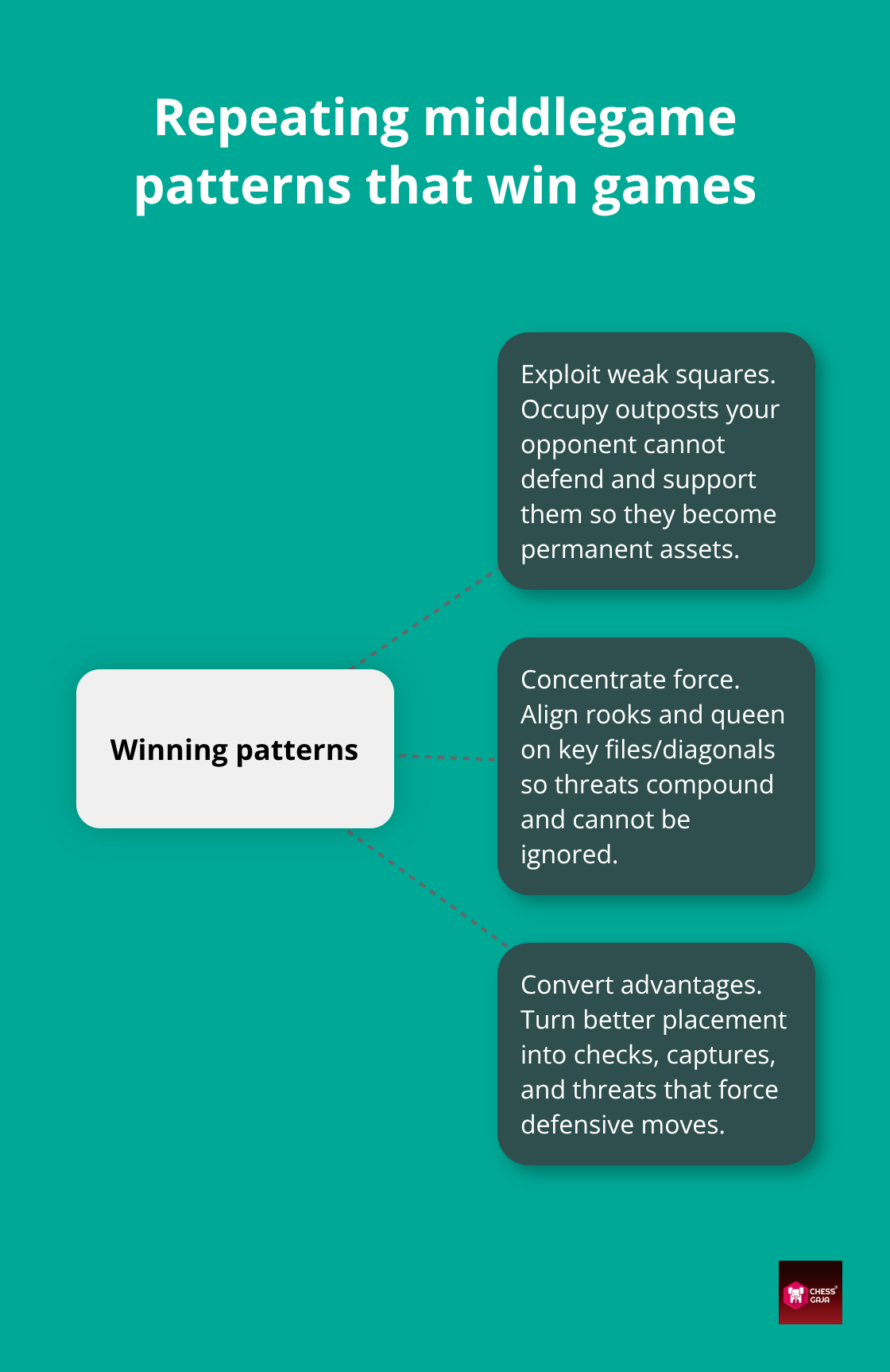
The first pattern every competitive player masters is exploiting weak squares that your opponent cannot defend. Weak squares emerge from pawn structure decisions your opponent made in the opening. If your opponent advances their c-pawn and e-pawn forward (such as playing c5 and e5), the d5 square becomes a permanent hole because no enemy pawn can ever defend it again. Place your knight on that d5 outpost and it becomes an absolute fortress. Your opponent must either trade it off or watch you build pressure around it.
This single piece on d5 forces your opponent into a reactive position because every other piece must work around your dominant knight. In tournament play across the USA, UAE, and Singapore, players who identify and occupy these weak squares within the first ten moves of the middlegame gain a measurable advantage. The key is not just finding the weak square but placing your piece there with support. An unsupported knight on d5 can easily be challenged and traded off. However, backing it up with a pawn on c4 or e4 makes that piece virtually immovable, causing your opponent’s position to collapse around it.
Concentrate Your Pieces on Key Files and Diagonals
The second pattern is piece activity through centralization and file control. Position rooks on open files where they exert pressure across the entire board. Centralize knights so they control multiple key squares simultaneously, while placing your queen on squares where it coordinates with other pieces to support attacking plans.
Most beginners spread their pieces too thin. They put one rook on a file, another rook somewhere else, and their queen on a random square. Strong players concentrate their force against a single target so their pieces work in harmony. Pressuring a weak e6 pawn requires maximum focus. Stack your rooks on the e-file and let your knight and queen control the surrounding key squares. This concentration of force creates actual threats your opponent cannot ignore. In real games, players who double rooks on a file or align their queen with a bishop on a long diagonal win material or force checkmate far more often than players with scattered pieces. The data from thousands of online tournaments shows that piece coordination wins games, not individual piece beauty.
Convert Positional Advantages Into Forcing Moves
The third pattern is converting positional advantages into concrete threats. You’ve identified a weak square, placed your piece there, and improved your piece activity. Now you must create forcing moves that your opponent must respond to. If your knight sits on d5 and your opponent’s king looks slightly exposed on the kingside, look for checks, captures, or threats that force your opponent to make defensive moves.
A check forces your opponent to move their king or block. A threat to capture material forces them to defend. These forcing moves prevent your opponent from implementing their own plans and give you the initiative. Players who understand this pattern convert their strategic advantages into wins because they press immediately with forcing moves rather than sitting back and enjoying their better position. The pattern is straightforward: better position leads to forcing moves, forcing moves lead to material gain or checkmate, material gain or checkmate leads to victory.
Final Thoughts
The players who improve fastest understand that middlegame strategy ideas separate consistent winners from those who plateau. You now know how to diagnose weaknesses, convert plans into moves, and recognize patterns that repeat across every tournament. Strategic intuition doesn’t come from memorizing principles-it comes from playing games, analyzing your decisions afterward, and asking yourself why stronger players made different moves in similar positions.
Play games with longer time controls where you can calculate properly. After each game, spend fifteen minutes on middlegame analysis of your decisions without an engine and ask yourself what your plan was, whether your moves served that plan, and what your opponent’s plan looked like. This deliberate practice compounds over time into measurable strength. Competitors across the USA, UAE, and Singapore who commit to this review process gain rating points consistently by learning from their mistakes rather than repeating them.
At Chess Gaja, we guide thousands of students through this exact progression across 40+ countries using GM-led coaching that combines classical chess training with personalized feedback. Book a Paid Starter Class today and receive a professional skill evaluation, a personalized study plan tailored to your current level, and clarity on exactly what middlegame concepts matter most for your next breakthrough.