You’ve probably noticed that pawn endgames decide more matches than any other phase of the game. Most players treat them as an afterthought, which is exactly why they lose positions they should win.
At Chess Gaja, we’ve seen this pattern repeatedly with students across the USA, UAE, and Singapore. The players who master pawn endgame strategies pull ahead of their peers fast.
Why Pawn Endgames Decide Tournaments
When a tournament ends, you rarely hear someone say they lost because of a bad opening choice or a weak middlegame plan. You hear them say they threw away a position in the endgame. This happens because most players spend the vast majority of their study time on openings and middlegame tactics, then panic when they reach a pawn endgame they’ve never prepared for. In tournaments across the USA, UAE, and Singapore, students collapse in positions that should be straightforward wins simply because they don’t know one key principle about king placement or opposition.
The Skill Gap Appears Fast
The difference between a player rated 1200 and one rated 1600 often comes down to endgame technique, not brilliance. A 1200-rated player might sacrifice material carelessly because they don’t recognize a passed pawn. A 1600-rated player knows that a single extra pawn with proper king support often decides the game in 15 moves. This gap widens dramatically at higher levels. Players who master pawn endgame conversion win games that weaker opponents don’t even know they’re losing. In rapid tournaments with time controls like 15+10, fast calculation gives you a massive advantage. You make confident decisions under time pressure instead of second-guessing yourself. Most of your opponents at local tournaments simply haven’t studied this material, which means you gain an immediate edge.
Tournament Wins Come from Precision, Not Luck
A scholastic player in the UAE recently won their age group by converting three pawn endgames in the final rounds. They weren’t the strongest tactician in the event, but they understood zugzwang and how to activate their king. In Singapore’s rapid championships, players routinely simplify into pawn endgames when they have a material advantage, confident they can convert. This confidence comes from knowing exactly which positions are winning and which are drawn.
Without this knowledge, you’ll reach endgames where one inaccurate king move throws away a full point. You might push an extra pawn forward without king support and watch your opponent capture it. Or you might fail to recognize zugzwang and miss the winning move entirely. These mistakes cost critical rating gains. Strong players treat pawn endgames as a skill to master, not a phase to survive.
What Separates Winners from the Rest
The players who pull ahead in tournaments understand one simple truth: pawn endgames follow patterns, and patterns can be learned. You don’t need to memorize thousands of positions. You need to recognize the core principles that apply to almost every pawn endgame you’ll face. King activity in pawn endgames, opposition, and pawn structure form the foundation of every winning strategy. When you know these principles, you stop making panic moves and start making calculated decisions.
Your opponents will notice the difference immediately-especially in rapid formats where time pressure forces weaker players to guess. The next section breaks down the core principles separating strong players from weaker ones. We will start with concepts that appear in almost every tournament game.
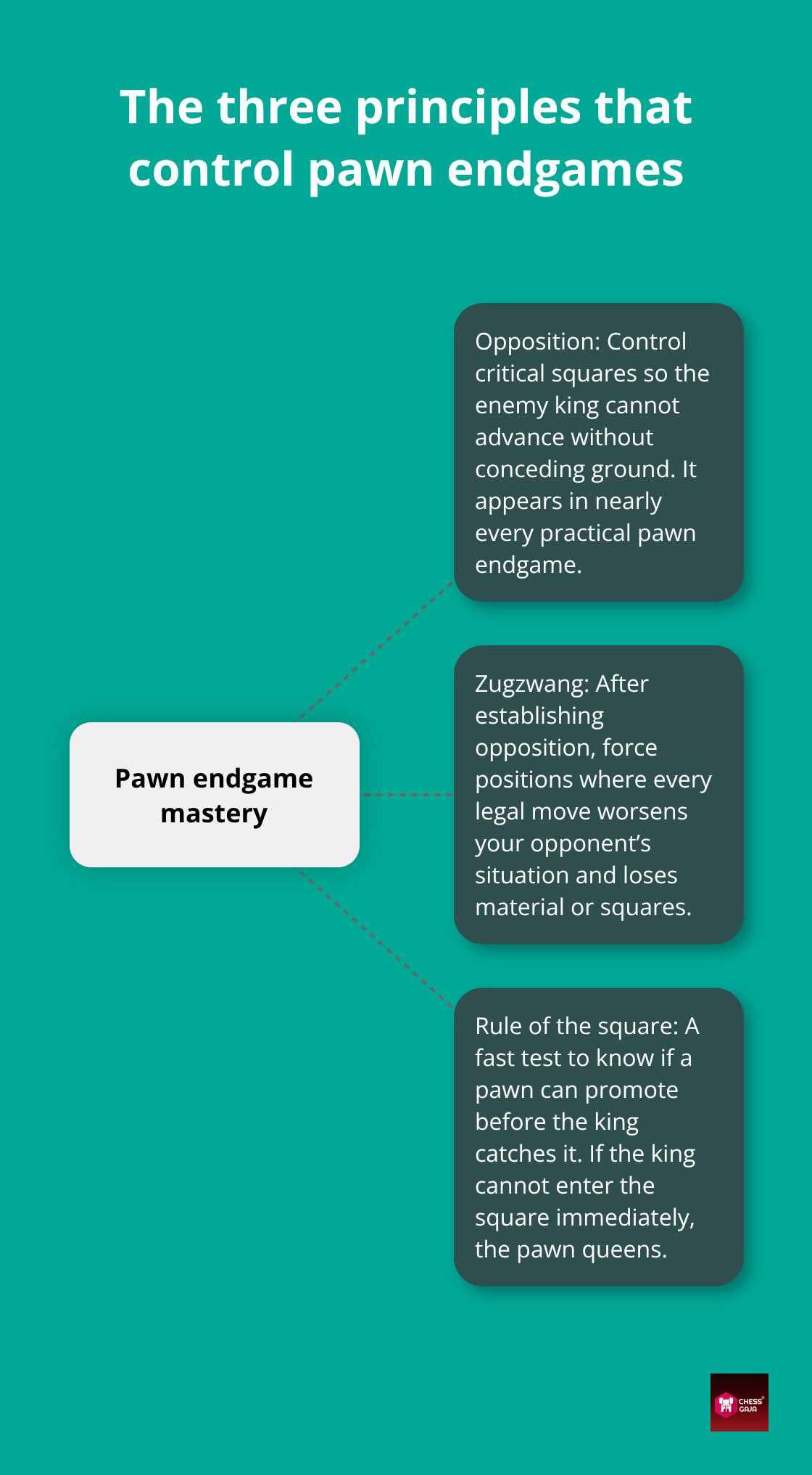
The Three Principles That Control Every Pawn Endgame
Opposition: The Foundation of Pawn Endgame Mastery
Opposition appears in nearly every pawn endgame you’ll face, and recognizing it instantly separates strong players from weaker ones. In chess, opposition is a situation in which both kings are two squares apart on the same rank or file, with one square between them. When you have opposition, your opponent cannot move their king forward without allowing your king to advance into a critical square. This principle decides positions instantly.
A practical example: imagine your king on e5 and your opponent’s king on e7, with your pawn behind on e4. It is your opponent’s turn, meaning you hold the opposition. Your opponent must step sideways to d7 or f7. This lets your king outflank them by advancing to d6 or f6 to escort your pawn to promotion. Opposition comes in three forms—vertical (same file), horizontal (same rank), and diagonal—and you need to spot all three instantly in tournament play.
Zugzwang: Forcing Your Opponent Into Losing Moves
Zugzwang means your opponent is forced into a losing move because every legal move worsens their position. In pawn endgames, zugzwang often appears after opposition is established. Your opponent’s king cannot advance, cannot retreat without giving up critical key squares, and cannot move sideways without allowing your king to outflank them. This is the direct result of controlling space with your king.
When you establish opposition correctly, zugzwang follows naturally. Your opponent faces an impossible choice: move the king and lose the pawn, or stay in place and watch you advance. This pattern repeats constantly in tournament games across the USA, UAE, and Singapore because most players don’t recognize when they’ve already lost the position.
The Rule of the Square: Determining Winning and Drawn Positions
Recognizing which positions are mathematically winning and which are drawn separates players who convert advantages from those who don’t. A passed pawn supported by an active king is almost always winning, while an isolated pawn can only promote on its own if the opponent’s king is too far away to enter its square.
The Rule of the Square states that if the defending king can step inside (or onto the boundary of) the imaginary square formed by the pawn and its promotion square on its next move, it can catch the pawn. If it cannot enter the square, the pawn promotes safely without needing king assistance.
Applying These Three Principles to Tournament Positions
Opposition, zugzwang, and the rule of the square solve the majority of pawn endgames that appear in tournament play. They are not theoretical abstractions-they are practical patterns that repeat constantly in games rated 1200 to 2000. Once you internalize these three principles, you stop making panic moves and start making calculated decisions. Your opponents will notice the difference immediately, especially in rapid formats where time pressure forces weaker players to guess.
The next section shows you exactly how to apply these principles to win positions you might otherwise draw or lose, with step-by-step techniques that work in real games.
How to Win Pawn Endgames When You Have Only a Slight Advantage
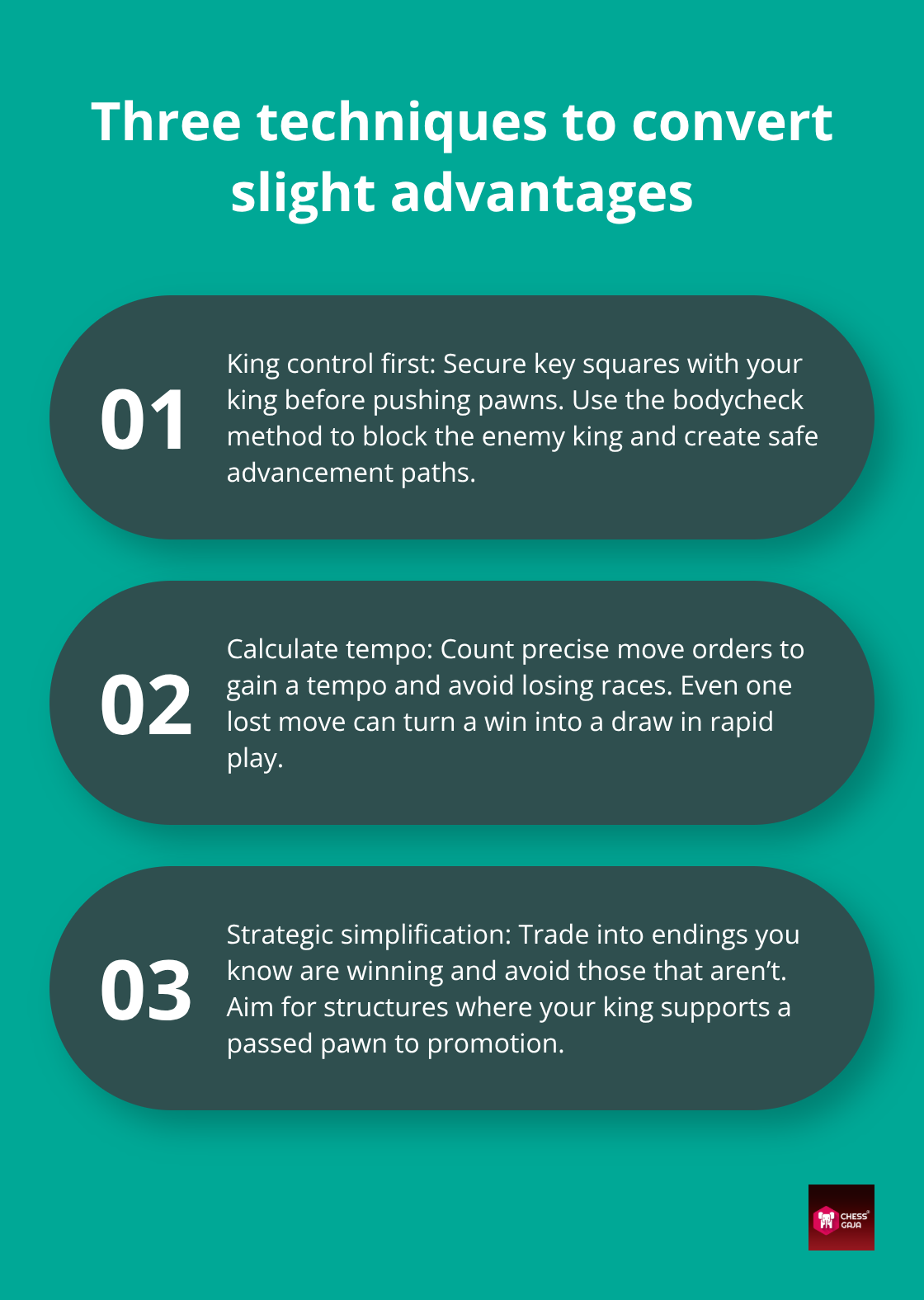
Most pawn endgames in tournament play don’t involve perfect positions. You’ll reach positions where you’re up a pawn, or your king is slightly more active, or your pawn structure is marginally better. The difference between converting these advantages into wins and throwing them away comes down to three concrete techniques that work repeatedly in real games.
Control Key Squares With Your King First
Controlling key squares with your king matters far more than pushing pawns. Occupying Key squares guarantees that your pawn can advance safely to promotion. When defending or outflanking, grandmasters use a technique called shouldering (or “bodychecking”)—using your king to physically block the enemy king’s path to those critical squares.
Imagine your pawn is on e4 with your king behind it on e3, while your opponent’s king sits on e5. Instead of rushing to push e5 right away, you play Kd3 or outflank to gain key squares. By forcing their king to commit first, you secure the path for your pawn to advance safely with full king support.
Calculate Every Tempo Move in the Endgame
Calculating tempo isn’t just about counting moves—it’s about manipulating turn order to force your opponent into giving up critical squares. If you push a pawn prematurely without king support, the enemy king catches it and you lose a crucial move. If you make a waiting move with your king that forces your opponent to retreat, you gain a game-winning tempo.
In rapid tournaments across the USA and UAE, players who calculate tempo accurately win positions they have no right to win. A player rated 1400 who understands tempo in pawn endgames beats a 1500-rated player who doesn’t. This is not exaggeration; this is what happens in tournament results every weekend.
Simplify Into Winning Positions, Avoid Losing Ones
Converting a slight advantage requires knowing which positions to simplify into and which to avoid. If you have a two-versus-one pawn majority on the queenside, your goal isn’t to trade pawns mindlessly, but to force a passed pawn.
Use this passed pawn as leverage to pull the enemy king away from the center. This lets your king infiltrate the opposite flank to collect the remaining pawns. If your opponent holds a passed pawn while you have a majority elsewhere, race calculation is critical. When your king cannot stop their pawn, you must create a faster passed pawn on the opposite flank.
A scholastic player in Singapore recently converted a position where they were up a single pawn by centralizing their king first, then using their pawn structure to force the opponent’s king away from key defensive squares. Instead of rushing, they held back on pushing the pawn prematurely. By calculating three moves ahead, the player recognized that their king would seize the promotion square first and forced a resignation before the pawn even stepped onto the 8th rank.
Apply These Techniques in Your Next Tournament
These three techniques-king control, tempo calculation, and strategic simplification-form the foundation of converting slight advantages into tournament wins. The players who master these methods stop making panic moves and start making calculated decisions. Your opponents will notice the difference immediately, especially in rapid formats where time pressure forces weaker players to guess.
Final Thoughts
Mastering pawn endgame strategies transforms how you perform in tournaments. The players who win consistently aren’t the ones with the sharpest tactics or the deepest opening preparation-they’re the ones who convert advantages in the endgame because they understand opposition, zugzwang, and king activity. When you apply these principles in your next tournament, you’ll notice opponents making mistakes they never made before.
Study real games from tournaments in the USA, UAE, and Singapore where players converted pawn endgames under time pressure. Play rapid tournaments where endgame technique decides results immediately. Review your own games and identify positions where you could have applied opposition or calculated tempo more accurately, because this is how rating gains happen.
At Chess Gaja, we’ve built a curriculum used by 5,000+ students across 40+ countries specifically to develop this skill. Our FIDE-rated coaches focus heavily on endgame mastery because they know it’s where tournaments are won. Book a Paid Starter Class where a Chess Gaja coach will evaluate your current endgame technique and create a development plan designed specifically for you.