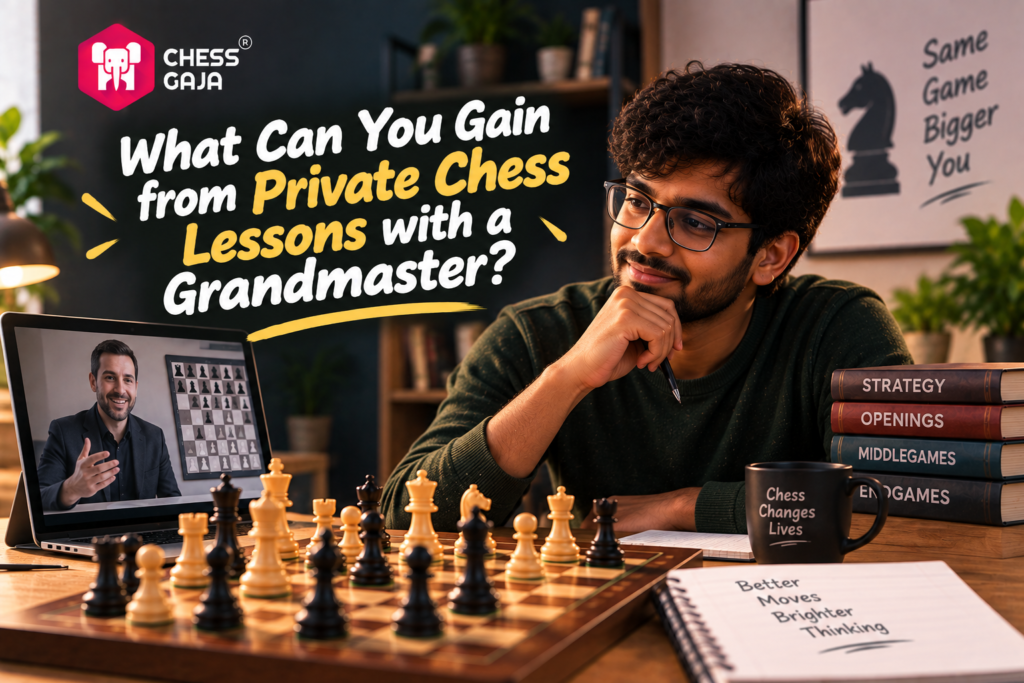
Adult chess players are returning to the game at unprecedented rates, driven by real cognitive benefits and career advantages. At Chess Gaja, we’ve seen this surge firsthand across our student base in the USA, UAE, and Singapore.
Private chess lessons with a Grandmaster coach transform how adults learn and compete. This guide shows you exactly what to expect and how to accelerate your progress.
Why Adults Are Returning to Chess Now
The Cognitive Revolution in Adult Chess
Adults are learning chess faster than at any point in the last two decades, driven by concrete benefits that extend far beyond the board. A 2024 study from the American Psychological Association highlighted how adults engaged in complex strategic games like chess demonstrate significant improvements in executive functioning, pattern memory, and working capacity compared to control groups.
This isn’t theoretical—adults in the USA, UAE, and Singapore are rediscovering chess because it delivers real cognitive returns. Your brain doesn’t just play chess; it rewires itself through deliberate pattern recognition and calculation, strengthening the same neural pathways that power professional problem-solving.
Chess as a Career Accelerator
Corporate professionals represent our fastest-growing student segment. They recognize that chess skills transfer directly to workplace performance. When evaluating positions under time pressure, you train the exact mental discipline required in boardroom decisions, negotiations, and crisis management.
The UAE’s growing chess infrastructure reflects this trend. Dubai and Abu Dhabi have seen a significant year-over-year increase in adult chess club memberships since 2024, driven largely by career professionals. In a parallel move, Singapore’s chess federation reported similar growth, showing strong adult tournament participation in 2025. Such players aren’t hobbyists—they are working professionals who recognize chess as a legitimate way to sharpen competitive thinking.
Mental Resilience and Emotional Stability
Beyond career development, adults turn to chess for mental resilience. The structure of chess (clear rules, defined outcomes, immediate feedback) provides psychological stability that appeals to high-stress professionals. You’re not guessing. You know whether you won or lost, and you can analyze exactly why. That clarity is rare in modern work environments and deeply satisfying to the adult brain.
Why Structured Coaching Accelerates Adult Progress
This is why private lessons with a Grandmaster coach have become the preferred pathway for serious adult learners. Unlike casual club play, structured coaching accelerates your progress dramatically. A beginner or intermediate student working with a Grandmaster coach typically gains 150–200 rating points in their first year, establishing a trajectory that far outpaces self-taught players. Adults don’t have the luxury of time that younger players do, so every lesson must compound toward measurable improvement. The investment is justified by speed and precision.
What separates Grandmaster-led instruction from other learning methods is the quality of feedback and the depth of strategic insight you receive. A coach who has competed at the highest levels understands not just what moves work, but why they work-and more importantly, how to transfer that understanding to your own decision-making process. This personalized acceleration allows adult learners to transition from casual play to competing confidently in rated tournaments within just 3 to 6 months of disciplined one-on-one instruction.
What Your First Grandmaster Lesson Actually Looks Like
The Diagnostic Assessment
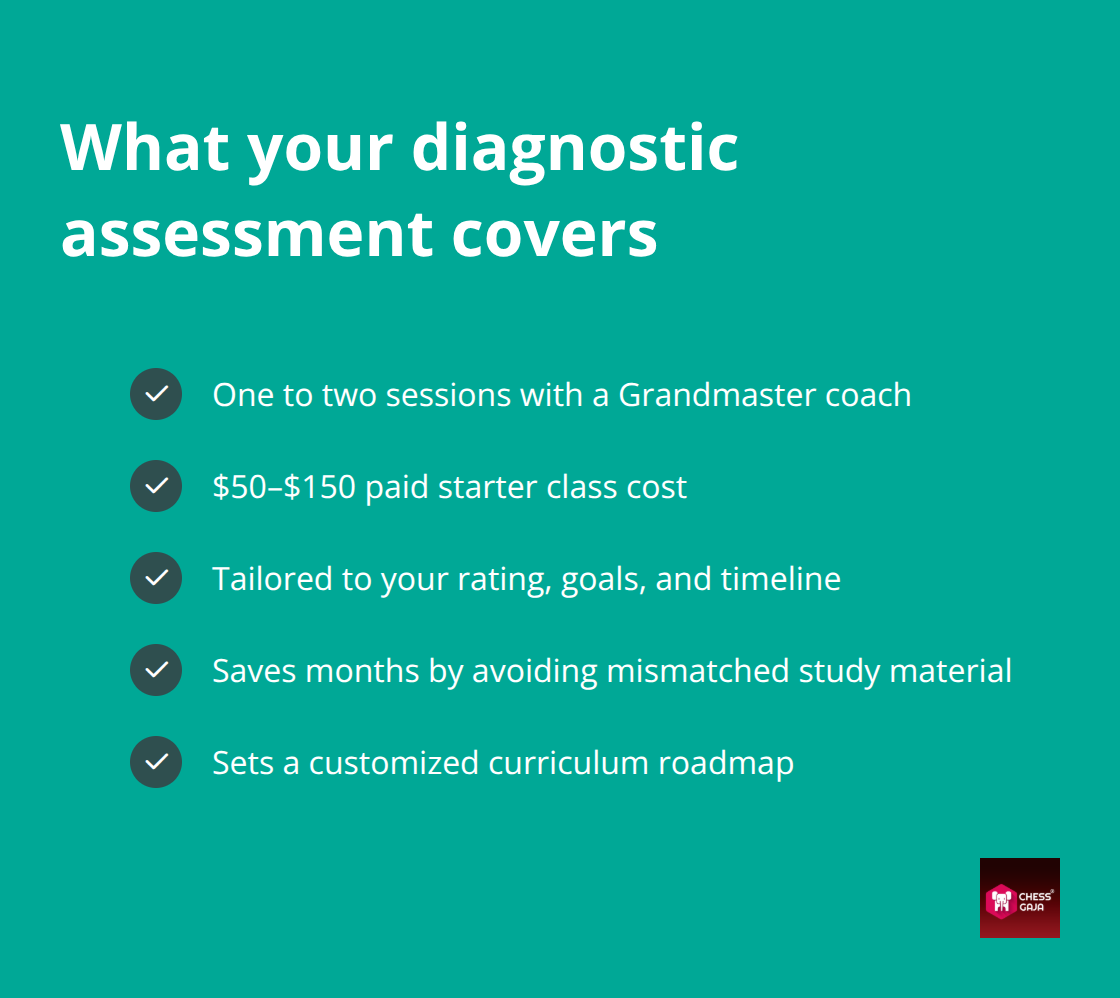
Your first session with a Grandmaster coach is not a lecture. It is a diagnostic conversation that maps exactly where you are and where you want to go. The coach asks you specific questions: How often do you play? What time controls do you prefer? Have you studied openings, or do you play by intuition? Do you want to compete in tournaments, or improve for personal satisfaction? These answers determine everything that follows.
Unlike generic online courses, a Grandmaster coach tailors the entire curriculum to your responses. If you are a 1200-rated player in Singapore who wants to reach 1800 within two years, your plan looks completely different from a 1600-rated player in the UAE who wants to prepare for a specific regional tournament. The assessment phase typically takes one to two sessions and costs between $50 and $150, but it saves you months of wasted effort on material that does not match your actual needs.
Building Your Personalized Curriculum
Once the assessment is complete, your coach constructs a structured curriculum that addresses your weaknesses with surgical precision. If your analysis reveals that you consistently lose positions in the endgame, your lessons will emphasize practical winning and drawing techniques rather than opening theory. if you struggle with time management during crucial calculation phases, your coach designs exercises to streamline your candidate move selection, helping you make high-quality decisions efficiently under clock pressure.
Real Grandmaster coaching does not follow a generic textbook sequence; it follows your rating, your goals, and your decision-making patterns. Between lessons, you receive a tailored study plan. This includes targeted chess books, puzzle software calibrated to your rating, and detailed game analysis of your recent losses. Every recommendation connects directly to what you learn in your lessons.
Real-Time Feedback on Your Thinking Process
After each session, you receive detailed feedback on your thinking process, not just your moves. A coach might say: “You calculated that variation correctly, but you spent eight minutes on a move that should take two minutes. Here’s how to recognize similar positions faster.” Or: “You found the right move, but for the wrong reason. Let’s discuss the principle that actually applies here.”
This real-time feedback separates Grandmaster coaching from self-study. You are not just learning chess; you are learning how to think like a competitive player. The coach knows exactly which skills to prioritize, which openings to study, and which tactical patterns will have the biggest impact on your rating. That efficiency compounds over time.
The Speed of Improvement With Expert Guidance
Students working with a Grandmaster coach typically see 150 to 200 rating point gains in the first year because every hour of instruction compounds toward measurable improvement. The coach eliminates wasted study time and focuses your effort on the skills that matter most for your specific rating and goals. That precision is what separates structured coaching from casual improvement, and it is why serious adult learners invest in professional instruction rather than trying to improve alone. Next, examine how a Grandmaster structures your core skills: openings, middlegame strategy, and endgames. This holistic approach accelerates your competitive results.
How Grandmaster Coaching Structures Your Three Core Skills
Opening Principles Matched to Your Rating
A Grandmaster coach does not teach openings, middlegame, and endgame as separate subjects. Instead, they integrate all three into a coherent system that matches your rating and tournament goals. The difference between this approach and self-study is dramatic. An adult player working alone might spend weeks memorizing opening lines that never appear in their games, while a Grandmaster coach identifies the exact opening principles you need based on your playing style and rating level. If you play as Black and struggle against 1.e4, your coach does not hand you a 50-page opening manual. Instead, they teach you one solid, reliable opening system with clear strategic goals, then focus your remaining study time on the middlegame positions that actually arise from that repertoire. This targeted approach means you spend zero time on irrelevant theory.
Middlegame Mastery: Where Ratings Rise
The middlegame is where most adult players lose rating points, and this is where Grandmaster coaching delivers the highest return. A coach analyzes your recent losses and identifies your decision-making patterns. Do you sacrifice material too quickly? For example, are you missing tactical opportunities because you calculate too slowly? Or perhaps you misread quiet moves that strengthen your opponent’s position? A Grandmaster identifies the specific weakness, then designs exercises that force you to correct it. If your analysis reveals difficulty spotting weak squares, your coach assigns targeted positional exercises focused on that theme. You then review those solutions together in your next lesson to lock in the principle. With consistent targeted practice over four to six weeks, you will start actively spotting these strategic patterns during your games, making faster and more confident positional decisions. Your rating rises because you solve the actual problem, not study generic chess theory.
Endgame Technique: Practical Positions Over Theory
The endgame phase operates the same way. Most adult players waste time on theoretical positions they will never encounter. A Grandmaster coach teaches practical endgames that actually appear in your games. Instead of forcing you to memorize abstract, highly theoretical endgame positions you may rarely encounter, your coach prioritizes essential practical endgame principles and recurring piece structures that directly apply to your actual games. This precision compounds across your entire game.
How Integration Accelerates Your Progress
Within 12 months of structured coaching, you stop losing to lower-rated opponents. You begin converting winning advantages cleanly and consistently. Integrating openings, middlegame patterns, and practical endgames creates a cohesive system. Each core component actively reinforces the others. Your coach ensures that the openings you study lead naturally into middlegame structures where you excel, and those structures connect to endgames you have already mastered. This coherence is what separates professional coaching from scattered self-improvement. Students who work with a Grandmaster coach typically gain 150 to 200 rating points in their first year of consistent private instruction because every element of their game works together toward a single goal: measurable competitive improvement.
Your Next Move
The decision to work with a Grandmaster coach is straightforward once you understand what structured improvement actually looks like. As outlined above, private chess lessons for adults accelerate your progress through personalized assessment, targeted curriculum design, and real-time feedback. Therefore, taking action is your next step.
Start by booking a professional skill evaluation with Chess Gaja. The initial diagnostic session costs between $50 and $150, allowing an experienced Grandmaster or FIDE-certified coach to assess your current rating, understand your goals, and map your development plan. In addition, our evaluation customizes everything to your needs—identifying whether you require opening work, middlegame pattern training, or endgame technique.
Chess Gaja serves over 5,000 students across 40+ countries, with strong communities in the USA, UAE, and Singapore. By joining, you connect with a global network of serious adult learners. High-performing adults bypass months of isolated trial-and-error by choosing structured coaching today.