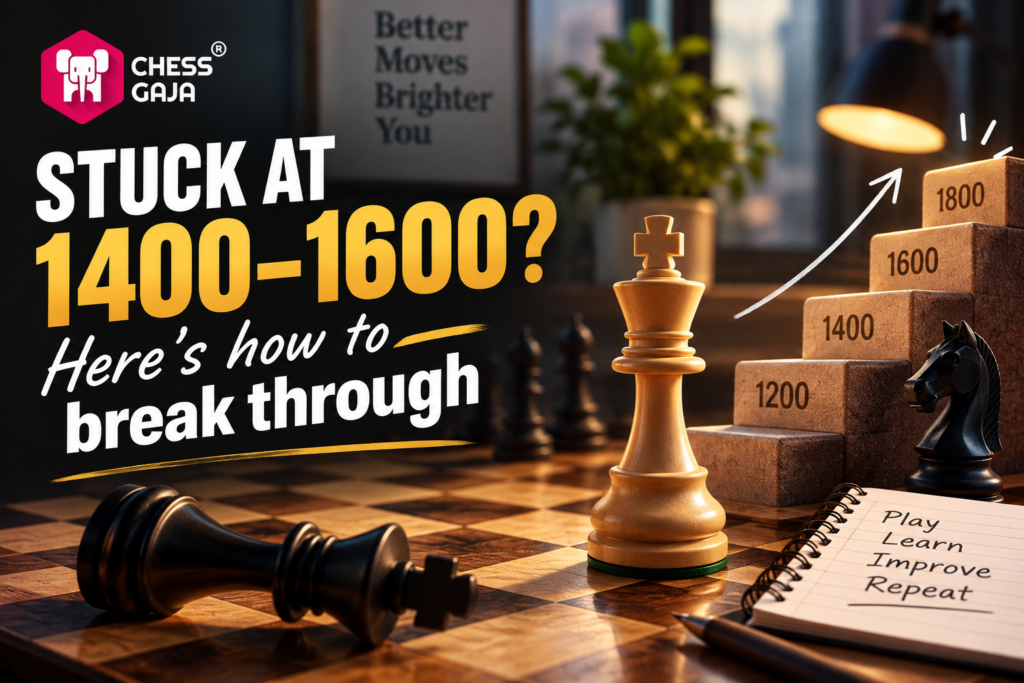
Most adult chess players hit a wall around 1400–1600 rating and stop improving. The frustration is real: you have less time than younger players, your brain works differently, and the gap between your current level and the next tier feels impossibly wide.
At Chess Gaja, we’ve worked with thousands of adult learners who broke through these plateaus using a completely different approach than traditional chess instruction. This guide shows you exactly how.
Why Adults Hit a Wall With Rating Improvement
Adult chess players face a fundamentally different learning environment than children. Most traditional instruction completely ignores this reality. The 1400–1600 plateau exists for clear reasons. Adults learn differently, practice inconsistently, and struggle to diagnose their own weaknesses. A significant majority of adult chess learners hit a rating ceiling within their first two years of serious play. This trend shows clearly across Chess.com and Lichess communities. The problem is not your age or intelligence. Most adults simply train the wrong elements and abandon practice when results stall. Lack of available hours is rarely the true barrier. Instead, progress depends on how you manage time during study and on the clock. A parent working 50 hours per week can still improve by 200 rating points in a year through focused, targeted study.
Three real obstacles hold adults back: a lack of targeted practice direction, absent accountability, and a hesitation to play enough rated games.
The Myth of Memorization
Adults also struggle with a false belief that chess improvement requires memorizing thousands of opening lines or studying endgame theory for months. This misconception causes burnout before real progress happens. In reality, a 1400-rated adult who spends 30 minutes daily on tactical pattern recognition and plays one rated game per week will gain 150–250 rating points within six months. The math is simple: tactics decide most amateur games through direct blunders or missed combinations, yet most adults spend only a small fraction of their study time on this area.
Inconsistency Kills Progress Faster Than Anything Else
Inconsistency destroys rating growth faster than any other factor. An adult who solves 50 puzzles on Monday, then plays no chess for five days, loses the pattern recognition momentum that was building. Your brain needs consistent stimulus to form neural pathways that recognize forks, pins, and tactical sequences automatically. Chess.com data shows that players who train at least four days per week gain rating twice as fast as those who train sporadically.
The second barrier is that adults rarely analyze their own games with any structure. You play a rated game, lose, feel frustrated, and move on without identifying the specific decision that cost you the rating point. A loss at 1500 rating typically contains one critical blunder—usually a single move that swings the engine evaluation by 1.5 to 2.0+ pawn units (an evaluation drop of +1.50 to +2.00). Most adults never find that move because they struggle to interpret engine output or lack a coach to explain what went wrong.
Fear of Competition Holds Adults Back
The third barrier is mental: adults fear losing rating points in public competition. This fear is completely backwards. Every loss in a rated game is free information about your weaknesses. A player who plays 20 rated games per month and loses half of them learns far more than a player who avoids competition and only practices puzzles. Winning at chess requires comfort with losing, and that comfort comes only from repeated exposure.
The Adult Advantage: Understanding Over Memorization
Adults have one massive advantage that younger players lack: you can understand the reasons behind chess principles without needing to memorize them. A child memorizes that you should control the center; an adult understands that central control limits your opponent’s piece mobility and gives you space for your own plans. This deeper comprehension means your improvement can accelerate faster once you practice correctly.
However, adults also face a real constraint: working memory. Your brain can hold fewer positions in mind simultaneously than a 12-year-old’s, which means calculation training must be structured differently. Do not try to calculate eight ply deep like a grandmaster. Instead, focus on calculating three to four moves deep (3–4 full moves for both sides) with absolute accuracy. Calculation depth will naturally expand over months of practice. This approach works because accuracy compounds. A calculation error in move three ruins everything that follows, so precision matters more than depth for adult learners.
Finally, adults benefit enormously from accountability. A child might ignore instruction. An adult who pays for coaching typically follows the plan after investing time and money. Leveraging this mindset creates significant momentum. Fast-improving players commit to structured coaching rather than trying to self-teach. Combining consistent daily practice, game analysis, and professional guidance forms the core foundation for sustainable rating growth.
How to Train Tactics and Strategy Without Wasting Time
Build Tactical Pattern Recognition Daily
Tactical pattern recognition separates players at different skill levels more than any other single skill. Adults who solve 20–30 tactical puzzles daily for six weeks gain 80–120 rating points before playing a single additional rated game. The reason is neurological, not magical. Your brain recognizes forks, pins, and skewers through repetition, and once that recognition becomes automatic, you stop missing tactical shots in real games.
Most adults make a critical mistake: they solve 200 puzzles in one session on Sunday, then ignore puzzles for five days. Puzzle training works only through consistent daily exposure. Use Chess.com or Lichess puzzle training, set a target of 20–25 puzzles per day focusing on high accuracy over speed, and track your streak. Missing two days resets your momentum, so treat this like brushing your teeth, not like optional studying. After four weeks of daily practice, your calculation speed accelerates noticeably. By the eight-week mark, you start winning games you previously would have lost to tactics alone.
Study Complete Games, Not Opening Lines
Strategic understanding requires studying complete games from strong players, not memorizing opening theory. Spend 45 minutes reviewing one complete grandmaster game. Focus on why each move was played and what plan guided the decision. This delivers far more value than memorizing 20 opening moves. Select games played by grandmasters rated 2600+ FIDE from a database like Lichess or Chess.com, then use an engine to verify key decisions.
Ask yourself three questions for every move: What problem did this move solve? What plan did it support? What weakness did it create for the opponent? This approach takes longer than passive watching, but it builds genuine strategic intuition rather than shallow pattern matching.
Master Endgames in Isolation
Adults benefit significantly from studying endgames separately, spending 10–15 minutes three times per week on king-and-pawn endings and basic rook endings. These positions appear in a large portion of amateur games, yet most adults skip endgame study entirely. Mastering these endings takes focused practice and yields immediate rating gains because you reliably convert winning endgames and defend theoretical draws instead of blundering them into losses.
Create Your Weekly Study Cycle
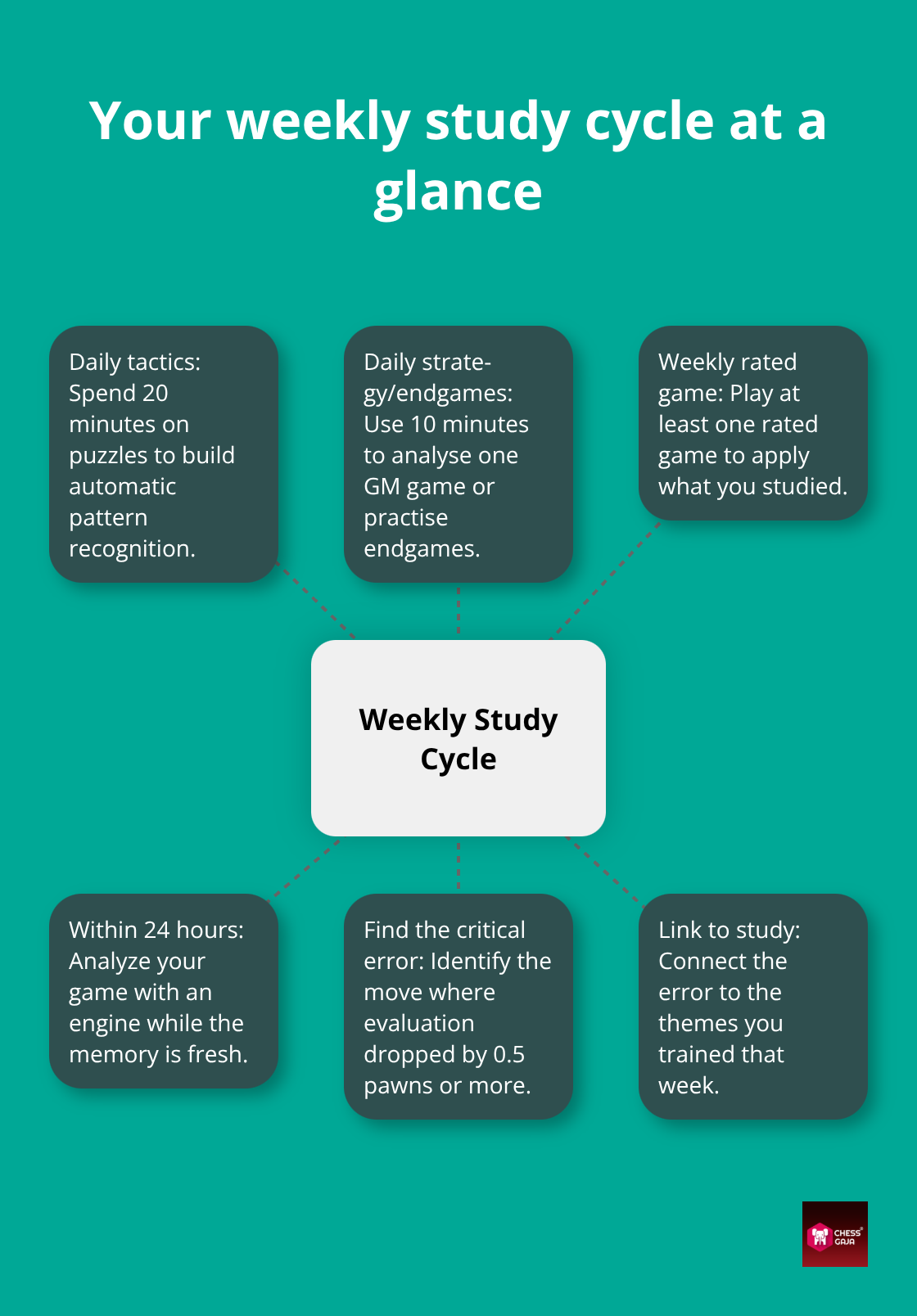
Block 30 minutes daily: 20 minutes for tactical puzzles and 10 minutes for grandmaster game analysis or endgame practice. Play at least one rated game per week. Analyze that game within 24 hours using an engine, identify your critical error, and connect it directly to your weekly study focus. This cycle-daily study, weekly rated games, weekly analysis-compounds into measurable progress.
Adults who follow this exact structure gain 200–300 rating points within six months, not because they are exceptional, but because they are consistent. The structure itself drives the results. Once you establish this routine, you move from hoping for improvement to expecting it. The next step is learning how to break through a rating plateau and extract maximum value from every loss.
How Rated Games and Loss Analysis Drive Real Progress
Rated Competition Closes the Gap Between Study and Results
The gap between puzzle training and actual rating improvement closes only through rated competition. An adult who solves 500 puzzles monthly but plays zero rated games will plateau at 1200–1400 rating because puzzle positions sanitize the chaos of real chess. Rated games force you to manage time pressure, handle unfamiliar positions, recover from mistakes, and execute under psychological stress. A player rated 1500 who plays one rated game per week gains 150–200 rating points annually simply from the pattern exposure and decision-making practice that competition provides.
Analyze Losses Within 24 Hours for Maximum Learning
The critical step most adults skip is analyzing losses within 24 hours of playing them. Your brain retains the emotional weight of a loss for roughly one day. Analyzing your game while that memory is fresh creates stronger neural encoding. Reviewing the same loss two weeks later is far less effective.
Open your loss in an engine like Stockfish, identify the move where your evaluation dropped by 1.50 to 2.00+ pawn units, and ask yourself what you missed. Was a tactical pattern from last week overlooked? Perhaps a strategic principle was misunderstood, or your calculation stopped one move too shallow. This connection between study and loss analysis transforms defeats into high-value learning events.
Players who follow this pattern—studying tactics and strategy daily, playing one rated game weekly, analyzing losses immediately—typically gain 150–250 rating points within 12 months on their own. The structure itself produces results because you force your brain to apply what you studied to positions you have never seen before.
External Perspective Breaks Through the Self-Blindness Barrier
Structure and consistency alone hit a ceiling around 1600–1800 Chess.com Rapid rating (or ~1300–1400 FIDE classical) for most self-taught adults. Beyond that point, you need external perspective because your own blindspots remain invisible to you. Working with a master instructor identifies patterns in your losses that you cannot see yourself. One adult student improved from 1540 to 1800 online rapid rating within months after a coach spotted subtle time-management errors in complex middlegames. Similarly, another student climbed from 1325 to 2260 USCF rating to earn the USCF National Master (NM) title. In his case, an expert diagnosis revealed that poor opening transitions were bottlenecking his sharp tactical ability. Re-anchoring his study around pawn structures unlocked his overall play. Without external feedback, these players would have continued grinding puzzles while their actual weaknesses remained unaddressed.
Accountability Accelerates Progress Faster Than Self-Teaching
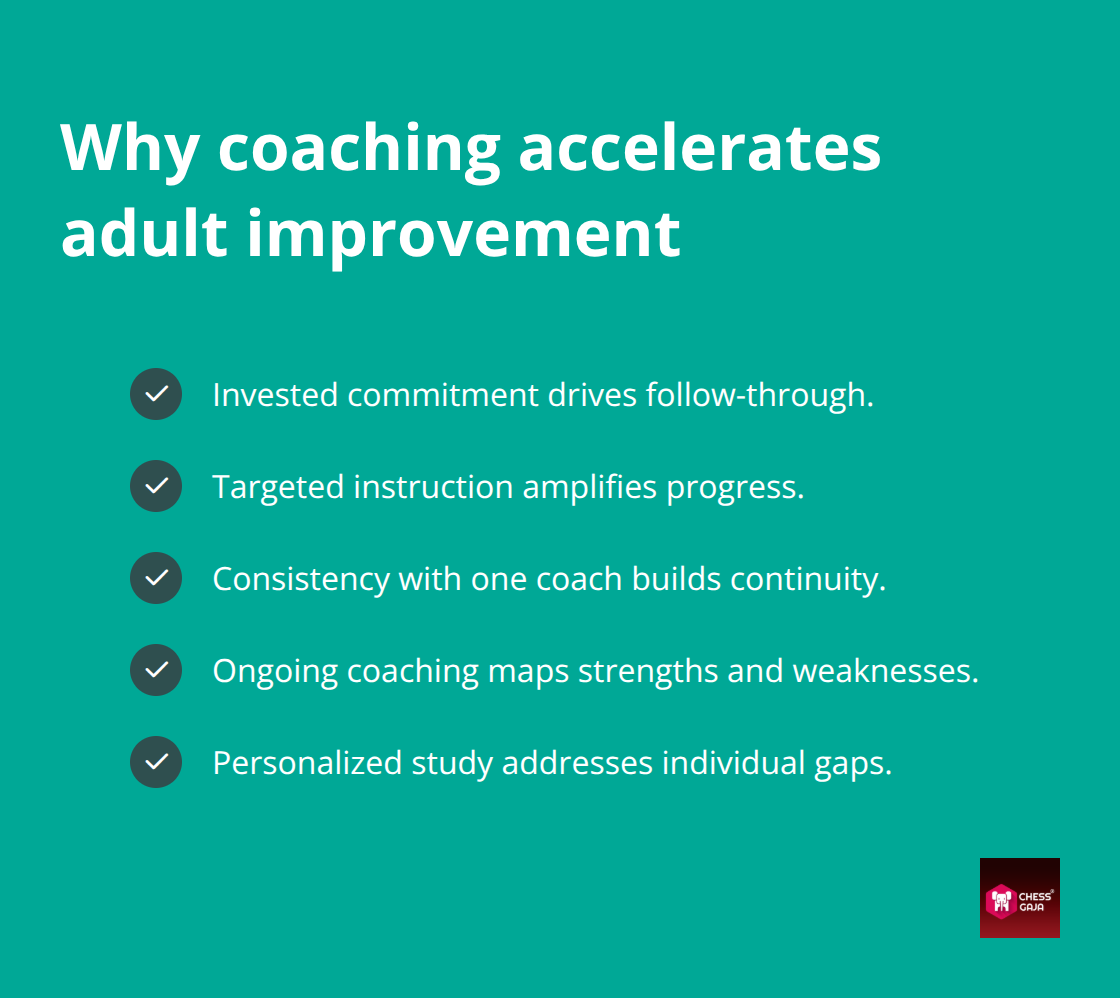
Professional guidance also accelerates progress through accountability. Committing to a structured program ensures follow-through due to invested time and reputation. This structure compounds with targeted instruction to build momentum. Ultimately, these factors create a learning velocity self-teaching cannot match. Beyond structure, the coaching relationship itself plays a critical role.
Long-term mentorship means your instructor understands your specific weaknesses over months, not just in a single session. Regular analysis allows us to build a detailed map of your strengths over time. Targeted coaching then addresses your individual gaps rather than offering generic material.
Players who invest in coaching gain 300–500 rating points within 12 months when combined with consistent daily study. By contrast, an adult training alone typically gains 150–250 points. Talent is rarely the differentiator here; effective diagnosis and accountability work together to eliminate wasted effort.
Your Next Move
Rating improvement for adults requires three elements working together: realistic goals, sustainable structure, and professional guidance. Set a realistic target—such as gaining 200 rating points on your primary platform or reaching 1500 FIDE within 12 months—and track your progress monthly using the USCF Player Ratings Look-Up tool or your platform’s rating history. This visibility holds you accountable and reveals whether your study translates into actual gains.
Creating a sustainable plan means building chess into your life, not around it. You need 30 minutes daily for study, one rated game per week at a time that works for your schedule, and analysis of that game within 24 hours. This rhythm requires no more time than watching a television episode, yet it compounds into measurable progress because consistency beats intensity every single time.
Professional guidance separates players who plateau from those who break through. A coach identifies your specific weaknesses—such as middlegame time management or weak endgame technique. From there, they prescribe targeted study to address your exact individual gaps.
At Chess Gaja, we work with you continuously over weeks and months. We build a detailed understanding of your strengths and weaknesses, ensuring your study plan constantly evolves as you improve.
Book a Paid Starter Class for a professional skill evaluation. Our coaches will assess your rating, identify your key weaknesses, and design a personalized study plan built around your schedule and goals.