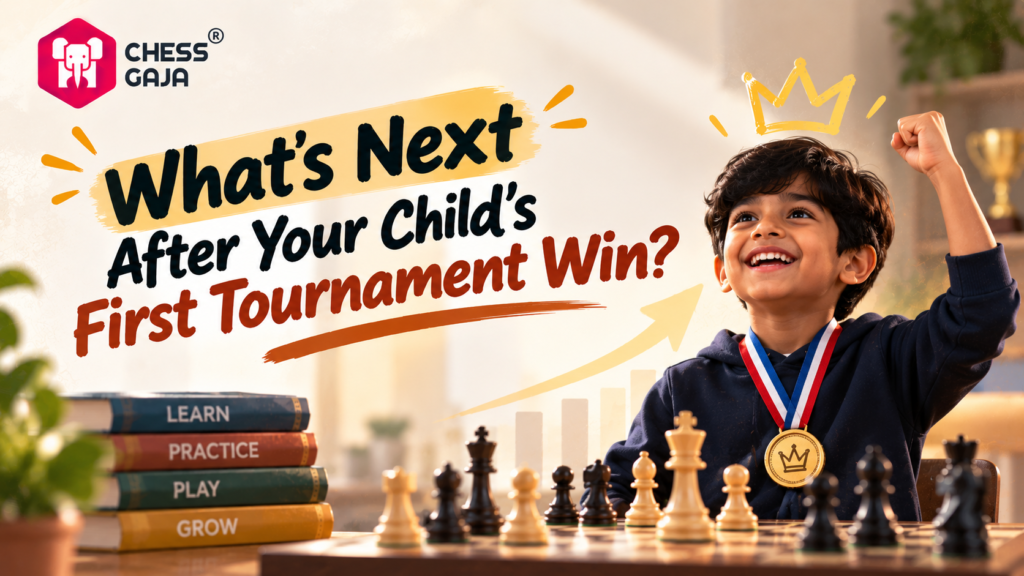
Your child just won their first scholastic chess tournament. Now what?
Scholastic chess programs provide the roadmap that turns occasional wins into consistent improvement. At Chess Gaja, we’ve seen young players advance three rating categories in a single year when they follow a structured pathway instead of playing casually.
The difference isn’t talent-it’s having the right system, experienced coaching, and regular competitive opportunities working together.
What Makes Structured Programs Different From Casual Play
Structured scholastic programs work because they replace randomness with progression. A young player in Dubai might win a tournament by luck, but without a system, the next tournament feels like starting over. Research from Frontiers in Psychology shows that chess instruction improves working memory and executive function. However, this only happens when programs run for sustained periods. This is where scholastic pathways matter: they guarantee that every lesson builds on the last one, and every tournament reinforces what was learned in training.
How Rating-Based Progression Builds Real Confidence
The difference between casual players and structured learners comes down to measurement. When a student follows a scholastic program aligned with rating systems like FIDE or USCF, they see concrete proof of improvement every few months. A chess rating measures your playing strength relative to others using the Elo system. A young student rated 800 USCF (or equivalent local national rating) knows exactly what 900 looks like, and the coach provides a roadmap to get there. This isn’t motivation through hope-it’s motivation through evidence. Programs use tiered curricula paired with regular rating ladders.
This setup keeps young players engaged because they always know what is next. Personalized study schedules built around each student’s current rating and goals accelerate progress significantly. The student sees their name move up a ladder, earns a higher rating, and knows exactly which skills produced that result.
Tournament Experience Builds the Skills Casual Play Never Develops
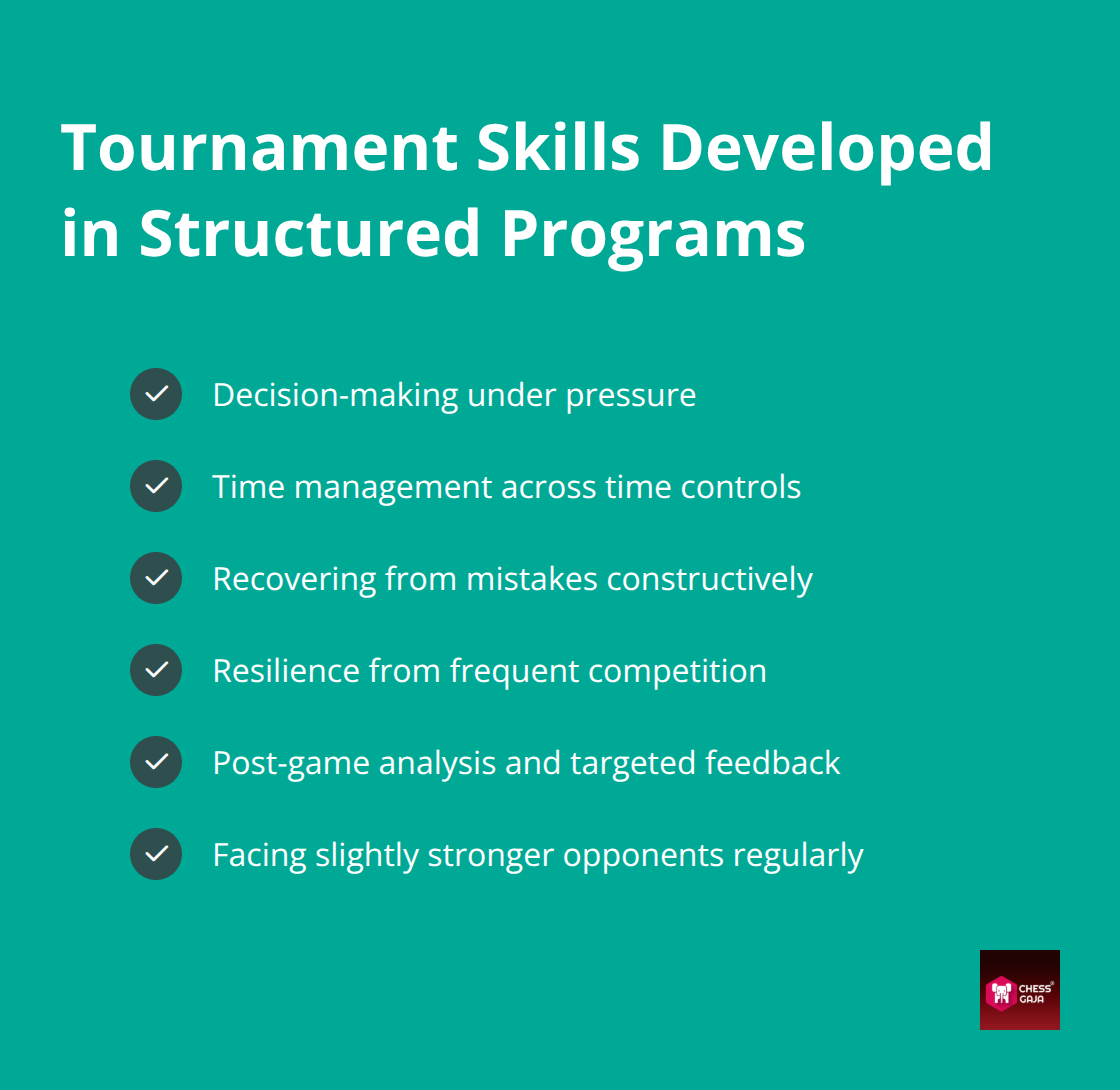
Playing chess at home with friends teaches tactics. Playing in tournaments teaches decision-making under pressure, time management, and how to recover from mistakes. A scholastic program runs 10+ tournaments monthly, creating dozens of competitive opportunities where young players face opponents at their level and slightly above. This consistent exposure to real competition teaches resilience faster than any classroom lesson.
Students learn that losing a game doesn’t mean they’re bad at chess-it means they found a gap in their preparation, which they can now fix. After each tournament, structured programs include post-session analysis and feedback, so the student understands not just what went wrong, but how to prevent it next time.
The Role of Coaching Continuity in Long-Term Growth
Casual play lacks the relationship that transforms a young player’s trajectory. A long-term coach understands a student’s patterns, strengths, and mental blocks. One-off instruction simply cannot match this deep insight. Structured programs assign coaches who stay with students throughout their journey, building trust and accountability. This continuity means the coach recognizes when a student plateaus and adjusts the curriculum accordingly. The coach also celebrates wins and helps students process losses-both essential for developing the mental resilience that separates competitive players from those who quit after their first setback. A coach who knows a student’s history spots key patterns. They quickly identify weak tactical areas and suitable openings.
From Analysis to Action: The Feedback Loop That Drives Improvement
Casual players rarely analyze their games systematically. Structured programs make analysis non-negotiable. After each tournament or training session, students receive detailed feedback on their decisions, time management, and tactical oversights. Post-game analysis helps you evaluate your mistakes and correct them, and it helps you improve your thinking and planning. The cycle of competition, analysis, and targeted practice is what separates players who plateau at 1200 from players who reach 1800 by their teenage years. Each tournament becomes a data point that informs the next training block, ensuring no opportunity for learning is wasted.
What Every Scholastic Program Must Have
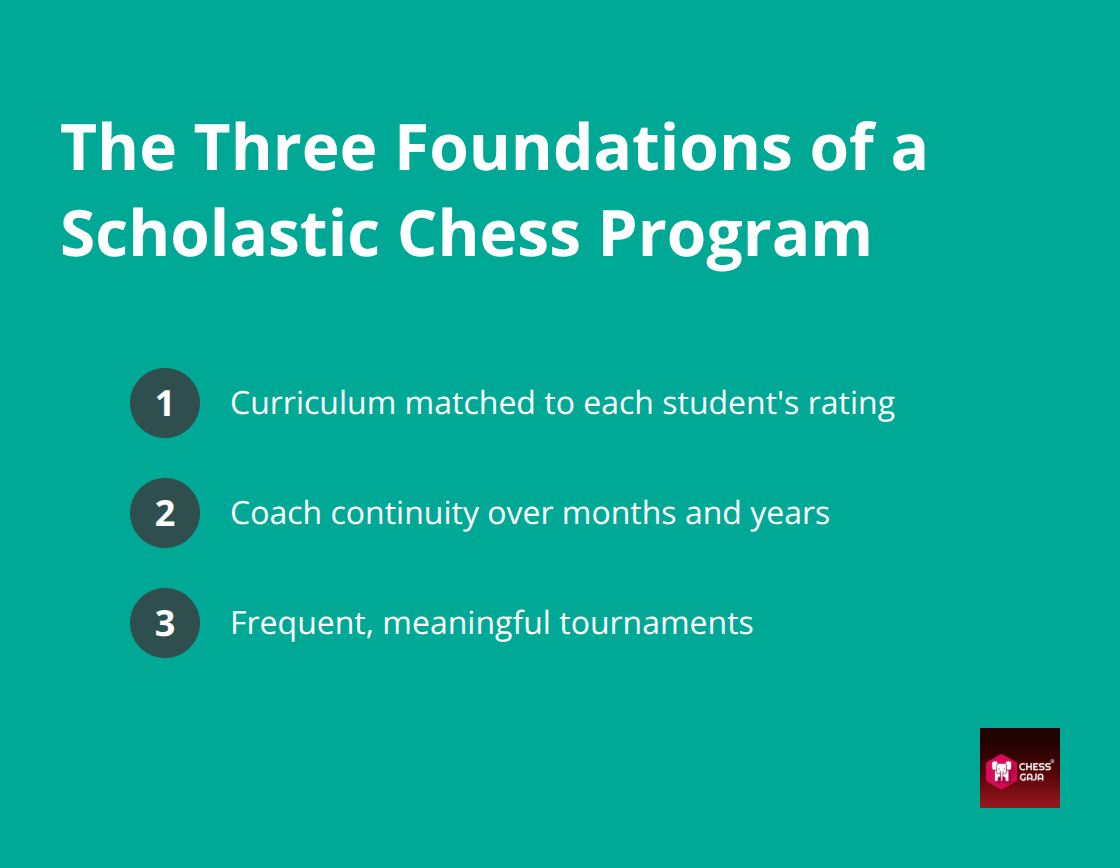
A scholastic chess program lives or dies on three foundations: a curriculum that matches where each student actually sits in their development, coaches who stick with students long enough to understand their patterns, and tournaments that happen frequently enough to matter. Without all three, you have fragments that don’t add up to real progress.
The students who advance fastest are those in programs where every piece connects to every other piece.
Why Age and Rating Must Drive Your Curriculum, Not Wishful Thinking
Most scholastic programs make a critical mistake: they teach the same material to every beginner regardless of age or prior chess exposure. A 7-year-old complete beginner needs a different approach than a 12-year-old with two years of casual play. The 7-year-old benefits from pattern recognition exercises and simple tactical puzzles that build intuition. The twelve-year-old needs to understand why those patterns work, which means introducing concepts like piece value and positional advantage.
A beginner rated 600 USCF needs foundational work on piece safety and basic tactical patterns. A student rated 1200 FIDE needs structured opening principles, core tactical calculation, and basic endgame technique. A student rated 1600 FIDE needs advanced positional understanding, deep endgame precision, and psychological resilience. Ignoring these differences causes wasted time. Programs end up teaching material students either already know or cannot yet grasp.
The curriculum should track each student’s rating and adjust the difficulty of puzzles, the complexity of positions studied, and the types of tournaments they enter. A structured chess curriculum promotes creativity, memory, emotional stability, and logic. This approach keeps students engaged without frustration or boredom.
Coach Continuity Matters More Than Coach Credentials Alone
A FIDE-rated coach is better than no coaching, but a FIDE-rated coach who knows your child is exponentially better than rotating between different coaches. Long-term coaching builds a clear chess memory. The coach identifies which openings fit the student, which tactics they miss, and how they handle competitive losses.
A student’s first coach should be the same coach who reviews their first tournament, analyzes their breakthrough win, and helps them process their first serious loss. This continuity creates accountability on both sides. The coach feels responsible for the student’s progress because they’re watching it unfold. The student trusts the coach because the coach has proven they remember what was discussed three weeks ago and what went wrong in last month’s tournament.
Programs that assign a different coach for every session or switch coaches when a student moves to a new rating band destroy this relationship. Students waste time re-explaining their learning style and coaches miss the patterns that unlock faster improvement.
Tournaments Must Happen Monthly, Not Twice a Year
A young player who competes once or twice yearly has almost no feedback loop. They play a tournament, wait months for the next one, and by then they’ve forgotten what they learned from the last tournament. Monthly tournaments normalize competition and create consistent learning cycles.
A young player who competes ten times a year treats tournaments as routine events where they apply their skills. A young player who competes twice a year treats tournaments as high-stakes moments where they freeze. The difference in performance is dramatic. Tournaments should primarily focus on classical time controls for deep calculation and rapid time controls for structured decision-making, giving young players space to apply their training without relying on hasty guesswork.
A scholastic program that offers only one tournament format once a year isn’t a program, it’s an event. The rhythm of regular competition keeps improvement moving. Students finish a training block, compete in a tournament, receive analysis, and have a new training focus within days. This cycle prevents the long gaps that cause young players to forget what they learned.
How Post-Tournament Analysis Transforms Competition Into Learning
Casual players rarely analyze their games systematically. Structured programs make analysis non-negotiable. After each tournament or training session, students receive detailed feedback on their decisions, time management, and tactical oversights. Post-game analysis helps you evaluate your mistakes and correct them, and it helps you improve your thinking and planning.
The cycle of competition, analysis, and targeted practice is what separates players who plateau at 1200 from players who reach 1800 by their teenage years. Each tournament becomes a data point that informs the next training block, ensuring no opportunity for learning is wasted. When a coach reviews a student’s tournament games, they spot patterns that the student cannot see alone. A coach spots tactical errors in the middlegame that students miss alone. They also identify when time pressure causes careless endgame moves. These observations shape the next week’s training focus.
Building the Foundation for Competitive Excellence
The three elements-curriculum matched to rating, coach continuity, and monthly tournaments-work together to create what separates casual players from competitive ones. A player enrolled in a program with all three elements advances rapidly. They gain ratings far faster than someone training casually. The structure removes randomness and replaces it with progression.
This foundation also prepares young players for the next level of competitive chess. As students advance through rating bands, they need more sophisticated training-deeper opening study, endgame technique, and psychological preparation for high-stakes matches. Programs that establish these three elements early make the transition to advanced play seamless because the student already understands how to learn from competition and how to work with a coach who knows their strengths and weaknesses.
How Scholastic Programs Accelerate Skill Growth
The difference between a player who improves two rating points per month and a player who gains twenty rating points per month isn’t talent. It’s the system that feeds improvement. Structured programs accelerate growth by eliminating wasted time. They create tight feedback loops between training, competition, and post-game analysis. A young player in the UAE rated 900 USCF who trains casually might take up to eighteen months to reach 1100. The same player in a structured scholastic program with personalized study plans, post-session analysis, and monthly tournaments can comfortably achieve that milestone within a structured annual season.
The acceleration happens because every training hour connects directly to competitive performance, and every tournament reveals exactly which skills need work next. Students who receive personalized study schedules tailored to their current rating achieve consistent, milestone-driven rating growth annually when they also compete in monthly tournaments and receive detailed post-game analysis. This acceleration isn’t magic—it is the result of three systems working together: a personalized study plan, rapid AI-powered feedback, and an active peer learning community.
Personalized Study Plans That Match Your Child’s Rating, Not Their Age
A 7-year-old rated 1200 USCF needs completely different training than a thirteen-year-old beginner rated 400 USCF, yet most scholastic programs ignore this and teach by age group. The younger, stronger player needs strategic calculation and endgame principles. The older, newer player needs piece safety, basic tactical vision, and board awareness. A personalized study plan starts with an honest rating assessment, then prescribes exactly which skills to develop and in what order. An 800 USCF student focuses on daily core tactics. Meanwhile, 1400 and 1800 rated players study opening repertoires and deep positional concepts.
Research from Frontiers in Psychology shows that chess instruction improves working memory and executive function, but only when the difficulty level matches the student’s current ability. Too easy and the student learns nothing; too hard and frustration kills engagement. Personalized study plans prevent both problems by specifying regular practice frequency—typically two to three structured sessions weekly—building neural pathways far faster than irregular cramming.
AI-Powered Feedback That Identifies Patterns No Human Coach Notices Alone
After each training session, a student should receive a summary of what they learned, what they struggled with, and what to practice next. Traditional coaching delivers this verbally, which means students forget half of it within hours. Modern scholastic programs use AI-powered class summaries delivered through a Learning Management System within hours of each session. The AI generates revision notes, highlights tactical patterns the student missed, and creates personalized quizzes to reinforce the lesson. This system enables significantly higher retention compared to students who simply attend class without structured review.
The AI also tracks data over weeks and months, spotting patterns that single sessions cannot reveal. If a student makes frequent time management errors, the AI flags it instantly. It then recommends targeted speed drills to sharpen decision-making. If a student struggles with an opening, the AI takes action. It immediately suggests targeted puzzle work for those specific positions. This data-driven approach prevents coaches from wasting time on generic advice and instead focuses training on the student’s actual weaknesses. A student’s monthly progress report shows exactly which tactical patterns improved, which time controls still need work, and which rating bracket they’re approaching. Parents see concrete evidence of progress, not vague promises. This transparency also motivates students because they see their own improvement data and know exactly what the next target is.
Community and Peer Learning That Make Consistent Improvement Sustainable
A young player training alone in their bedroom faces a psychological burden that undermines long-term growth. They don’t know if their progress is normal, they don’t see other players working as hard as they are, and they lack the healthy peer competition that normalizes effort. Scholastic programs create community through monthly academy tournaments, student forums, and peer learning groups. A student in a monthly tournament with fifteen peers sees real progress. They realize that losses are normal and effort produces results.
This peer environment is powerful because it replaces self-doubt with evidence. A student who loses to a peer learns that superior skill came from preparation, while winning proves that their training actually works. Furthermore, after a loss, seeing peers process similar setbacks normalizes the experience and builds psychological resilience faster than any coach’s pep talk.
How Post-Tournament Analysis Transforms Competition Into Learning
Casual players rarely analyze their games systematically. Structured programs make analysis non-negotiable. After each tournament or training session, students receive detailed feedback on their decisions, time management, and tactical oversights. Post-game analysis transforms competition into learning by helping students evaluate their mistakes and correct them. The cycle of competition, analysis, and targeted practice separates players who plateau at 1200 from players who reach 1800 by their teenage years. Each tournament becomes a data point that informs the next training block, ensuring no opportunity for learning is wasted. When a coach reviews a student’s tournament games, they spot patterns that the student cannot see alone. A coach might notice that a student makes the same tactical error in the middlegame or that time pressure causes careless moves in the endgame. These observations shape the next week’s training focus.
Final Thoughts
Structured scholastic chess programs deliver measurable results because they eliminate the randomness that defines casual play. A student who follows a rating-matched curriculum and competes monthly achieves steady annual growth. Conversely, casual players often struggle to break past their plateau. The difference compounds over years, and the structured player reaches competitive strength while the casual player still searches for direction.
Long-term chess success requires three key factors working together. You need personalized training matching your child’s rating, dedicated long-term coaches, and regular competitive tournaments. Programs missing any of these three elements produce inconsistent results, while programs with all three produce champions. When evaluating chess programs, start with key questions. Does the program assess your child’s rating before assigning work? Do coaches stay long-term, and does the program provide post-tournament analysis?
Book a Paid Starter Class with Chess Gaja today. You will receive a professional evaluation and a personalized roadmap for your child. The starter class offers honest feedback on your child’s level. It provides clear recommendations tailored to your family’s goals and schedule. From that first class forward, your child’s coach stays with them, building the continuity that transforms occasional wins into consistent advancement.