
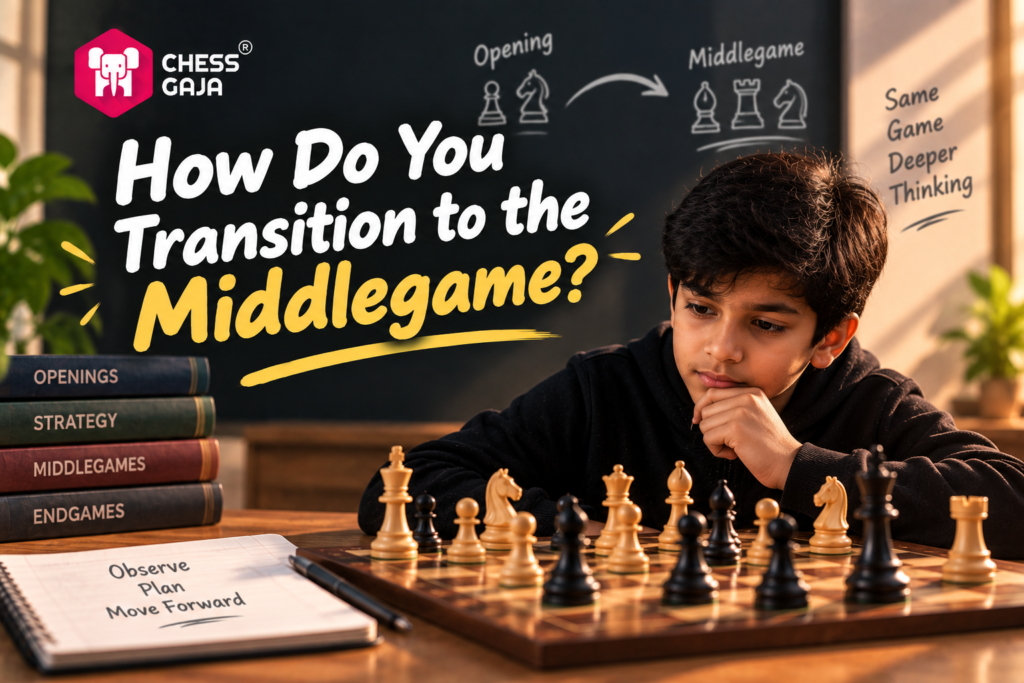
Most chess players know how to follow opening principles. But the moment those first 10-15 moves end, they freeze up.
Transitioning to the middlegame is where your real chess skill shows. We at Chess Gaja have seen countless students struggle with this exact shift-they finish their opening moves and suddenly have no plan. The good news is that smooth transitions follow a learnable pattern, and we’ll walk you through it here.
When Does Your Opening Actually End?
The opening does not end at an arbitrary move count like move 15. It ends the moment both players finish natural development and the board demands a concrete strategic plan rather than memorized theory. Most players miss this moment entirely. Rather than formulating a plan, amateur players often continue playing memorized development moves. Expecting the position to reveal what to do next is a mistake. The position simply becomes chaotic instead.
Three Signals That Your Opening Has Shifted
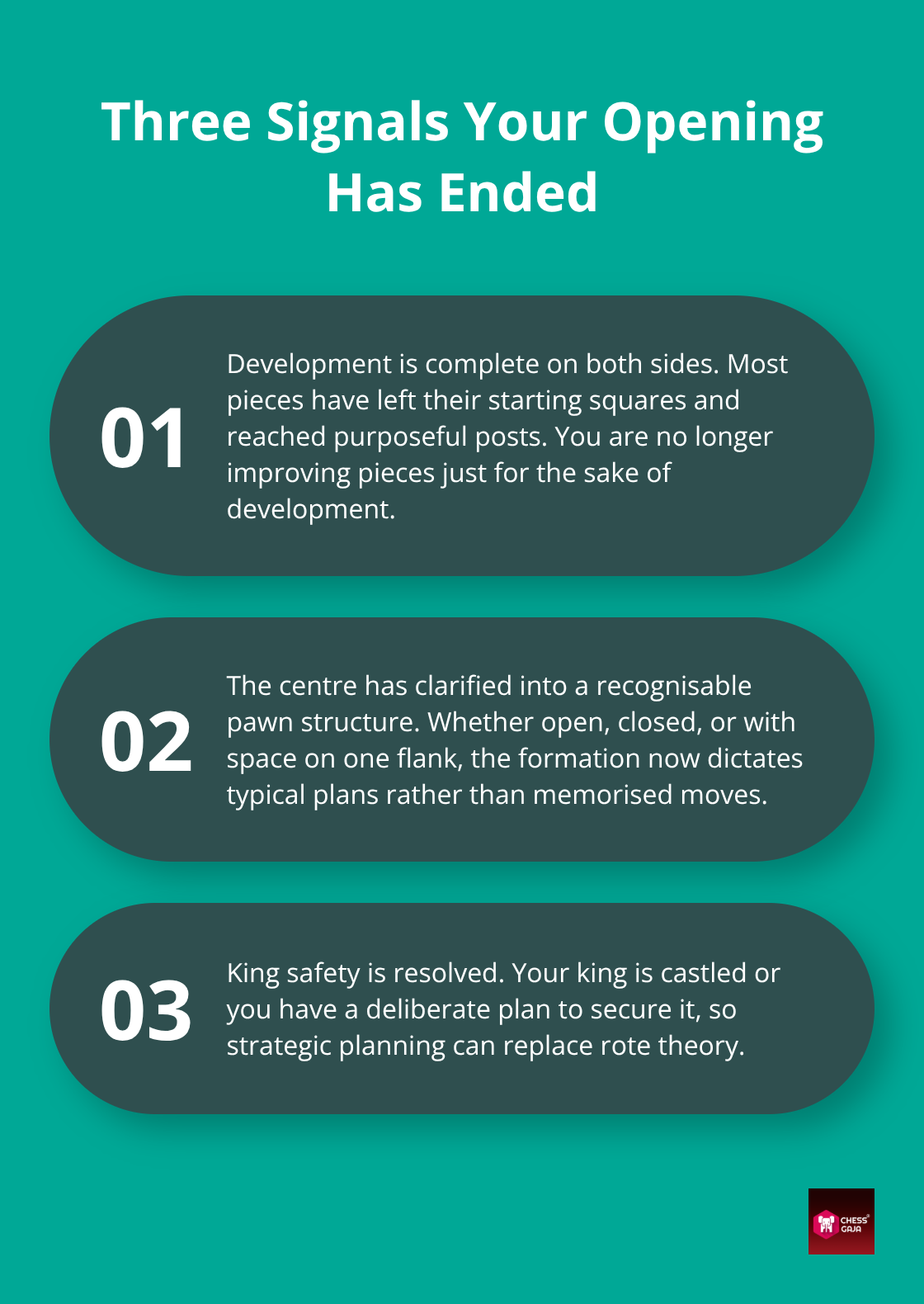
We teach students to recognize three concrete signals that the opening phase has shifted. First, both sides have moved most pieces off their starting squares at least once. Your bishops, knights, and rooks should have found purposeful squares aligned with your opening structure. Second, the center has stabilized into a recognizable pawn formation-whether that’s a closed center with locked pawns, an open center with traded pieces, or a space advantage on one flank. Third, king safety is resolved. Either your king is castled and relatively secure, or a deliberate plan around king safety is underway.
When all three conditions exist, your opening has ended. The middlegame has begun. Now you stop following theory and start building a plan based on the specific position in front of you.
Why Most Beginners Collapse at This Moment
This shift is where most beginners collapse. Many students memorize 15–20 opening moves without building a framework for what comes next. Instead of executing a coherent strategy, decisions are made based on superficial tactics or material captures. Consequently, scattered and uncoordinated play quickly squanders the opening advantage.
Reading the Three Layers of Your Position
Once your opening ends, your position contains three layers of information. The first layer is material-are you up a pawn, down a piece, or equal? Count carefully. The second layer is piece activity. Where are your pieces positioned? Are they controlling key squares, or are they sitting passively on the back rank? The third layer is pawn structure. What does your pawn skeleton look like, and what does your opponent’s look like? A single weak or doubled pawn can define your entire middlegame plan.
These three elements determine what your position needs from you. If you’re up material, look to trade off your opponent’s active pieces to simplify the position and strip away their tactical counterplay. Superior piece activity requires immediate action. You must create concrete threats before your opponent catches up in development. If your pawn structure creates a permanent weak square, turn that square into a knight outpost or a target for your rooks.
Why Pawn Structure Matters More Than You Think
Most beginners ignore pawn structure entirely and focus only on material and tactics. This is backwards. A pawn structure weakness can dominate the next 20 moves of your game. Study your own games and identify which pawn structures appear most frequently in your openings. Then learn what middlegame plans work best in each structure. This targeted study is far more efficient than memorizing more opening lines, and it prepares you for the concrete decisions that actually matter in the middlegame.
How to Move Your Pieces Into Attacking Positions
Stop Moving Pieces Without Purpose
The moment your opening ends, most players make the same error: they move pieces without a reason. A knight jumps to a square because it looks active. A rook slides to an open file because rooks belong on open files. But scattered piece movement wastes time and fails to build pressure. Instead, you need a concrete target. Every piece move should answer one question: does this move improve my attack or defense on a specific square or file? If the answer is no, the move wastes a tempo.
Identify and Improve Your Three Worst Pieces
In the first 5-8 moves after your opening concludes, identify your three worst-placed pieces. Passive pieces typically suffer from changing pawn structures. Common examples include a knight stranded on a4, a bad bishop biting on granite, or a rook stuck on its starting square. Upgrading these three pieces is your primary job in the early middlegame. This task is purely mechanical work rather than complex theory.
Take your worst piece and ask where it needs to go to create a real threat. If your knight is stranded on the rim at a4, reroute it back toward the center via c3 or b2 so it can control key squares or reach an outpost. If your bishop is blocked by your own pawns, reroute it to an open diagonal where it pressures your opponent’s position. Players who improve their pieces in the first 10 middlegame moves gain measurable rating improvement, simply because they stop wasting tempos.
Coordinate Pieces Around Central Control
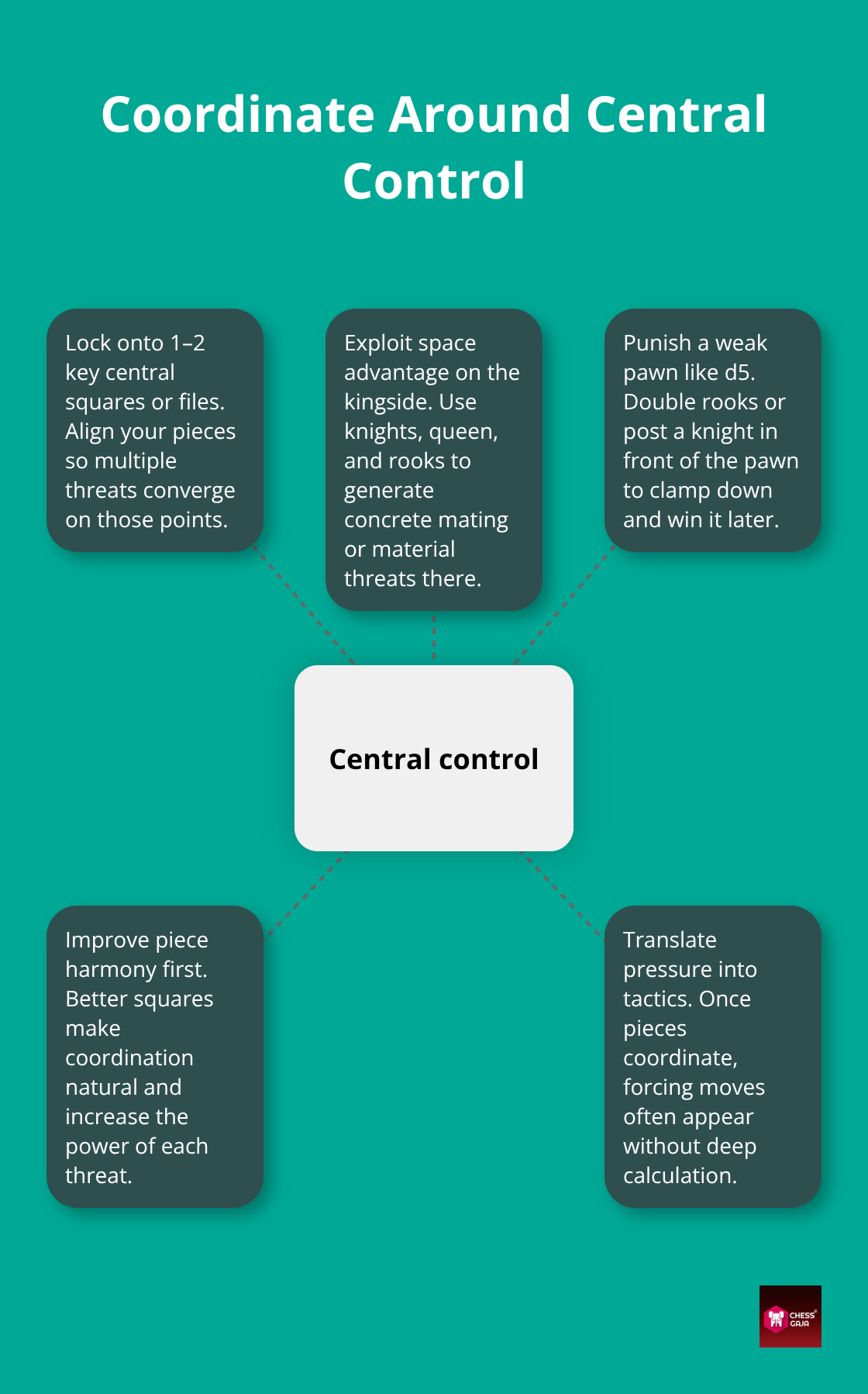
Control of the center and key squares follows naturally from piece placement. Once your pieces occupy better squares, coordinate them around one or two central squares or open files where you want to build an advantage. If you have a space advantage on the kingside, your pieces work together to create threats there. If your opponent has a weak pawn on d5, your knight and rook coordinate to attack it or occupy the square in front of it.
A key distinction between a 1200-rated player and an 1800-rated player is positional vision combined with targeted calculation. An advanced player immediately sees how a rook on the seventh rank and a knight on f5 work together to overwhelm the g7 or h7 defense, whereas a rook passive on the first rank and a knight on a3 generate zero threats. Concrete, coordinated pressure matters far more than abstract piece activity.
Create One Concrete Threat in the Next 2-3 Moves
A threat means your opponent must respond to your move, not the other way around. After you place your three worst pieces on better squares, identify one concrete threat you can create in the next 2-3 moves. This threat does not need to be a checkmate. It can be the threat to win material, to invade with your queen, or to create a passed pawn. Mentally articulate your plan—or, during practice games, write it down on a scratchpad—to force complete clarity on what you are threatening and which pieces will execute that threat.
This transforms your middlegame from aimless shuffling into purposeful play that forces your opponent to react. Once you establish this first threat and your opponent responds, you move to the next phase: recognizing when to press your advantage and when to shift your plan based on how your opponent defends.
Where Most Players Derail in the Transition
Three Critical Errors That Destroy Your Advantage
The moment your opening ends, most players make three critical errors. The first error is mechanical: they continue playing opening moves long after development finishes. A player pushes a rook to the seventh rank because rooks belong on the seventh rank, not because a specific threat exists on that rank. Another player develops a bishop to an aggressive square and then shuffles it back and forth without a clear target because they lack a plan. This aimless movement wastes tempos and hands your opponent time to build counterplay.
The second error is positional: they fail to coordinate their pieces around a single target. A knight sits on d5, a rook on the e-file, and a queen on g5, but none of them work together to create real pressure on a specific square or weakness. Individual pieces look active while the position generates zero concrete threats.
The third error is tactical: they miss immediate winning opportunities because they are stuck in passive mode. After you improve your piece placement and coordinate around a target, your opponent’s position will often yield concrete tactical vulnerabilities—such as a back-rank weakness, a pinned defender, or an unprotected piece. Players who remain in passive opening mode miss these tactics entirely.
The Real Rating Gap Happens in the First 10 Middlegame Moves
Analysis of amateur games reveals that most of the rating gap between 1200 and 1600 players is decided during the first 10 moves of the middlegame, not in opening memorization or endgame technique. The lower-rated player loses their opening advantage through aimless piece shuffling and a failure to create concrete threats. In contrast, the higher-rated player systematically improves their worst pieces, coordinates around a target, and forces their opponent onto the defensive.
The difference is not calculation power-it is the absence of a concrete plan. A 1600-rated player thinks in terms of specific targets and threats. A 1200-rated player thinks in terms of general activity and material.
Articulate Your Plan to Eliminate Aimless Play
To avoid this trap, explicitly state your plan to yourself (or write it on a scratchpad during practice games) after your opening ends. Spell out which piece you will improve first, where it will go, and what threat it will help create. Then define your first concrete threat in the next 3–5 moves. This simple discipline—forcing yourself to articulate your plan—eliminates the vast majority of aimless middlegame play.
Players who practice this method report measurable rating gains within a few weeks because they stop wasting tempos and start building positions where their opponent must defend rather than attack. Articulating your thoughts forces clarity. Vague ideas disappear, leaving only concrete plans.
Final Thoughts
Transitioning to the middlegame is a skill you can master through deliberate practice and clear thinking. The three principles we covered-recognizing when your opening ends, improving your worst pieces, and creating concrete threats-form the foundation of every strong middlegame. These are not advanced concepts reserved for titled players; they are mechanical skills that any player can develop within weeks of focused work.
After your opening concludes, pause for 30 seconds and explicitly state your plan. Which piece needs improvement first? What single threat will you create in the next 3–5 moves? This discipline transforms aimless play into purposeful chess, allowing players who adopt this habit to see measurable rating gains within a few weeks as they stop wasting tempos and force their opponents onto the defensive.
At Chess Gaja, we work with students across the USA, UAE, and Singapore to master this skill through online classes and 1-on-1 coaching. Our GM-led curriculum reaches students in over 40+ countries. It delivers structured middlegame training tailored directly to your rating level.
A Chess Gaja coach will analyze your recent games to pinpoint exactly where your transitions falter. Book a Paid Starter Class today for a professional skill evaluation and customized improvement plan.