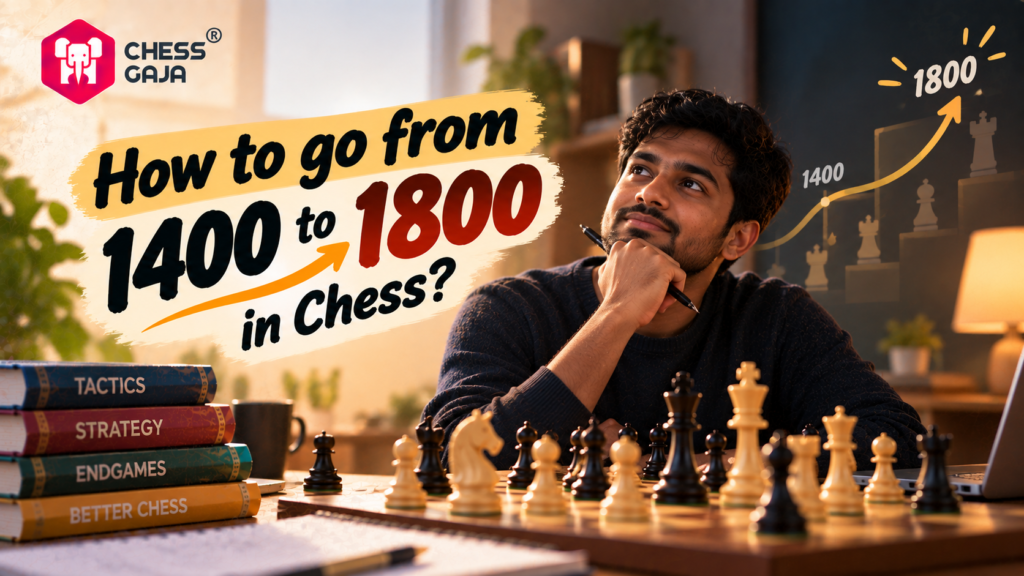
Most adult chess players hit a wall around 1400 rating. They practice sporadically, memorize openings without understanding them, and never review their losses.
At Chess Gaja, we’ve coached thousands of adults through this exact frustration. The path to 1800+ isn’t about talent-it’s about following a structured system that fits your schedule and builds real chess understanding.
Why Adults Plateau in Chess
The Time Fragmentation Problem
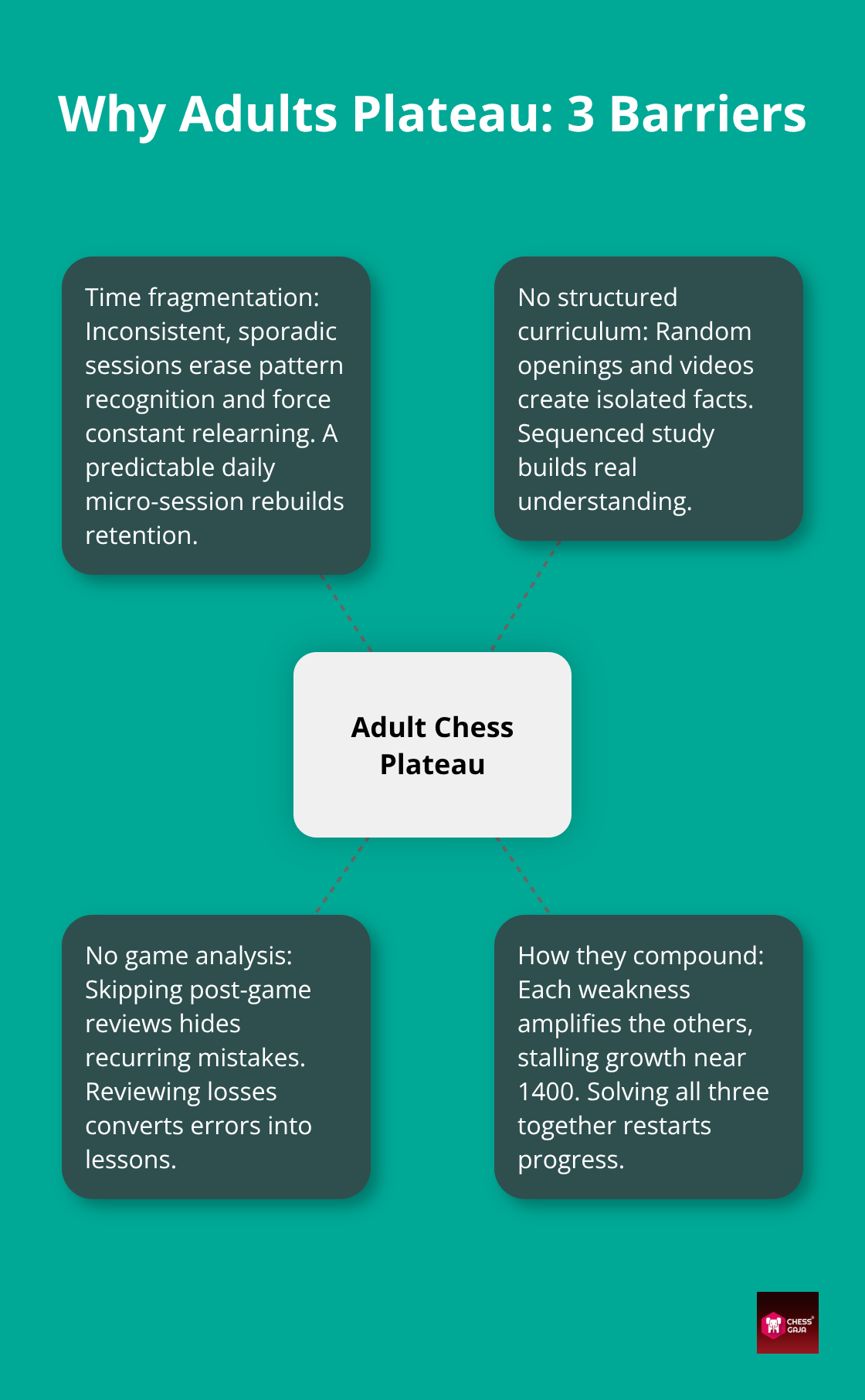
Adult chess players face three main barriers to rating growth. Most never solve them.
The first barrier is time fragmentation. Many adults consume passive content, like stream recaps, rather than focusing on structured active study. Sporadic training destroys pattern recognition. True improvement requires deliberate, daily exposure to concrete positions, calculation drills, and strategic themes.
A Chess.com study of 2 million games showed clear results: just 30 minutes of daily practice builds sustainable growth.
Inconsistent schedules don’t just slow progress-they waste the time you do invest because your brain hasn’t retained the lessons from your last session. You essentially restart from scratch each time you return to the board.
Learning Without a Structured Curriculum
The second barrier is learning without structure. Most adults buy a random opening book, memorize 20 moves, and call it preparation. They watch YouTube videos on endgames but never drill the positions until they become automatic. They solve tactics one day and never revisit similar patterns. Without a structured learning path that builds sequentially-starting with pattern recognition, moving to concrete endgame technique, then to opening principles-you accumulate isolated facts instead of understanding.
The Game Analysis Gap
The third barrier is worse: adults play games but almost never analyze them. A player at 1400 loses to a back-rank tactic, plays another game the next month, and falls into the same trap. They never extracted the lesson. Analyzing your own losses for 15 minutes reveals why you made each mistake and what position type to recognize next time. That single habit compresses improvement timelines dramatically. Without it, you repeat failures instead of learning from them.
How These Barriers Compound
These three problems compound into a wall near the 1400 rating level. Inconsistent practice leads to forgetting past lessons. Operating without a curriculum leaves you unsure of what to study. Skipping game analysis prevents learning from your mistakes entirely.
Together, these habits create years of stagnation until you fix the root causes.
Players who break past 1400 solve all three issues at once. They build a consistent schedule, follow a structured learning path, and review every major loss.
Tactics Win Rating Points
Tactics are the currency of chess improvement, and they matter more than openings or endgames for adults climbing from 1400 to 1800. A study analyzing Chess.com’s database of millions of games found that tactical mistakes account for the vast majority of losses below 1600 rating. Adults often dismiss tactics as boring drill work, but this is precisely why they stagnate. The adults who break 1800 treat tactics like a professional sport treats conditioning-non-negotiable and daily.
Adults who solve 20 to 30 tactical puzzles daily for 12 weeks show average rating gains of 150 to 200 points. The reason is straightforward: tactics train your brain to spot forcing moves, calculate consequences, and avoid one-move blunders that destroy otherwise sound positions. You cannot reach 1800 if you lose games to back-rank mates, undefended pieces, or knight forks you missed in one second of inattention.
The Three Patterns That Dominate Your Rating
Most adults waste time solving random puzzles without understanding the underlying patterns. Instead, focus your daily practice on the core tactical themes that appear most frequently between 1400 and 1800: pins, skewers, double attacks (forks), discovered attacks, and removal of the defender.
A pin occurs when a piece cannot move without exposing a more valuable piece behind it. A skewer is similar, but with the more valuable piece in front. Removal of the defender happens when you eliminate the piece protecting a critical square. Solve 10 puzzles per theme daily on Chess.com or Lichess by filtering your tactics. Within two weeks, you will recognize these patterns automatically during games.
Measurement That Actually Predicts Rating Growth
Most adults never track their tactical progress, so they have no idea whether their practice works. Start a simple spreadsheet that records your puzzle accuracy each day and your average solving time per puzzle. Adults improving toward 1800 typically reach high accuracy on medium-difficulty puzzles within 8 weeks of consistent daily practice. Your solving time should drop from 40 seconds to 15 seconds over this period. This occurs as pattern recognition becomes automatic.
Once your accuracy stabilizes consistently and your solving time drops below 20 seconds, increase the puzzle difficulty by 50–100 points rather than jumping abruptly. This measurable progression prevents both burnout from solving puzzles that are too easy and frustration from puzzles that are too hard. Track your FIDE rating monthly and correlate it with your puzzle metrics. Consistent puzzle rating growth directly reflects improved tactical vision, which correlates strongly with rapid rating progress over time.
Moving From Tactics to Endgame Mastery
Tactical strength alone will not carry you to 1800. Once you build solid pattern recognition through daily puzzle work (roughly 8 to 12 weeks in), you must shift focus toward endgame fundamentals. Many adults skip this step and wonder why their rating plateaus despite solving hundreds of puzzles. The reason is simple: tactics win positions, but endgames convert them into points. A player who spots a knight fork but then mishandles a king-and-pawn endgame still loses the game. The next section shows you which endgame positions matter most and how to drill them efficiently alongside your tactical work.
Accelerating From 1400 to 1800 Rating
Skip Opening Memorization
Openings consume far too much study time and deliver almost no rating gain below 1800. At 1400 rating, you lose games because you blunder tactics or mishandle endgames—not because your 15th move deviates from grandmaster preparation.
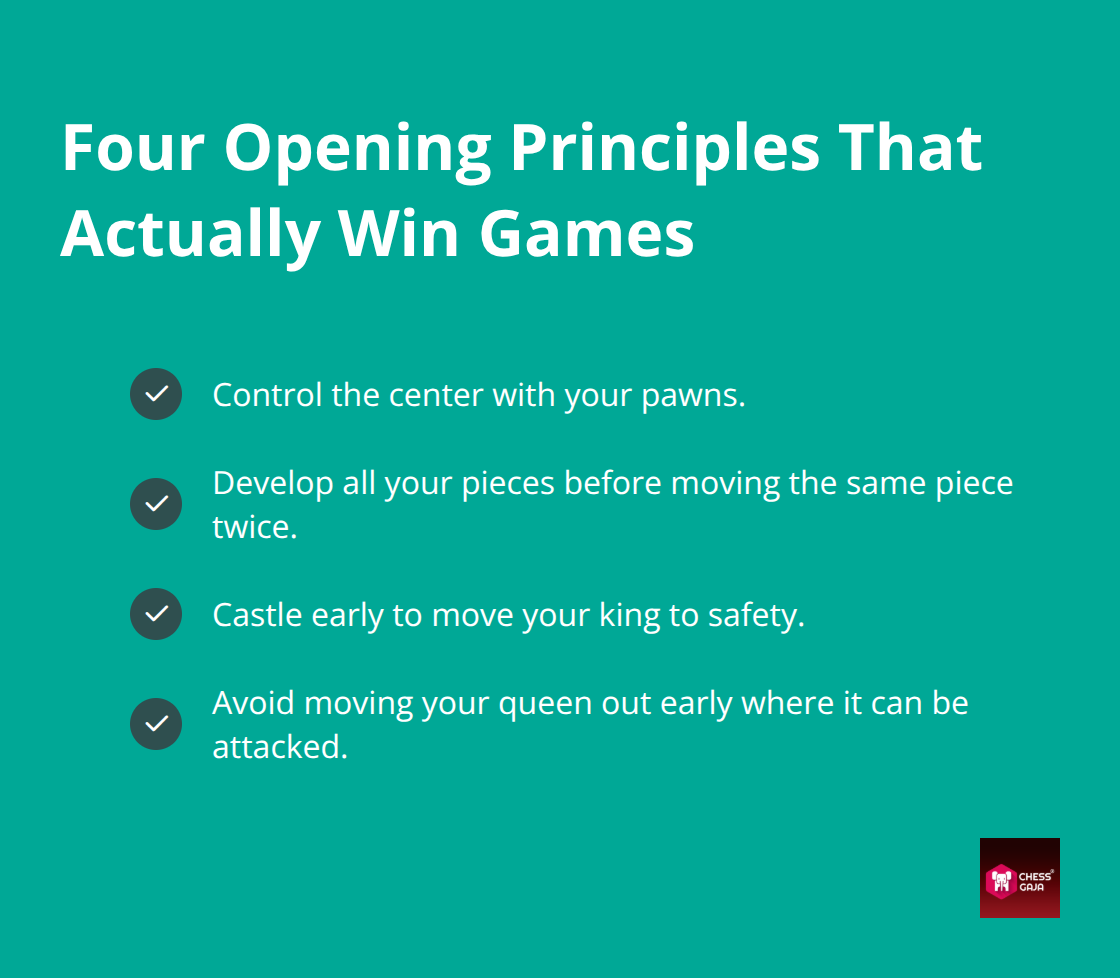
Adults often waste weeks memorizing 25-move lines, only to forget them during a tournament. Instead, master four opening principles: control the center, develop minor pieces quickly, castle early, and connect your rooks. That is genuinely all you need below 1800.
When you play White, choose one straightforward opening like 1.e4 or 1.d4 and learn the core ideas behind it rather than memorizing variations. A study of 100,000 amateur games found that players following core principles outperformed those who memorized deep opening lines without understanding them. Those relying solely on memory thought they were preparing, but they were actually wasting time.
For Black, pick one solid response to 1.e4 (the Caro-Kann or French Defense are both practical) and one solid response to 1.d4 (such as the Slav Defense or King’s Indian Defense). Learn the basic move order and the main ideas behind each. Do not memorize. Understand why your pieces go where they go. When your opponent plays a move you did not expect, you will still know what to do because you understand the principles, not because you memorized a line.
Endgame Positions That Convert Advantages Into Wins
Endgames are where tactical victories turn into rating points, and most adults skip this section entirely. You can win a position with a brilliant knight fork, then lose the resulting endgame because you do not know whether a rook and pawn can beat a rook alone. Three endgame positions account for the majority of endgames adults face between 1400 and 1800: king-and-pawn endings, rook endgames, and queen endgames.
Spend 15 minutes daily on king-and-pawn positions. Set up a position where White has a king and one pawn, Black has a king only, and practice winning or drawing depending on which side you are assigned. Master the rule of the square. Count the steps from the pawn to promotion, then project that distance sideways to form a square. If the defending king can step inside this square on their turn, they can stop the pawn; if not, the pawn promotes without help. Practice this until you calculate it instantly.
Rook endgames require understanding two core ideas: active rooks dominate passive ones, and rook plus pawn versus rook can often be drawn using key defensive setups like the Philidor Position. Use Lichess’s endgame trainer to work through rook positions for 10 minutes daily. Master basic checkmating patterns first. You must execute a Queen versus lone King mate in under 30 seconds without causing stalemates before studying complex queen endgames.
Analyze Every Loss Within 24 Hours
Game analysis separates adults who break through 1800 from those who plateau at 1400. After every significant loss, spend 15 to 20 minutes reviewing the game within 24 hours while the position is still fresh. First, review the game on your own without an engine to identify where you felt uncomfortable or lost control. Then, verify your calculations using analysis tools on Chess.com or Lichess to pinpoint the exact tactical or positional mistake that turned the evaluation.
Write down the tactical pattern you missed or the strategic mistake you made. Over 12 weeks, adults who analyze every loss show average rating gains of 120 to 180 points because they stop repeating the same mistakes. Players who do not analyze their games repeat them constantly.
Additionally, spend 30 minutes weekly studying annotated master games. Focus on players who specialize in your opening structures. Use a “guess-the-move” approach: cover the notation, evaluate the position, and ask yourself what move you would play before revealing the GM’s choice. This actively trains your positional intuition and plans in key middlegame structures. This habit builds intuition that no amount of puzzle solving can teach.
Combining Your Training Elements
Tactics, endgames, openings, and game analysis work together to accelerate your progress. Combine daily tactics (20 to 30 puzzles), daily endgame drills (15 to 20 minutes), monthly opening reviews, and immediate game analysis after every loss. Doing this helps you accelerate from 1400 to 1800 faster than expected. Each element addresses a different weakness that holds adults back. Tactics eliminate one-move blunders. Endgames convert advantages into wins. Opening principles prevent early mistakes. Game analysis stops you from repeating losses. Adults who execute all four components simultaneously reach 1800 within 6 to 12 months of consistent practice.
Final Thoughts
Reaching 1800 requires more than a system-it requires coaching and tournament play to accelerate your progress. A coach identifies blind spots in your games and holds you accountable. This dramatically compresses your feedback loop. Adults who work with a coach for 8 to 12 weeks show faster rating gains than self-taught players. Mistakes get corrected in your second game instead of weeks later.
Tournament play forces you to apply everything you learned under real pressure, where time management and execution matter as much as preparation. Play 2 to 3 serious classical games (15+10 or longer) weekly instead of blitz. This teaches clock management, deep calculation, and endgame execution under real pressure. Combine this tournament experience with structured coaching. This helps adult learners reach 1800 far faster than solving puzzles at home alone.
At Chess Gaja, we work with adults across the USA, UAE, and Singapore who are serious about reaching 1800 through personalized coaching and tournament support.
Our FIDE-rated coaches provide study plans, game analysis, and accountability through 1-on-1 sessions. These are paired with monthly academy tournaments to test your progress in a supportive environment. The adults who break through to 1800 follow a system, get professional guidance, and stay consistent-and you can start that journey today.