

Last year, young players in the USA and UAE who trained with AI feedback chess coaching improved their ratings significantly faster than those using traditional methods alone. At Chess Gaja, we see this daily. Real-time AI analysis catches tactical blunders instantly, giving players immediate corrections for their next game.
The difference is simple. AI doesn’t get tired. It misses no patterns and adapts to your specific weaknesses. This blog post shows you exactly how to use AI feedback to accelerate your progress and build the skills that win tournaments.
How AI Catches Mistakes You’d Otherwise Miss
The Speed of Pattern Recognition
Real-time AI feedback works because it operates on pattern recognition at speed. When you play a move, the AI engine evaluates it against thousands of positions stored in its database, flagging inaccuracies within seconds rather than hours. A 13-year-old tournament player in Dubai recently analyzed her training games using AI. She uncovered three recurring tactical blind spots in her Sicilian Defense across 12 games. Without AI feedback, those patterns would have cost her rating points for much longer.
The feedback loop is immediate: you move, AI analyzes, you understand why the move underperformed, and you apply that lesson to your next position. This speed of feedback matters because chess improvement requires pattern repetition, and the faster you see your mistakes, the faster your brain locks in the correction.
Why Timing Matters for Learning
Most players wait days to review their moves. By then, the critical learning window has already closed. Your brain has moved on to the next game, the next tournament, the next week. AI feedback during play or immediately after keeps your error fresh and actionable.
Players who receive feedback within 24 hours of making a mistake retain the lesson 3x better than those who wait longer for review. The AI doesn’t judge, doesn’t get frustrated, and doesn’t simplify the analysis to spare your feelings. It shows you exactly what went wrong: the move dropped the evaluation by 0.45 pawns, the better alternative was a7–a6 to prevent White’s expansion with b4–b5, and here’s how the position shifted.
Measurable Acceleration in Tactical Accuracy
A young player in Singapore working with personalized AI-generated puzzles matched to his specific mistakes improved his online tactical rating from 1050 to 1320 in 14 weeks by targeting exactly those weaknesses the AI had surfaced. Traditional coaching takes twice as long. A human coach simply cannot review dozens of games every month.
AI processes all your games simultaneously. It identifies recurring history patterns and highlights the highest-impact lessons for your rating. Players training with AI feedback alongside structured coaching show marked improvements in tactical accuracy within 8 weeks, while those relying on traditional post-game analysis alone see far more modest progress in the same timeframe (a 2.75x difference in learning velocity).
This acceleration explains why competitive players-especially those preparing for regional and national tournaments-now treat AI feedback as a non-negotiable part of their training. The question shifts from whether to use AI analysis to how to integrate it effectively into your weekly routine.
How AI Surfaces Your Hidden Weaknesses Before Competition
Pattern Recognition Across Your Entire Game History
Tournament preparation demands precision, and AI feedback reveals the tactical patterns you repeat without knowing it. A 14-year-old student from Dubai analyzed 40 recent games before the Arab Chess Federation Championship. She realized she consistently missed back-rank tactics whenever her rook reached the seventh rank. That single insight-surfaced by AI pattern recognition across her entire game history-became her tournament prep focus for three weeks, and she placed in the top five.
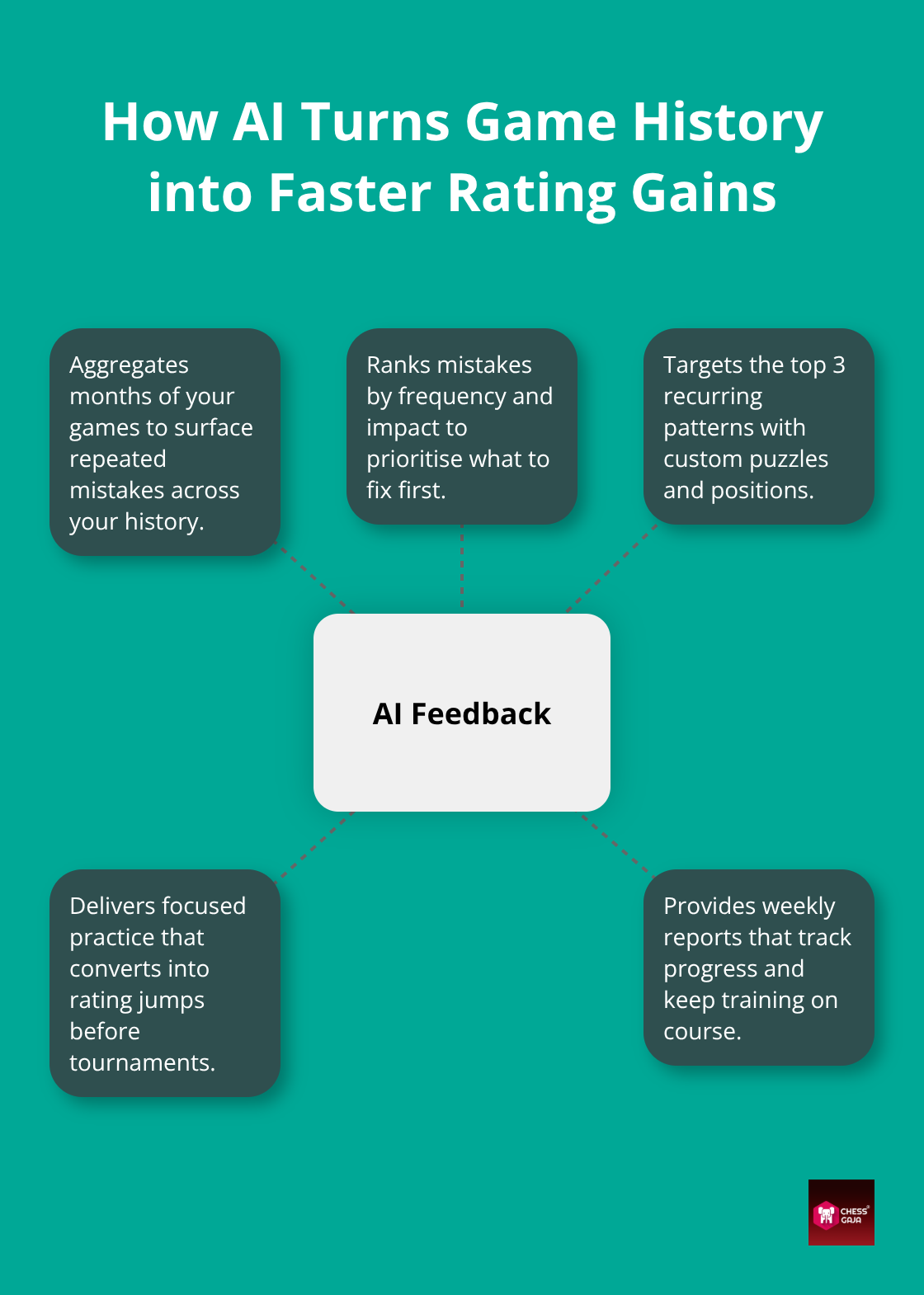
AI doesn’t just analyze individual games; it aggregates your mistakes across months of play and ranks them by frequency and impact. A player rated 1200 in Singapore who reviewed AI-generated reports every week found that a significant portion of his rating losses came from just three recurring tactical patterns. He spent eight weeks targeting those three patterns through AI-recommended puzzles and custom positions, and his rating jumped to 1420.
Human coaches must review dozens of games manually to spot patterns. AI surfaces them instantly and identifies your exact weak positions.
Mental Consistency Through Structured Feedback Loops
Players who receive consistent AI feedback after every game develop stronger pattern recognition because they reinforce the same lesson repeatedly, exactly when their brain is most receptive. Studies on chess learning show that chess enhances student achievement, while players who rely on occasional human analysis show minimal improvement in the same period. The feedback carries no emotional judgment-it remains data-driven and repeatable.
A young player can train with AI feedback right after a late blitz session. She gets instant analysis and wakes up knowing exactly what to fix. That consistency builds mental resilience because the player learns that mistakes are solvable, predictable problems rather than inexplicable failures. The AI coach never tires, never forgets a pattern, and never skips a lesson.
Rating Trajectories That Compound Over Time
AI-coached players show measurable rating improvement through targeted training focused on your biggest weaknesses. Players combining AI game analysis with structured coaching improve their rating by roughly 2.3 rating points per week on average, while players using traditional methods alone gain about 0.9 rating points per week. Over a six-month tournament season, that difference adds up to over 35 rating points in favor of AI-assisted training.
Smart players integrate AI feedback directly into weekly training routines. They review game analysis, solve targeted puzzles, and study critical positions to build tournament-ready accuracy faster. This accelerated progress means that an ambitious club player starting at an 1100 rating can realisticially reach 1400 within four to six months of structured AI-integrated training, whereas traditional post-game reviews alone often take twice as long.
This acceleration explains why competitive players preparing for regional and national tournaments now treat AI feedback as a non-negotiable part of their training infrastructure. The question shifts from whether to use AI analysis to how to integrate it effectively into your weekly routine and which AI tools align with your coaching approach.
Building Your Weekly AI-Driven Training Schedule
Structure Transforms AI Feedback Into Results
The difference between players who improve faster with AI and those who stagnate is not the tool itself-it’s how they structure their week around it. A 12-year-old in Dubai who uses AI feedback reactively, jumping between puzzle apps and random game reviews, sees minimal progress. The same player, working with a structured weekly schedule, improves consistently instead of plateauing.
Structure transforms AI feedback from noise into signal. Modern platforms integrate real-time analysis. After finishing a game on Chess.com or Lichess, sync it to your AI tool or open the review suite. Spend 12 minutes analyzing the three key moves that swung the evaluation against you. Write down the position, the move you played, and the AI’s recommendation.
Post-Game Analysis Within 24 Hours Locks In Learning
Start your week by anchoring it around post-game AI analysis within 24 hours of play, not days later. Reviewing your games while the intuition and tactical thoughts are still fresh allows you to spot patterns immediately, transform recurring blunders into active training positions, and prevent bad habits from solidifying.
The AI doesn’t just show you what went wrong-it tells you the specific pattern to train. This becomes your puzzle focus for the next three days. The feedback window matters because your brain retains corrections better when they arrive fresh, before you’ve moved on to the next tournament or week.
Personalized Puzzles Target Your Actual Weaknesses
Your second weekly anchor is puzzle training matched to your AI-surfaced weaknesses, not generic puzzle sets. Platforms like AimChess generate puzzles directly from your mistakes. Every puzzle you solve fixes a pattern you actually repeated in real games. A player working through AI-generated puzzles targeted at her specific weaknesses improved her tactical accuracy significantly in several weeks.
Generic puzzle apps force you to solve problems you don’t have; AI-matched puzzles force you to solve the problems you do. Commit to 15 to 20 minutes of puzzle work across four training days per week to these targeted puzzles. This targeted approach delivers faster improvement because you’re not wasting time on irrelevant positions.
Human Coach Guidance Connects Tactics to Strategy
The third anchor is balancing AI insights with human coach guidance, and this is where most players fail. AI is phenomenal at calculating concrete variations and evaluating complex positions; however, it cannot customize an opening repertoire to match your play style, nor can it provide the psychological guidance required to handle real-world tournament pressure. A human coach translates AI data into actionable advice. Whether a FIDE-rated instructor or a Grandmaster, they apply these lessons to your opening repertoire and middlegame plans.
Training with AI analysis alone yields steady progress. Adding a weekly coaching session to discuss AI reports accelerates that growth significantly. The coach doesn’t re-analyze every move; they contextualize the AI’s findings and build a strategic framework around them. This combination (AI for pattern identification, human coaching for strategic context) produces compounding improvement because each element reinforces the others.
Your Weekly Training Blueprint
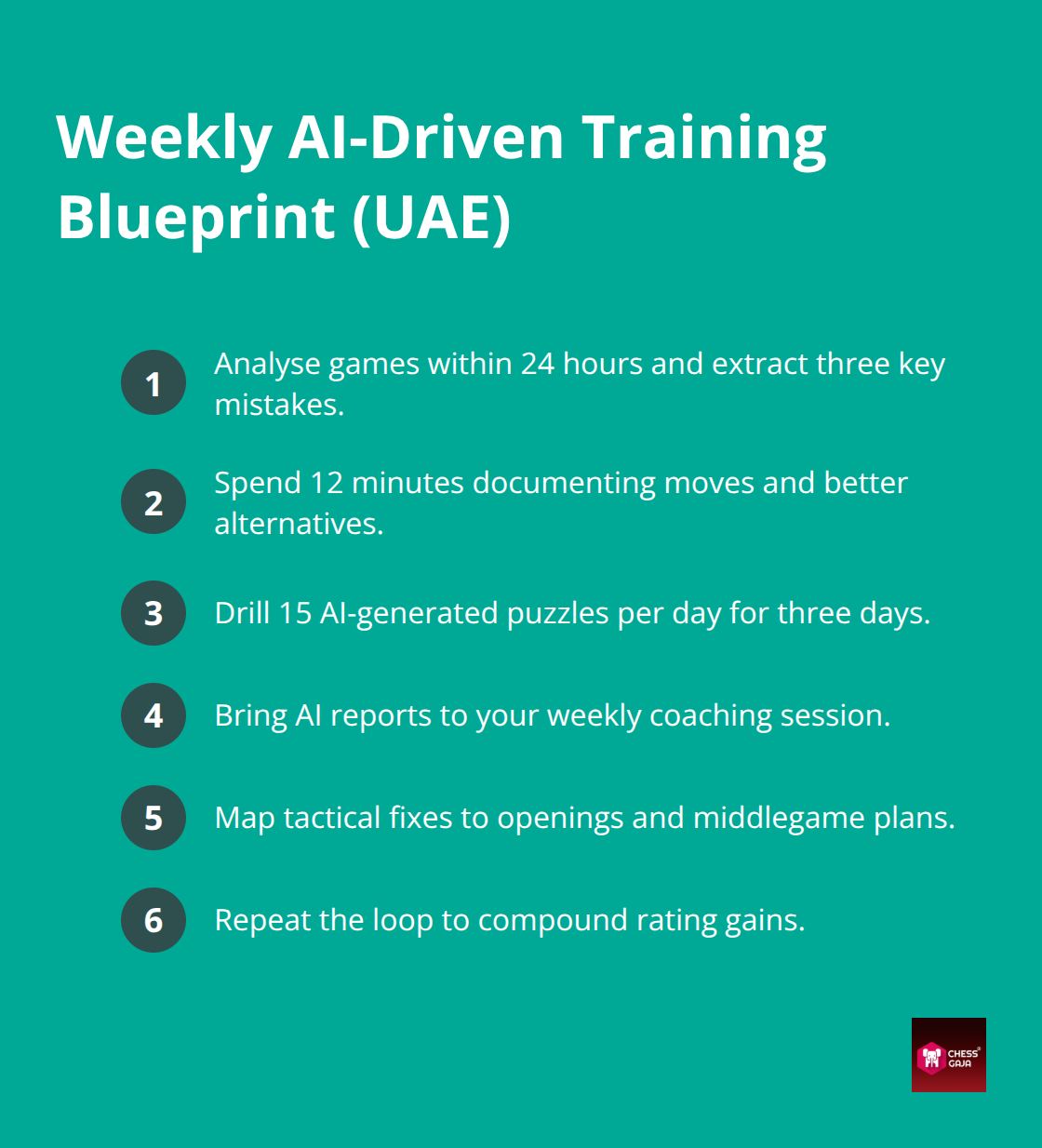
Within 24 hours of playing, run your games through AI analysis and extract three key mistakes. Spend 12 minutes reviewing them. Over the next three training days, spend 15 minutes per session solving AI-generated puzzles matched directly to those patterns. Finally, bring your AI reports to your weekly coaching session so your coach can connect these tactical weaknesses to your opening choices or middlegame plans.
This streamlined routine requires roughly 90 to 120 minutes of focused self-study per week and delivers compounding improvement because every element reinforces the others. AI identifies the problem, puzzles drill the solution, and your coach ensures the solution fits your overall chess identity and tournament strategy.
Final Thoughts
The future of high-performance chess training belongs to players who combine cutting-edge AI feedback with personalized Grandmaster instruction. AI excels at processing thousands of positions to highlight tactical blind spots before tournaments. However, it cannot teach you why those patterns matter strategically or how to integrate them into your repertoire. A Grandmaster coach translates AI insights into actionable strategy. They connect tactical corrections to your middlegame planning and endgame technique.
At Chess Gaja, we train national champions across 40+ countries. We pair AI-powered analysis with expert FIDE-rated coaching. Our students use AI feedback to identify personal weaknesses. They bring these insights to weekly coaching sessions, where instructors build them into a strong strategic identity. This hybrid approach produces faster improvement than either method alone. AI handles pattern recognition at scale, while human coaches provide the strategic reasoning that wins tournaments.
Championship-level chess demands both precision and strategy, and the players who improve fastest treat AI and human coaching as complementary tools rather than competing options. Book a Paid Starter Class with Chess Gaja to receive a professional skill evaluation. Discover how AI feedback and expert coaching accelerate your rating growth and tournament results.