


Your first tournament is coming up, and you’re nervous about the opening. You’ve studied tactics, but the first 10 moves still feel like guesswork.
We at Chess Gaja have coached thousands of beginners through this exact moment. The best openings for beginners aren’t the flashiest-they’re the ones that build real confidence and keep you safe from early traps.
Why Opening Knowledge Matters for Beginners
The Cost of Playing Without a Plan
Your first 10 moves dictate your game. They decide if you reach move 15 with a playable position or a lost one. Most beginner losses rarely happen in the middlegame. Instead, early blunders hand your opponent a concrete advantage before real play even begins. Playing without a clear plan leads to random moves and undefended pieces. Your opponent will easily punish these mistakes with basic tactics.
A student in Dubai lost three tournament games in the opening phase alone. In each game, he hung a piece within the first eight moves. He had studied tactics for months but never learned which squares to control or when to develop his pieces. Once he learned the core ideas behind two solid openings, his tournament results improved immediately because he stopped creating his own tactical disasters.
How Opening Knowledge Stops Early Losses
Opening knowledge does something specific for your rating: it prevents you from losing before the real game starts. First moves have clear goals: control the center, develop pieces, and safeguard your king. Understanding this lets you spend energy on strategy instead of fixing blunders. Beginners who master three reliable openings quickly gain 150–200 rating points. They achieve this in three months simply by eliminating early losses.
Openings are not about memorizing 20 moves of theory. Instead, learn basic piece placement, recognize key traps, and play with confidence. This foundation simplifies the middlegame. You enter it with developed pieces, controlled center squares, and a safe king—setting the stage for clear tactical thinking.
Now that you understand why openings matter, let’s look at three specific openings that work best for beginners—two reliable choices for White and one rock-solid option for Black—and why each builds your confidence in different ways.
Three Openings That Work
The Italian Game: Simple Logic Over Memorization
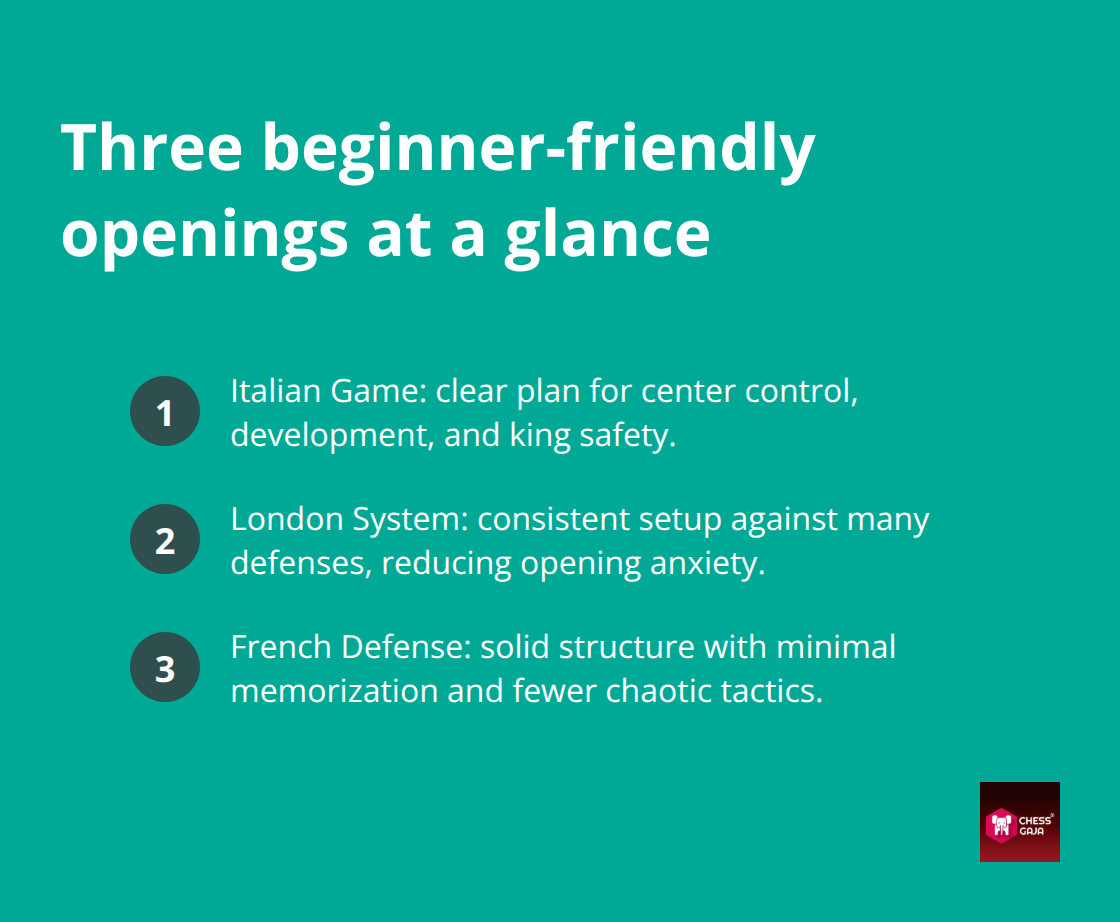
The Italian Game is the gold standard for beginners. It teaches fundamental priorities: control the center, develop actively, and safeguard your king. When you play 1.e4, 2.Nf3, 3.Bc4, you execute a plan rather than memorize lines. Your c4-bishop targets f7, the weakest square in Black’s position. This pressure forces your opponent onto the defense and gives you natural activity.
A student from Singapore jumped from 1,200 to 1,450 rating in four months with the Italian Game. She succeeded by following simple logic: develop a piece, control a square, and castle quickly. The key is not to memorize 15 moves of theory but to understand why each move matters. After 1.e4 e5 2.Nf3 Nc6 3.Bc4, your next moves follow naturally—develop your remaining minor pieces (like Nc3 and d3), castle kingside, and look for tactical opportunities around f7. This systematic thinking prevents the aimless piece shuffling that costs beginners games.
The London System: Consistency Against Any Defense
The London System teaches you something Italian doesn’t: how to play solid chess when your opponent chooses unusual defenses. You build a solid pawn structure (pawns on d4, e3, and c3) that works against almost anything Black plays, which removes the anxiety of facing unknown positions. A tournament player in Dubai reported that switching to the London System eliminated his fear of unpredictable Black defenses because the core setup stays identical regardless—develop your dark-squared bishop to f4, support the d4-pawn with e3 and c3, and build a solid position.
The French Defense: Reliability Without Complications
The French Defense, played as Black after 1.e4 e6, gives you a reliable response that doesn’t require memorization. You get a solid pawn structure with clear strategic goals, helping you avoid chaotic tactical melee early on and forcing your opponent to play a structured, positional game. The French teaches you that you don’t need a flashy advantage-you need a playable position where your pieces coordinate and your king is safe.
One Principle Connects All Three
These three openings share one core benefit: they simplify your early decision-making by giving you clear, consistent setup goals, freeing your mental energy to focus on tactics rather than opening anxiety. Now that you understand which openings work and why, the next step is recognizing the mistakes that even solid opening choices cannot protect you from.
Common Opening Mistakes Beginners Make and How to Avoid Them
The Three Errors That Ruin Sound Openings
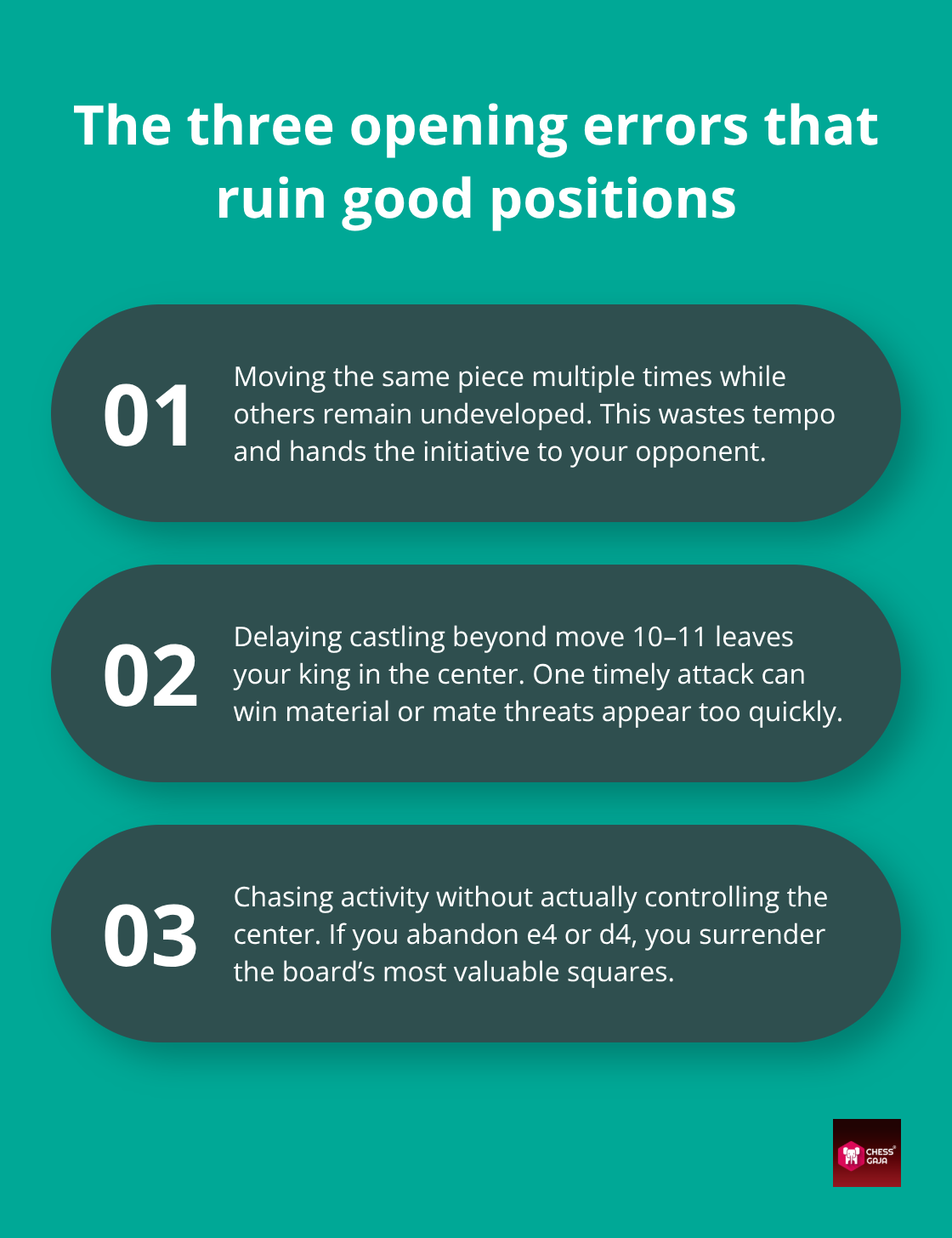
Most beginners ruin solid opening plans not because they lack knowledge but because they violate three concrete principles during the first 15 moves. The first mistake is moving the same piece multiple times while other pieces sit undeveloped. A beginner plays 1.e4 e5 2.Nf3 Nc6 3.Bc4. Then, he moves that bishop three times seeking the perfect square while his b1-knight stays stranded. This wastes tempo and leaves him vulnerable to counterattacks.
The second mistake is delaying castling past move 10 or 11. A student from Singapore reached move 12 in a tournament game with her king still stuck in the center. Her opponent opened up the center lines with e4-e5 and launched a tactical strike on f7, forcing her to lose her queen in just a few moves. The third mistake, often overlooked, is playing for activity in the center without actually controlling it. A beginner plays d4 or e4, then abandons control of the center to chase an opponent’s piece, surrendering the most critical squares on the board.
Why These Errors Cost Games Before Move 20
These three mistakes ruin sound openings. They account for almost every beginner loss before move 20. A tournament player in the UAE reported that his opening positions improved dramatically once he enforced a simple rule: develop one new piece per move, castle early, never waste tempo. He stopped losing games in the opening because his pieces were coordinated and his king was safe.
The Mechanical Fix That Works
The fix is straightforward and automatic. Develop your minor pieces as quickly as possible and castle within 10 moves. Never move a piece twice unless forced to retreat or capturing a clear tactic. After you place your knights on active squares (like Nf3 and Nc3 for White, or Nf6 and Nd7/Nc6 for Black depending on your opening), develop your bishops, and castle your king to safety, your opening phase is complete. Only after completing these fundamental development steps should you look to reposition pieces or initiate active central attacks. The openings you learned work only if you respect this discipline. Skip it, and even the Italian Game or London System cannot save you from your own errors.
Final Thoughts
The Italian Game, the London System, and the French Defense work because they eliminate guesswork from your early development and teach you what your pieces should do in the opening phase. Opening mastery isn’t about memorizing 20 lines of theory-it’s about learning which squares matter, recognizing common traps, and building the discipline to develop systematically. Commit to these openings and follow core principles: develop pieces, castle early, and control the center. Beginners gain 150–200 rating points in three months simply by stopping self-inflicted losses.
The real acceleration happens when you practice these openings consistently in tournament play and analyze your games afterward. Every game provides critical lessons. You learn key squares, opponent reactions, and calculation limits. This is where opening knowledge transforms into chess strength.
At Chess Gaja, our Grandmaster-led curriculum, used across 40+ countries, focuses on building this foundation first-solid openings, clear principles, and the discipline to execute them. If you’re ready to accelerate your opening confidence and get personalized feedback on your play, book a Paid Starter Class with one of our FIDE-rated coaches. Your coach will evaluate your current level, identify which combination of these openings fits your style best for both White and Black, and create a study plan tailored to your goals.