

Checkmating patterns practice separates players who win games from those who struggle to finish them. Most beginners memorize moves without understanding why they work, which leaves them helpless when positions shift slightly.
At Chess Gaja, we’ve coached thousands of students through this exact problem. The solution isn’t more memorization-it’s learning to recognize patterns and execute them with precision in real games.
The Three Patterns That Stop Most Beginners Cold
Back Rank Mate: The Most Common Finish
Back Rank Mate ends more beginner games than any other pattern. It happens because players forget their king has nowhere to run. Imagine a student from Dubai playing online and pushing their rook to the seventh rank, thinking they are attacking. Their opponent suddenly slides a rook all the way down to the first rank. Because the king is trapped behind its own pawns with no escape square, it gets checkmated in a single move. This pattern repeats thousands of times monthly on Chess.com and Lichess because beginners never practice it deliberately.
The fix is straightforward. Spend 10 minutes daily solving back-rank positions where your rook delivers the final check while your opponent’s king remains boxed in by its own pawns. Start with positions where the mating rook is already on the board. Then, progress to puzzles where you must move your rook into the winning square. Within two weeks of consistent practice, you’ll spot this pattern instantly in real games and avoid falling into it yourself.
Scholar’s Mate: Why Understanding Beats Memorization
Scholar’s mate is a famous four-move checkmate that punishes unprepared players. It teaches a harder lesson than back rank patterns by proving why piece coordination beats memorization. A player in Singapore or New York might learn the four moves by heart. Yet, they still fall for it because moving the bishop to c4 and queen to h5 only creates a threat if f7 stays weak. The defense is equally simple: play e6 or g6 early, or develop your knight to c6 and f6 to cover the weak squares and control the center.
Students who memorized the attack but never learned why it fails waste time on a dead strategy. The real value of studying Scholar’s mate is learning how weak king-side squares create mating opportunities, and that proper piece development eliminates those threats early. Practice this by playing Scholar’s mate positions where you defend. This helps you internalize the defensive principles that stop it cold.
Two Rook Checkmate: Precision Through Systematic Thinking
Two rook checkmate teaches precision and systematic thinking. It requires no tricks—just methodical control of escape squares. This endgame appears when one side completely dominates, stripping the board down to a king and two rooks versus a lone king. Players often blunder here by checking randomly instead of building a mating net to shrink the king’s available squares step by step.
The winning method is using one rook as a barrier to cut off the king’s escape rank or file, while the second rook delivers a check to push the king back, alternating them like a lawnmower until the king is trapped on the edge. Solve 15 to 20 positions where you have two rooks and must checkmate a lone king in under 10 moves. This trains your brain to think in terms of systematic restriction rather than flashy tactics. The pattern teaches patience. Scholar’s mate and back rank positions rarely demand it, but this discipline carries directly into your middlegame decisions.
Moving From Pattern Recognition to Real Game Application
These three patterns form the foundation of tactical mastery, but knowing them in isolation won’t transform your results. The next step is learning how to spot these patterns when they emerge naturally in your games, where positions look messy and the mating net isn’t obvious at first glance.
Practical Tactical Drills: Turning Pattern Knowledge Into Speed and Accuracy
How Your Brain Recognizes Patterns Under Pressure
Pattern recognition in chess works like spotting a friend’s face in a crowd. The more you see it, the faster your brain recognizes it without effort. Most beginners study checkmating patterns in isolation, solving puzzles where the answer sits obvious on the board. Real games look nothing like these clean positions. Your opponent’s pieces block key squares and pawn structures shift the geometry. As a result, mating nets form gradually over several moves rather than appearing fully formed.
Most players fail in the gap between knowing a pattern and spotting it under pressure. Students who jump straight into rated games often stall around 1200–1400 online. In contrast, those who practice connecting patterns to messy positions consistently break through to 1600+. The difference is systematic drilling that forces your brain to extract the pattern from noise.
The Three-Phase System That Builds Speed
The fastest way to build this skill is solving puzzles where only a fraction of the board shows the mating threat. This forces you to ignore irrelevant pieces and focus on the critical squares. Lichess Studies and Chess.com’s Tactics Trainer both offer curated pattern collections, but most players waste time on random medium-difficulty puzzles instead of working through 50-100 positions tied to a single theme.
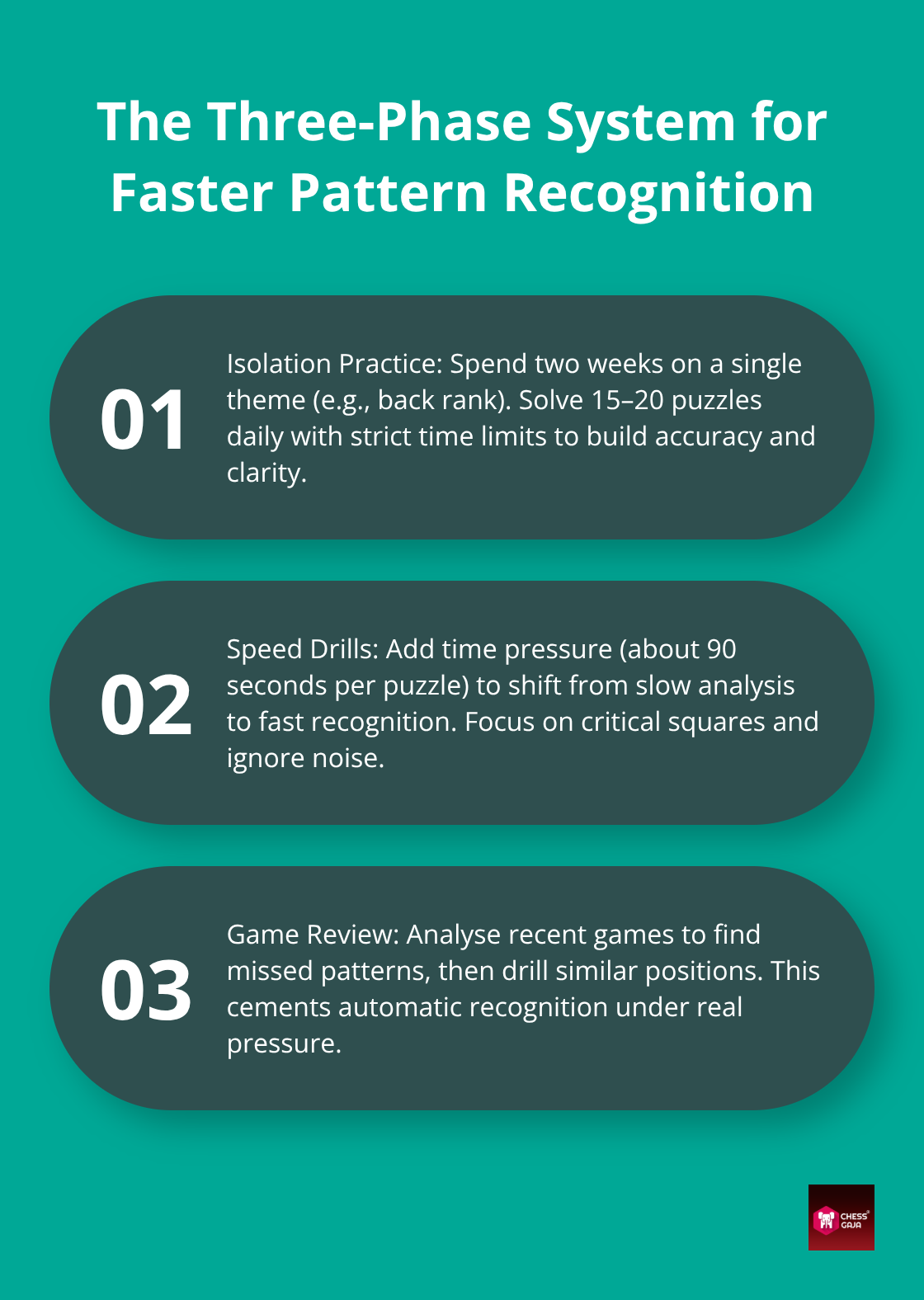
Spend two weeks on back rank positions only. Solve 15-20 puzzles daily in 20-minute sessions with a 90-second maximum per puzzle. Time pressure matters because it builds speed, shifting your brain from slow analysis to instant pattern recognition. After two weeks, your brain will instantly spot back rank vulnerability in any position.
Then rotate to Scholar’s mate vulnerabilities—focusing specifically on weak squares around f7 and f2—and repeat the cycle.
Measuring Your Progress With Data
Track your solve times using the platform’s data; if your average drops from 45 seconds to 15 seconds on back rank puzzles, you’ve achieved automaticity in chess tactics. This metric tells you when to move forward to the next pattern rather than guessing based on how confident you feel.
The final step is reviewing your last 10 tournament or blitz games. Mark every position where a back-rank pattern appeared but you missed it. Then, solve similar positions until the pattern becomes automatic. Students who follow this three-phase system-isolation practice, speed drills, then game review-report spotting mating patterns 3-4 moves earlier than before, which translates directly to higher ratings and cleaner victories.
From Puzzle Board to Tournament Table
This systematic approach transforms pattern knowledge into tournament-ready skill, but the real test arrives when you face live opponents who don’t cooperate with your mating plans. The next chapter explores how to apply these patterns when your opponent actively resists, and how to adjust your tactical vision when the position refuses to match your expectations.
Common Mistakes Players Make When Practicing Checkmate Patterns
Most players who hit a rating ceiling between 1200 and 1400 share a common problem: they memorized checkmate patterns without understanding the positioning principles that make them work. A student in Dubai solves 100 back rank mate mate puzzles where the rook sits perfectly placed, but then plays a tournament game where the attack fails because the opponent pushed h6, creating a crucial escape square (luft) for the king. The pattern looked identical in the puzzle, but the underlying geometry was completely different.
Puzzle training isolates patterns from their context. It strips away defensive resources and positional complications that appear in real games. The solution is direct: stop solving random patterns and start solving positions where you must first identify what’s being attacked, then determine which defensive pieces matter. On Chess.com, players who prioritize defense-focused puzzles advance 200–300 rating points faster. They outperform those who focus exclusively on attacking patterns.
The Trap of Memorization Without Purpose
Memorizing Scholar’s mate or the Arabian mate creates a false sense of progress because you can recite the moves without actually understanding when these patterns apply. A player might know that the Arabian mate uses a knight to protect a rook delivering checkmate on the corner square. However, if they don’t understand how the king gets trapped on the edge, they will force the sequence prematurely and lose key material. The real cost isn’t just the lost game-it’s the wasted practice time.
Students who memorize patterns without connecting them to the underlying principles waste time on drills that don’t improve their actual tactical vision. Before solving any pattern puzzle, ask yourself three questions: Which squares around the king are weak? Which of my pieces can attack them? What defenders can the opponent use? Only after answering these questions should you solve the position. This shifts your brain from mechanical pattern recall to active pattern recognition, which enables quick spotting of tactics for both executing and defending against them.
Isolation Training Creates Tournament Blindness
The gap between puzzle performance and tournament performance is larger than most players admit. A student might solve back-rank puzzles with high accuracy and 20-second average solve times. Yet, they can completely miss a back-rank vulnerability in a tournament game when 15 other pieces create visual noise. Lichess data shows that players who practice only isolated patterns score 300-400 rating points lower in tournament play than their puzzle ratings suggest.
The fix requires practicing patterns within messy positions where the majority of the board contains irrelevant pieces and structures. First, master a pattern in clean positions. Then, spend two weeks solving that pattern embedded in real game positions where you must filter out visual noise. This trains your brain to work under the cognitive load that tournaments create. Mixed tactic modes like Chess.com’s Puzzle Rush or Lichess’s Theme Mix force your brain to identify which pattern applies under time pressure. Practice these mixed formats in 15-minute sessions, three times weekly. Your tournament results will shift dramatically once your pattern recognition works in cluttered positions rather than clean diagrams.
Why Defense Training Separates Strong Players From Weak Ones
Players who only practice attacking patterns never develop the defensive intuition that stops opponents from executing the very patterns they’ve memorized. A student who studied back rank mate for three weeks can spot it instantly-but only when they’re attacking. When their opponent’s rook lands on the back rank, they freeze because they never practiced defending against back-rank mating threats.
Every attacking pattern has defensive counter-measures, and understanding those defenses is equally important as executing the attack. Start solving positions where you defend against back rank mate, Scholar’s mate, and two rook checkmate. For each pattern, practice defensive positions where your king faces the mating threat and you must find the defensive move that stops it. This creates neural pathways that activate both when you attack and when you defend. The result is a player who spots mating threats three moves earlier. They understand not just the final position, but all the defensive tries before it.
Final Thoughts
Checkmating patterns practice builds your tactical foundation because it trains your brain to recognize forcing sequences that end games decisively. Every back rank mate, Scholar’s mate defense, and two rook checkmate you solve strengthens the neural pathways that spot mating threats in real positions. This isn’t theoretical improvement-it’s measurable skill development that translates directly to tournament results.
Your daily practice structure determines whether pattern knowledge sticks or fades. Spend 15 minutes solving isolated patterns to build accuracy, then 10 minutes solving the same patterns embedded in messy positions to build speed under pressure. Review your last five games weekly, marking positions where you missed a mating pattern, then solve similar positions until the pattern becomes automatic.
Under Grandmaster guidance at Chess Gaja, our FIDE-rated coaches design personalized tactical training plans. Each plan is tailored specifically to your rating goals. Your next step is booking a Paid Starter Class for a skill evaluation. Our coaches will assess your tactical vision, spot missing patterns, and build a practice schedule to accelerate your rating growth.