

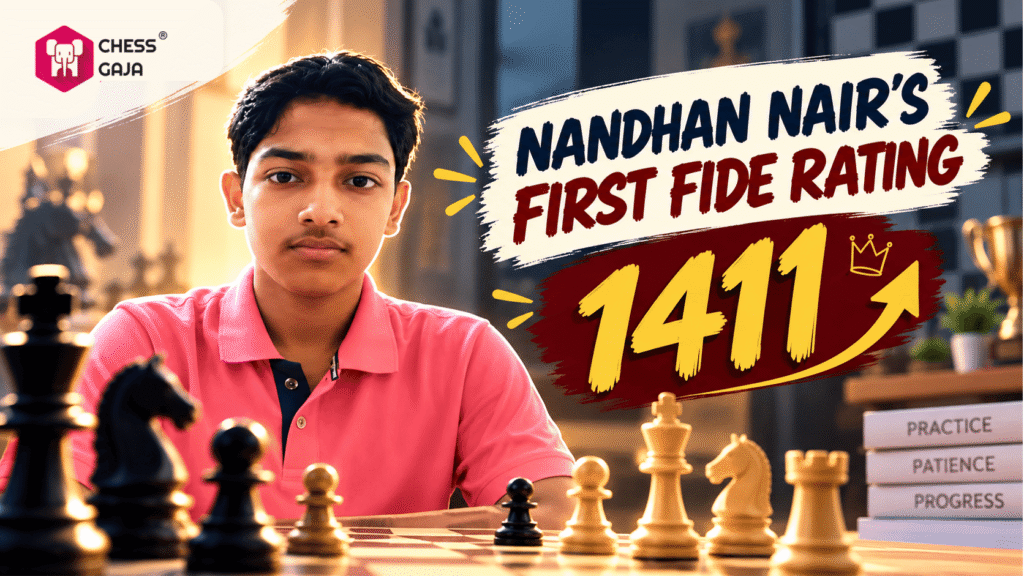
Every chess journey begins with a first move. Some players start with a game against a family member or a friend, while others develop their passion through online matches, hours of practice, and a deep curiosity about the game.
For Nandhan Nair, a student at Chess Gaja, that journey has reached an important milestone: earning his first FIDE rating of 1411.
After competing in his first FIDE-rated tournament in Thrissur, Kerala, Nandhan secured five wins in nine games against a competitive field of approximately 600 participants. The experience gave him an opportunity to test his preparation, learn from challenging positions, and take his first steps into rated competitive chess.
But his journey is about more than a rating. It is also about patience, learning from mistakes, family support, and the ambition to become a stronger player.
In this student success story, we explore how Nandhan discovered chess, prepared for his first rated tournament, and developed his goals for the future.
How Nandhan Nair Discovered His Passion for Chess
Nandhan’s interest in chess began with casual games against his friends, family members, and schoolteachers. What started as a fun activity gradually developed into a deeper interest in the game.
He eventually began playing online and created an account on Chess.com to explore chess further.
What particularly attracted him was the calculation involved in the game. With an interest in mathematics and science, he enjoyed thinking through positions, calculating variations, and exploring different possibilities before making a move.
This curiosity encouraged him to keep learning and improving.
His experience is a reminder that a passion for chess can begin in the simplest ways. A few friendly games can develop into a long-term pursuit when curiosity and a willingness to learn are present.
Nandhan’s First FIDE-Rated Tournament: A Milestone Achievement
Participating in a first FIDE-rated tournament is an important step for aspiring competitive chess players. It provides an opportunity to compete in rated games, experience tournament conditions, and begin building an official rating.
For Nandhan, this milestone came at a tournament in Thrissur, Kerala.
According to his interview with Chess Gaja, the tournament attracted approximately 600 participants. Despite the nerves associated with his first rated event, Nandhan performed well, winning five of his nine games.
Here are the key highlights of his achievement:
- First FIDE rating: 1411
- Tournament performance: Five wins in nine games
- Tournament location: Thrissur, Kerala
- Approximate number of participants: 600
Nandhan also faced opponents with higher ratings, including players rated around 1500–1600. Competing against stronger opposition gave him valuable experience and an opportunity to assess his playing strength.
Earning a first FIDE rating of 1411 marks an encouraging beginning to his competitive chess journey. It gives him a starting point from which he can work towards higher ratings and more ambitious goals.
How Nandhan Prepared for His First Rated Chess Tournament
Behind every tournament performance is a preparation process. Nandhan approached his first rated event by combining practical board work, game analysis, opening preparation, and online practice.
1. Practising on a Physical Chessboard
Nandhan practised by playing against himself on a physical chessboard. This allowed him to explore positions, calculate possible variations, and consider alternative moves.
Working through positions on a physical board can also help players become more comfortable analysing chess away from a computer screen.
2. Analysing Mistakes and Reviewing Positions
Nandhan used an analysis board to examine his mistakes and understand what he had done well or poorly in different positions.
Game analysis is a valuable part of chess improvement. Rather than simply moving on after a game, players can identify recurring mistakes, recognise missed opportunities, and develop a better understanding of their decisions.
3. Preparing His Opening Knowledge
He also spent time preparing his openings before the tournament.
Understanding opening principles and familiar positions can help players navigate the early stages of a game more confidently. However, opening knowledge must be supported by calculation, sound decision-making, and the ability to respond to unfamiliar positions.
4. Playing on Chess.com and Lichess
Nandhan also used Chess.com and Lichess to practise against different opponents and encounter a variety of positions.
Combining online games with thoughtful analysis can help players recognise tactical patterns, test their understanding, and identify areas that need further work.
His preparation demonstrates the value of using multiple learning methods rather than relying on a single approach.
Overcoming Nervousness and Learning from Tournament Mistakes
A first rated tournament can be an exciting but challenging experience. Players must manage the pressure of competitive games while making accurate decisions under time constraints.
Nandhan admitted that he was nervous before and during the tournament because it was his first FIDE-rated event.
He encountered some opening difficulties but worked through them as the games progressed. In one game, he reached a winning position but eventually lost after overlooking a checkmate.
Despite the disappointment, he remained positive about his overall performance.
This experience highlights an important lesson for developing chess players: a single mistake does not define your ability, and one lost game does not erase the progress you have made.
Chess improvement requires players to accept setbacks, analyse what went wrong, and return to the board ready to learn. Developing the ability to manage emotions and recover from mistakes is just as important as improving calculation and opening knowledge.
For Nandhan, the tournament was an opportunity not only to demonstrate his strengths but also to identify areas for improvement.
A Memorable Game: Patience Makes the Difference
Among the games Nandhan played during the tournament, his sixth game stood out as particularly memorable.
He faced an opponent rated approximately 1450–1460 and felt that he had played well in the opening. During the middlegame, he attempted a strong attack, but the position did not develop as he had expected.
Rather than allowing the unsuccessful attack to determine the outcome, Nandhan continued looking for ways to improve his position.
He eventually reached a favourable endgame. By restricting his opponent’s pieces and exchanging pieces, he gradually strengthened his position until his opponent resigned.
For Nandhan, this was one of the most satisfying moments of the tournament.
The game illustrates an important principle of chess: winning is not always about finding a spectacular attack. Sometimes, success comes from improving piece activity, limiting the opponent’s options, making useful exchanges, and converting a favourable position into a win.
Nandhan also recalled feeling both happy and nervous during the game. He recognised that he was playing well but remained conscious of the possibility of making a mistake.
That balance between confidence and concentration is a familiar challenge in competitive chess. Even when a player has an advantage, staying focused until the game is finished remains essential.
What Chess Has Taught Nandhan About Patience and Mental Strength
For Nandhan, chess has taught lessons that extend beyond the board.
One of his most important takeaways is that chess improvement requires patience, consistent practice, and time.
He believes players cannot rush their development. Becoming stronger involves practising regularly, learning from mistakes, and allowing time for new skills and concepts to develop.
He also highlighted the importance of taking breaks. Players may experience periods when their form is not at its best, and recognising the need for rest can be part of maintaining a sustainable practice routine.
Nandhan believes chess also helps develop calculation, decision-making, and mental strength.
These lessons are valuable for young players balancing chess with academics and other responsibilities. Progress is not always immediate, and every tournament will not produce the same results. What matters is continuing to learn and approaching improvement with a long-term mindset.
His experience reinforces a useful message for aspiring chess players: improvement comes not only from playing more games but also from practising thoughtfully, reviewing mistakes, managing pressure, and maintaining consistency.
The Role of Family Support in Nandhan’s Chess Journey
Behind many young chess players is a support system that encourages them to pursue their goals.
Nandhan shared that his parents were very happy with his tournament performance and supported him throughout the event. He also explained that their support played a role in his joining Chess Gaja.
Family encouragement can make a meaningful difference in a young player’s development, particularly when competitive chess involves preparation, travel, time commitments, and the emotional ups and downs of tournaments.
Nandhan’s achievement is therefore an opportunity to recognise both his personal effort and the encouragement he has received along the way.
At Chess Gaja, we are proud to celebrate our students’ milestones as they continue to develop their skills, gain competitive experience, and pursue their chess ambitions.
Nandhan’s Chess Inspirations and Future Goals
Every aspiring player looks to someone who inspires them to aim higher.
Nandhan named Viswanathan Anand and Rameshbabu Praggnanandhaa as his main inspirations in the chess world. He admires their high level of play and their journeys from young chess enthusiasts to players competing at the highest levels.
Their achievements motivate him to continue learning, raise his playing strength, and work towards his own long-term goals.
Looking ahead, Nandhan wants to achieve a higher rating and eventually earn a chess title. He specifically mentioned ambitions such as becoming a National Master or an International Master.
He also expressed a desire to contribute to India’s success in chess tournaments.
These are ambitious goals that will require continued training, tournament experience, careful game analysis, and long-term commitment. His first FIDE rating gives him an important milestone from which he can measure his future progress.
The road ahead will bring new opponents, difficult positions, and more lessons to learn. For Nandhan, however, earning his first rating is not the end of the journey. It is the beginning of the next stage.
Chess Gaja Celebrates Nandhan Nair’s Achievement
At Chess Gaja, a student’s progress is about more than a single tournament result or rating milestone. It is about developing a deeper understanding of chess, learning from experience, and building the confidence to face new challenges.
Nandhan Nair’s journey reflects the importance of curiosity, preparation, patience, and a positive attitude towards improvement.
From playing with friends and family to competing in his first FIDE-rated tournament, he has taken an important step forward in his development as a competitive chess player.
His experience also reminds us that mistakes are part of learning. What matters is the willingness to analyse them, continue practising, and return to the board ready to improve.
Congratulations to Nandhan Nair on earning his first FIDE rating of 1411!
We wish him continued progress, many memorable games, and success as he works towards his future chess goals.
At Chess Gaja, we look forward to seeing him continue to learn, compete, and grow as a player.
Every strong chess journey begins with a commitment to keep learning.
Final Thoughts
Nandhan Nair’s journey is a reminder that every chess achievement begins with a willingness to learn, practise, and improve. Earning his first FIDE rating of 1411 is an important milestone, and we look forward to seeing him continue progressing towards his future goals.
For aspiring chess players looking to improve their skills through structured training, explore Chess Gaja Online Chess Classes.
For official player profiles, FIDE ratings, tournament results, and standings, visit the official FIDE website.
Congratulations once again to Nandhan Nair on this achievement. May this be the first of many milestones in his chess journey!