

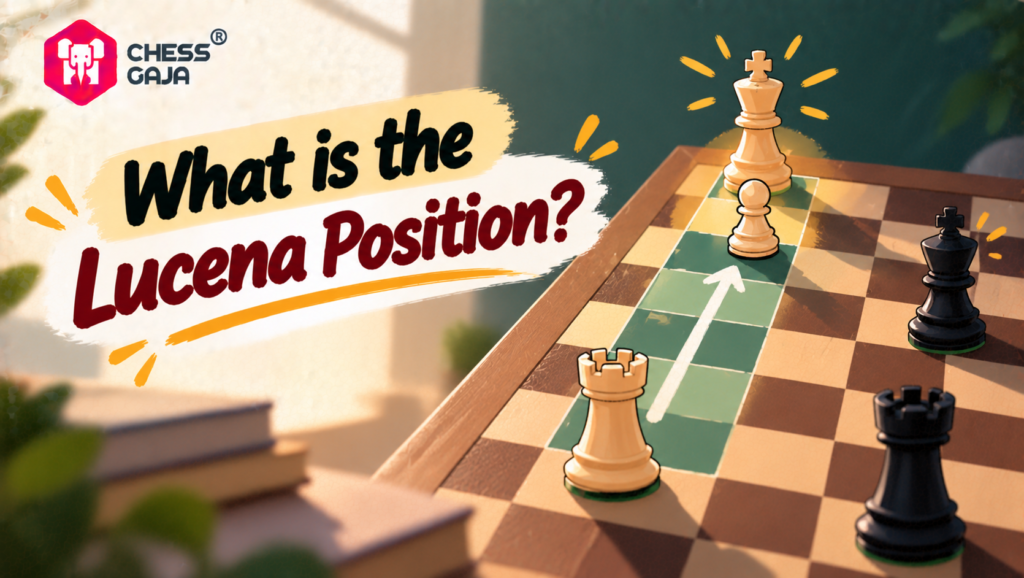
You’ve seen it happen in tournaments: a player with a rook and passed pawn gets pushed to the edge of the board and seems trapped. Then they execute one precise move sequence and suddenly the position flips. That’s the Lucena position in action.
At Chess Gaja, we’ve watched junior players from the USA, UAE, and Singapore transform their endgame results by learning this single pattern. The Lucena position essentials aren’t complicated, but they’re powerful enough to win games that look lost.
What the Lucena Position Actually Is
Juan Luis de la Lucena, a Spanish master from the 15th century, documented this endgame pattern in his treatise on chess. The position itself is straightforward: your rook and king defend a passed pawn while the opponent’s rook and king try to stop it. The Lucena position stands out due to its unique setup and tactical sequence. It emerges when your passed pawn reaches the 7th rank (2nd rank for Black). Your king must stand directly on the promotion square ahead of the pawn. This isn’t theoretical—it appears in real tournament games constantly, and junior players who recognize it win games that others resign.
Why This Pattern Wins Games You’d Otherwise Lose
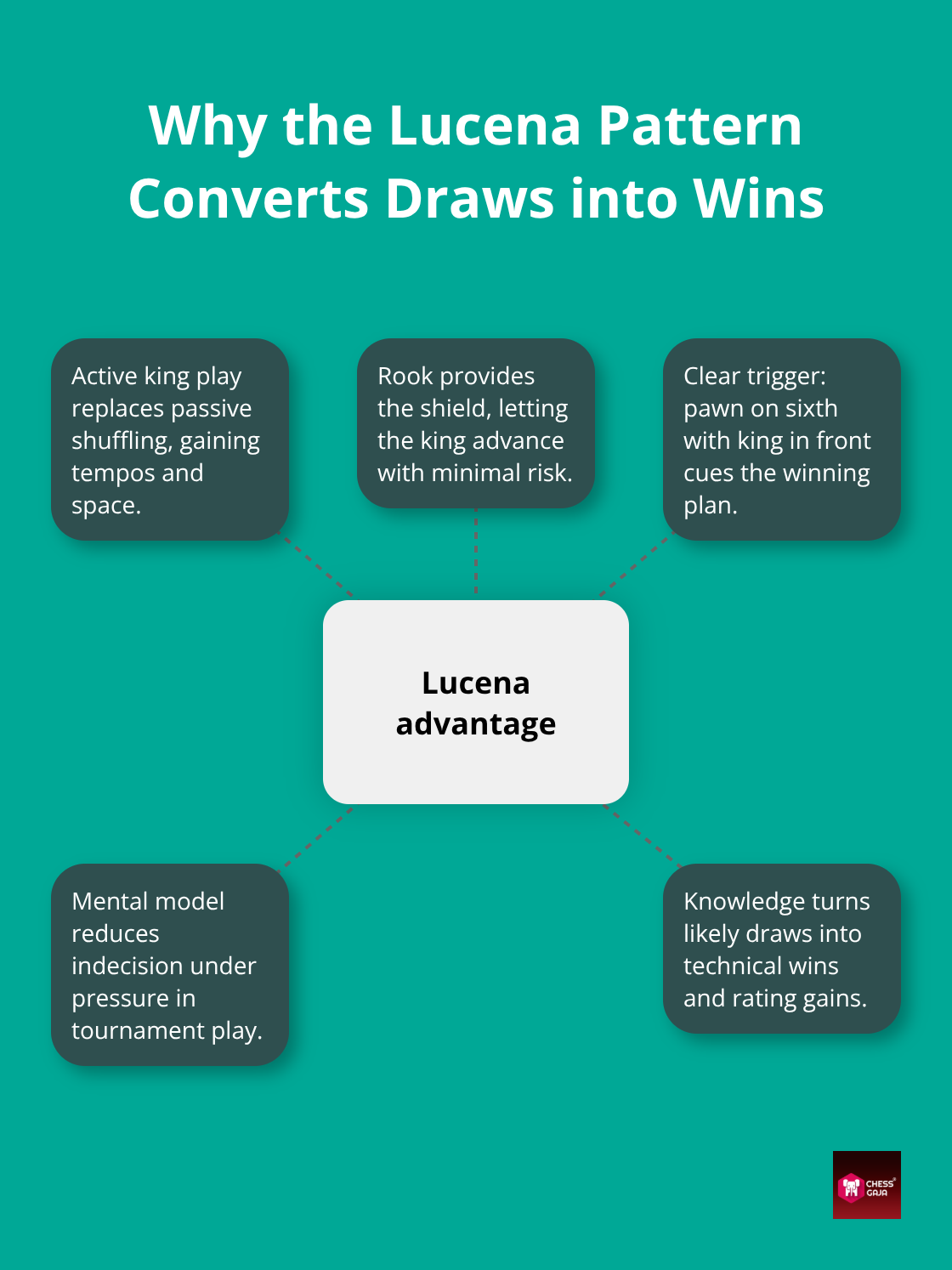
Players who understood the Lucena position converted their rook endgames into wins at significantly higher rates than those without this knowledge. The Lucena position teaches you to activate your king aggressively instead of retreating it passively. Most beginners waste moves shuffling their king around the board, losing time and tempos. The Lucena technique shows you exactly when to push forward and when your rook does the defensive work.
This single shift in thinking changes how you evaluate endgame positions for the rest of your chess career. Tournament players who master this pattern typically gain rating points within months because they stop drawing positions they should win.
Real Positions from Recent Junior Tournaments
At the 2024 Dubai Youth Chess Championship, a 13-year-old player pushed their passed pawn to the 7th rank. Their king stood directly ahead of the pawn. The opponent’s rook moved aggressively to check from behind. Without the Lucena technique, this player would have defended passively and drawn. Instead, they executed the building the bridge maneuver—placing their rook on the 4th rank to shield their king—and converted the win in 5 precise moves. The same pattern appeared at junior championships where players recognized and played Lucena positions correctly. In the USA, junior players from Texas and California who trained this endgame pattern showed measurable improvement in their tournament results within two months of focused study.
What Separates Lucena Mastery from Casual Knowledge
Recognizing the Lucena position and actually playing it correctly are two different skills. Many beginners spot the pattern but hesitate at the critical moment, moving their rook passively instead of executing the bridge technique with confidence. The difference lies in repetition and structured practice (which we’ll explore in the next section). Players who analyze puzzles and recent games develop key pattern recognition. This makes the Lucena setup automatic under tournament pressure, converting theoretical knowledge into real rating gains.
How to Set Up and Execute the Lucena Position
Recognizing the Exact Geometry
The Lucena position requires three specific pieces in exact geometric arrangement: your rook, your king, and your passed pawn. Your pawn must sit on the 7th rank (for Black, the 2nd rank), and your king occupies the promotion square directly in front of it. The opponent’s rook attacks your king while their king is cut off by at least one file. This setup appears frequently in tournament play. Rook endgames naturally evolve into passed pawns. The 7th rank is the critical threshold where the Lucena technique becomes available.
Recognizing this geometry takes practice, but once you see it three or four times in real games, the pattern sticks. When your passed pawn reaches the 7th rank with your king in front, stop and check if the opponent’s king is cut off from the pawn. If yes, you have a Lucena position. Train yourself to pause at this moment and verify the setup—you’ll catch these winning opportunities instead of drifting into passive defense.
Executing the Building the Bridge Technique
The building the bridge technique is the tactical sequence that wins these positions. Your rook moves to the 4th rank (the 5th rank if playing as Black). This placement ensures that once your king steps out to clear the pawn’s path and takes checks from the enemy rook, your rook on the 4th rank acts as an umbrella to block the checks. The name describes exactly what happens: your rook creates a protective bridge that shields your king while allowing the pawn to advance to a queen.
Most beginners hesitate here because moving the rook backward feels counterintuitive, but this single move transforms a drawn position into a technical win. Practice this sequence alongside other essential endgame strategies in rated puzzle training. Start at the 1400–1600 rating range where Lucena positions appear regularly. Solve at least ten puzzles correctly before testing the idea in tournament play.
Avoiding the Three Critical Mistakes
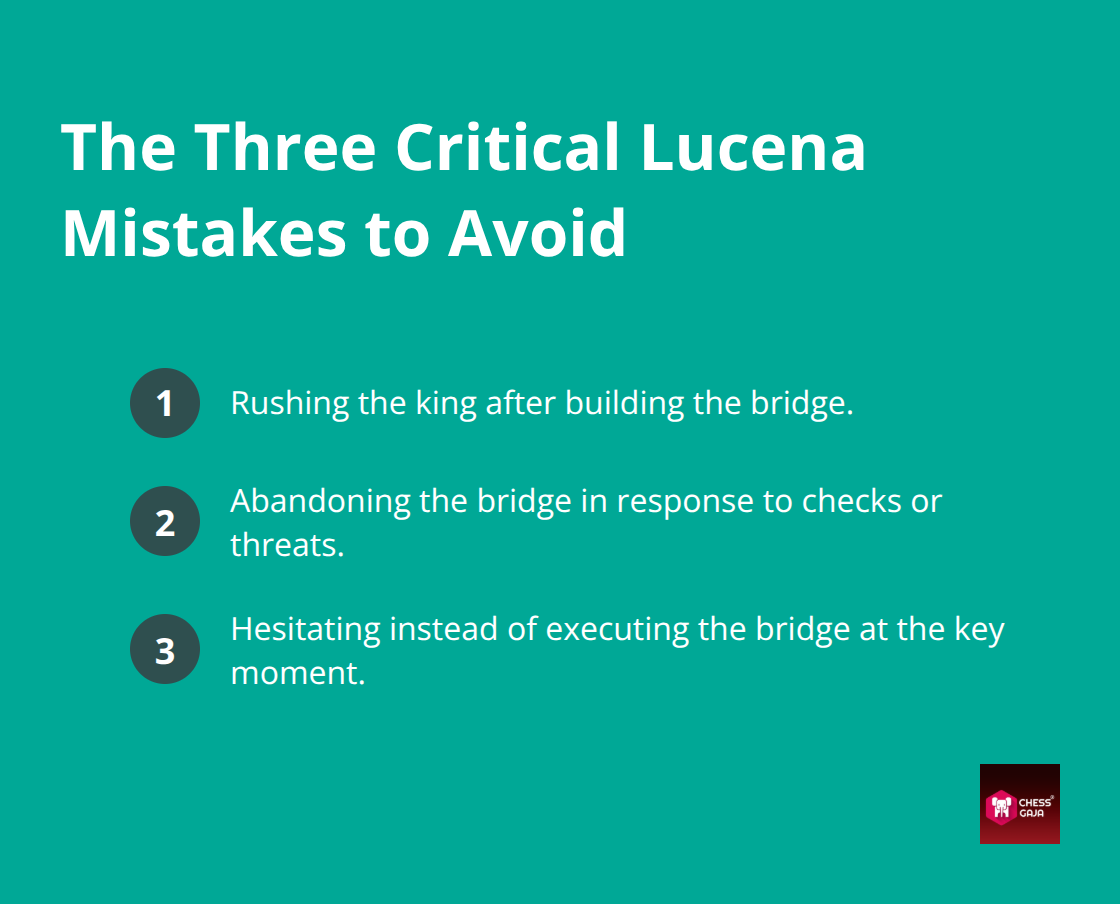
The first mistake beginners make is stepping their king out before placing the rook on the 4th rank. Without the 4th-rank bridge in place, your king will be hounded by endless checks from the enemy rook, forcing it to retreat back in front of the pawn. Once your rook is on the 4th rank, step your king out immediately. As the opponent gives checks, walk your king toward your 4th-rank rook, which will block the final check and secure promotion within 4 to 6 moves.
The second mistake is abandoning the bridge structure when the opponent creates checks or threats. Your rook stays on the bridge rank until your pawn queens. Temporary checks and rook activity don’t change the fundamental plan.
Under tournament pressure, players panic and deviate from the winning plan. Solve endgame positions from start to finish rather than finding just one winning move. This builds the mental resilience needed when your opponent creates threats.
The third mistake involves hesitation at the critical moment itself. Many beginners spot the pattern but fail to execute the bridge with confidence. The difference between recognizing the Lucena position and actually playing it correctly lies in repetition and structured practice. Structured puzzle training creates fast pattern recognition. This allows you to execute the Lucena technique automatically under tournament pressure.
Building Pattern Recognition Through Deliberate Practice
Puzzle training accelerates your ability to spot and execute Lucena positions in real games. Start with obvious bridge positions. Then, progress to setups requiring several moves of calculation before committing to the technique. This progression builds strong mental discipline. It helps you stay aggressive when your opponent’s rook creates threats, preventing passive defense.
Tournament analysis reveals how Lucena positions emerge from your own games. After each tournament, review your rook endgames and identify moments where you could have applied the Lucena technique. This concrete feedback transforms abstract knowledge into actionable skill. The players who gain rating points fastest are those who connect puzzle training to their actual tournament experience.
How to Train Lucena Positions Without Wasting Time
Start with Structured Puzzle Progression
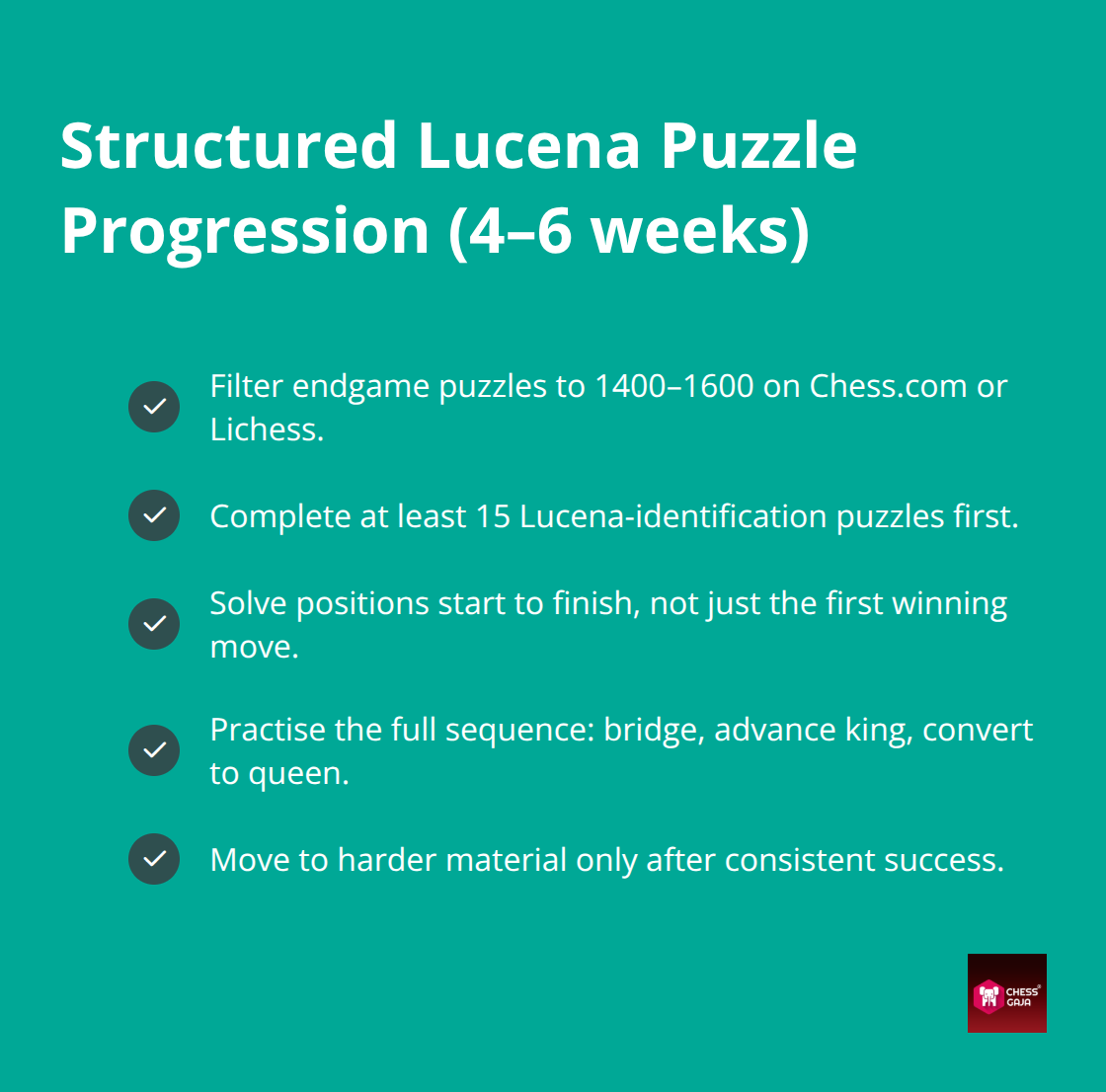
Solving random endgame puzzles won’t build the pattern recognition you need for tournament play. Players who improve fastest follow a structured progression: start with positions where the bridge move is obvious, then advance to positions requiring three to five moves of calculation before executing the technique. Filter for endgame puzzles rated 1400–1600 on Chess.com and Lichess. Complete at least 15 puzzles by correctly executing the setup before moving to harder material.
Most players miss a critical detail: you must solve positions from start to finish. Do not stop after finding just the first winning move. When you practice this way, your brain learns the entire sequence-building the bridge, advancing your king methodically, and converting the position into a queen-rather than treating it as an isolated puzzle.
Players who train this way report converting Lucena positions in actual games within four to six weeks of consistent practice, whereas casual puzzle solvers often miss the pattern entirely under tournament pressure.
Connect Puzzle Training to Your Tournament Games
Tournament analysis separates players who study chess from players who improve at chess. After each tournament, open your games and specifically search for rook endgames where your passed pawn reached the 6th or 7th rank. Identify moments where you could have applied the Lucena technique but didn’t, and play those positions out on a board to completion. This concrete feedback connects your puzzle training to real results. A coach reviews your tournament games within 48 hours and highlights exactly where you missed Lucena opportunities, then assigns targeted puzzles addressing your specific weaknesses.
Practice Between Sessions with Purpose
Practice rated puzzles for 15–20 minutes daily between coaching sessions. Avoid passive video watching. Real pattern recognition develops through repetition and active calculation. Personalized study schedules blend targeted puzzle sets with your actual games. This ensures every training hour directly improves your tournament results. This targeted approach (combining your real games with rated puzzle training) accelerates your progress far more than general endgame study. Fast-improving players connect puzzle training directly to their tournament games. This feedback loop sharpens your Lucena recognition under time control.
Final Thoughts
Mastering the Lucena position essentials transforms how you evaluate rook endgames for the rest of your chess career. Players who recognize this pattern and execute it confidently stop drawing positions they should win and start converting technical advantages into real rating gains. Winning with the Lucena position under pressure requires deliberate practice. You need structured feedback and consistent analysis of your actual games.
Solving puzzles without tournament results usually means a training gap. You must connect your daily practice directly to real positions from your games. After your next tournament, review every rook endgame and identify moments where the Lucena technique applied. This concrete analysis reveals exactly what your training needs to address, and a coach can accelerate this process by reviewing your positions within 48 hours.
At Chess Gaja, we help junior players across the USA, UAE, and Singapore master endgames. We combine rated puzzle training with direct analysis of your tournament games. Book a Paid Starter Class for a professional skill evaluation. Your coach will assess your endgame understanding, fix key weaknesses, and turn the Lucena technique into tournament wins.