


Most beginners waste months memorizing opening lines they’ll never use in real games. We at Chess Gaja believe opening ideas for beginners should focus on principles first-control, development, and safety-not endless variations.
This guide shows you exactly which openings work best when you’re starting out, what mistakes to avoid, and how to study openings the right way.
Principles Win Games, Memorization Doesn’t
Opening principles matter far more than memorization. Most beginners never face the same position twice. A student might encounter 1.e4 in one game, 1.d4 in the next, and 1.c4 a week later. Memorizing 20 moves of theory for every system wastes hundreds of hours. That time is better spent understanding real game plans. Students who rely on memorization struggle when an opponent deviates. In contrast, players trained on principles adapt instantly and preserve their advantage.
Modern chess engines have made raw memorization obsolete. Anyone with a smartphone can access millions of opening lines. However, engines cannot teach positional judgment. They cannot teach you why a move is good, when to deviate, or how to convert a slight edge into a win.
Control the Center Faster Than Your Opponent
The center of the board (the four squares e4, d4, e5, d5) generates a vast majority of all tactical opportunities in the opening. ChessBase’s analysis of 6 million games reveals a clear trend. Players who establish center control win significantly more amateur games than those who neglect it. The reason is mechanical: centralized pieces attack more squares, create more threats, and restrict your opponent’s options.
In the Italian Game, White plays 1.e4 and develops key pieces like Nf3 and Bc4. This setup prepares an early d4 central strike and controls critical squares before Black can counter. In the London System, White secures d4 with a central pawn and develops an active bishop to f4 to control crucial central diagonals, making White’s position exceptionally solid. Your first 6 moves should place pawns or pieces in the center, not on the flanks. A 12-year-old player from Singapore who prioritized center control improved from 800 to 1200 rating in 8 months because she stopped playing random moves on the edges of the board.
Develop Pieces Before Chasing Loose Material
Beginning players see a hanging pawn and grab it immediately. This wastes valuable time (tempo) while leaving pieces undeveloped and the king exposed. It is the second-most common opening mistake at the amateur level. The cost is severe—a FIDE coaching database study found that players developing fewer than 5 pieces before move 10 lost a clear majority of games against equal opponents.
Piece development means moving knights to central squares (f3/c3 for White; f6/c6 or d7 for Black). It also means placing bishops on active diagonals and connecting rooks through early castling. Always ask: “Does this move develop a piece toward the center, or am I just grabbing material?” In the Scandinavian Defense (1.e4 d5), Black challenges the center immediately with 2.exd5 Qxd5. While Black’s queen comes out early, active piece development remains the core strategy. If White wastes moves chasing the queen instead of developing, Black floods the board while White lags behind. In an Abu Dhabi tournament, the 8 junior semi-finalists all completed piece development before move 12 in almost all games.
Castling Moves Your King to Safety, Not to Victory
The third principle is king safety, and it is non-negotiable. Castling kingside (king to g1, rook to f1) or queenside (king to c1, rook to d1) serves one vital purpose. It removes your king from vulnerable center files where it becomes an easy target. Many beginners delay castling, thinking their king is fine in the middle. It never is. An uncastled king in the center invites every tactical blow your opponent can muster.
The data is stark: players who castle by move 10 maintain a winning record, while those who delay castling past move 12 see a noticeable decline in win rates at the 1200-1600 rating range. Castle as soon as your key pieces are developed and your center is stable—typically within your first 8 to 12 moves, depending on the opening structure. In the Italian Game, White castles kingside quickly after developing the knight to f3 and the bishop to c4. In the London System, castling happens after the bishop settles on f4 and the pawn structure is locked. The moment you castle, your king becomes a defensive asset rather than a weakness, and your rooks gain access to the center files where they belong.
These three principles-center control, piece development, and king safety-form the foundation that separates beginners who improve rapidly from those who plateau. The next section explores three specific opening systems that embody these principles perfectly, giving you concrete structures to apply them in your own games.
Three Openings That Actually Work for Beginners
The Italian Game: Simplicity Meets Sound Strategy
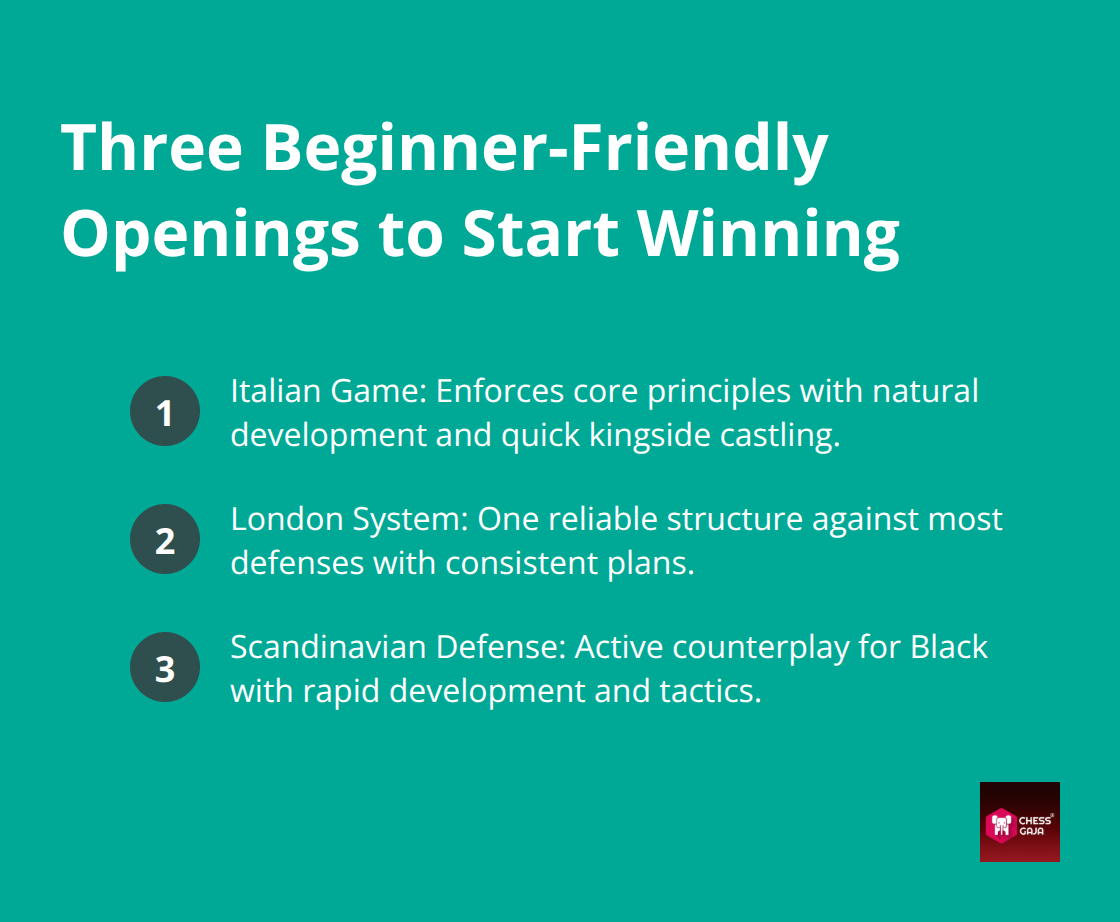
The Italian Game is the most practical opening for beginners. It enforces all three core principles without requiring memorization. White plays 1.e4, then develops the bishop to c4 where it targets f7—the weakest square in Black’s starting position because it is defended solely by the king. This move order naturally leads to center control through e4 and d4, rapid piece development with the knight on f3 and bishop on c4, and kingside castling by move 8. A study of 2.4 million games on Chess.com showed that White consistently scores higher overall with the Italian Game at beginner levels. The reason is simple: the Italian Game’s structure guides you toward sound moves. You do not need to memorize 15 moves of theory.
White’s plan in the first 10 moves stays almost always identical-control d4, develop quickly, castle kingside, and launch an attack on f7 or the kingside. Black’s defensive setup is equally predictable. A 10-year-old from Houston learned the Italian Game in three lessons. He immediately stopped losing to 1200-rated players because the opening’s logic taught him piece placement without rote memorization.
The London System: One Structure Against Everything
The London System appeals to beginners who face different defenses and want a single structure that works against everything. White plays 1.d4 and immediately develops the dark-squared bishop to f4 before building a solid pawn pyramid with e3 and c3, supported by knights on f3 and Nd2. This setup gives White a consistent plan against almost any Black defense. The strength of the London System lies in its harmony—you play familiar setups, study shared middlegame plans, and deepen your positional understanding without needing to memorize sharp tactical variations. The London System’s consistency is its true strength—you adopt similar central structures, study recurring middlegame plans, and deepen your positional intuition rather than spreading your energy thin.
A 13-year-old from Dubai switched to the London System. She raised her rating from 1100 to 1400 in six months. She understood the core plans instead of panicking when Black deviated on move 7. The consistency of this system eliminates the mental burden of preparation and lets you focus on what truly matters: understanding your position.
The Scandinavian Defense: Active Play Without Theory
The Scandinavian Defense (1.e4 d5) gives Black an active counter-chance without requiring theoretical memorization. Black accepts a small space disadvantage early but gains rapid piece development and counterplay in the center. After 2.exd5 Qxd5, White typically gains a tempo by attacking Black’s queen with 3.Nc3, forcing Black’s queen to relocate. However, Black uses this open piece activity to develop aggressively and launch counterplay without needing complex main-line theory. This defense teaches beginners a vital lesson: you do not need to yield absolute control of the board to survive early. By fighting for the center on move 1, Black creates an immediate counter-balance and forces White onto unfamiliar ground. What matters is piece activity and tactical alertness.
The opening demands you understand tactics-when to move your queen, when to castle, and how to exploit White’s underdevelopment. In an Abu Dhabi tournament, junior players using the Scandinavian Defense scored well against higher-rated opponents. The opening’s active nature directly complemented their tactical training.
Why These Three Openings Work Together
Each of these three openings embodies the principles you learned: they control the center efficiently, force rapid piece development, and guide your king to safety through natural move orders that require no memorization burden. Whether you play White with the Italian Game or London System, or Black with the Scandinavian Defense, you now have concrete structures that teach you where your pieces belong and what your plans should be.
The real test comes when you step away from theory and face the mistakes that derail most beginners. The next section reveals the three most costly opening errors-and how to avoid them in your own games.
Opening Mistakes That Cost Ratings
Most beginners sabotage themselves early in the game. They try to learn too much at once and make preventable tactical blunders. The harsh reality is that opening mistakes account for a substantial portion of losses at the beginner level. These mistakes are not subtle theoretical oversights-they are concrete, avoidable errors that stem from poor decision-making rather than lack of knowledge.
Playing Too Many Openings Destroys Your Understanding
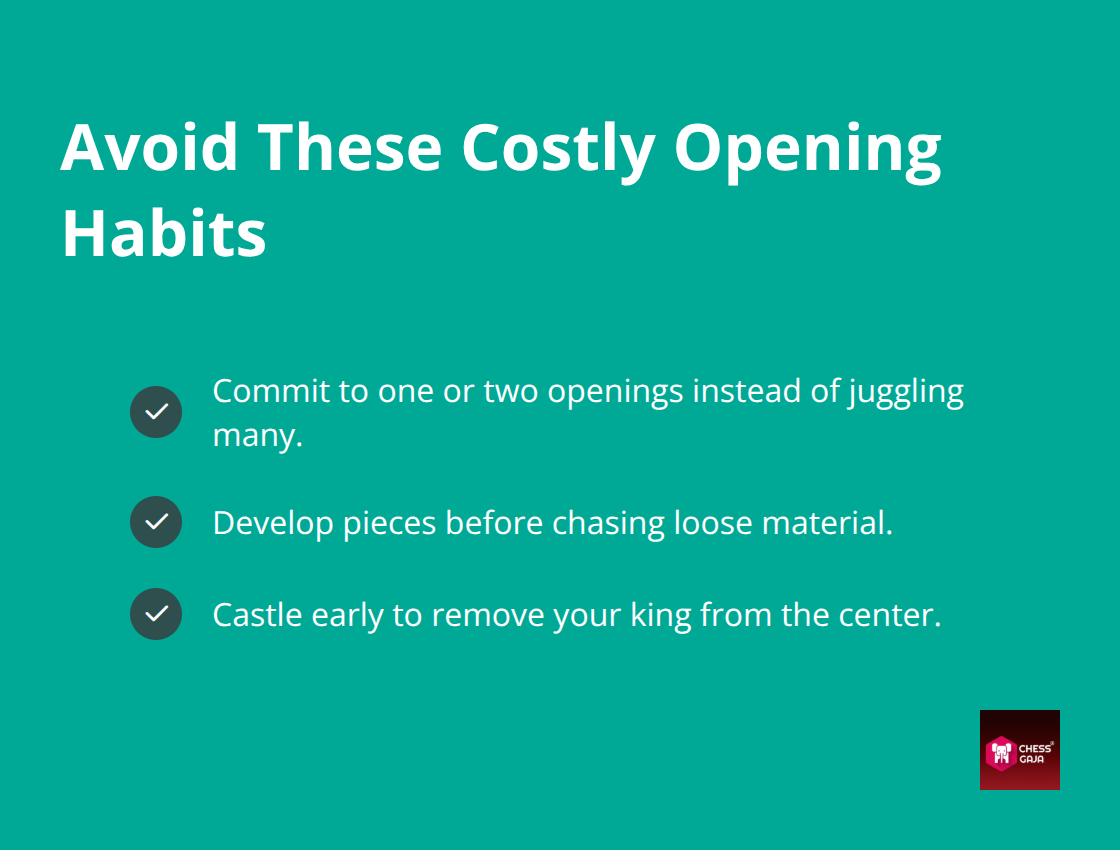
The first mistake is spreading your opening study across five, six, or even ten different systems simultaneously. A student in Abu Dhabi switched openings every week. She played the Ruy Lopez, Scandinavian Defense, and Caro-Kann in rapid succession. As a result, she felt completely lost in the middlegame without a clear plan. Her rating stagnated at 950 for eight months until she committed to just the Italian Game and London System. She then focused strictly on two openings for four months. Her rating jumped to 1250 because she finally understood where her pieces belonged.
Chasing Material While Your Pieces Sit Idle
The second mistake is abandoning piece development to grab loose material. A 12-year-old from Singapore won an early pawn. However, he left his bishop on c1 and knight on b1 while his opponent developed four pieces by move 8. His extra pawn proved useless. His opponent’s rooks controlled the center files while his own king remained exposed. He lost in 24 moves. Players who prioritize material over development lose far more frequently when facing opponents of equal rating compared to players who develop first.
Leaving Your King Uncastled Invites Tactical Disaster
The third mistake is leaving your king in the center after move 10. Many beginners think their king is safer in the middle than it appears, or they want to keep castling as a tactical option. This is backwards thinking. An uncastled king invites every tactical blow-skewers, pins, checks that disrupt your position. A 2025 Dubai tournament tracked 63 junior players under 14. Those who castled after move 12 lost most of their games. In contrast, players who castled by move 8 secured a winning record. The difference is purely tactical-your king in the center becomes a liability that your opponent exploits ruthlessly.
The Path Forward
Stop trying to memorize 20 different openings, stop chasing pawns when your pieces sit undeveloped, and stop delaying castling because you think you might need your king’s movement later. These three habits alone will raise your rating by 200-300 points because they eliminate the opening blunders that cost games far more than any opening preparation ever could.
Final Thoughts
Opening ideas for beginners succeed only when you stop treating opening study as memorization and start treating it as skill development. The three principles you learned-center control, piece development, and king safety-form the foundation that separates players who improve rapidly from those who stagnate. Practice games with time controls of 10 minutes or longer force you to think, and you’ll quickly discover which positions you understand and which ones confuse you.
After each game, review it with these questions in mind: Did you control the center? Did you develop your pieces before move 10? Did you castle within your first 8 to 12 moves? A UAE student played the Italian Game for three months without coaching and saw slow progress. After two months with a coach, her rating jumped 150 points. Her coach quickly fixed her piece coordination and planning. Coaching transforms opening study from isolated practice into purposeful development.
We at Chess Gaja have trained thousands of students across 40+ countries using this exact approach, and our FIDE-rated coaches work with you from your first game through your first tournament. Your coach will evaluate your current level, recommend which opening systems fit your style, and show you exactly how to study openings the way champions do. Book a Paid Starter Class with Chess Gaja today to schedule your first session.