

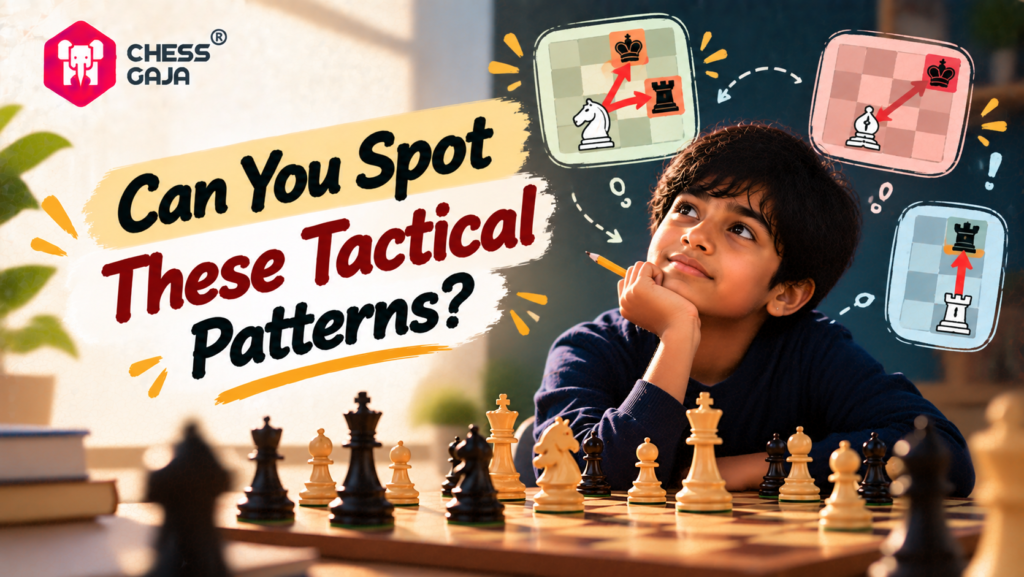
You’ve seen it happen in tournaments: a player spots a winning move in seconds while their opponent misses it entirely. The difference isn’t talent-it’s tactical pattern recognition.
At Chess Gaja, through our specialized online chess classes, we’ve coached thousands of players who transformed their game by learning to see these patterns automatically. In this post, we’ll show you exactly how to train your eye to find breakthroughs your opponents overlook.
Five Tactical Patterns That Win Material in Your Next Game
The Five Patterns That Appear in Most Games
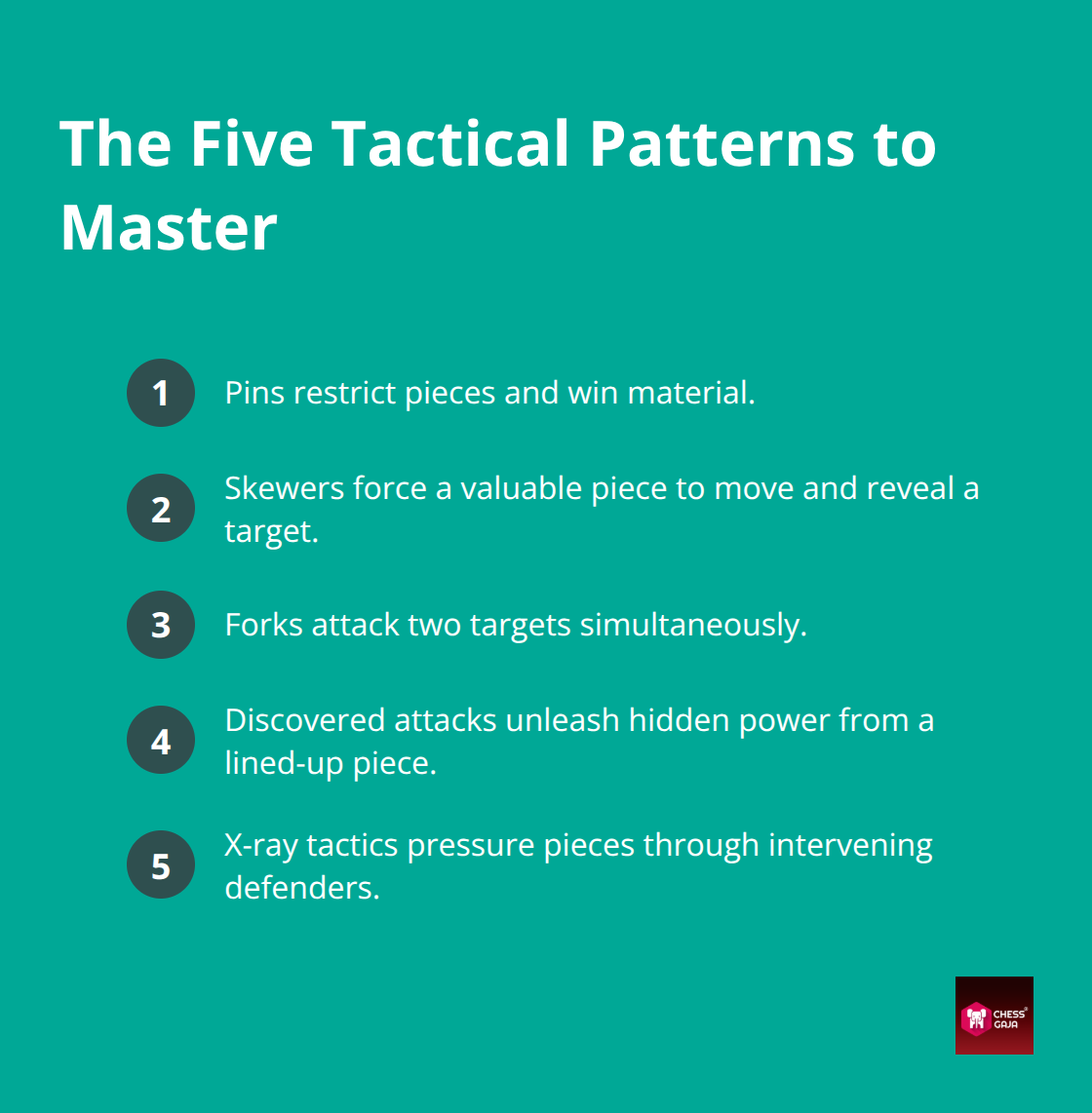
The five tactical patterns we teach appear in a vast majority of games played below 1600 rating, according to analysis of thousands of games on Chess.com and Lichess. Learning to spot these patterns is not optional if you want to improve quickly. A pin restricts one or more of your opponent’s pieces by attacking them in a way that prevents safe movement. In a real game from a Dubai youth tournament in 2024, a young player’s bishop on e5 pinned the opponent’s queen to the king, completely paralyzing Black’s position and winning material within five moves. The key insight: pinned pieces lose their power.
How Pins and Skewers Create Immediate Advantages
When you spot a pin, ask yourself what that piece was defending. If it was defending something valuable, you have found your breakthrough. A skewer is the reverse of a pin. The higher-valued piece gets attacked first, and moving it reveals a lower-valued piece behind it. One competitive player in Singapore used a simple queen check on h8 to force the king to move, then captured a rook on the back rank-a textbook skewer that won the game in one tactic.
Forks, Discovered Attacks, and X-Ray Patterns
Forks and double attacks create two simultaneous threats that your opponent cannot defend. A knight jumping to c7 to attack both the king and queen at the same time forces your opponent into an impossible choice. What makes forks dangerous is their speed-your opponent has one move to respond, and usually both pieces cannot be saved. Discovered attacks happen when one piece moves aside and reveals a hidden attack from a piece behind it.
For example, moving a knight with check can unmask an attack from your rook directly onto the enemy queen. This pattern punishes opponents who leave high-value targets aligned with your long-range pieces. X-ray patterns take this a step further: your piece exerts force or defense through an opponent’s piece along a file, rank, or diagonal—such as a rook defending a critical back-rank square directly through an opposing rook standing in between.
Why These Patterns Repeat Constantly
These five patterns repeat constantly in tournament games because they exploit basic principles of piece placement and king safety that beginners and intermediate players frequently ignore. The strongest players spot these patterns within seconds because they have solved hundreds of puzzles reinforcing each motif. You do not need to be a genius to recognize them-you need systematic training.
Training Your Brain to Recognize Patterns Automatically
Start by solving 10 to 15 tactical puzzles daily focused on one pattern at a time. Spend three days on pins, three days on skewers, three days on forks, and three days on discovered attacks. This focused approach trains your brain to recognize the visual shapes these patterns create. After two to three weeks of this daily practice, you will start spotting these patterns in your own games without conscious effort. The pattern recognition process works because your brain learns to match visual configurations to winning sequences.
When you see a piece that cannot move without exposing a more valuable piece, your pattern-matching system immediately flags it as a pin. When you see two pieces on the same line with your attacking piece, your brain recognizes a discovered attack. This automatic recognition separates calculating players from those who see winning moves instantly. Next, move beyond isolated puzzles. Test these patterns against real opposition in structured training games.
Building Tactical Mastery Through Deliberate Practice
Three Layers of Training That Bridge Puzzles to Real Games
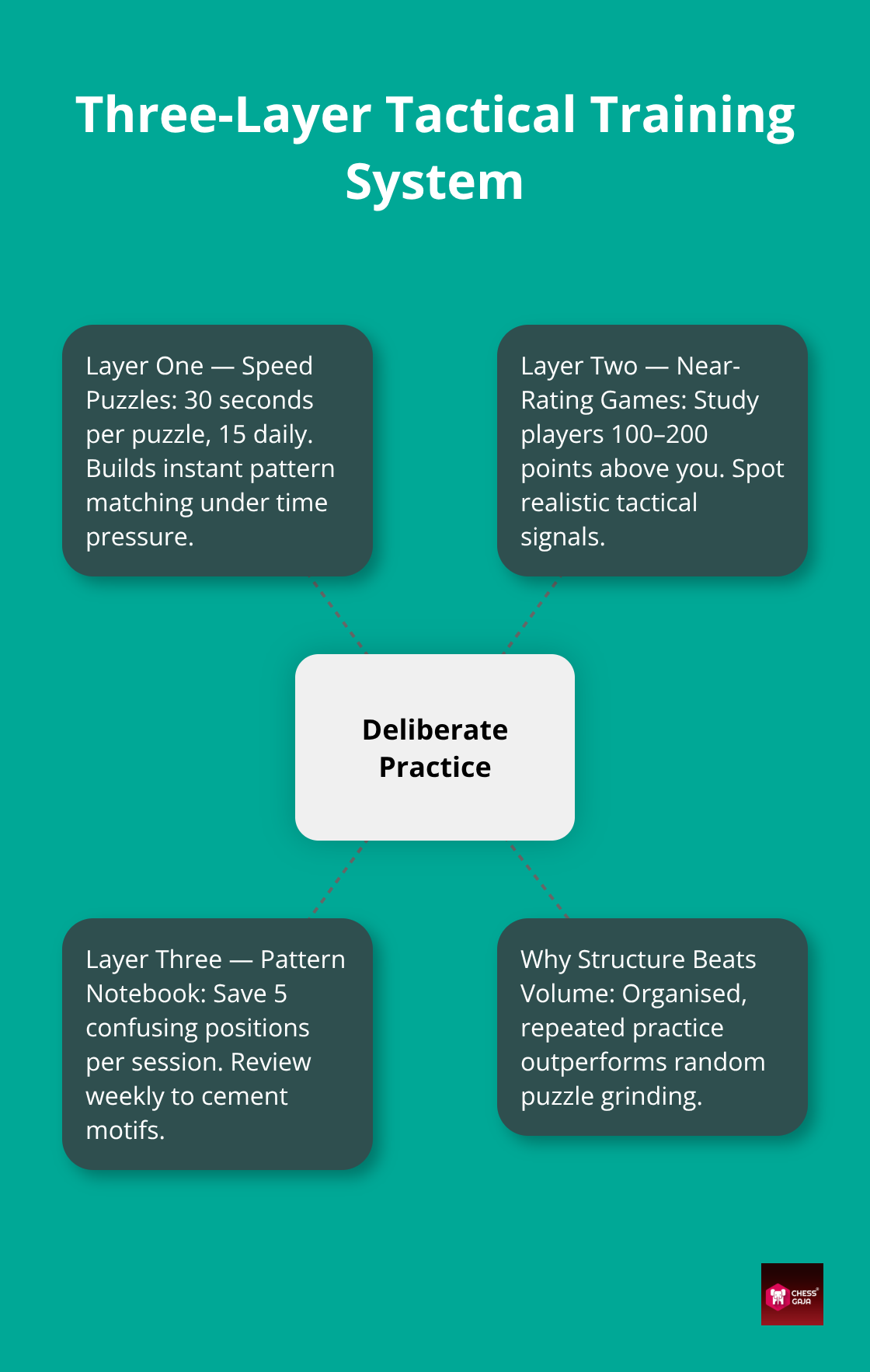
Puzzle training alone fails most players because puzzle positions lack the noise and complexity of actual tournament games. We teach a three-layer system that mirrors how strong players actually develop pattern recognition. Each layer builds on the previous one, moving you from artificial positions to real competitive scenarios where your tactical eye must work under pressure.
Layer One: Speed-Based Puzzle Training with Time Constraints
Set a timer for 30 seconds per puzzle on Chess.com or Lichess and solve 15 puzzles daily at your current rating level. This constraint forces your brain to match visual shapes instantly rather than calculate every variation. After two weeks at this pace, your pattern-spotting speed accelerates dramatically. Pattern recognition comes from repetition, and the time pressure trains your automatic recognition system-the same system that lets experienced players spot tactics without conscious calculation. Without this speed component, you develop slow, deliberate pattern matching that collapses under tournament time pressure.
Layer Two: Study Games from Players Near Your Rating
Analyze games from players 100 to 200 rating points above you, not from Grandmasters. A junior in Dubai who plays at 1400 rating should study games from 1500–1600 players, not from elite competitors. This gap matters because players at your near-rating level make the same errors you do, but they have learned to spot the tactical breakthrough and punish those mistakes in real time.
Download five games each week from Chess.com’s games database filtered by your rating range and your preferred openings. Spend 15 minutes analyzing one critical position per game. Focus on moments where your near-rating peer executed a tactic you missed. Analyzing games, replaying tactics, and learning new things will help you propel yourself forward. Ask yourself what visual signal alerted them to the tactic three moves before it happened. This reverse-engineering process trains your brain to recognize warning signs earlier in the position.
Layer Three: Build a Personal Pattern Notebook
After each puzzle session, screenshot or write down the three positions that challenged you most. Organize these by pattern type: pins, forks, discovered attacks, skewers, and x-ray tactics. Within one month, you will have nearly 90 curated positions organized by motif. Review this collection every Sunday for 10 minutes. This repetition with organized material trains your long-term pattern memory far more effectively than random puzzle solving. Your personal library becomes a reference tool you return to repeatedly, reinforcing the visual patterns your brain needs to recognize instantly.
Why Structure Beats Volume
Many players waste time solving puzzles without any structure, jumping between difficulty levels and pattern types. This scattered approach creates surface-level recognition without depth. Focus on a 30-day program of 450 organized puzzles, nearby-rated game analysis, and personal library reviews. This structured system advances your tactical vision far faster than random puzzle solving.
The difference lies in how your brain consolidates learning-organized repetition with clear categories builds stronger neural pathways than random exposure. Once you master this three-layer approach, you’re ready to test these patterns against real opposition where the stakes matter and your opponents actively resist your tactical plans.
From Puzzles to Tournament Pressure
The Reality of Competitive Time Pressure
The gap between solving a tactic in 30 seconds and executing it under tournament time pressure is enormous. A position that looks obvious in a puzzle database becomes a blur of possibilities when your opponent sits across the board and you have 15 minutes on your clock. This transition demands a specific training approach that mirrors real competitive conditions.
Start playing rapid games at your current rating level on Chess.com or Lichess immediately after your daily puzzle sessions. A junior in Singapore who solves 450 puzzles over 30 days but never plays rapid games will freeze when facing tournament opposition. The puzzle environment is artificial: your opponent has already blundered, the position is forced, and you simply need to find the winning move. Real games demand that you create the tactical opportunity yourself, recognize it among 20 other candidate moves, and execute it while managing time pressure.
Diagnose Your Tactical Mistakes After Every Game
After your rapid games, spend 10 minutes reviewing the position where you missed a tactic or failed to convert an advantage. Ask yourself three specific questions: Did you fail to consider the move as a candidate? Did you calculate the tactic accurately but second-guess yourself? Or did the tactical pattern exist on the board while you completely missed the visual trigger? This self-diagnosis reveals whether your problem is pattern recognition, calculation confidence, or tactical execution.
Most players between 1200 and 1600 rating miss tactics because they do not scan for patterns systematically during games. Instead, they calculate random moves and hope something works. Develop a scanning routine in the first 15 seconds of your turn: look for pieces that cannot move safely, look for unshielded targets aligned along the same file, rank, or diagonal, and identify enemy pieces that are undefended or inadequately protected. This deliberate scan takes just 15 seconds. Based on game analysis at the 1400–1600 level, it catches most available tactics in club play.
Trust Your Pattern Training in Complex Positions
The second mistake is overestimating the complexity of tactical patterns you have studied. Players often see a pin and freeze because the position looks more complicated than the puzzle they trained on. The pin is still a pin. The pattern has not changed. A bishop on e5 pinning a queen to a king behaves identically whether the position occurred in a puzzle or in your tournament game. Your brain is lying to you when it tells you the position is too complex. The pattern training you built through systematic study applies directly. Trust it. Your training created neural pathways that recognize these visual configurations automatically, and those pathways fire the same way in tournament games as they do in puzzles.
Verify Before You Capture
The third mistake is playing too fast after spotting a tactic. You see a fork with your knight on c7 and immediately play it without confirming your opponent has no defensive resource. In tournament games at 1400 rating, a significant portion of tempting tactical moves fail because the defender has a counter-tactic or a desperado move. Spend 20 seconds verifying that your tactic actually wins material or delivers mate.
Ask yourself: Can your opponent sacrifice something to complicate the position? Can your opponent create a back-rank threat that forces you to deal with it before you capture material? Can your opponent give checks that interfere with your plan?
This verification step prevents losing games to tactics you did not calculate fully. Players between 1200 and 1600 rating lose more games to premature captures than to missing tactics entirely. A young player from Dubai who trained on 450 puzzles but plays without verification will convert only a fraction of the tactical opportunities they spot, while a player who spends 20 seconds verifying each tactic converts nearly all of them. The time investment pays immediate dividends in tournament results.
Final Thoughts
The five patterns you’ve learned-pins, skewers, forks, discovered attacks, and x-ray tactics-appear in most games below 1600 rating. Tactical pattern recognition is not a luxury. It is the fastest path to climbing your rating. Successful players master these exact patterns first, then test them under tournament pressure.
Your next steps are clear: commit to 30 days of focused puzzle training with 15 puzzles daily organized by pattern type, while analyzing five games weekly from players 100 to 200 rating points above you. Build your personal pattern library by saving the three most challenging positions from each daily session, organized by motif, and review this collection every Sunday for 10 minutes. This three-layer system—speed-based puzzles, nearby-rated game analysis, and organized repetition—accelerates your tactical vision far more effectively than unstructured practice.
When you transition to rapid games, dedicate the first 15 seconds of your turn to your scanning routine—look for restricted pieces, aligned targets, and undefended material. Always take 20 seconds to verify candidate tactics for hidden defensive resources before capturing, and trust the core patterns you’ve trained.
Ready to accelerate your tactical vision with personalized master guidance? Book a Paid Starter Class with Chess Gaja to have a FIDE-rated coach evaluate your games, pinpoint your pattern-recognition gaps, and build your customized road to master-level calculation.