

Your first tournament is coming up, and you’re wondering what separates players who perform well from those who freeze under pressure. The answer isn’t talent alone-it’s preparation.
At Chess Gaja, we’ve coached thousands of young players through their tournament journeys. The tournament prep steps that work are simple: build your foundation, sharpen your skills, and train your mind. This playbook shows you exactly how.
Build a Solid Foundation with Consistent Training
Tournament preparation starts long before you sit down at the board. Success in your first event belongs to those who avoid late-night cramming, choosing instead to build a solid foundation over weeks of consistent training. This foundation rests on three pillars: a structured practice schedule, a focused opening repertoire, and endgame mastery. Most young players skip one of these and wonder why their tournament results disappoint.
Establish a Practice Schedule You Can Maintain
Start with a practice schedule you can actually maintain. If you’re a student in Dubai, Abu Dhabi, Singapore, or the USA balancing school and chess, try 45 minutes daily rather than 3-hour weekend cramming sessions. Research shows that pattern recognition in chess training improves through distributed practice-short, consistent sessions-rather than massed practice. Allocate most of your schedule to puzzles and tactical training. Reserve the remaining time for opening study and endgame drills.
Develop a Focused Opening Repertoire
Don’t memorize 20 opening variations; instead, build a focused repertoire of 2 to 3 solid systems deeply so you understand the ideas behind every move. Specifically, master one primary weapon with White (such as 1. e4 or 1. d4) and two reliable setups with Black—one against 1. e4 and one against 1. d4. A 1400-rated player focusing deeply on core structures rather than dozens of sidelines learns strategic themes that apply across hundreds of real games.
Master Endgame Principles Through Daily Practice
Endgame study separates tournament performers from casual players. Most young players lose games they could have drawn or won because they don’t know basic endings. Spend 15 minutes daily on essential endgame positions. Focus on key rook endgames like the Lucena and Philidor positions, plus fundamental king-and-pawn concepts. Far from abstract theory, these represent concrete patterns you’ll face in real tournaments. Endgame positions with only kings and pawns require instant recognition and precise calculation. Mastering these evaluations gives players a psychological edge that carries through the entire game.
Track Your Progress to Identify Real Improvement
Your practice schedule works only if you track progress. After each 45-minute session, note what you studied and how many puzzles you solved correctly. After 4 weeks, review your notes. Check whether your puzzle accuracy improved and if you feel faster in opening lines. Can you calculate endgame positions now without hesitation? This feedback loop is what separates deliberate practice from wasted time. Many young players practice for the sake of practice. Instead, treat each session as a test: Am I stronger today than yesterday? Tournament performance reflects the cumulative effect of small improvements compounded over months. A student who improves consistently week over week will be dramatically stronger over time.
The players who freeze under tournament pressure aren’t weak-they simply didn’t prepare their minds and skills for the specific demands of competitive play. Your foundation must be solid before the tournament starts. Once you’ve built this base, the next step is to sharpen the tactical and strategic skills that separate strong players from the rest.
Sharpen Your Tactical and Strategic Skills
The foundation you built through consistent training means nothing if you can’t execute under tournament pressure. Tournament performance hinges on three concrete skills: recognizing tactical patterns instantly, extracting lessons from your own games, and understanding how strong players think.
Most young players waste time on these areas by doing them randomly instead of systematically. A student in Singapore who solves 50 random puzzles weekly learns less than one who solves 10 puzzles daily with focused analysis. The difference is deliberate practice versus passive repetition. Your tactical training must target the exact patterns that appear in your rating range, your game analysis must identify recurring mistakes, and your study of master games must teach you decision-making, not just memorization.
Solve Puzzles Strategically to Build Pattern Recognition
Solve puzzles daily, but solve them strategically. A 1400-rated player should spend 15 minutes daily on puzzles rated between 1300 and 1600, not jumping randomly between 800-level and 2000-level positions. Puzzle ratings on platforms like Chess.com and Lichess are typically higher than game ratings because you already know a tactic exists in a puzzle. If your puzzle rating drops close to your game rating, it indicates a severe gap in basic pattern recognition. If your puzzle rating is much higher, your tactical vision is fine, but you struggle with time management or calculating tactics in unprompted game positions. The gap tells you what to train.
After solving puzzles, spend 3 minutes analyzing your mistakes-not just why you missed the answer, but what pattern you failed to recognize. A fork, a pin, a discovered attack, a back-rank threat-name it explicitly. Over 4 weeks, track which tactical motifs appear most frequently in your missed puzzles. That’s your primary weakness. Spend the next week or two drilling that specific pattern exclusively before returning to mixed sets. A student who identifies that they consistently miss pins might solve 100 pin-focused puzzles over ten days, immediately sharpening their accuracy in real games.
Analyze Your Own Games to Extract Real Lessons
Every game you play contains data. After each tournament game or serious practice game, analyze it within 24 hours while it’s fresh. Don’t replay the entire game passively; instead, stop at critical moments and ask yourself three questions: What was I thinking here? How could I have approached this differently? Which pattern did I miss?
A student from Dubai who loses a game because they overlooked a simple back-rank mate should spend 10 minutes analyzing that single position, not the whole game. Write down the mistake explicitly: I missed the back-rank threat because I focused on my own attack and ignored king safety. Next time I play a position where my king has limited escape squares, I’ll check for back-rank threats before making any move. This isn’t vague reflection-it’s a concrete rule you’re adding to your decision-making process.
After analyzing 10 games over two months, clear patterns will emerge. For instance, if you consistently struggle in the middlegame when an opponent attacks your kingside, focus your study on defensive middlegame positions. Alternatively, if games slip away in endgames where you hold a passed pawn, drill passed-pawn scenarios specifically. The students who improve fastest aren’t the ones who play the most games-they’re the ones who analyze fewer games but extract maximum learning from each one.
Study Master Games to Learn Decision-Making
When you study a game by a strong player, you’re not learning moves-you’re learning how a stronger mind approaches positions. Watch a game by Garry Kasparov or Judit Polgar at your own pace, and stop after Black’s 10th move.
Ask yourself: If I had White here, what would I play and why? and Write down your move before checking what the grandmaster played. Should their choice differ from yours, analyze why it was superior. Perhaps they spotted a tactical motif you missed, or maybe they were executing a long-term positional plan you hadn’t considered. This active engagement teaches real decision-making.
Study 2-3 complete games per month deeply rather than skimming 20 games. Pick games from grandmasters whose style matches your strategic goals. For sharp, tactical positions, study attacking legends like Garry Kasparov or Judit Polgar. Players who prefer solid, maneuvering games can focus on classical positional masters like Anatoly Karpov or Tigran Petrosian. A 1400-rated student studying games by players rated 2000+ will see ideas that are years ahead of their current understanding, which is the point—you’re exposing yourself to stronger thinking.
After studying a game, play through it again a week later without looking at the moves. How many moves did you predict correctly? Successfully predicting most moves indicates you are absorbing the underlying logic. Conversely, missing the majority of key moves suggests the game was too advanced and requires adjusting your material. These three skills-tactical pattern recognition, game analysis, and master-game study-form the technical edge that separates tournament performers from casual players. But technical skill alone won’t carry you through a full tournament day. Your mind must be trained as rigorously as your chess knowledge.
Train Your Mind Before You Train Your Moves
Your technical preparation means nothing if your mind collapses under tournament pressure. A student in Singapore might solve puzzles perfectly during practice but make careless blunders in round three. Similarly, players in the USA who know their opening lines can still panic when facing unexpected moves.
Tournament performance relies on two distinct factors: your technical knowledge and your emotional control under pressure. Most young players focus entirely on chess knowledge while ignoring mindset. This is a critical mistake. Solid technical preparation means nothing if you freeze during games. Young players struggle primarily because they never trained their nervous system to stay calm. Your mind needs repeatable routines practiced well before competition day.
Build a Pre-Game and In-Game Routine You Can Repeat
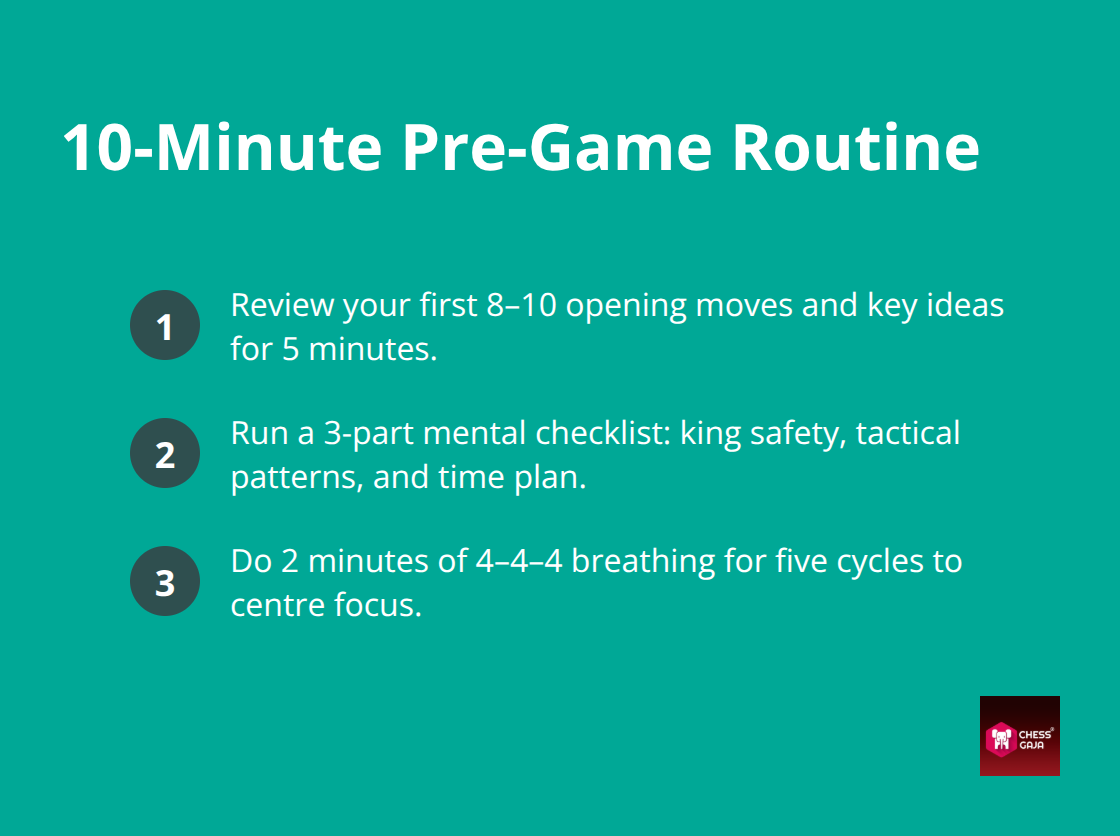
Before each tournament game, use a 10-minute routine that primes your mind for accurate play. Arrive at the board 15 minutes early, sit down, and spend five minutes reviewing your opening lines silently-not memorizing, but reminding yourself of the first 8-10 moves and the key ideas behind them.
Next, devote three minutes to a quick mental checklist: Is my king secure? Are there immediate tactical threats? How should I pace my time for this specific round?
Finish with two minutes of controlled breathing—inhale for four counts, hold for four, exhale for four, repeated five times. This sequence calms your nervous system and sharpens concentration.
Practicing this sequence ahead of time ensures you execute it automatically in round one, keeping your mind composed.
During the game itself, pause for 10 seconds after your opponent moves before you touch a piece. Use those 10 seconds to scan for forcing moves-checks, captures, threats-in that specific order. This forced pause prevents the panic-driven blunders that happen when you move too quickly. Students who adopt this habit report fewer tactical oversights because the pause creates a psychological circuit-breaker between impulse and action.
Manage Time Pressure Through Matched Practice
Tournament performance depends partly on how you have trained time management. If you have only played 3-minute blitz games in practice, you will make different mistakes in a 60-minute tournament game than a student who regularly plays 15-minute rapid games. Players who practice in time controls within 5 minutes of their tournament time control make significantly fewer time-management errors. A student preparing for a tournament with 90-minute games should spend the majority of their practice games in 60-90 minute time controls, not blitz. This trains your pace-setting instincts.
During the opening phase, play standard moves efficiently without auto-piloting—if your opponent plays an unexpected move on move 4, pause to re-evaluate rather than rushing. Moving into the middlegame, allocate 2–3 minutes per move on standard decisions, reserving 5–8 minutes when you reach critical positions. Once in the endgame, slow down and calculate precisely, as a single miscalculation can lose a winning position. A student who practices time management systematically in training will naturally pace themselves correctly in tournaments instead of rushing through moves or running short on time in critical positions.
Play Mock Tournaments Under Identical Conditions
The single most effective tournament preparation is playing mock tournaments under identical conditions. If your real tournament starts at 9 a.m. and uses 90-minute games, organize a practice tournament at 9 a.m. with 90-minute games.
Schedule three games in a single day with 30-minute breaks between rounds, mirroring the real event. After each mock game, spend 10 minutes recording your initial thoughts and critical move choices while fresh. However, save deep engine analysis until the daily session ends so your energy stays focused.
Running a full test run two weeks before your event significantly enhances performance. Simulated match play trains your mind to stay sharp across multiple games—a completely different challenge than single practice games. Your nervous system adapts to the rhythm, fatigue, and cumulative pressure of tournament play.
Final Thoughts
Peak performance comes from consistency compounded over months, not intensity compressed into weeks. Our tournament prep steps target your technical foundation, tactical execution, and mental resilience. They work because they address these areas as interconnected systems rather than separate concerns.
Start your tournament prep now, even if your tournament sits three months away-build your practice schedule this week, choose your opening repertoire this month, and play your first mock tournament six weeks before competition.
High-performing tournament players aren’t necessarily those with the most natural talent—they are the ones who prepare systematically across all three areas. A solid foundation helps students in Singapore stay grounded, but it won’t prevent round-three panic without mental training. For players in the USA, focusing purely on tactics still leaves them vulnerable in endgame positions. Even students in Dubai with flawless opening knowledge risk costly time-management errors if they skip realistic tournament practice.
We at Chess Gaja have guided thousands of young players through this exact preparation process across 40+ countries using our GM-led coaching and structured curriculum. Your next step is to book a Paid Starter Class with one of our FIDE-rated coaches, who will evaluate your current level, identify your specific weaknesses, and build a personalized tournament prep plan tailored to your goals and timeline.