
You’ve hit a plateau. Your rating hasn’t budged in months, and you’re not sure what’s holding you back.
At Chess Gaja, we have coached thousands of intermediate players. Rapid improvement comes down to three key habits: analyzing your games, picking the right openings, and focusing your daily practice. This post covers simple tips that bring clear results.
Analyze Your Own Games Systematically
Analyzing your own games drives real improvement. Your losses are your best teacher. Most intermediate players skip this crucial step, causing them to plateau. Focused analysis helps you learn from actual games instead of abstract theory.
Start With Your Losses
Start with your losses, not your wins. When you lose, one or two critical moments usually cost you the game. Your job is to find them.
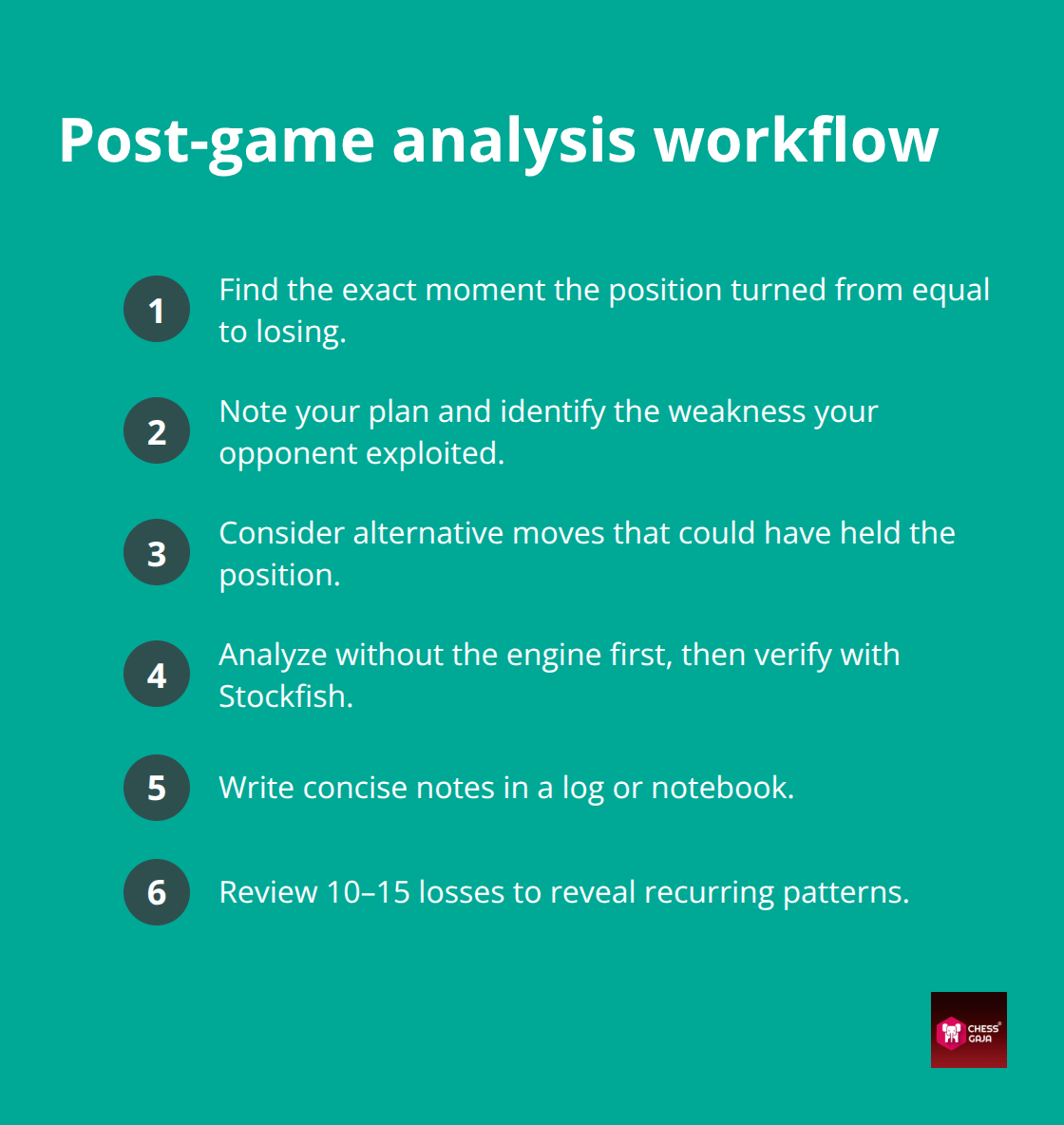
Open your game on Chess.com, Lichess, or ChessBase with the engine turned off. Play through the game move by move and try to identify the critical moment where your position shifted from equal to losing. Only turn on Stockfish after you have completed your own analysis to verify your conclusions.
This usually happens in the middlegame. Once you find that moment, ask yourself three questions:
- What was your plan?
- Did your opponent exploit a weakness?
- Could another move hold the position?
Write down your answers in a simple document or notebook. This takes 15-20 minutes per game, but it’s the most productive time you’ll spend. Engine analysis shows you what you missed tactically, but your own reasoning shows you what you need to fix strategically.
After reviewing 10-15 losses this way, patterns emerge. For instance, you might notice repeated back-rank weaknesses in your games. Other times, pushing pawns too aggressively in the middlegame leaves open gaps. Frequently missing forcing defensive moves is another common issue.
Track Your Recurring Mistakes
These recurring mistakes are exactly what you need to target in your training. Track them in a spreadsheet with the date, your opponent’s rating, the opening, and the specific error. Over two months, you’ll have a clear picture of your weaknesses. Then you can dedicate puzzle training and opening study directly to fixing those patterns instead of training randomly.
Why Engine Analysis Alone Fails
Relying only on what the engine recommends creates a false sense of improvement. The engine finds the best move, but it doesn’t explain why you played a worse move or how to avoid the same mistake next time. Players who use engines without personal reflection often repeat the same errors in the next tournament. Instead, use the engine as a verification tool after you’ve already analyzed the position yourself. This forces your brain to work harder and builds the calculation skills you need during actual games.
The Tracking System That Works
Create a simple three-column log: the date and opponent rating, the opening you played, and one sentence describing the critical mistake. After 20 games, you’ll see which openings expose your weaknesses most often and which tactical themes appear repeatedly. This isn’t busy work-it directly informs what you study next.
If your log shows that you consistently lose as Black in the Sicilian Defense (or against it as White), you know that reviewing your Sicilian pawn structures and typical middlegame plans is far more valuable than picking up an entirely new opening. This data-driven approach transforms your practice into targeted improvement rather than scattered effort.
The patterns you uncover in your losses point directly to the next area where intermediate players struggle: choosing which openings to study and how to study them properly.
Master One Opening Repertoire Deeply
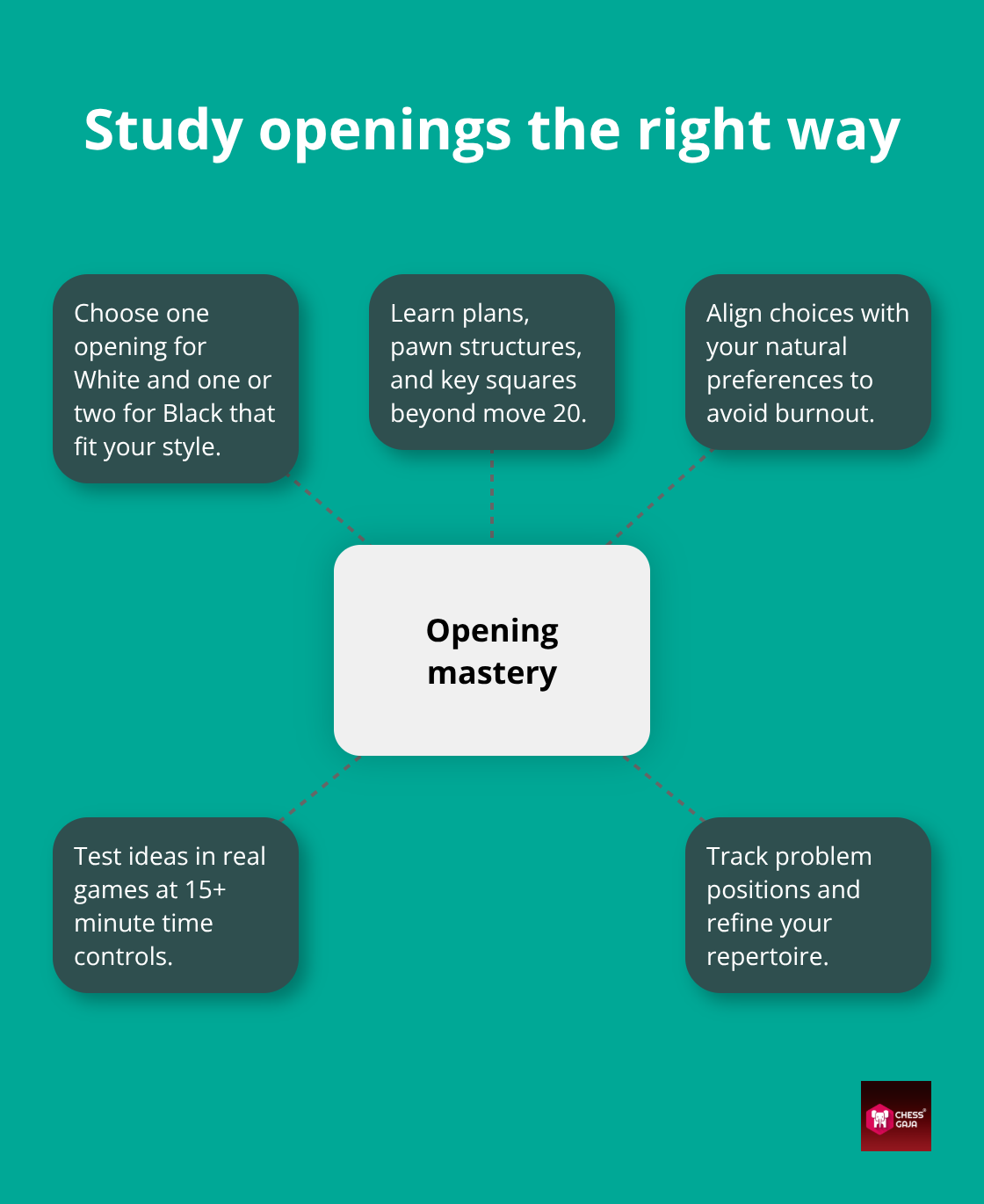
However, most intermediate players study openings incorrectly. They memorize long theoretical lines, play one tournament, and abandon the opening when surprised. As a result, this habit wastes time. Instead, choose two or three main openings and learn the key plans well past move 15.
This shift from memorization to understanding separates players stuck at 1600 from those climbing toward 2000.
Choose Openings That Match Your Playing Style
Pick one opening for White and one or two defenses for Black. Base your choice on your style, not on trends. Do you prefer quiet, strategic games? Try the London System or Ruy Lopez as White. Avoid sharp openings like the Sicilian Dragon. Those require exact tactical moves right away. Do you like aggressive play? Openings like the Sicilian Dragon or King’s Indian Defense reward tactical play and sharp piece moves.
Do not pick openings that clash with your style. Players who prefer solid games burn out if they study sharp lines. They spend too much energy on calculations that do not fit their strengths. Your opening should match your natural style. Pick moves that feel comfortable to you.
Learn the Ideas Behind Your Openings
Once you pick your openings, focus on key ideas. In the Ruy Lopez, learn White’s classic knight re-routing plan: Nb1–Nd2–Nf1–Ng3 (or Ne3) to control the critical f5 or d5 squares. You do not need to memorize every line in the Morphy Defense; instead, focus on understanding key pawn structures and thematic piece maneuvers.
Write down three core ideas for each position. This helps you spot similar structures in real games. You will know what to do, even if your opponent plays a surprise move. The engine shows the best move. Only your own analysis shows why it works.
Test Your Openings in Real Games
Next, test your openings in real games against similar or higher-rated opponents. Play games with at least 15 minutes per side on Chess.com or at a local club. This gives you time to think beyond pure memorization.
Always track positions that cause trouble. For instance, if you get lost by move 10 playing the Sicilian Defense as Black (or playing against it as White), stop memorizing variations. Instead, focus on understanding the core middlegame plans and pawn structures.
Play your openings consistently for two months. You will learn when to attack, when to defend, and how to win small gains. Real experience builds true skill. Memorized lines only give false confidence. The positions where you struggle show where to focus your daily practice.
Sharpen Your Middlegame and Endgame With Focused Daily Work
Tactical puzzles and endgame drills build fast progress. However, most players train incorrectly. You need a daily routine that targets your exact weaknesses, not random puzzles.
Match Puzzles to Your Actual Mistakes
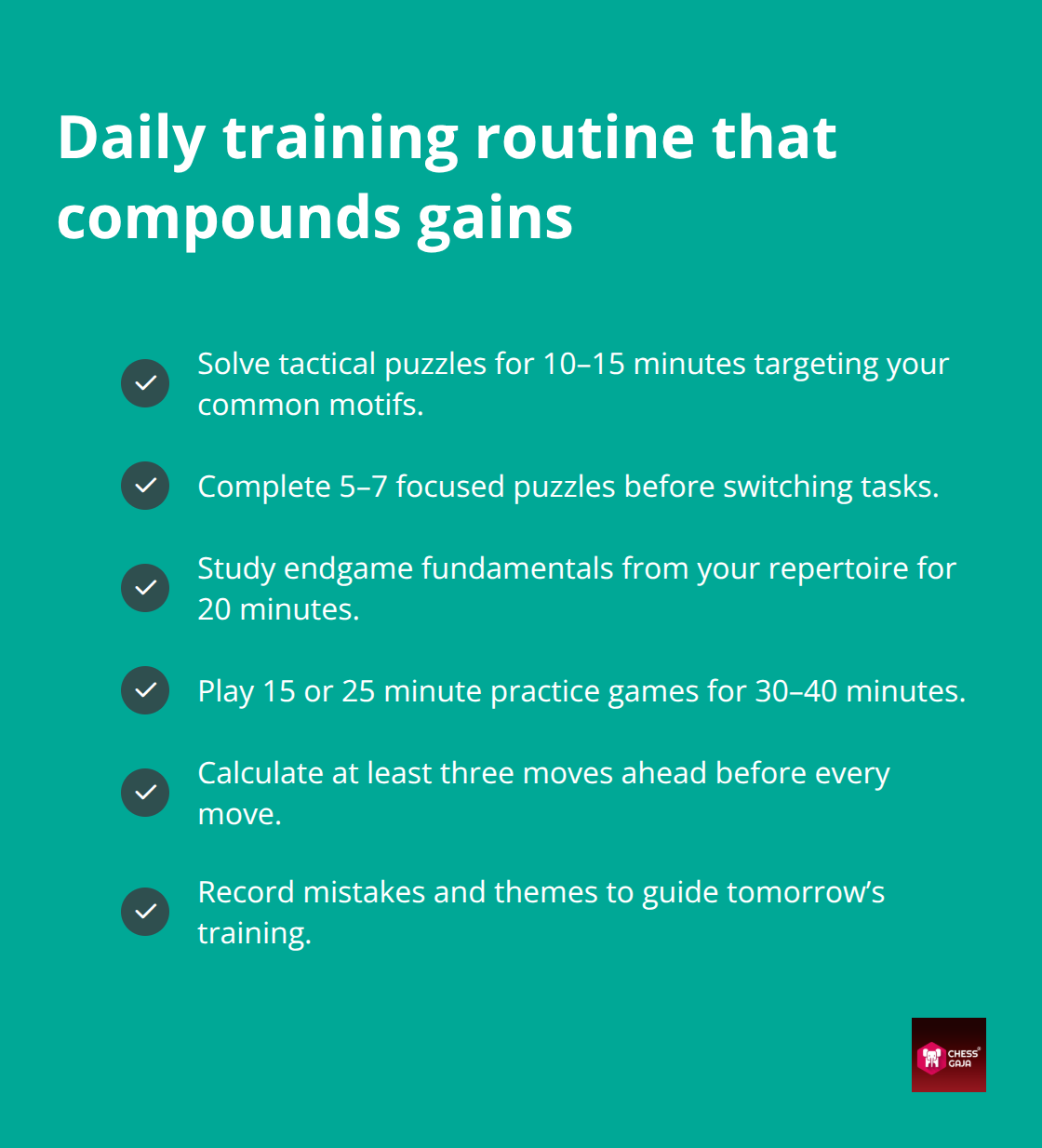
Start with 10 to 15 minutes of puzzles each morning. Target the exact mistakes from your log. Do back-rank weaknesses cost you games? Solve back-rank puzzles until patterns become automatic. If defense is hard, focus on puzzles with single saving moves.
This targeted approach produces faster gains than solving 50 random puzzles per week. Solving puzzles that match your real mistakes builds stronger skill. It works much faster than solving random puzzle sets. After you complete 5-7 puzzles, move to endgame fundamentals with concrete positions you’ll actually reach in your chosen openings.
Study Endgames From Your Repertoire
First, study king and pawn endings, rook endings, and specific positions from your repertoire. Next, spend 20 minutes setting up a key endgame position on a physical board or screen. Without moving the pieces, calculate the key variations as deeply as you can (aiming for 4 to 6 moves deep in pawn races or rook endings) to train your visualization and calculation depth. Finally, write down the key principle, such as opposition or active rook placement.
In addition, this written clarity forces your brain to explain why the position works. Therefore, match your endgame study to your openings. Consequently, you will encounter these positions naturally in real games rather than abstract theory.
Build Calculation Accuracy in Practice Games
Indeed, accurate calculation separates 1600 players from 2000 players. After puzzle and endgame work, play a 30-to-40-minute slow game against opponents near your rating. During critical moments—such as checks, captures, pawn breaks, or piece trades—force yourself to calculate candidate lines 2–3 moves deep before making your move.
Write down your calculations during post-game review. Use an engine to check if your calculations were right. This builds mental strength for real tournaments. Stick to this daily routine: 15 minutes of puzzles, 20 minutes of endgame study, and 30 to 40 minutes of practice games. Your tactical skill will jump in two months.
The Consistency That Drives Results
Above all, consistency and specificity matter most. One month of focused practice beats three months of scattered effort. Similarly, targeted puzzles beat a generic puzzle library every time. Because this structure addresses real weaknesses, players routinely gain 100 to 150 rating points within three months.
Final Thoughts
Analyzing games, mastering openings, and building daily study habits form the basis for steady growth. Quality practice beats tournament volume every time. Spending 45–60 minutes daily on targeted puzzles, endgames, and slow practice games delivers clear rating gains within three months.
Many intermediate chess players reach a point where self-directed improvement slows down. You’ve applied these tips for intermediate chess players, you’ve tracked your mistakes, and you’re still hitting a ceiling. This is exactly when professional coaching accelerates your progress and identifies the specific gaps holding you back.
At Chess Gaja, we coach players across the USA, UAE, and Singapore. Book a Paid Starter Class to get a complete skill check. Our coaches will analyze your games, pinpoint your weaknesses, and show you exactly what to practice for fast progress.