
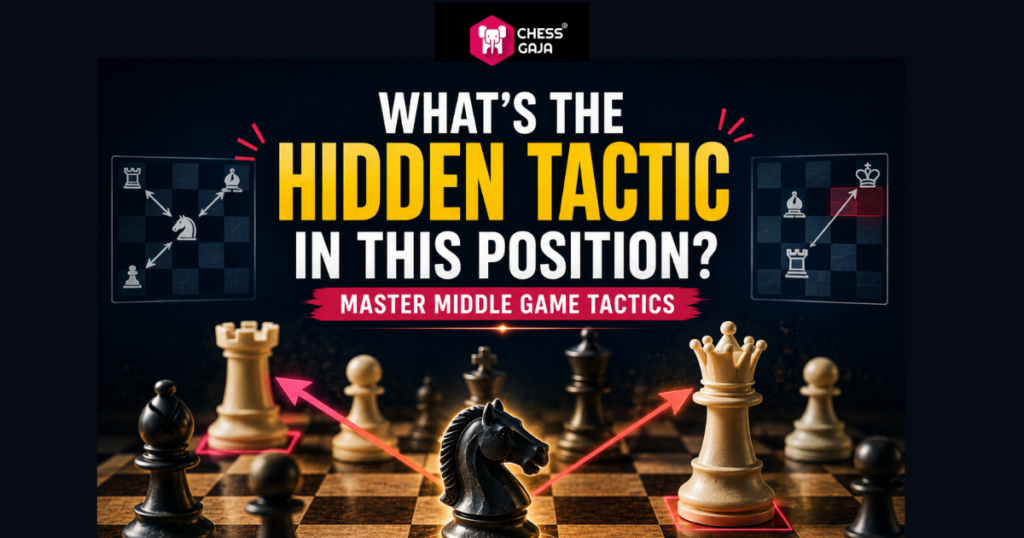
The middle game is where most chess players lose their matches. You spot a move that looks good, but you miss a better tactical blow hiding two moves deeper.
At Chess Gaja, we’ve worked with thousands of students who struggle with chess middle game tactics at exactly this moment. The difference between players who win and those who don’t comes down to one skill: seeing the patterns your opponent can’t defend against.
This guide shows you how to build that vision.
What Tactics Actually Win Middle Game Positions
Many players memorize forks or pins, but fail to spot them under pressure. A student in Dubai spent weeks drilling tactics on Chess.com’s Puzzle Trainer. Yet, in tournament play, they missed a simple knight fork that cost them the game.
The problem wasn’t their knowledge. It was their approach.
Tactics don’t exist in isolation. They emerge from real board positions. First, identify why your opponent’s pieces are vulnerable. Then, exploit that weakness with a forcing move.
Ask the Right Question After Every Move
Start with one question after every move your opponent makes: which of their pieces has the fewest defenders? This single habit transforms how you see the board.
In the middle game, an undefended piece or a piece defending multiple threats is where tactics live. When you find that weak piece, check if you can attack it with a forcing move-a check, a capture, or a direct threat.
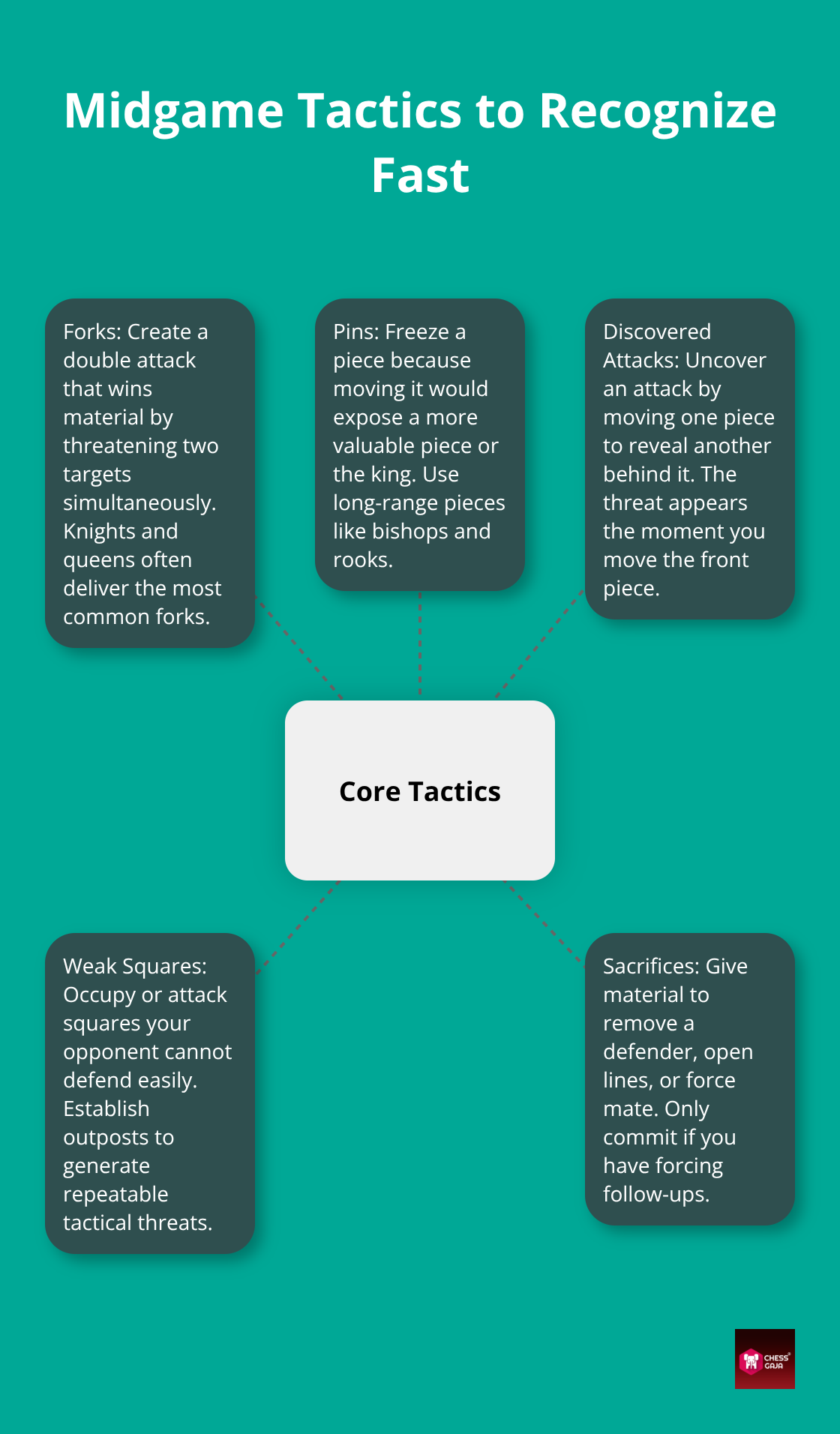
If your knight moves to attack both your opponent’s queen and rook at the same time, that’s a knight fork. Similarly, when a piece moves away to unveil an attack from a bishop, rook, or queen behind it—often while creating a secondary threat of its own—you’ve executed a discovered attack.
The key difference between intermediate and advanced players is speed of recognition. A 1500-rated player calculates three moves ahead to spot a tactic. A 2000-rated player recognizes the pattern instantly.
Identify Weak squares in Your Opponent’s Position
Weak squares form the foundation of middle game tactics. A weak square is one your opponent cannot defend easily, often because a pawn is missing or a piece is overloaded.
In our Grandmaster-led chess classes, we teach how targeting squares like e5 or probing weaknesses on c7 and h7 creates immediate tactical opportunities when Black misplays their pawn structure.
Study one position daily where you identify the weakest square in your opponent’s camp, then ask: can my knight land there? Can my bishop control that square?
Once you place a piece on a weak square, your opponent’s pieces become vulnerable to pins, forks, and discovered attacks. This is why your least active piece matters-it’s often the one that can reach a weak square first.
Count Moves Before You Sacrifice
Piece sacrifices look flashy, but they are only sound if you calculate forcing lines accurately. A correct sacrifice either forces checkmate, wins back material with interest, or completely dismantles your opponent’s position.
Many players sacrifice material hoping for an attack, but lose because they didn’t count carefully. A classic bishop sacrifice on h7 (the Greek Gift, starting with Bxh7+) looks tempting. However, if your knight cannot jump in with check (such as Ng5+) and your queen cannot join the attack on h5 or g4, the sacrifice is simply a blunder.
Only sacrifice to remove a key defender, open lines, or create unstoppable threats. After a sacrifice, your next two moves must be forcing. Use checks, captures, or direct mate threats to keep the initiative.
The difference between a winning tactic and a lost game comes down to calculation discipline. You now understand where tactics hide and how to spot them. The next step is training your pattern recognition at tournament speed, which means practicing these concepts under time pressure until they become automatic.
Train Tactics Under Time Pressure
Set a Timer and Analyze Without an Engine
The gap between solving tactics on Chess.com Puzzle Trainer and winning tactics in real games exists because puzzles give you unlimited time to think.
In standard online rapid tournaments (like 10+10), you have limited time per move, which means you must recognize and execute tactics in seconds, not minutes. Start by taking a position from your last lost game and setting a timer for 90 seconds. Your job is to find the best move without using an engine. Write down your candidate moves, then calculate two moves deep for each one.
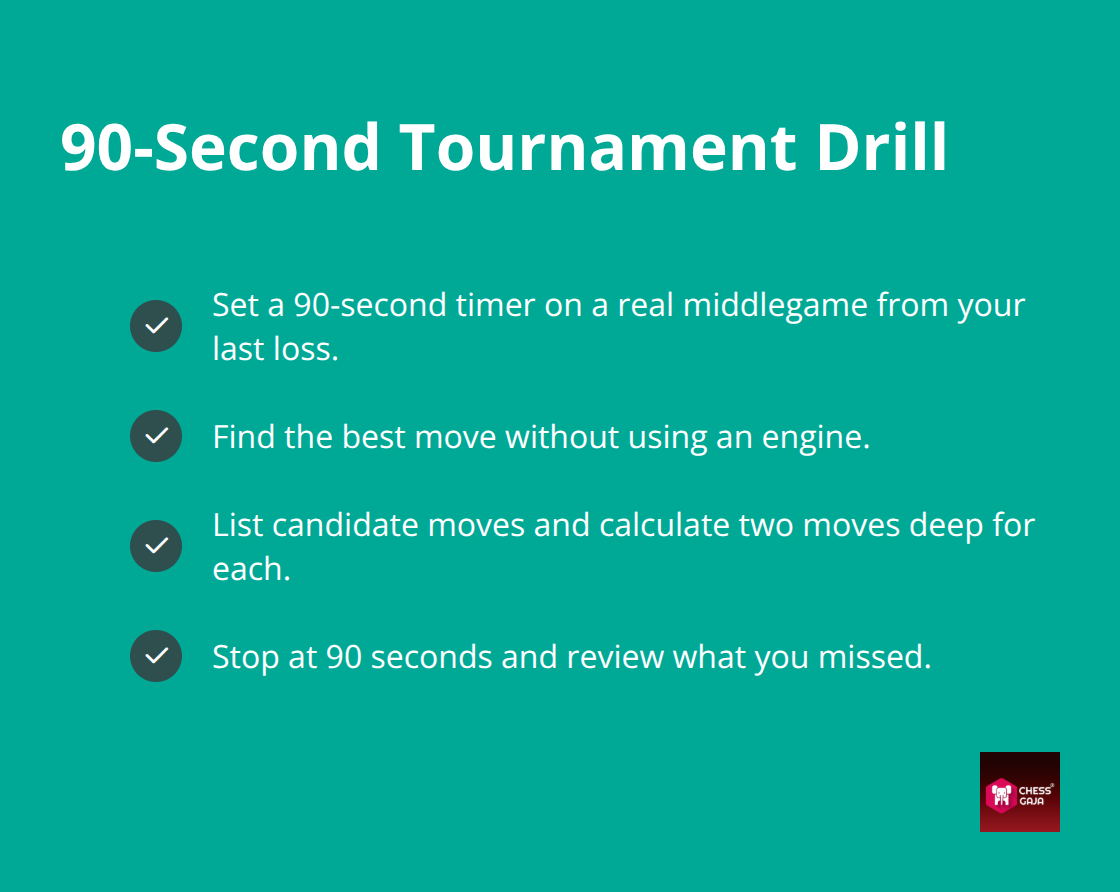
This forces you to think like a tournament player rather than a puzzle solver. After 90 seconds, stop and analyze what you missed. Did you overlook a forcing move? Did you calculate a line incorrectly? The answer reveals your specific weakness.
Research shows that players overlook available tactics during games due to time pressure and emotional stress. A student in Singapore recently discovered through this exercise that she was calculating knight moves incorrectly, missing forks because she visualized the knight’s destination square wrong. Once she corrected this mental habit, her tactical accuracy improved significantly in tournament play within three weeks.
Replay Real Middle Game Positions to Build Intuition
The second practice method is position replay. Take a middle game position from a real game between 1500-rated players on Chess.com or FIDE databases and play through it move by move. Pause briefly before key moments to ask: What forcing moves exist? Is there a weak square to exploit? Try to sense where the tactics are brewing before deeply calculating lines. This trains your intuition to spot tactical setups naturally in full games, not just in isolated puzzle diagrams.
Track Your Tactical Mistakes Across Games
The third method combines all skills: play blitz games on Chess.com, then analyze only the middle game positions where you blundered. For each blunder, identify which tactical pattern you missed (fork, pin, weak square, sacrifice). Track these patterns over 20 games. If you miss forks more than any other tactic, spend the next week drilling fork recognition specifically. This data-driven approach works because it targets your actual weaknesses, not generic tactics. Most players fail because they practice everything equally instead of fixing what costs them games.
Your tactical training now has structure and purpose. The next step is building the confidence to execute these tactics when your opponent plays fast, which requires a different kind of practice altogether.
Building Tactical Speed That Works in Real Games
Most players approach pattern recognition backwards. They solve 50 puzzles daily expecting tournament performance to improve. Then, they wonder why they miss tactics under time pressure.
The disconnect happens because puzzles and real games operate at different speeds. A puzzle gives you one position with unlimited time. A real game gives you dozens of positions with a clock ticking away.
Players who skip intermediate speed training often plateau around 1400 rating. Their pattern recognition simply works too slowly. To break through, you need three simple shifts in how you train.
Solve Puzzles at Tournament Speed
First, solve puzzles with a 30-second timer instead of unlimited time. This forces your brain to recognize patterns faster. A student in Abu Dhabi who implemented this reported spotting forks and pins significantly faster in her subsequent tournament games. The timer creates pressure that mirrors real match conditions.
Your brain learns to activate pattern recognition instantly rather than calculate every variation. When you remove the safety net of unlimited thinking time, you train the neural pathways that matter most in actual play.
Develop Pattern Recognition Through Scanning
Second, practice rapid position scanning. When you quickly replay real middle games from master or intermediate games without calculating every single branch, you absorb how tactical themes arise naturally. You develop intuition about which squares matter and which pieces are vulnerable. Position replay teaches you the language of real chess rather than the artificial language of puzzles.
Play Blitz Games to Test Your Speed
Third, play 10-minute rapid games specifically to test your tactical vision under clock pressure. After each game, review only the middle game positions where you hesitated or blundered. This reveals whether you actually saw the tactic but calculated slowly, or missed it entirely. These are different problems requiring different solutions. A player who sees the tactic but calculates slowly needs to practice faster calculation. A player who misses the tactic entirely needs more pattern recognition work.
Log Your Tactical Blind Spots
Building confidence takes time. Tactical mistakes decrease gradually rather than disappearing overnight. A player in Singapore tracked her errors across 30 rapid games. She missed back-rank patterns in 8 games, but never missed knight forks.
She spent two weeks studying back-rank positions specifically. After this focused training, her error rate dropped to 1 back-rank miss per 20 games. This data-driven approach works because it targets your actual gaps.
Your tactical style matters more than you think. Some players spot knight forks faster than pins due to how they visualize pieces. Others struggle with discovered attacks, but excel at identifying weak squares.
The best way to refine your vision is reviewing 10-minute rapid games on Chess.com. Analyze your blunders without an engine for 10 minutes. Identify which pattern cost you the game. Then, spend 3 days drilling that specific pattern before playing again.
This cycle of review, targeted practice, and play produces real rating gains. One student working with Grandmaster-led coaching improved from 1350 to 1520 in four months using this method. Structured training consistently beats random puzzle grinding.
Final Thoughts
The three key tactical patterns are forks, pins, and weak square exploitation. Mastering them accelerates your rating growth faster than studying anything else.
A fork attacks two pieces at once. A pin paralyzes a piece to threaten something valuable behind it. A weak square gives your pieces a strong landing pad.
When you train these three patterns under time pressure, your middle game tactics improve within weeks.
Regular practice transforms your middle game performance because it rewires how your brain recognizes threats under real match conditions. Improvement happens through a direct loop: track your blunders across games, drill your weakest pattern daily for 10 minutes, and test your progress under match conditions until your tactical vision becomes automatic.
Your next step is working with experienced coaches who can analyze your games. At Chess Gaja, our FIDE-rated coaches provide personalized game analysis. They help you target your exact weaknesses through our learning platform.
Our Grandmaster-led curriculum has helped thousands of players across the USA, UAE, and Singapore.
Book a Paid Starter Class for a professional skill evaluation. One of our coaches will review your recent games, spot your tactical blind spots, and build a custom training plan for you.