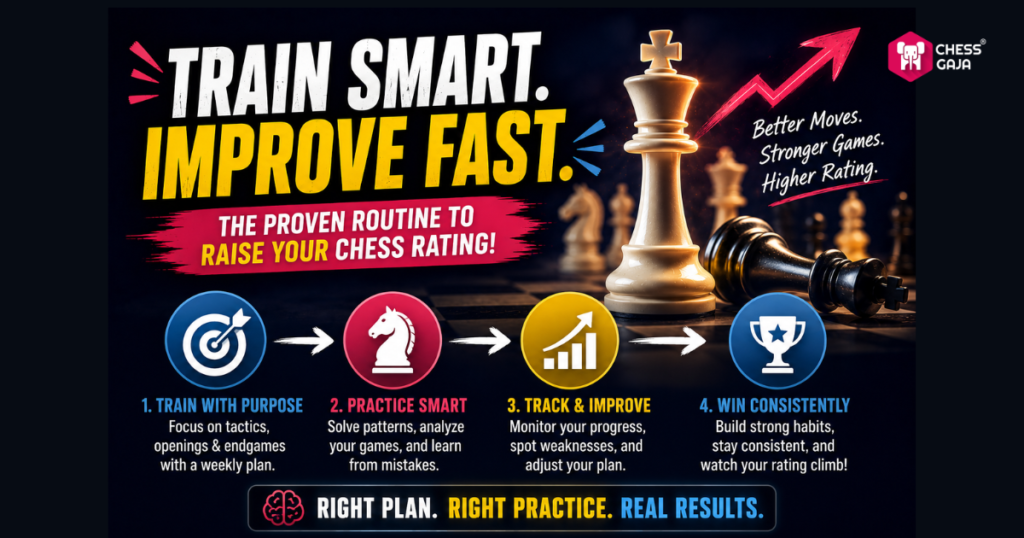
Most beginner players practice randomly and wonder why they plateau. At Chess Gaja, we’ve seen thousands of students transform their games by following effective training routines that build week by week.
The difference isn’t talent-it’s structure. This guide shows you exactly how to organize your training, track real progress, and know when to adjust your approach.
Structure Your Weekly Training Like a Tournament Player
Train the Way Competitive Players Prepare
The fastest way to improve is to train like a competitive player. Divide your week into focused blocks instead of scattered practice. A tournament player knows their exact daily goal, and you should too.
Most beginners spend five hours a week on chess, but waste three hours on unfocused study. The gap between 1200 and 1600 Elo is rarely talent. It comes down to how you allocate those five hours.
Commit to a Fixed Schedule
Start with a fixed schedule. Pick three to five specific days each week and stick to the same times. Training on Monday, Wednesday, and Friday at 6 PM works far better than random sessions.
Set concrete, measurable daily goals. Do not just say you will study for an hour. Instead, aim to solve 20 puzzles and analyze one recent game. This keeps you focused and prevents aimless browsing.
Allocate Your Time Across Three Core Areas
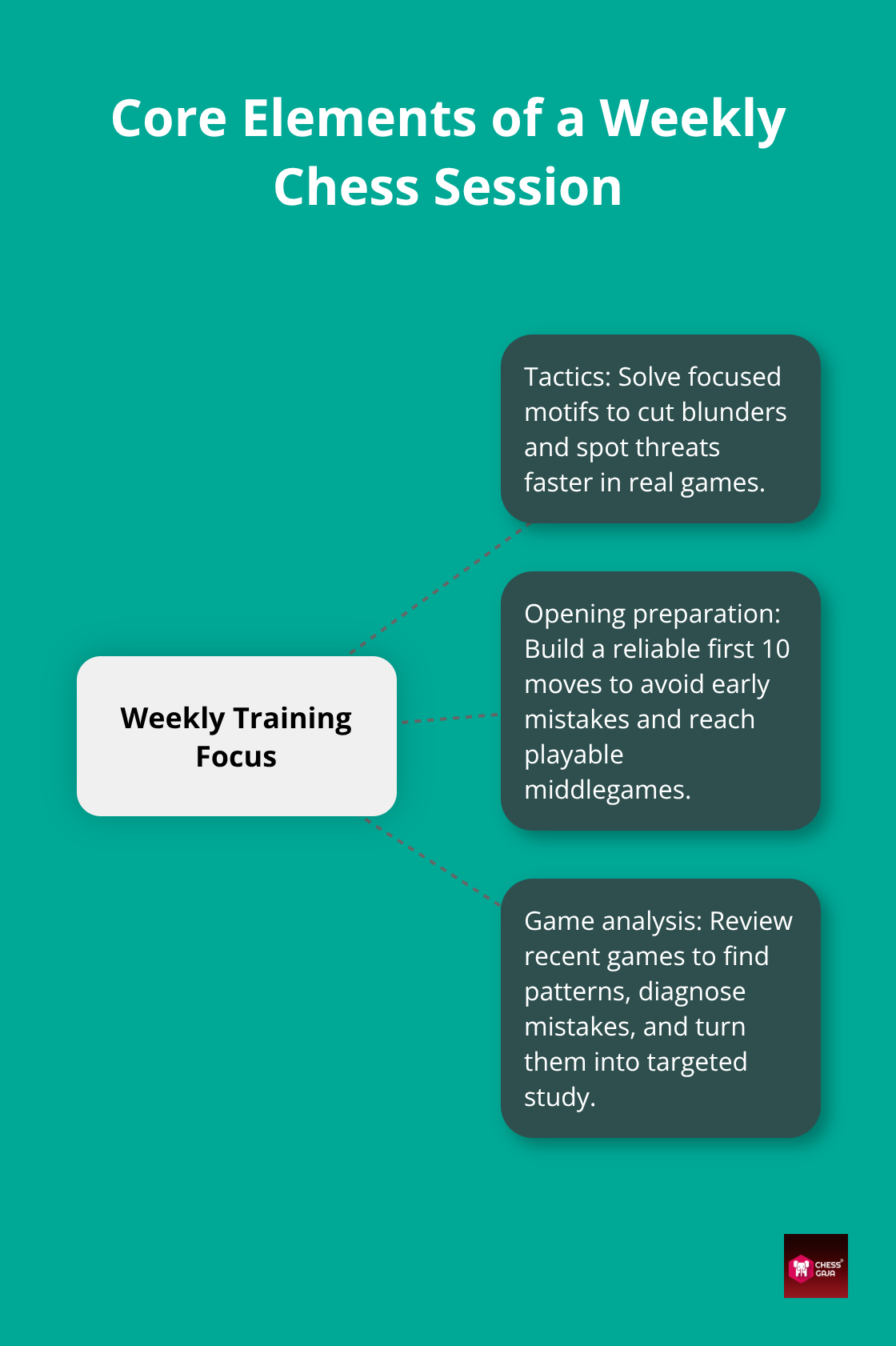
Each practice session should balance three elements: tactics, game analysis, and basic opening principles. Opening study should take the smallest share of your time because memorizing deep theoretical lines yields very low ROI for beginners compared to developing tactical vision and analyzing past mistakes.
If you have 90 minutes to train, spend about 40 minutes on tactics, 30 minutes reviewing your games, and 20 minutes on openings.
Do not train like a Grandmaster until you cross 1800 Elo. A 1200-rated player analyzing complex endgame theory sees little rating gain. Why? Most of their games are decided in the middlegame by tactical blunders long before a complex endgame is reached.
Focus on what decides your games today. If you blunder pieces in the middlegame, prioritize tactical vision over deep opening lines. Stopping blunders and spotting patterns will drive your immediate growth.
Track Your Weekly Progress in a Simple System
Track what you work on each week in a simple spreadsheet. Write down the date, the type of training, and how long you spent. After four weeks, you’ll see patterns. You might realize you skipped opening study twice and your games suffered. This data drives better decisions in week five.
Players who track their training improve far more consistently because they catch their own study gaps early. Once you have this baseline data, you’re ready to add progressive methods that accelerate your growth beyond basic consistency.
Methods That Move Your Rating Forward
Tactical puzzles alone will not get you past 1400. You need a clear progression system where each stage builds on the last.
Randomly jumping between tactics, openings, and endgames creates major gaps in understanding. Instead, follow a structured sequence:
- Tactics: Teach you to spot threats quickly.
- Endgames: Teach you to convert winning positions.
- Game Analysis: Shows where your weaknesses cost you rating points.
Start With Tactical Patterns, Not Isolated Puzzles
Solve one tactical motif at a time in 3-to-5-day sprints: spend 3 days on forks, 3 days on pins, and 3 days on skewers before shifting to unlabelled, mixed sets. When you practice a single motif, your brain locks in the pattern. However, doing it for weeks creates “pattern bias” in real games where motifs aren’t named.
Set a minimum of 30 minutes per session on a motif until you achieve high accuracy, then immediately integrate mixed puzzle sets. This trains you to spot tactics in real-time without hints.
Add Endgame Positions When You Hit 1300
Once you reach a stable 1300 rating, dedicate time to structured endgame basics. Avoid obscure theoretical endgames for now. Focus on king and pawn endgames, basic rook endgames, and queen versus pawn endgames.
Spend 15 to 20 minutes twice a week on drills rather than pure theory. Always use positions from your own games first. Did you lose a game in the endgame? Study that exact position type. Players who fix their own endgame mistakes build confidence far quicker than those studying generic textbook positions.
In month one, master basic checkmates (King + Rook, King + Queen) and pawn principles like Opposition. As you cross 1300–1400, introduce the Lucena and Philidor Rook and Pawn positions.
Use Game Analysis as Your Real Teacher
Game analysis connects tactics and endgames to reality. After each rated game, spend 25 to 30 minutes reviewing it. Don’t analyze every move. Instead, find the three turning points where your position shifted.
Ask yourself: did I miss a tactic, mishandle the opening, or play poorly in the endgame? This tells you what to study next week. If you lost because of a missed fork on move 18, that’s a signal to spend more time on fork patterns. If you lost a winning endgame, that’s a signal to add more endgame drills.
Players who systematically review their key turning points build deep self-awareness, directly eliminating repetitive blunders and unlocking much faster, more consistent rating progression over a 12-week block.
Track Your Mistakes to Prioritize Study Time
Track which type of mistake appears most in your last ten games. If the majority of your losses stem from tactical oversights, dedicate the majority of your practice time to tactical vision. This data-driven approach prevents wasted study time on areas where you’re already strong. Your game reviews reveal the exact weaknesses that hold back your rating, and this information shapes your entire training plan for the next four weeks. Once you identify these patterns, you’re ready to improve your rating systematically and adjust your schedule when improvement slows.
Know When Your Training Works
Your rating improvement follows a predictable pattern when you track it correctly, and this data tells you whether to keep your current plan or change it entirely. Most beginners check their rating once a month and feel discouraged when progress seems slow, but the real signal lives in your game results and mistake patterns week to week.
After each training block of four weeks, calculate your average rating gain. A beginner improving from 1100 to 1150 in four weeks shows a 50-point gain, putting them on track for a 150-point boost over a three-month period. This rate of growth is solid and proves your training structure is working. If you gained only 10 points in four weeks, your plan needs adjustment immediately because you’re not converting your study into better games.
Measure Progress in Four-Week Blocks
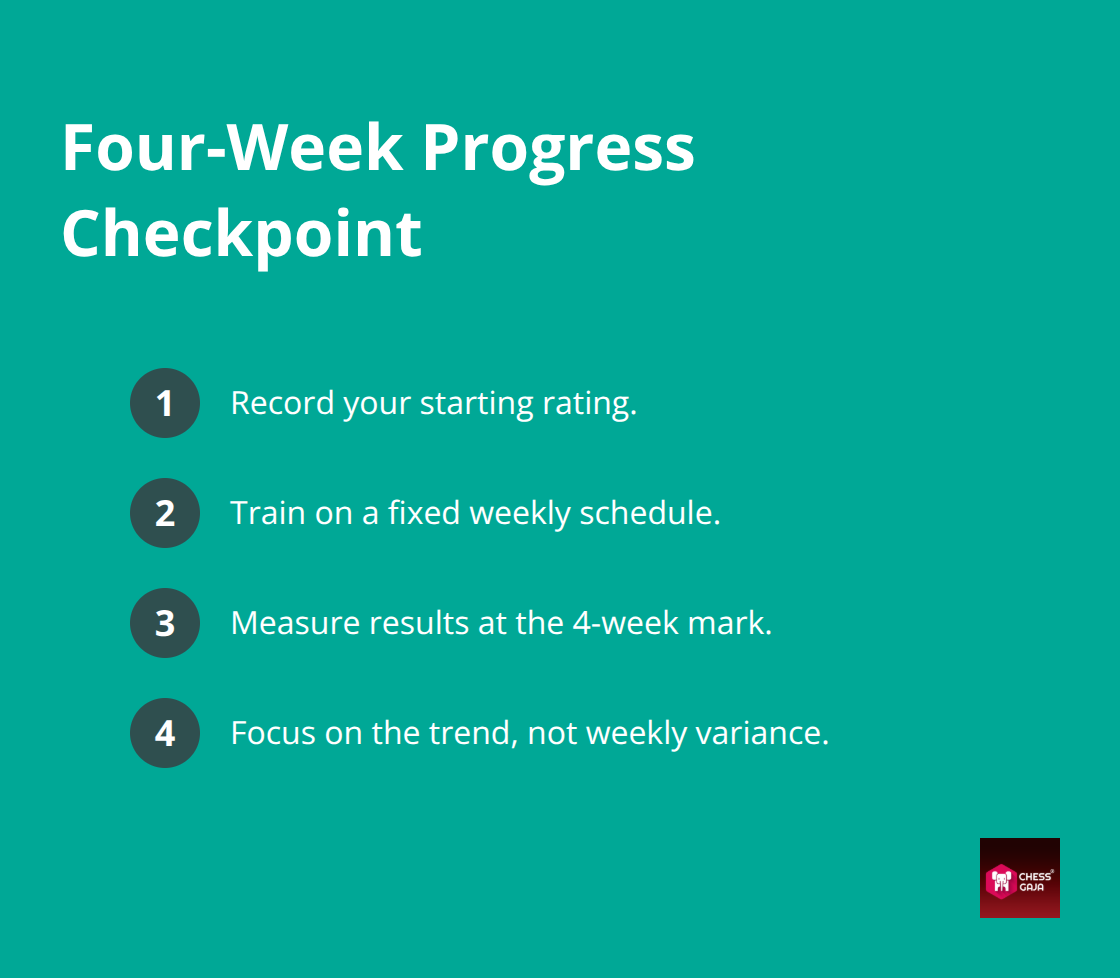
The fastest way to spot what’s working is to record your rating before you start a new training phase, then measure it exactly four weeks later. Don’t measure weekly because rating fluctuations from variance cloud the real trend. Four-week blocks reveal the true signal.
Players in the USA who improved from 1200 to 1300 in eight weeks followed this exact method: they tracked their starting rating, committed to a fixed schedule, and measured results at the four-week mark. Their data showed that improved tactical accuracy correlates with rating gains, which meant their time allocation was correct.
Identify Your Mistake Patterns
Your game analysis reveals which mistakes drain your rating, and this becomes your roadmap for the next training phase. After each game, mark whether you lost rating points because of a tactical blunder, an opening mistake, or an endgame miscalculation. Track these categories in a simple spreadsheet for ten games. If seven of your ten losses stem from tactical oversights, dedicate the bulk of your study time to tactical practice while analyzing why those tactical opportunities arose in the first place. Players who target the root causes of tactical blunders improve far more reliably than those who simply grind more puzzles.
Respond to Plateaus With Immediate Changes
When your rating plateaus for four to six weeks, it signals a true stagnation point rather than standard rating variance. This means your current routine requires higher puzzle difficulty or a shift in focus.
If you’ve been solving 1400-rated tactical puzzles with high accuracy for three weeks without rating improvement, move to 1500-rated puzzles immediately.
The solution is simple: increase the difficulty threshold, add a new training element, or shift your time allocation based on recent game mistakes. Players who implement these adjustments gain 100 to 150 rating points in twelve weeks because they respond to actual data.
Accelerate Progress With Professional Guidance
Experienced coaches spot where your training has stalled and recalibrate your plan in real time. A coach identifies patterns you miss on your own and adjusts your difficulty level before you waste weeks on ineffective study. This real-time feedback prevents the common trap of staying at the same puzzle difficulty for too long or neglecting a critical skill that holds back your rating. When you work with a professional coach, the adjustment happens immediately rather than after you notice the plateau yourself.
Final Thoughts
Consistency beats intensity every single time. A player who trains 45 minutes five days a week will outpace someone who trains four hours once a week, because your brain needs repeated exposure to patterns through steady, structured practice over weeks and months rather than occasional marathon sessions. The players who gain 100 to 150 rating points in twelve weeks aren’t training harder than everyone else-they’re training smarter by showing up the same time each week and following a plan that adjusts based on real data.
Professional coaching accelerates your growth dramatically. An experienced coach spots where your routine falls short and recalibrates your plan immediately.
Instead of wasting weeks on the wrong puzzle difficulty, a coach fixes these errors right away. This real-time feedback prevents plateaus and saves you months of frustrating trial and error.
We at Chess Gaja have built our approach around this principle, working with players across 40+ countries using a curriculum designed to deliver measurable rating gains.
If you’re ready to stop guessing and start improving with professional guidance, book a Paid Starter Class with us today. A coach will evaluate your current level, identify your specific weaknesses, and design a training plan built for your goals.