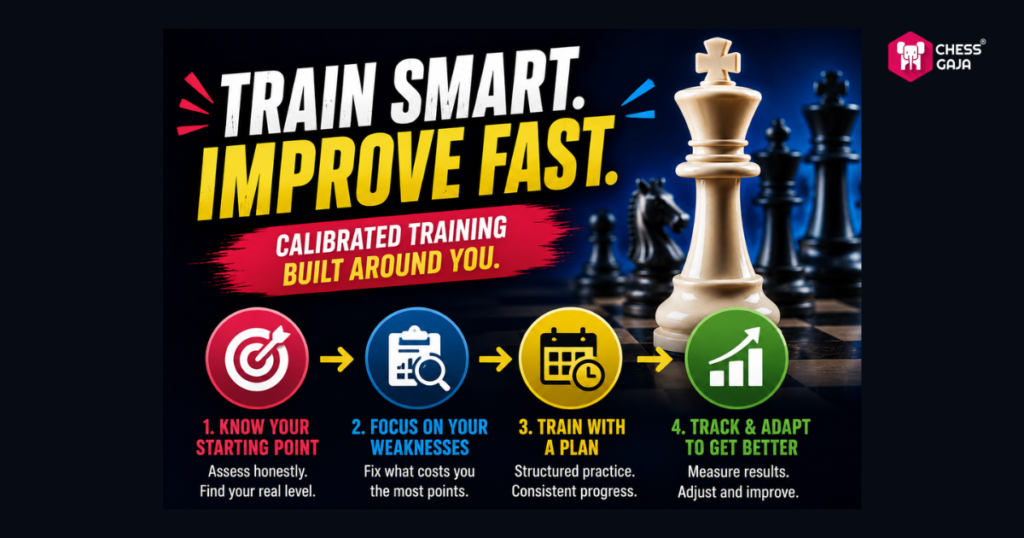
Most beginners waste months following generic training plans. These plans rarely match their actual skill level. At Chess Gaja, we’ve seen thousands of players stuck because they never took time to honestly assess where they started.
Calibrated training for beginners changes this. When you build a plan around your real weaknesses and honest goals, progress accelerates dramatically.
Know Your Actual Starting Position
The Puzzle-to-Game Gap
Most beginners overestimate their tactical ability. A student in Singapore might solve 1400-rated puzzles on Chess.com yet struggle at 900 in real games. Tactical ability in puzzles differs significantly from real game performance. Players often think they understand tactics but freeze when facing a real opponent. Your starting position is not what you hope you are; it is what you actually do under pressure.
Test yourself honestly by playing 10 rated games using a Rapid time control (such as 10+0 or 15+10 on Lichess, or 10|0 or 15|10 on Chess.com), then examine the results. That rating is far closer to your true playing strength than any puzzle streak. Rapid formats accurately reflect board vision by allowing time for real calculation, whereas blitz and bullet formats primarily reward pre-moves and fast reaction time.
Opening Knowledge Versus Opening Strength
Another common trap is confusing opening knowledge with opening strength. You might memorize 15 moves of the Sicilian Defense, but you will still lose if you don’t understand the resulting plans and pawn structures. The opening phase transitions into the middlegame as minor piece development concludes, king safety is secured, and central tension is created. Connecting your rooks completes initial development, but the middlegame truly begins when concrete planning and tactical play take over. A strategic pawn break opens lines for piece activity and initiates central or wing play. True opening understanding isn’t about memorization—it’s knowing how to play the resulting positions when book memory ends around move 10.
Analyze your recent Rapid games and track your critical tactical blunders (leaving pieces undefended, missing basic forks, pins, skewers, or single-move checkmates). If you average multiple blunders per game, your tactical vision and board awareness require immediate work regardless of your puzzle rating. Do you repeatedly convert equal or winning positions into losses after queen trades? If so, basic endgame technique demands attention first.
Why Honest Assessment Accelerates Everything
Dishonest self-evaluation creates wasted months. A beginner in Austin might study complex Najdorf lines while blundering basic knight forks. They won’t improve because they are training the wrong skill. Honesty forces you to start where you actually are, not where you wish you were.
This principle drives calibrated training. It matches your effort directly to your real gaps, not imaginary ones. When you assess accurately, you build a plan that works. When you lie to yourself about your level, every subsequent decision compounds the mistake. Your next step is identifying exactly which weaknesses hold you back most.
Where Your Weaknesses Actually Hide
The Tactical Foundation Matters Most
Now that you’ve assessed your real rating, the next step is identifying which specific weaknesses drain your points most consistently. Most beginners blame their openings because it’s the most visible part of chess study. However, game data reveals a completely different story. Analysis of beginner game records shows that the vast majority of losses below 1000 rating stem from tactical oversights, not opening mistakes. Your weak link is almost certainly not the opening.
To find it, download your last 20 rated games from Chess.com or Lichess, then analyze where you dropped material or missed tactical threats. If multiple games reveal undefended pieces or basic tactical oversights in the middlegame, improving your board vision and calculation must be your immediate priority. If several games show you converting winning positions into losses in simplified piece endings, basic endgame techniquedemands attention first. This diagnostic review takes 90 minutes and eliminates guesswork entirely.
Why Strategy Comes Later
Advanced positional and strategic concepts matter far less at the sub-1000 level than concrete calculation and basic board vision. Take a student in Dubai who spends two months studying complex pawn structures: if they still lose games to elementary knight forks or skewers, their training plan is misaligned. Below 1200 rating, games are rarely decided by subtle positional nuances. They are almost exclusively determined by undefended pieces, missed threats, and tactical oversights. Mastering basic tactical vision and single-move calculations must precede deep strategic study.
Setting Goals That Actually Work
Set your goal based on your actual timeline and commitment level. If you train 5 hours per week over a 12-week cycle, a realistic improvement target is 100 to 200 rating points if you focus strictly on your primary weakness. If you commit 2 hours weekly, expect a sustainable gain of 50 to 100 points over the same period. Vague goals like becoming stronger waste time because they provide no measurement. Instead, commit to a specific rating number within a defined timeframe, then build your weekly schedule backward from that target.
Allocating Your Weekly Hours
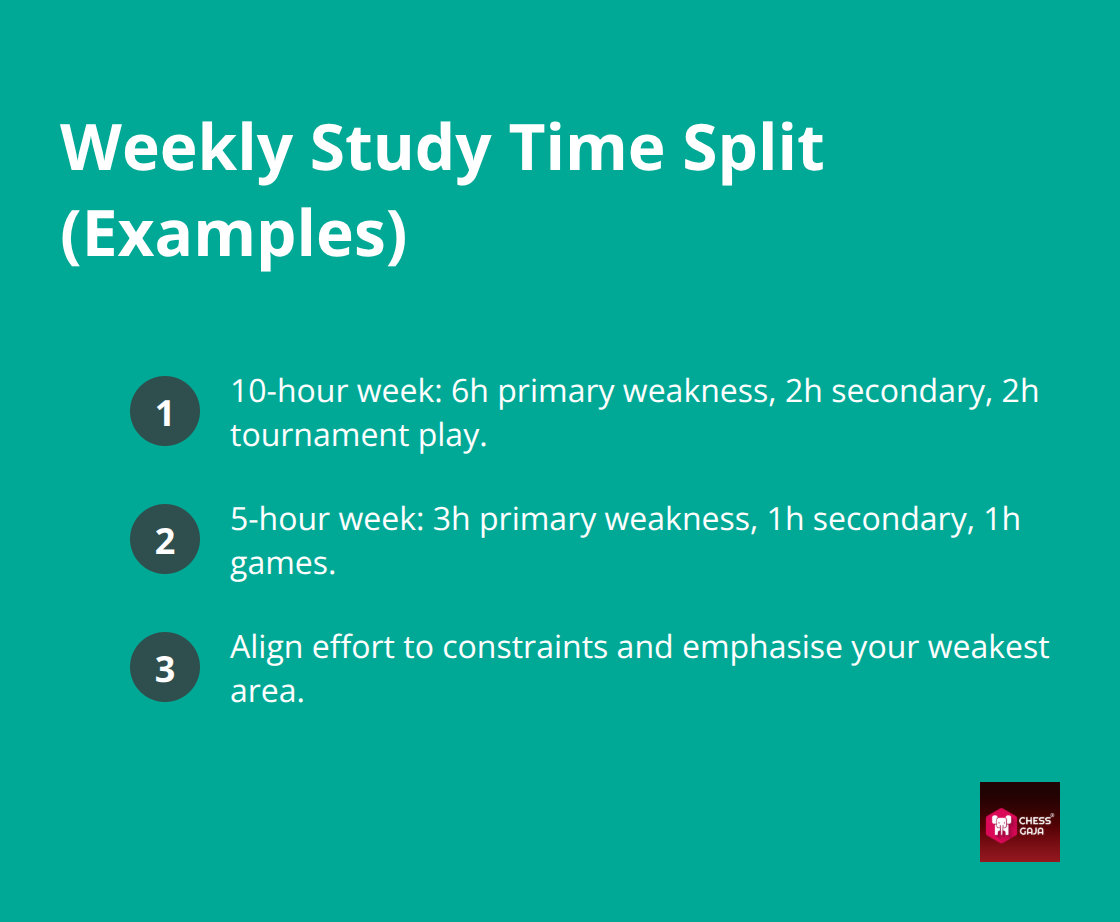
A 10-hour weekly schedule should allocate 6 hours to your primary weakness, 2 hours to secondary skills, and 2 hours to tournament play. A 5-hour schedule splits into 3 hours primary weakness, 1 hour secondary, and 1 hour games. This structure ensures your effort matches your constraint and your weakness receives the attention it actually needs.
Once you know your weaknesses and have allocated your time, the real work begins-and that’s where a structured weekly routine transforms intention into measurable results.
How to Know Your Training Is Actually Working
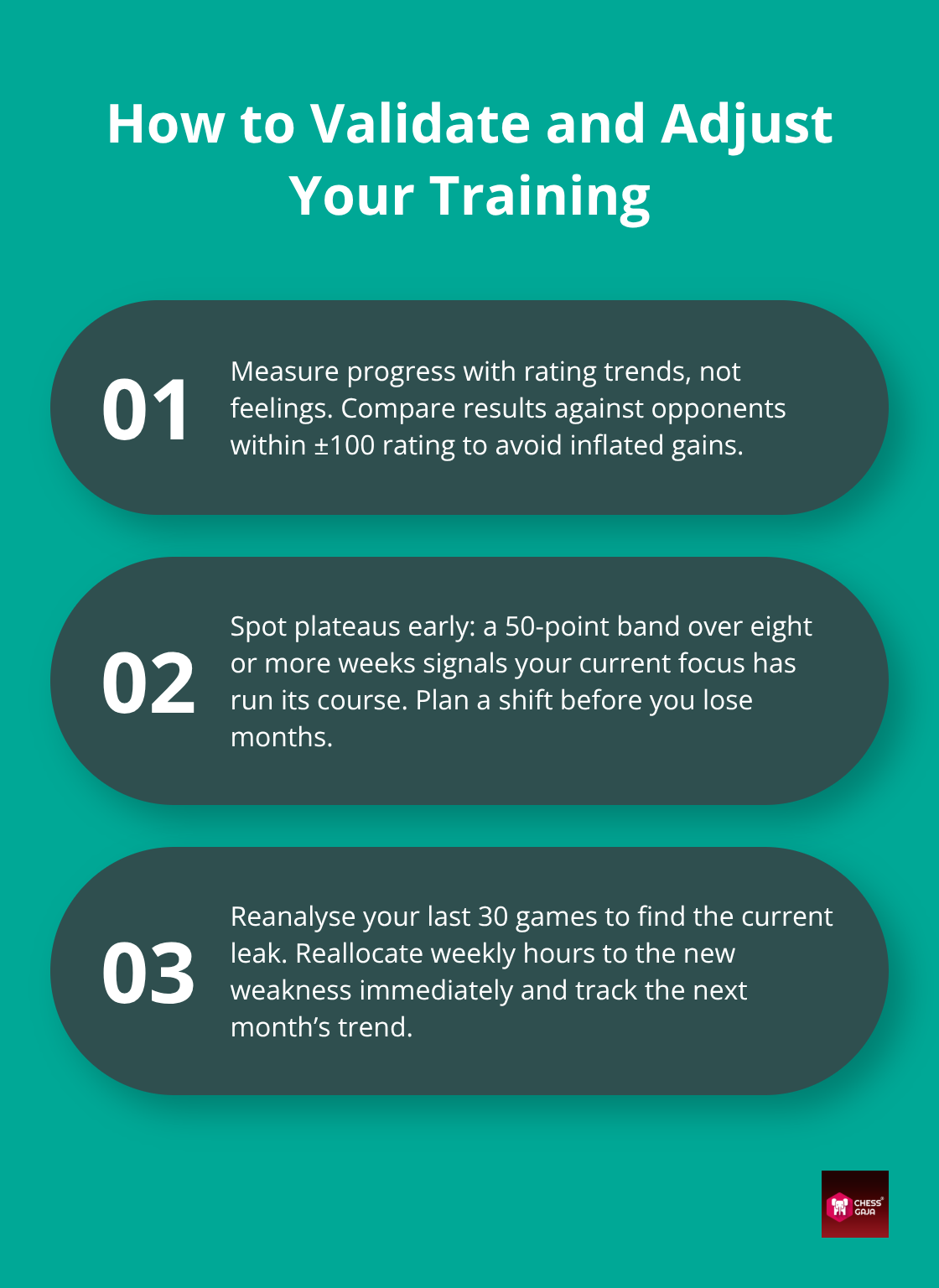
Rating improvement stands as the most honest metric of progress, but most beginners misinterpret what their numbers mean. A student in California who gained 150 rating points in three months might feel accomplished until they realize 100 of those points came from playing weaker opponents in a smaller tournament pool. Real progress means consistent wins against opponents at your current level, not inflated ratings from favorable matchups.
Track your rating across at least 20 Rapid games on the same platform using a consistent time control (e.g., 15+10), then calculate your monthly trend. If your rating climbs 30 to 50 points per month while playing opponents within 100 points of your level, your training plan works. If your rating flatlines or drops despite increased study hours, something in your approach needs adjustment immediately. The data tells you the truth; your feelings about progress are unreliable.
Spotting Stagnation Before It Costs You Months
Stagnation is inevitable, but most beginners ignore it until they waste months spinning their wheels. Rating stagnation means your score stays within a 50-point band for 3 to 4 consecutive weeks despite consistent training. This happens because you’ve mastered the skill your plan targeted, and now you need a new focus. A beginner who spent two months drilling basic tactics might stagnate at 950 rating because tactics alone no longer drive improvement; endgame technique or opening transitions become the limiting factor next. The solution is simple: download your last 15 to 20 Rapid games from the past month, identify where you consistently lost material or games, then reallocate your weekly hours to that new weakness. If you lost four games to endgame mistakes, shift 2 hours from tactics to endgame study immediately. Waiting for inspiration wastes time; data-driven adjustment works.
When Your Method Fails, Change It Fast
Some training approaches simply don’t align with how you process board positions. A student might spend hours on unrated puzzle platforms with no rating gain because standalone puzzles train tactical pattern recognition in isolation, not real-game candidate-move calculation or time management. If you have trained with a specific method for four weeks without seeing improvements, adjust your approach. If puzzle platforms aren’t translating into game wins, switch to analyzing your own losses with a board or coach to see where you missed tactical opportunities during actual play. Similarly, if you are memorizing opening variations but still losing, stop studying move orders and shift to reviewing the plans and pawn structures of the resulting middlegames.
Final Thoughts
Generic training plans fail because they ignore your actual weaknesses. A beginner in Singapore following a standard curriculum might waste weeks on openings when tactics are the real problem, or a student in Austin might drill endgames while their rating stalls because they lose to basic tactical oversights. Calibrated training for beginners works differently-it assesses honestly, identifies your specific gaps, and adjusts based on rating data, compressing months of wasted effort into weeks of focused improvement.
Students who follow generic methods often plateau or gain only 30 to 50 rating points over three months. Students who use calibrated training targeting their actual weaknesses can double or triple that growth rate—gaining 100 to 200 points in the same timeframe—because every hour of study addresses a real problem, not an imaginary one. Professional coaching accelerates this process further, as a FIDE-rated coach analyzes your games, spots patterns you miss, and adjusts your plan before you waste weeks on the wrong skill.
At Chess Gaja, our Grandmaster-led coaching uses this exact approach across 40+ countries, helping students move from beginner to intermediate levels faster than solo study allows. A Paid Starter Class with Chess Gaja reveals your true starting position, identifies your primary weakness, and builds a personalized plan matched to your timeline and commitment level. This single session eliminates the months of confusion most beginners face and puts you on a path where every hour of training produces measurable results.