

Your opening moves set the tone for everything that follows. A weak repertoire forces you to react instead of control the game, which costs you rating points and confidence.
At Chess Gaja, we’ve seen thousands of players waste months memorizing lines that don’t fit their style. Opening repertoire strategy isn’t about knowing the most popular moves; it’s about building a system that works for how you actually play.
Why Opening Choices Shape Your Results
Your opening moves determine your middlegame positions. A player using the Ruy Lopez faces predictable pawn structures and tactical themes. Switching to the King’s Gambit or Scotch Game changes those demands entirely.
This is a practical reality. When your opening matches your style, your strengths shine. When it does not, you waste moves fixing early errors.
Students who pick openings matching their preferences achieve rapid, tangible rating gains simply because they understand the resulting positions far better.
A positional player rated 1400 should avoid sharp Sicilian lines. They need pawn structures they can navigate with confidence. Meanwhile, tactical players benefit from open positions and early piece activity.
A player rated 1400 who prefers solid, positional play shouldn’t memorize sharp Sicilian lines. That player needs openings leading to pawn structures they can navigate confidently. Similarly, a tactical player benefits from openings with sharp middlegames and early piece activity rather than closed systems requiring long-term strategy.
The Cost of Mismatched Openings
Beginners often copy top grandmasters. You might watch a video on the Caro-Kann and memorize 12 moves. But in round three, your opponent deviates on move 8. Without deep understanding, you quickly get lost.
This approach wastes time and causes frustration. Instead, choose openings where you grasp the purpose behind every move.
If you play 1.d4 followed by c4, g3, and Bg2 (a Catalan setup), focus on understanding why you develop that bishop along the long diagonal. Don’t just memorize standard setup moves. Rating gains come from positions you comprehend, not memorized lines. A narrow repertoire of two solid openings beats six half-studied lines every time.
Assess Your Playing Style First
Strong players construct repertoires around their personal strengths. Players with great endgame technique favor simplifying lines. Tactical visionaries choose systems with early complications.
Take time to assess your preferences. Do you prefer long-term maneuvering or sharp tactics? That honest assessment guides your choices.
You do not need to play like a Grandmaster. Play what works for your current level. Intermediate club players improve fastest with one solid system for White and one main defense for Black. This focused approach builds pattern recognition much faster than chasing theoretical trends.
Once you pick your openings, learn to practice them effectively. How you study determines whether you gain rating points or stagnate.
Once you’ve identified your playing style and selected openings that match it, the next step is understanding how to practice these systems effectively. The difference between players who gain rating points and those who stagnate often comes down to how they study and analyze their opening play.
Building Your Opening System Around How You Play
Match Your Opening to Your Playing Style
A flexible opening system relies on clarity. You must know your goals for the first 12 to 15 moves.
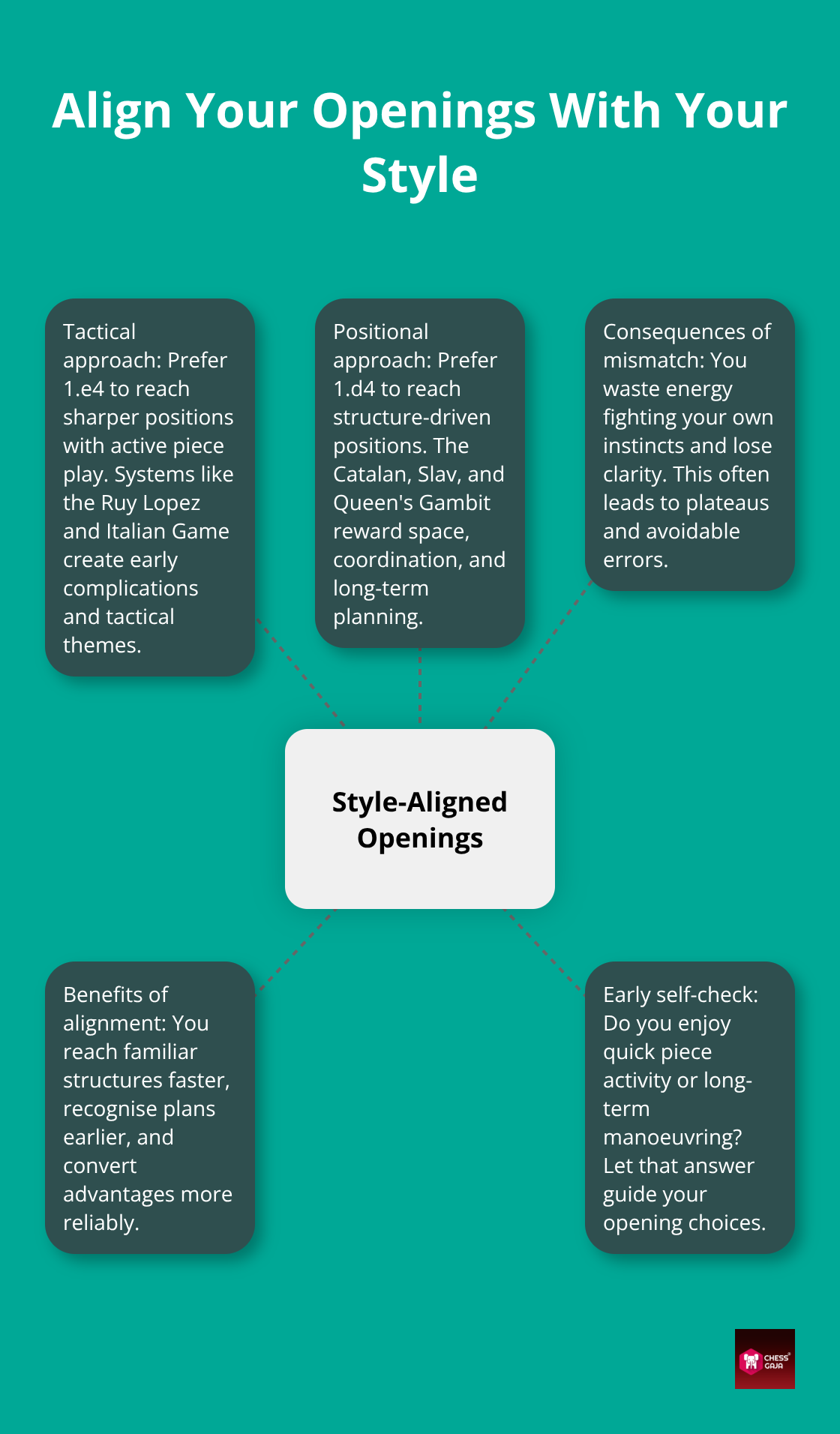
- Tactical Players: Struggle with quiet, solid setups like the London System (for White) or solid defenses like the Slav Defense (for Black). They thrive when pieces interact quickly. Options like 1.e4, the Italian Game, or the King’s Gambit fit them well.
- Positional Players: Waste energy on sharp lines like the Najdorf Sicilian. They excel at maneuvering and spatial control. Systems like 1.d4, the Catalan, or the Queen’s Gambit suit their strengths.
Mismatched openings cost you games. When you fight your natural instincts, you lose focus on executing your strategy.
The mismatch between your style and your opening costs you games. Players who pick openings against their natural style typically stagnate. They spend critical energy surviving uncomfortable positions rather than executing a cohesive plan. Your first decision is identifying whether you’re primarily tactical or positional. Tactical players thrive when pieces interact quickly, creating combinations and forcing sequences. Positional players excel when they maneuver pieces into superior squares, control key areas, and exploit long-term imbalances.
Once you’ve made that honest assessment, your opening choices follow logically. Tactical players should lean toward 1.e4. It leads to sharper positions with early piece play and direct complications. The Italian Game and King’s Gambit offer immediate tactical richness. A positional player benefits more from 1.d4, which naturally produces positions where pawn structures matter and long-term planning shapes the game. Systems like the Catalan or Queen’s Gambit reward players who excel at maneuvering and spatial control. They prioritize long-term coordination over raw, move-by-move calculation.
Narrow Your Repertoire for Faster Improvement
Most players underestimate how much depth they can extract from a narrow repertoire. Club players gain far more rating points by mastering two or three openings thoroughly. Maintaining a broad selection of half-remembered lines only slows your progress. Students who commit to a single system for White and a single system for Black improve faster and reach higher peaks than those who rotate constantly.
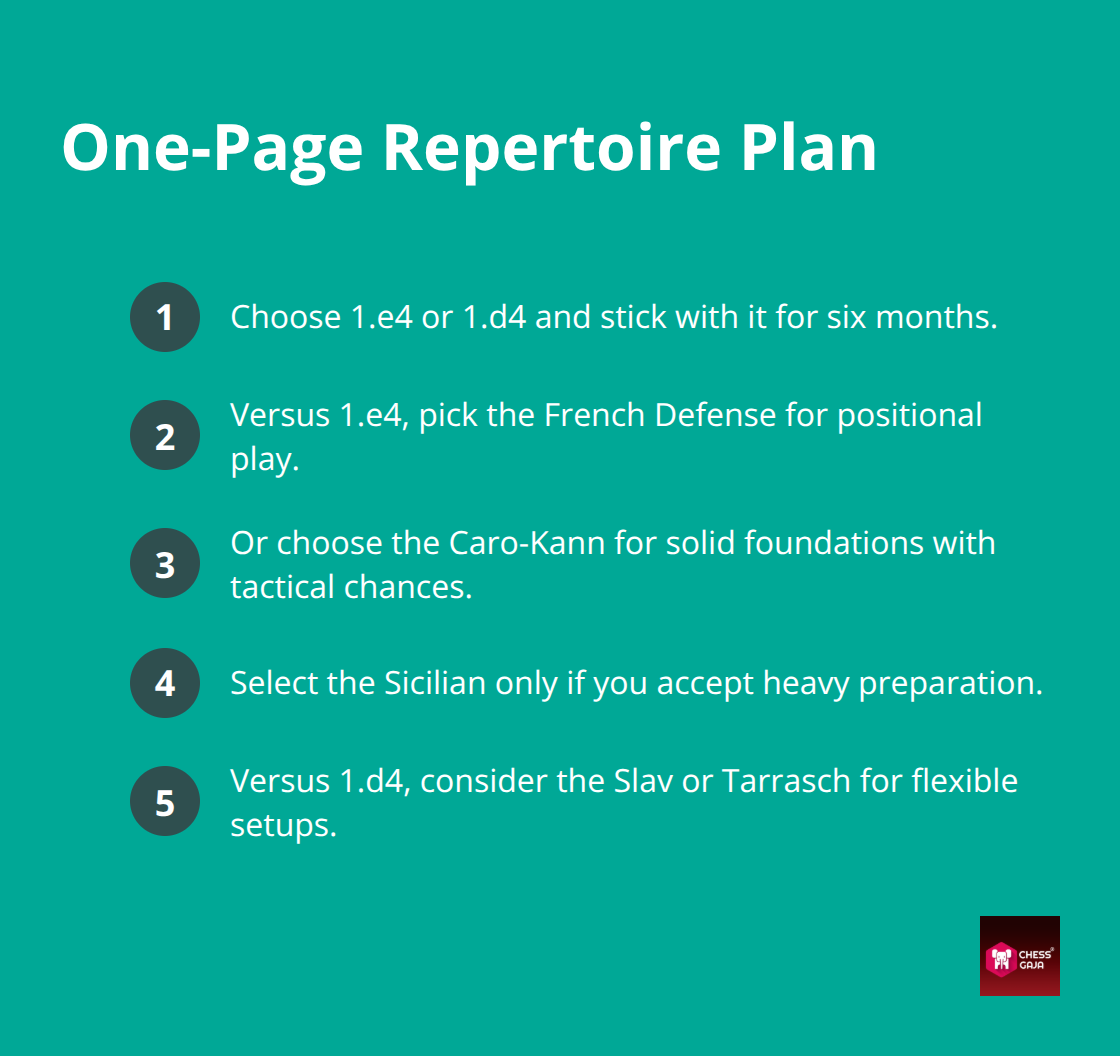
For White, pick one move-either 1.e4 or 1.d4-and stick with it for at least six months. For Black against 1.e4, choose one response that aligns with your style: the Caro-Kann or French Defense for solid, counter-attacking setups, or a reliable Sicilian setup like the Accelerated Dragon if you want dynamic piece play without memorizing endless classical lines (though you must prepare against White’s positional Maróczy Bind with 5.c4).
Against 1.d4, reliable choices like the Slav Defense (for solidity) or the Tarrasch Defense (for dynamic piece play centered around an Isolated Queen’s Pawn structure) offer clear plans based on piece activity rather than endless theoretical lines.
Within each opening, limit yourself to one main line and one alternative. If you play the Ruy Lopez as White, don’t learn the Open, Closed, and Exchange variations all at once. Master the Closed Variation thoroughly, then add one alternative only after you’ve played it 15 to 20 times. This concentrated approach builds pattern recognition far faster than breadth. A player who switched from multiple opening systems to two systems gained rating points within months, simply because they could recognize typical middlegame patterns and execute plans without hesitation.
Test Your Openings Before Committing
The third element involves ensuring your chosen openings lead to middlegames where you feel confident. Before committing to an opening, play 15 to 20 games with it at rapid time controls to test how you handle both main lines and non-standard opponent responses in the resulting middlegames. Do you understand the typical pawn structures? Can you identify where your pieces belong? Do you see a clear plan for the next 20 moves?
If you answer no to any of these questions, the opening isn’t right for you yet. Swap it for something simpler. Players in the UAE and USA who spend two weeks studying an opening before playing it gain substantially more from that opening than those who jump into tournament play after watching a single video. The commitment matters more than the specific opening you choose.
Once you’ve selected openings that match your style and tested them in real games, you need a systematic approach to studying and analyzing them. The difference between players who gain rating points and those who stagnate often comes down to how they practice these systems effectively.
How to Study Your Openings Without Wasting Time
After you’ve selected openings that match your style, the next phase determines whether you actually improve or simply accumulate memorized lines. Most players study openings the wrong way: they watch a video, memorize 15 moves, then play a game and forget everything when their opponent deviates. The result is wasted hours with minimal rating gains.
Players who analyze their own games gain rating points faster than those who only study theoretical lines.
Review Your Games Before Anything Else
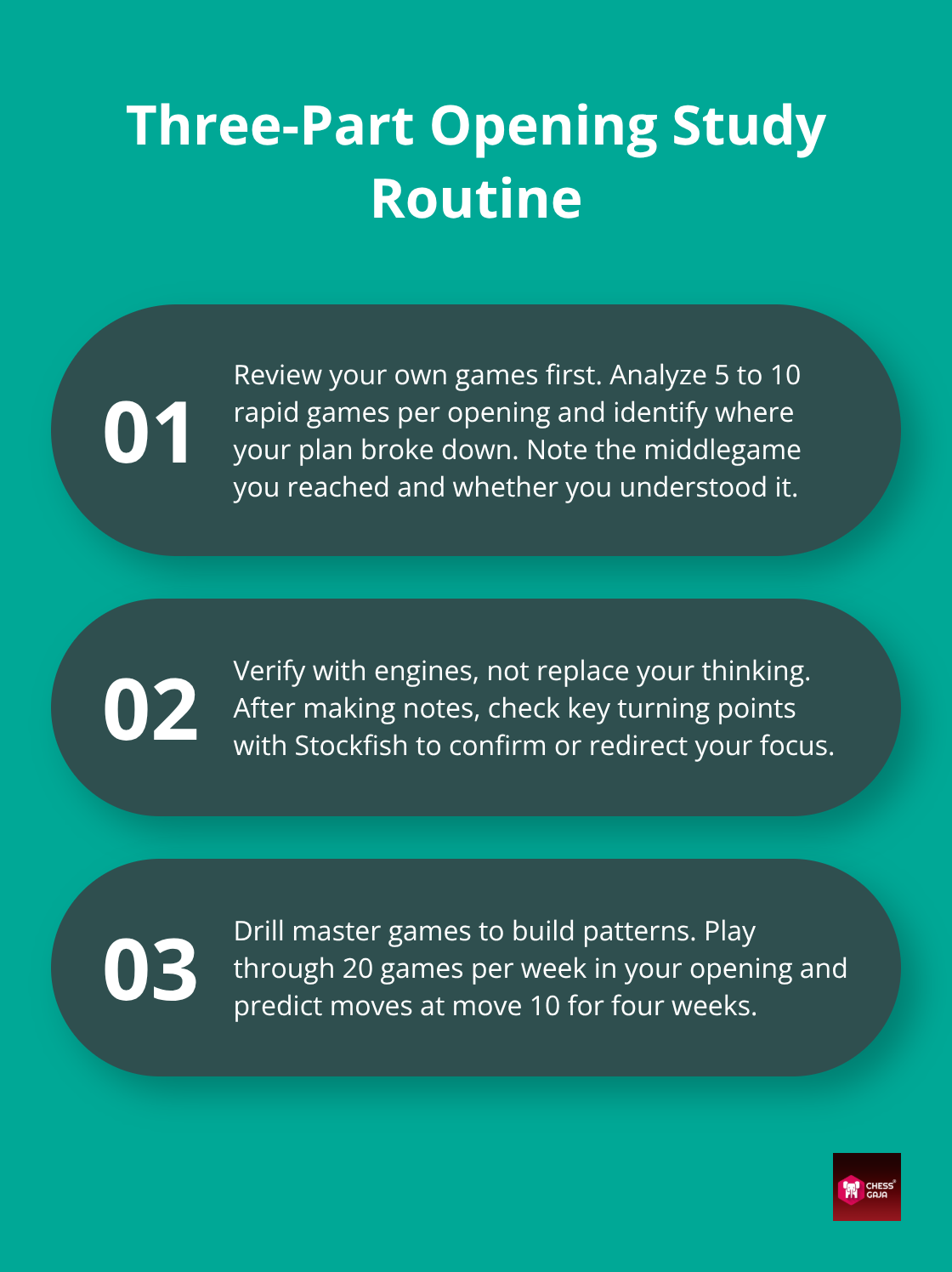
Start with 5 to 10 games in each opening at rapid time controls on Lichess or Chess.com, then review every single game afterward. Don’t skip games where you lost badly-those contain your most valuable lessons. After each game, ask three specific questions: Where did your opening plan break down? What middlegame position did you reach, and did you understand it? Could you have played those first 12 moves differently to reach a position you’re more comfortable with?
Write these answers down in a simple document. Over time, you’ll notice patterns. Maybe you consistently reach positions where you don’t know where your knight belongs. That tells you to study knight placement in your chosen opening, not general knight theory. A player in Singapore who tracked this for three months discovered she was reaching positions with doubled pawns on the queenside, which she disliked. She adjusted her opening choice to avoid that structure entirely and saw immediate improvement because she was finally playing positions that suited her instincts.
Use Engines to Verify, Not to Teach
Engine analysis becomes valuable here, but only if you use it correctly. After analyzing your own game first, run it through Stockfish or another strong engine on Lichess, but don’t let the engine become your teacher. The engine will show you every inaccuracy, which feels productive but wastes your time. Instead, use engines to verify your own analysis.
If you thought move 14 was the turning point, let the engine confirm whether that’s where your advantage disappeared. If the engine flags a significant evaluation shift on move 8, go back and check if you missed a key tactical pattern or fundamentally broke an opening principle. This distinction matters: you’re training yourself to think like a strong player, not training yourself to follow a computer. Players who rely on engines to tell them what to play in the opening plateau because they never develop their own pattern recognition. A player who spends dedicated time analyzing a game independently before running an engine review improves far faster than one who immediately relies on Stockfish to evaluate every move. The second player had more analysis but less understanding.
Build Pattern Recognition Through Master Games
For training drills, create a simple system where you play through master games in your chosen opening using Lichess Learn or Chess.com’s opening trainer. Set a target: play through 20 games in your opening per week, but don’t memorize them. Instead, after each game, pause at move 10 and predict what White or Black played next. If you’re wrong, understand why that move was better than yours. This trains pattern recognition directly.
After four weeks of this focused drill, you’ll recognize typical positions instantly and play your opening moves with confidence rather than hesitation. Players who maintain this practice for three months report that their opening moves feel natural and automatic, which frees mental energy for the middlegame where rating points are actually won.
Final Thoughts
Your opening repertoire planning determines whether you control the game or spend the middlegame fixing early mistakes. The players who gain rating points fastest aren’t those who memorize the most lines-they’re the ones who select openings matching their style, test those openings in real games, and analyze their own play systematically. This approach works whether you’re a student in Singapore preparing for your first tournament, a player in the UAE building toward competitive play, or someone in the USA working toward consistent improvement.
Commit to one opening system for White and one solid response to each of your opponent’s main moves with Black. Play 10 to 15 games in each opening at rapid time controls, then review every single game. Use engine analysis to verify your own thinking, not to replace it, and study master games in your chosen openings to build pattern recognition. Within three months of this focused practice, your opening moves will feel natural, and you’ll reach middlegames where your strengths actually matter.
Professional coaching accelerates this progress significantly. At Chess Gaja, our FIDE-rated coaches work with students across 40+ countries to build opening systems tailored to individual playing styles. Book a Paid Starter Class with us for a professional skill evaluation-our coaches will assess your current playing style, recommend openings that match your strengths, and show you exactly how to study them for maximum improvement.