Endgame positions decide most chess games. Are you preparing for your first tournament or aiming to boost your rating? Converting winning positions into actual wins separates strong players from the rest.
At Chess Gaja, we’ve coached thousands of players across 40+ countries, and we’ve seen one pattern repeatedly: players with solid endgame technique win more games. This blog post breaks down the essential concepts you need to master.
King and Pawn Endgames: Where Precision Wins Games
Opposition: The Foundation of Control
King and pawn endings are where most amateur players leak points. A tournament player in Florida or Singapore might push a passed pawn two squares forward, only to realize too late that the opponent’s king can stop it. The difference between winning and drawing often comes down to one concept: opposition.
Stand opposite the enemy king with an odd number of squares (usually one) between you. The player who does not have the move holds the opposition. This forces the defending king to step aside and concede critical squares. Controlling these key squares determines whether the passed pawn can be successfully escorted to promotion.
In practical play, young tournament players frequently miscalculate tempo, moving their king one square when they should move the pawn. Players who practice opposition patterns against a chess engine—even for 15 minutes daily—convert these endgames far more reliably within just two weeks.
Calculating the Pawn Race
When both sides have passed pawns, the game becomes a race. Your pawn is four squares from promotion, the opponent’s is three. Most beginners count moves and assume they lose, but tempo and king activity change everything.
Can your king support your pawn while blocking the opponent’s? If so, you win despite being further behind. Always count precisely and apply the Rule of the Square. How many moves until each pawn promotes? Can your king reach the critical squares or step into the pawn’s square to intercept it? Write down the moves if you’re learning.
Players who train with structured endgame drills report faster calculation under tournament time pressure because they’ve seen these patterns dozens of times.
Zugzwang: Winning Without Force
Zugzwang-a situation where any move worsens your position-appears in king and pawn endings. If your opponent must move and every legal move concedes vital squares, loses material, or allows your pawn through, you’ve won without forcing anything. This concept separates players rated 1200 from those rated 1600. Young players should practice positions where zugzwang appears after five to seven moves. This builds strong intuition for recognizing when opponents are trapped by their obligation to move.
Building Your Winning Plan
Identify your passed pawn immediately. Calculate whether your king can escort it safely to promotion. If the opponent’s king can intercept it, create a second weakness. You can also distract their king to break the defense. Applying the Principle of Two Weaknesses forces your opponent to choose which area to defend, and often their king cannot stretch across both flanks. This is not theory-it’s the core decision-making process in every king and pawn ending that matters.
Calculate with a target promotion square in mind, working backward from key escort squares. This approach prevents the common errors caused by pushing pawns blindly. Your plan might be: advance the pawn two squares, then move the king to support it, then push again. Simple plans win. Complex calculations without direction waste time and invite errors.
Rook endgames demand a different mindset. While king and pawn endings reward precision in calculation, rook endings reward activity and piece placement. Your next step is to master how an active rook transforms a seemingly drawn position into a winning one.
Rook Endgames: Why Piece Activity Matters More Than Material
Rook endgames punish passivity harder than any other ending. A player from Texas with an extra pawn can still lose if their rook sits passively on the back rank while the opponent’s rook invades. The shift from king and pawn endings is fundamental. Calculation alone does not win rook endings. Move your rook to active squares. Create threats, cut off the opponent’s king, or dominate open files.
The Cost of Poor Rook Placement
In single-pawn rook endgames, practical play shows that blunders decide most games. Passive rooks and misplaced kings matter far more than strictly forced theoretical outcomes. This reality highlights the severe cost of poor rook placement. A rook on the wrong square drops material, falls into a skewer, or allows the opponent’s rook to penetrate. The primary mistake players make is placing their rook passively—either in front of their own passed pawn or passively defending weaknesses. Remember the Tarrasch rule: rooks belong behind passed pawns—whether supporting your own or impeding your opponent’s.
Young tournament players often make these errors under time pressure. The cause is a lack of repeated drill practice. The fix is simple. Practice rook endgames against an engine for 10 minutes daily. Focus on keeping your rook active and your king mobile.
Simplification as Your Winning Strategy
When you gain an advantage in a rook endgame, simplification wins more reliably than complex tactical shots. Trade pieces toward a pure winning position rather than hunting for intricate combinations. If you reach a pure rook and pawn endgame, activate your king immediately. Your king must transform from a passive spectator into an active piece that supports passed pawns and invades key weaknesses.
The Lucena Position: Building the Bridge to Win
A tournament player who understands the Lucena position knows how to use their rook to ‘build a bridge,’ shielding the king from checks and guaranteeing pawn promotion. This setup appears in real games every week across tournaments in Florida, California, and beyond. Players rated 1400 to 1600 who study this position report converting winning rook endgames consistently because they recognize the winning setup within the first few moves and execute without hesitation.
The Philidor Position: Holding What Seems Lost
The Philidor position teaches how to hold a rook endgame. First, establish a 3rd-rank barrier (6th rank from the attacker’s perspective) with your rook to cut off the enemy king. Once the attacker pushes their pawn to the 6th rank ( defender’s 3rd rank), drop your rook back to the 1st rank (or 8th rank if playing White) to deliver relentless checks from behind. These positions are not abstract theory-they appear in real games every week across tournaments in the USA and beyond.
Building Pattern Recognition Through Practice
First, memorize the Lucena setup and Philidor defense as reference patterns. Then, play 20 to 30 practice games against an engine. This builds direct experience with both structures. Set the computer to push passed pawns aggressively so you face realistic defensive challenges.
When you build this pattern recognition, rook endgames shift from scary and confusing to manageable and winnable. The discipline to keep your rook active, avoid hanging material, and recognize when to set up a defensive barrier or push for promotion is what separates players who convert winning rook endgames from those who let victories slip away.
Minor piece endgames demand yet another adjustment-bishops and knights move differently, and their strengths and weaknesses create entirely new winning patterns you must master.
Minor Piece Endgames
Bishop Endgames: Controlling the Right Diagonal
Bishop endgames with pawns on both flanks separate players who understand piece mobility from those who rely on memorized moves. A young player in the UAE or Singapore facing a bishop endgame often assumes that having the same number of pawns means a draw, but this assumption costs games. When diagonals are open, an active bishop that controls key squares on both flanks can completely restrict a passive opponent’s bishop, creating winning chances even with equal material. The critical skill is recognizing when your bishop is the stronger piece and using your centralized king alongside your bishop to create a passed pawn on the flank where your bishop dominates.
In same-color bishop endgames, pawn structure is everything. Place your pawns on squares of the opposite color complex to your own bishop. This keeps your bishop mobile and active. It also forces your opponent’s pawns onto passive squares where your bishop can target them. Players who practice bishop endgames regularly convert these positions more consistently because they stop second-guessing whether a position is truly drawn and instead calculate concrete winning plans.
Here is your actionable training step. Set up positions with a bishop and four pawns against a bishop and three pawns. Play these out against an engine defending accurately. Force yourself to identify which side of the board favors your bishop, push a pawn there, and convert the advantage into a passed pawn.
This single skill-recognizing which flank belongs to your bishop-eliminates most of the confusion beginners face in these endings.
Knight Endgames: Centralization Wins
Knight endgames require a unique approach: because knights are short-range pieces, knight endgames closely resemble king and pawn endgames. A tournament player in Florida or Texas who tries to handle a knight endgame using bishop logic will struggle because knights need centralization and precise maneuver sequences to be effective. The strength of a knight lies in its ability to secure central outposts and create tactical fork threats, so your winning plan must focus on controlling key squares while your own pawns advance.
Knights are short-range pieces that struggle to cover both flanks at once. Centralizing your knight early is vital. It allows your knight to pivot quickly between defending your pawns and attacking weaknesses on both flanks.
The most common mistake is moving a knight to the edge of the board when it should jump to a central square where it covers more territory. When you have a small advantage (one extra pawn or a slightly better pawn structure), your knight must harass the opponent’s pieces relentlessly until you create a second weakness or push a passed pawn through.
Players who study knight maneuver patterns through practice games where they must activate their knight develop faster calculation skills in real tournaments because they internalize the rhythm of knight play.
Converting Small Advantages: Piece Activity Decides
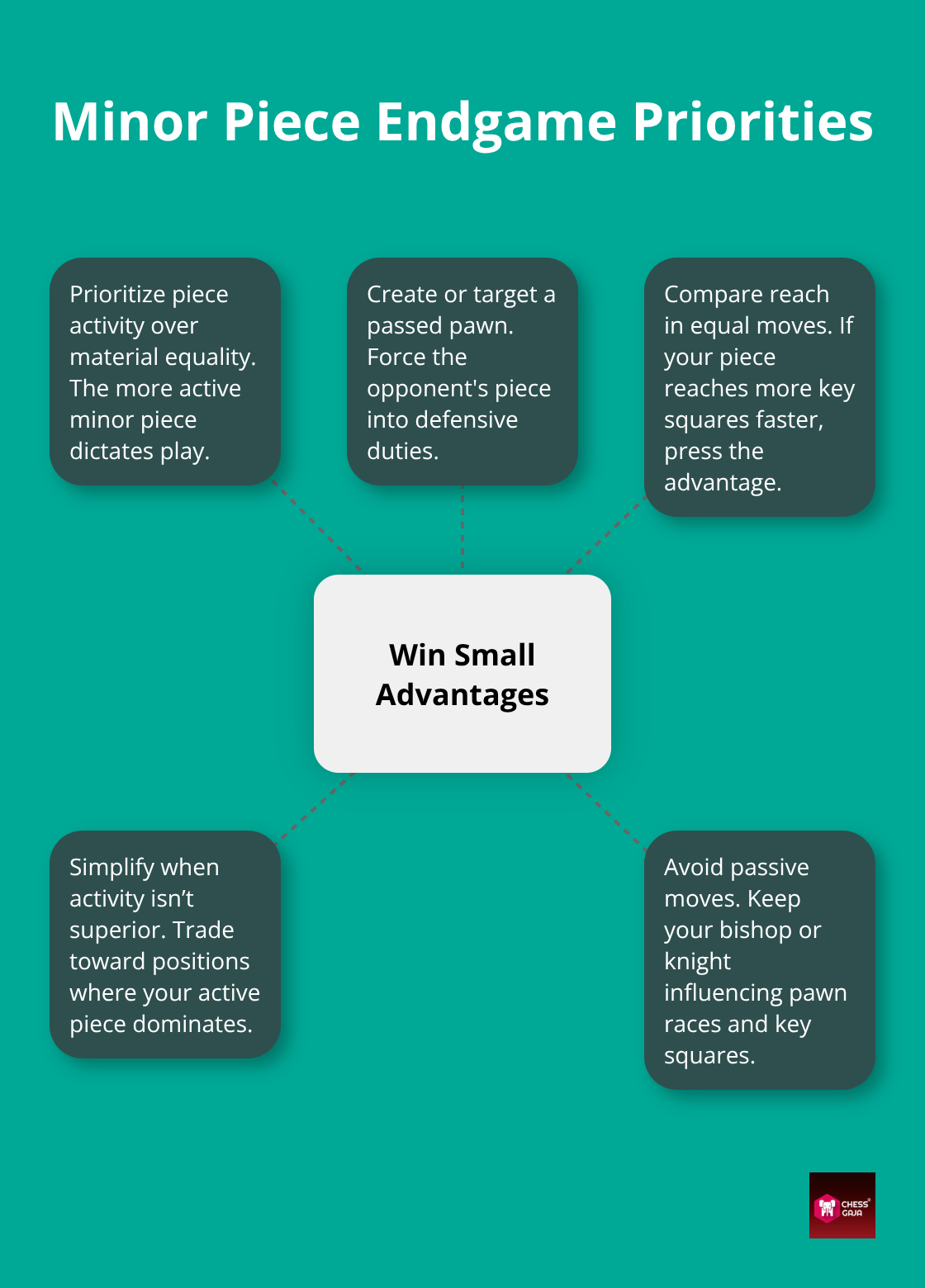
Converting small advantages into wins in minor piece endgames depends on one principle: your piece must be more active than the opponent’s piece. A bishop restricted to one diagonal or a knight trapped on the rim loses despite having material equality. Use a quick practical test.
Calculate whether your piece reaches better squares than your opponent’s piece in the same number of moves. If yes, you have a concrete winning plan. If no, you need a different approach—such as creating a passed pawn to force your opponent onto the defense, or calculating whether trading into a pure king and pawn endgame guarantees a win.
Young players often overlook this comparison and move passively, assuming the position will resolve itself. It does not. Minor piece endgames reward aggressive piece placement and force your opponent into reactive defense. The difference between a draw and a win is whether your bishop or knight controls the outcome of pawn races and pawn advances.
Final Thoughts
Endgame technique essentials boil down to three core principles: calculate precisely, place your pieces actively, and recognize when your position shifts from drawn to winning. King and pawn endgames demand exact counting and opposition mastery. Rook endgames punish passivity and reward piece activity above all else. Minor piece endgames require you to compare your piece’s mobility against your opponent’s and exploit the difference relentlessly.
Real improvement happens when you apply these concepts in actual games under tournament conditions. Young players who combine structured endgame practice with regular tournament participation gain rating points consistently because they convert winning positions instead of letting them slip away. The fastest path to mastery involves 15 minutes of daily practice against a chess engine, starting with king and pawn positions, then moving to rook endgames, then minor pieces.
We at Chess Gaja have built our coaching around this exact principle, and our FIDE-rated coaches work with students across 40+ countries to accelerate endgame mastery. Your next step is to book a Paid Starter Class for a professional skill evaluation where a coach will review your recent games, identify which endgame types cost you the most points, and build a practice plan tailored to your rating and goals.