


Your first moves in chess shape everything that comes after. As Grandmaster Priyadharshan Kannappan notes, countless beginners stumble because they skip the fundamentals of early opening plan concepts. As a result, they struggle for the rest of the game.
The good news: solid opening habits are learnable. This post breaks down exactly how to control the center, develop your pieces, and avoid the mistakes that hold beginners back.
Control the Center from Move One
Why the Center Matters in Chess
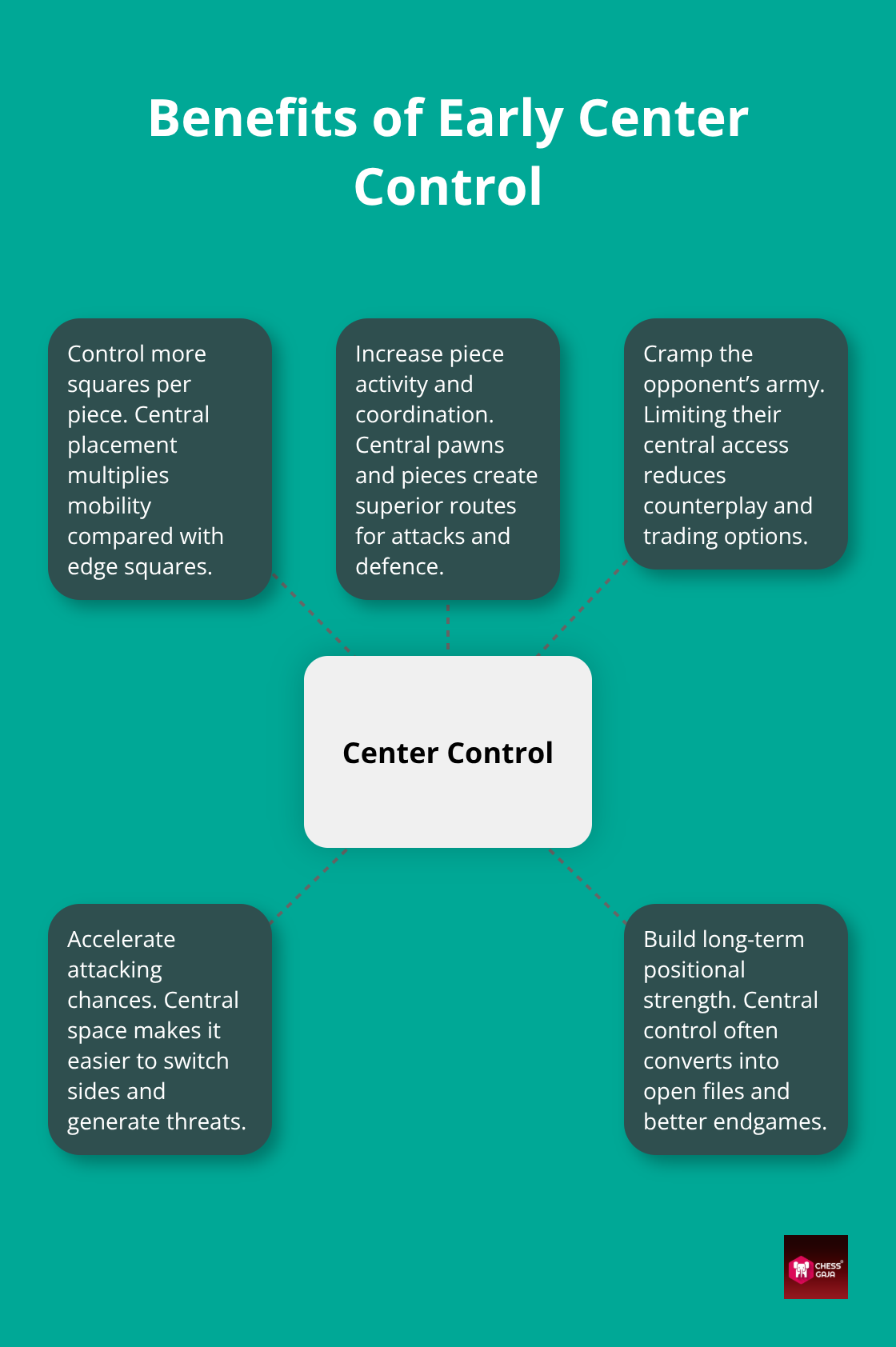
The center of the board-the four squares d4, e4, d5, and e5-is where chess games are decided. For example, pieces placed in the center control twice as many squares as pieces on the edges. A central knight (on e4 or d4) attacks eight squares, whereas a knight placed on the rim (such as on a3 or h3) attacks only four. This isn’t theory. This is measurable board geometry that directly translates to stronger positions and more winning chances. When you control the center early, your pieces gain scope, your opponent’s pieces become cramped, and your attack options multiply.
Practical Center Control in Your First Moves
The strongest approach is to control the center with pawns, then support them with pieces. Move your e-pawn or d-pawn two squares forward on move one or two. This immediately claims space. In addition, follow up with your knights and bishops (typically developing knights before bishops) to reinforce that pawn. If your opponent doesn’t contest the center, you’ve won a decisive spatial advantage before move five. If they do contest it, you’re forced into tactical play-exactly where solid opening preparation helps.
For example, don’t waste moves on the flanks or bring your queen out early while the center sits empty. However, players rated under 1200 often move a flank pawn (like h3 or a3) on move two or three, which hands the center to their opponent without a fight. That’s a losing habit. Your first four or five moves should answer one question: who controls d4, e4, d5, and e5? If the answer is you, your position is already better.
Center Control and Piece Placement
Once you’ve staked a claim in the center with a pawn, your next job is to place pieces where they defend that pawn and attack your opponent’s center. Furthermore, a bishop on c4 or f4 for White (or c5/f5 for Black) exerts strong diagonal pressure toward the center and key target squares. A knight on f3 supports your e4 pawn, controls crucial central squares (such as d4 and e5), and sets up a safe kingside castle. A rook centralized to e1 (via Re1 after kingside castling in 1.e4 openings) or to d1/c1 (via Rd1/Rc1 in 1.d4 openings) backs up your central control and dominates open files.
Every piece should pull double or triple duty: controlling central squares, attacking your opponent’s pieces, and preparing your own threats. Beginners place pieces haphazardly-a bishop to b5 just because it looks active, a rook to a4 for no clear reason. Strong players place pieces where they reinforce the center and create multiple threats at once. The difference in position strength after ten moves is stark.
A student from Dubai who learned to ask before each move-does this piece help control the center or support my center pawns?-improved their opening play immediately. Within three months of applying this principle consistently, their rating climbed from 800 to 1050. Better opening positioning fueled that entire 250-point jump.
From Center Control to Piece Development
Controlling the center with pawns and pieces sets the stage for your next critical task: developing your remaining pieces efficiently. Piece development coordination means bringing your knights, bishops, and pawns into active positions as swiftly as possible. The center gives you the foundation. Now you need to build on it with pieces that work together toward a unified plan.
Develop Your Pieces Efficiently
Knights and Bishops in Active Squares
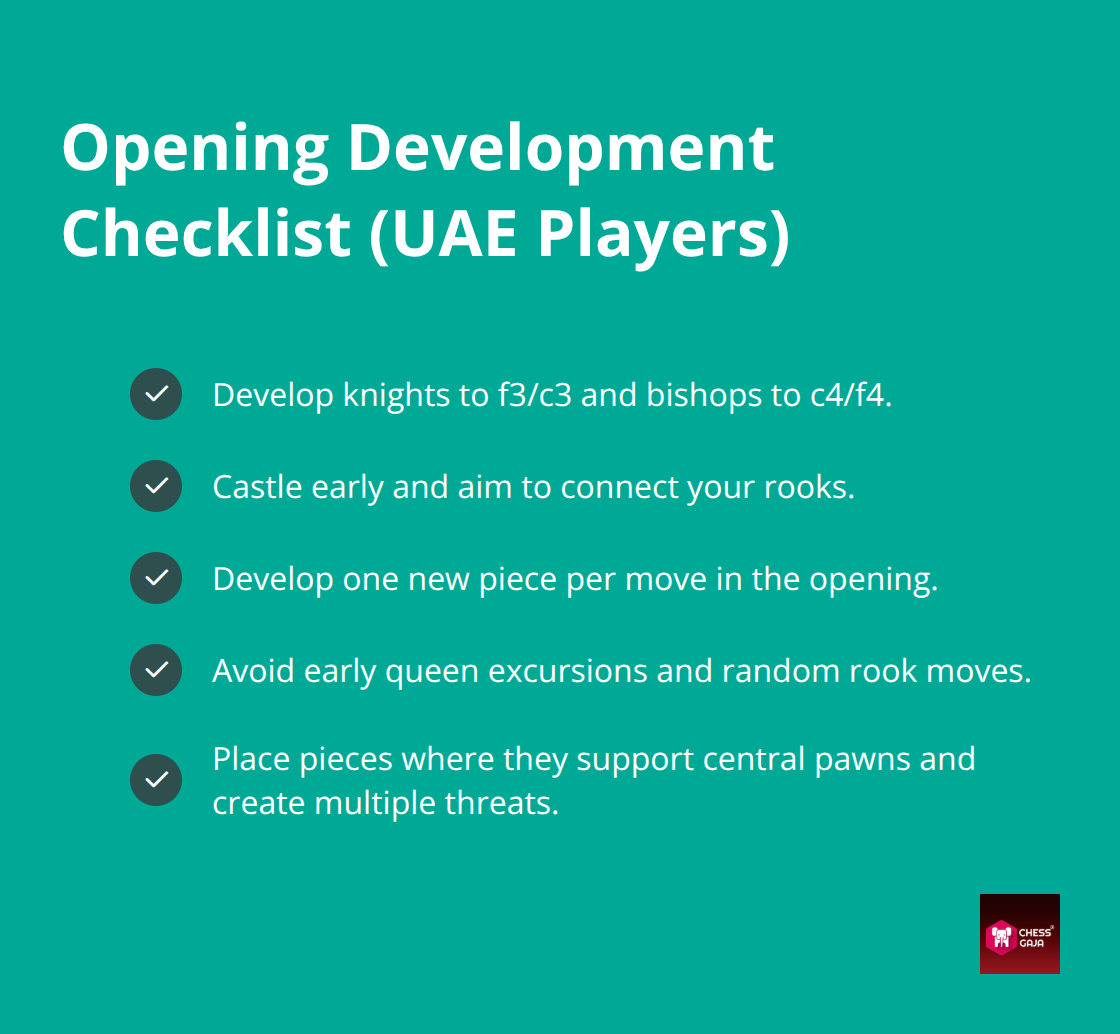
Ask yourself one hard question before each move: does this piece control the center or support my center pawns? A knight belongs on active squares like f3 or c3 for White (f6 or c6 for Black) early on, rather than passive rim squares like h3 or a3. A bishop developed to c4 or f4 (c5 or f5 for Black) exerts strong diagonal control toward key central and target squares. Avoid developing a bishop to a passive or aimless square where it doesn’t influence the center or create meaningful pressure. The difference between a beginner and a 1400-rated player shows up in these first ten moves. Beginners develop pieces to empty squares. Strong players develop pieces to squares where they accomplish multiple goals simultaneously.
Developing 1.Nf3 supports your e4 pawn, controls crucial central squares (such as d4 and e5), and prepares kingside castling. In contrast, moving to h3 controls far fewer squares and fails to influence the center.
Rook Placement and Connection
After your knights and bishops are placed, your rooks must connect. Connected rooks means your rooks sit on the same rank or can defend each other across the board. This happens after you develop your minor pieces and castle. Most beginners ignore rook placement entirely and wonder why their position collapses in the middlegame. A rook centralizing to e1 (via Re1 after kingside castling) backs up your center, controls an open file if the e-file clears, and prepares to invade. A rook on a1 with no plan accomplishes nothing.
The moment both your rooks can support each other, your opening phase ends and your middlegame plan begins. Until then, rook placement matters only if it serves your center control or defends your pieces.
Avoiding Piece Redundancy
One mistake beginners make constantly is moving the same piece two, three, or even four times before developing other pieces. This is piece redundancy, and it hands your opponent a free advantage. The opening phase lasts roughly ten to fifteen moves. Because that window is limited, you must get your entire army into active squares as quickly as possible. If you move your knight from g1 to f3, then to g5, and back to f3, you’ve wasted three tempos while your opponent developed three different pieces.
A student from Singapore who tracked their move efficiency improved dramatically. Instead of moving one piece multiple times, they forced themselves to develop a new piece with each move. Their position after twelve moves went from cramped and passive to spacious and dangerous. That discipline alone-one piece per move, no exceptions-lifted their rating from 950 to 1200 in four months.
Planning Piece Placement in Advance
The real skill is seeing which square each piece needs in advance and placing it there the first time. For example, knights can jump directly into play on move one (such as 1.Nf3 or 1.Nc3), whereas bishops require an initial pawn push (such as 1.e4 or 1.d4) to open their diagonals. Because you plan ahead, you move each piece once and accomplish your setup goals faster than your opponent can react.
This forward thinking separates players who develop efficiently from those who waste tempos and fall behind in the race to activate their pieces.
Once your pieces occupy strong squares and your rooks connect, you’ve completed the opening phase. What remains is recognizing the mistakes that derail even well-developed positions-and that’s where many beginners stumble.
Common Opening Mistakes Beginners Make
Too Many Pawn Moves in the Opening
Beginners waste tempos on flank pawns while the center sits undefended. A student from Charlotte played flank pawn moves h3, a3, and b3 in their first six moves (instead of developing pieces), handing their opponent complete control of d4 and e4 without resistance. Those flank pawns accomplished nothing except squander time. Your pawns should support your center strategy, not wander aimlessly. Instead, control the center with 1.e4 or 1.d4, support your center with your pieces (such as Nf3 or Nc3), and refrain from unnecessary pawn pushes until your minor pieces are developed and your king is castled. Data from amateur games consistently shows that players under 1200 who make excessive pawn moves in the first ten turns lose a significantly higher percentage of their games due to delayed development and king exposure. The correlation is direct: pawn wandering equals position collapse.
Delaying King Safety Through Late Castling
Beginners neglect king safety by castling too late or not at all. As a result, a player from Abu Dhabi who delayed castling until move 15 faced a devastating mating attack before their king could reach safety. Castling early is a key principle in the opening. It moves your king away from the center where it attracts threats, activates your rook, and signals that your opening phase is progressing normally. Players who castle early win more games because their king survives the middlegame intact. The difference between a safe king and an exposed one determines whether you reach the endgame or face checkmate in the middle of the board.
Moving the Same Piece Multiple Times
Because beginners move the same piece multiple times while other pieces sit undeveloped, this piece redundancy becomes the fastest way to fall behind in the opening race. For instance, moving your knight from g1 to f3, then to g5, and back to f3 wastes three full tempos. Meanwhile, your opponent develops three different pieces in that time and builds an overwhelming spatial advantage.
One student from Singapore tracked their move efficiency and discovered they moved their queen four times before developing a single knight. That single habit change-one new piece per move, no exceptions-lifted their rating from 950 to 1200 in four months.
The rule is absolute: develop one piece per move until your minor pieces occupy strong squares, your king is castled, and your rooks connect. Every move that violates this rule gifts your opponent a free advantage that compounds with each passing turn.
Final Thoughts
The early opening plan concepts you’ve learned in this post form the foundation of every strong chess player’s game. Therefore, always control the center with pawns and pieces, develop one new piece per move, and castle early to protect your king. Furthermore, avoid wasting tempos on flank pawns or redundant piece moves. These principles work at every rating level from 600 to 2600, rewarding consistency with measurable results.
A student from the UAE applied these principles in every single game and climbed 250 rating points in three months. A player from Singapore tracked their move efficiency, forced themselves to develop one piece per move, and jumped from 950 to 1200 in four months. These outcomes reflect the predictable result of building strong opening habits early and reinforcing them in every game you play. Your opening moves determine whether you enter the middlegame with a spatial advantage, active pieces, and a safe king-or whether you scramble to catch up while your opponent attacks.
At Chess Gaja, our FIDE-rated coaches work with students across the USA, UAE, and Singapore to transform opening understanding into tournament results. A Paid Starter Class gives you a professional skill evaluation tailored to your current rating and goals, plus a personalized study plan to accelerate your improvement. Book your session today and take the first step toward stronger openings and higher ratings.