Your chess rating has plateaued. You’ve tried countless online courses and coaching sessions, yet progress feels stuck. The problem isn’t your effort-it’s that traditional training methods don’t adapt to how you actually learn.
At Chess Gaja, we’ve built LMS-driven chess training systems that use AI to personalize every aspect of your development. Real data about your strengths and weaknesses guides your practice, not guesswork.
What AI Analysis Reveals About Your Chess
The Moment Your Game Ends, Analysis Begins
The moment you finish a game in an LMS-powered system, the AI does not wait for you to ask questions. It immediately scans every move you made. It compares your choices against thousands of master games and engine evaluations. This is not guesswork—it is pattern matching at scale.
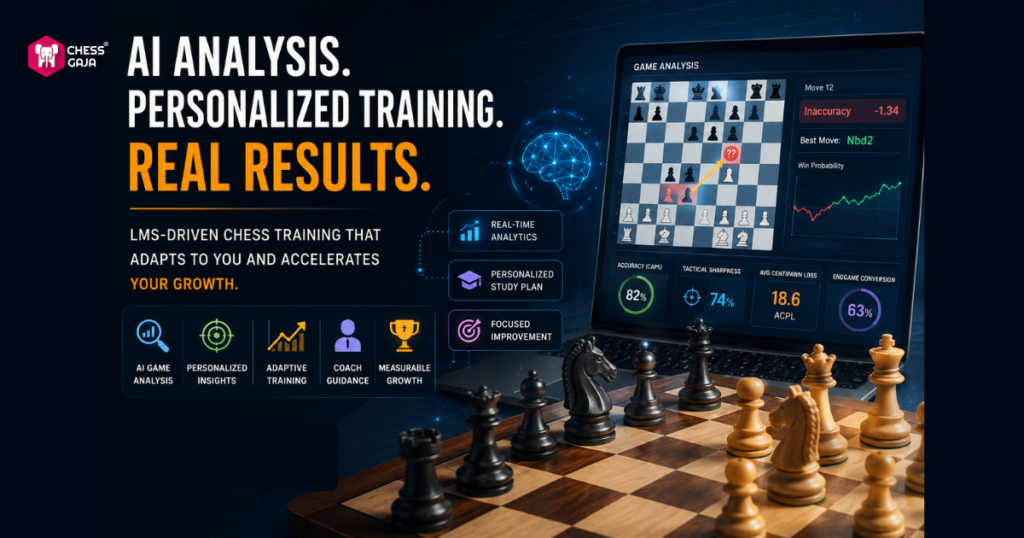
When Stockfish or similar engines analyze your game, for example, they assign objective evaluations to each position. Because of this, they quickly identify whether you had a winning advantage, a slight edge, or were already lost. The AI then flags where your choice diverged most sharply from master play. A student in Dubai receives immediate feedback showing that move 12 was an inaccuracy, the exact centipawn evaluation drop (or win-probability loss) it caused, and the engine’s top tactical continuation. This precision is impossible in traditional coaching, where a coach reviews only three to five games per week.
Performance Dashboards Show Exactly Where You Stand
LMS systems generate performance dashboards that track critical metrics: overall move accuracy (CAPS), tactical sharpness, endgame conversion rates, average centipawn loss (ACPL), and opening performance.
A student in Singapore might discover through their analytics that they consistently convert winning positions with a material advantage but frequently stumble in equal, quiet positions—revealing a critical weakness in positional play and maneuvering. That student then receives puzzle recommendations and study plans targeting exactly that gap.
The data does not lie. If your puzzle success rate or solving speed drops under time constraints, the system detects it immediately. It then adjusts your training to build resilience under tight time constraints. Take Siddharth Jagadeesh, Singapore’s youngest Grandmaster at age 17 in 2024. He trained using AI simulations and analysis tools that revealed his exact development areas.
The system tracks which opening variations you struggle with, which tactical motifs trip you up, and which endgames you handle confidently. A student in the USA can see their progress mapped across months and years. They get concrete metrics showing rating progression, rating trajectory curves, and performance rating trends rather than vague assessments like “you’re getting better.”
Real-Time Adaptation Outpaces Traditional Coaching
Traditional coaches design lesson plans based on assumptions. In contrast, AI-driven systems observe what you actually do and adjust in real time. If your puzzle-solving accuracy reaches a consistently high threshold, the system increases difficulty immediately. If you make repeated mistakes in an opening, the system prioritizes that opening in your homework. This is the difference between seeing a coach once weekly and using a system that tracks every move you make.
Personalized AI-powered summaries are generated after every class. They show what you learned, highlight confusing areas, and give your coach a clear roadmap for next session. The summary is built directly from your performance that day. A student struggling with rook endgames receives endgame puzzles, while a student dominating tactical positions gets complex strategic scenarios. This personalization scales across thousands of students simultaneously.
How Coaches Use This Data to Accelerate Your Growth
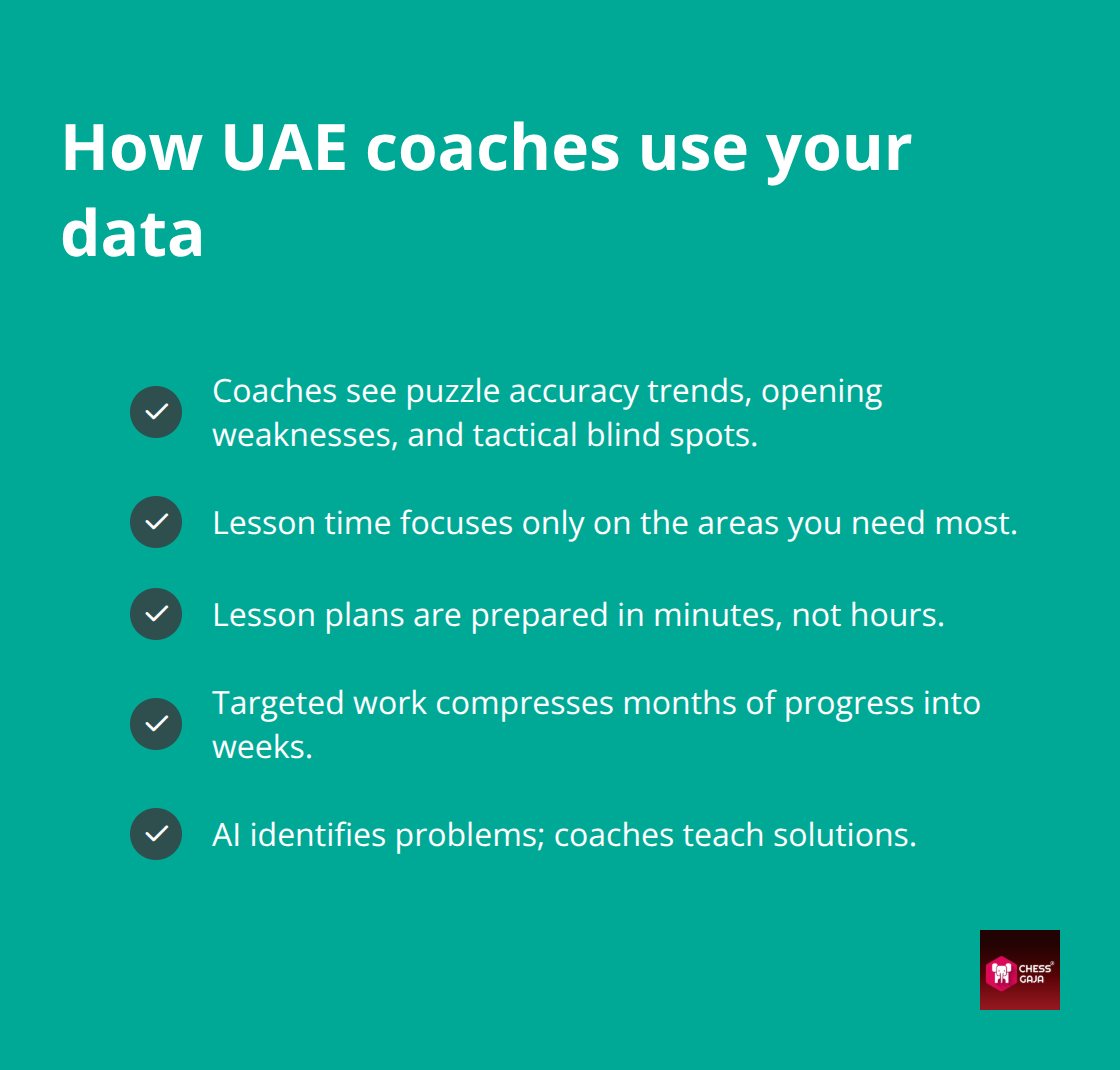
Your coach receives the same performance data you do. They see your puzzle accuracy trends, your opening weaknesses, and your tactical blind spots before your next lesson. This means your coach does not waste time reviewing what you already know. Instead, they focus the entire session on the specific areas where you need help most.
A coach in the UAE can prepare a lesson plan in minutes rather than hours because the LMS has already identified your exact development priorities. Therefore, when you sit down for your next class, your coach knows precisely which positions to analyze, which tactical patterns to drill, and which strategic concepts to emphasize. As a result, this targeted approach compresses months of traditional coaching into weeks of focused improvement. The coach and the AI work together-the AI identifies the problem, and the coach teaches the solution through explanation, demonstration, and guided practice.
From Analysis to Measurable Rating Growth
The feedback loop closes when you apply what you learned. You receive a puzzle recommendation, solve it, and the system records whether you found the right move. You study an opening variation your coach highlighted, play it in your next game, and the system tracks whether you executed it correctly. Over weeks and months, this cycle compounds. Students who engage with AI-powered analysis and follow their personalized study plans see measurable rating growth because they practice what actually matters for their specific position. The system does not ask you to study random positions or memorize openings you will never play. It asks you to focus on the exact gaps between your current skill and the next level. AI-driven training produces faster results than traditional methods-every hour of practice targets a real weakness, not a theoretical one.
How Puzzles and AI Summaries Compound Your Progress
Precision Puzzle Training Eliminates Wasted Practice
Solving random puzzles versus targeted puzzles separates treading water from making real progress. LMS systems assign puzzle difficulty based on your current rating and specific performance gaps. A 1400-rated student struggling with back-rank mate threats gets puzzles isolating that exact tactical motif. Similarly, a student in Abu Dhabi with weak endgame conversion receives calibrated rook-and-pawn positions rather than basic checkmate drills.
Focused practice on identified weaknesses produces measurable improvement far faster than scattered practice. When you complete a puzzle session, the system records your speed and hint usage. Over dozens of puzzles, patterns emerge. If you overlook knight forks but consistently calculate pins, your next training set automatically shifts toward fork motifs. If your accuracy drops after five minutes, the system adjusts session lengths to build stamina.
AI Summaries Connect Teaching to Tournament Performance
The real acceleration happens when puzzle practice connects directly to your coach’s teaching. After every class, an AI-generated summary identifies what you learned, where you struggled, and what to practice next. A student studying the Sicilian Defense receives a summary highlighting main lines, pawn structures, key strategic motifs, and reinforcing tactical puzzles.
Your coach prepares this summary by reviewing your in-session performance data. The next day, your puzzle recommendations arrive pre-loaded into your account. You solve ten puzzles mirroring your lesson. Three days later, in a tournament game, you play that exact Sicilian line, seize the initiative in the middlegame, and convert the advantage into a full point.
Tracking the Connection Across Months and Years
Over twelve months, students who consistently follow this cycle see rating gains of 150 to 300 points. The system tracks this connection across all your classes, puzzles, and games. When you sit down with your coach, they can show you exactly which concepts stick and which need deeper work. Your coach observes which opening variations, endgame techniques, and tactical patterns you apply in actual play.
The data reveals not just what you studied, but what you internalized. A student might solve many puzzles yet fail to recognize the pattern in a real game. The LMS tracks whether your puzzle training translates into actual game wins. If it does not, your coach adjusts the training approach immediately.
Tournaments Transform Theory Into Winning Instinct
Tournament Play Closes the Gap Between Study and Competition
The moment you step into a tournament game, every puzzle you solved and every lesson you studied must translate into real decisions under pressure. This is where most chess training fails. Students study openings in isolation, solve tactics without time limits, and review endgames with no consequences. Then they play a tournament game and freeze. The position matches something they learned, but the clock is ticking, their opponent is watching, and suddenly the knowledge vanishes.
Monthly academy tournaments create a controlled competitive environment where you apply everything you learned that month. A student who spent four weeks studying the Ruy Lopez gets to test those exact pawn structures and piece maneuvers when the opening appears on the board. The positions are familiar. The patterns are fresh. The tactics you drilled appear on the board. You recognize them instantly and win. This is not luck-it is the direct result of training that connects study to competitive application.
Calibrated Opposition Ensures Every Game Teaches
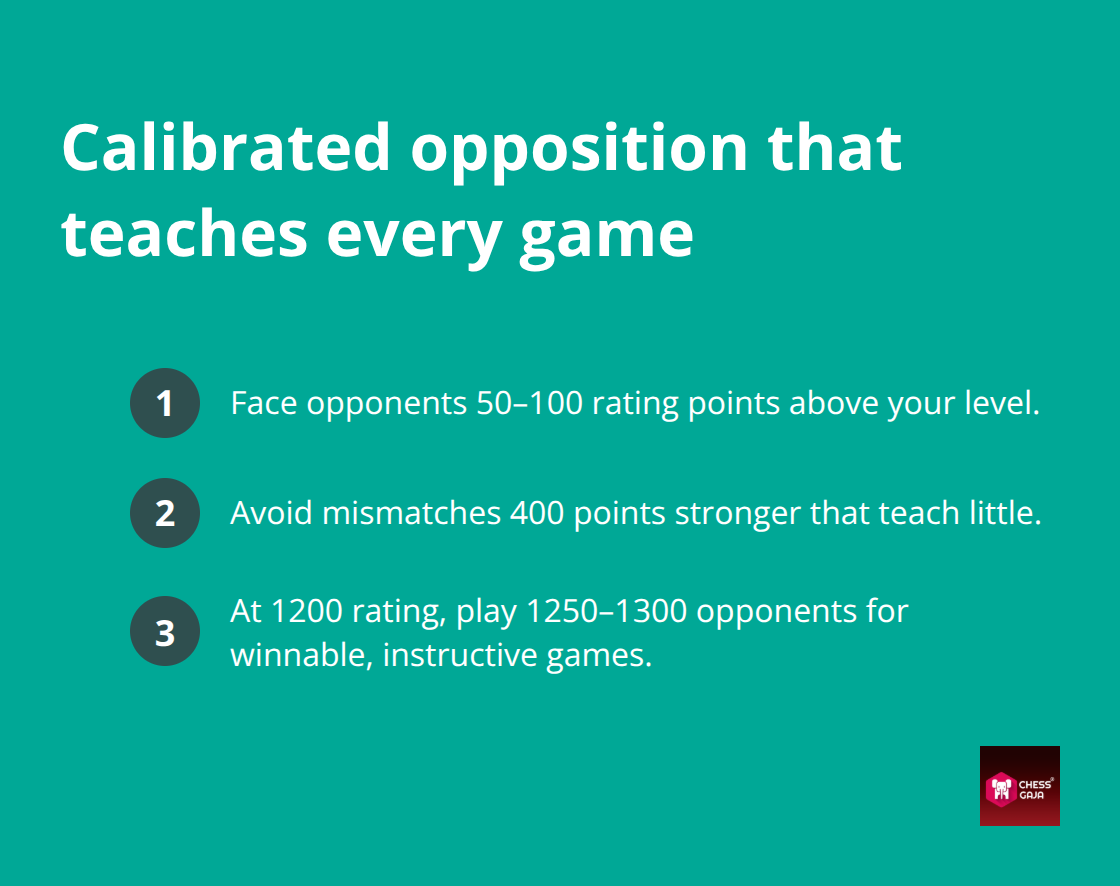
Our tournaments attract 50 to 200 students monthly across rating categories, from 600-rated players to advanced competitors. You play opponents at your exact skill level, not stronger players who crush you in 20 moves. Research on learning shows that optimal challenge occurs when you face opponents roughly 50 to 100 rating points above your current level. Play someone 400 points stronger and you learn nothing except how to lose quickly. Play someone 50 points stronger and every game teaches something.
Tournaments calibrated to this principle ensure every game is winnable and instructive. A student rated 1200 faces opponents in the 1150–1300 range, keeping games competitive without throwing them against 1600-rated masters. This creates the psychological conditions for growth-you win some games, lose others, and learn from both outcomes. The competitive pressure forces you to apply knowledge under real constraints, revealing gaps that classroom study alone would miss.
Coaches Extract Lessons From Tournament Performance
After your tournament games end, the analysis begins immediately. While AI generates instant post-game metrics, FIDE-rated coaches review these critical moments during your next session to address the psychological and positional reasons behind those decisions. Did you misunderstand an opening concept your coach taught? The review shows it and your coach adjusts next month’s lessons. Did you execute a tactic flawlessly that you struggled with three weeks ago? The review celebrates that growth and identifies the next skill to develop.
Siddharth Jagadeesh reached the Grandmaster level through this exact blend of structured analysis and high-volume competitive play calibrated to his developing strength. The tournament environment forced him to apply training under real pressure, revealing gaps that classroom study alone would miss.
Data Reveals the Gap Between Puzzle Skill and Game Skill
Your coach uses your tournament performance to benchmark your progress against global peers. When you solve puzzles in your LMS, you track your tactical solving success rate. In a tournament, you see whether that translates into overall move precision. Some students maintain an exceptionally high puzzle-solving success rate but struggle to maintain high move precision (CAPS) or low ACPL (Average Centipawn Loss) in practical play—revealing a gap between pattern recognition and real-game calculation.
Other students win most of their games despite moderate puzzle accuracy, showing they apply tactical knowledge effectively in practical play but may still lack broader strategic depth. The coach intensifies strategic training accordingly. This data-driven approach to competitive development eliminates the guesswork that plagues traditional coaching. You are not training generically toward strategic chess practice. You are training toward specific, measurable tournament results that your coach and you can track month to month (opening execution, tactical conversion, endgame technique).
Final Thoughts
Traditional chess coaching relies on a coach’s memory of your last lesson, their intuition about what you need, and hope that you practice between sessions. LMS-driven chess training eliminates this uncertainty entirely. Every move you make, every puzzle you solve, and every game you play generates data that your coach uses to make decisions. A coach in Dubai reviewing your performance dashboard sees exactly which opening variations you execute correctly, which tactical patterns still confuse you, and which endgame positions you handle with confidence.
Continuous improvement happens between sessions because the system never stops working. Puzzle recommendations arrive based on your specific weaknesses. Meanwhile, game analysis summaries highlight the exact moments that determined your wins and losses. Your homework targets the precise gaps your coach identified.
A student in Singapore struggling with rook endgames receives endgame puzzles the next day. At the same time, a student in the USA who executed an opening flawlessly gets advanced positions to deepen their understanding.
At Chess Gaja, we have built this system serving over 5,000 students across 25+ countries with FIDE-rated coaches who understand that chess development is a partnership between data, teaching, and your commitment to improvement. Our LMS platform delivers AI-powered summaries after every class, personalized puzzle recommendations, and tournament opportunities designed to transform your training into results. Book a Paid Starter Class with one of our coaches for a professional skill evaluation that reveals exactly where you stand and what your development path looks like.